

BUSINESS STRATEGY / FOUNDER GUIDE

How to Start a Security Business: From First Contract to Profitable Company

Learn how to start a power washing business, estimate startup costs, check permits, price jobs for profit, choose equipment and attract customers.

ZH Research Team

Reviewed by Zain Hameed

Date Published

October 26, 2026

ZH Editorial Team

Business Strategy Desk

Imagine winning a contract to guard a commercial building overnight. The client wants uninterrupted coverage, your quote looks profitable, and you have guards ready to work.

Then a guard calls in sick. You need an approved replacement, the client expects the site covered, and wages still need paying even if the customer’s invoice isn’t due for another month.

That’s the difference between supplying a guard and running a security company.

If you’re researching how to start a security business, the challenge isn’t simply finding clients. It’s building an operation that can deliver legally compliant coverage, protect people and property, and make money after payroll and overhead.

Think of this as the Contract-to-Coverage Framework:

  • Positioning: Which guarding or patrol services will you sell, and to whom?
  • Compliance: What licences, training, insurance and safeguards must be in place?
  • Contract economics: Will the billing rate cover every staffing and operating obligation?
  • Operations and growth: Can you fill shifts, maintain standards and retain clients?

1. Decide What Type of Security Business to Start

Before hiring guards, choose the service your company is prepared to deliver. A single officer at an office reception, a vehicle patrol covering several sites and a large event all require different staffing, equipment and supervision.

Common options include unarmed guarding, mobile patrols, construction-site protection, event access control and ongoing commercial building security. Armed assignments carry additional legal, training, insurance and safety requirements wherever they are permitted.

For most new operators, a narrow service offering is easier to manage than promising every form of protection.

Choose the clients you understand

A warehouse might need overnight access control. A residential complex may want visitor management and routine patrols. An event organizer could need trained staff for a few busy hours.

Research local competitors’ service offerings, client feedback and coverage promises. Complaints about missed shifts, weak reporting and unresponsive supervisors can reveal gaps in the market.

Your position should be built on reliable delivery, not simply the lowest hourly price. If you’re comparing possible niches, business consultancy support can help you assess demand and operating costs before committing to contracts.

2. Global Private Security Market Outlook and Growth Opportunities

Private security is a sizeable global service industry, but market growth doesn’t guarantee that an individual guarding company will succeed.

According to The Business Research Company’s Security Guarding Services Market Report 2026, the worldwide market reached USD 184.33 billion in 2025 and is estimated at USD 198.68 billion in 2026. It is forecast to reach USD 265.20 billion by 2030, equivalent to approximately 7.5% compound annual growth from 2026 to 2030.

Global security guarding services market forecast, 2025–2030
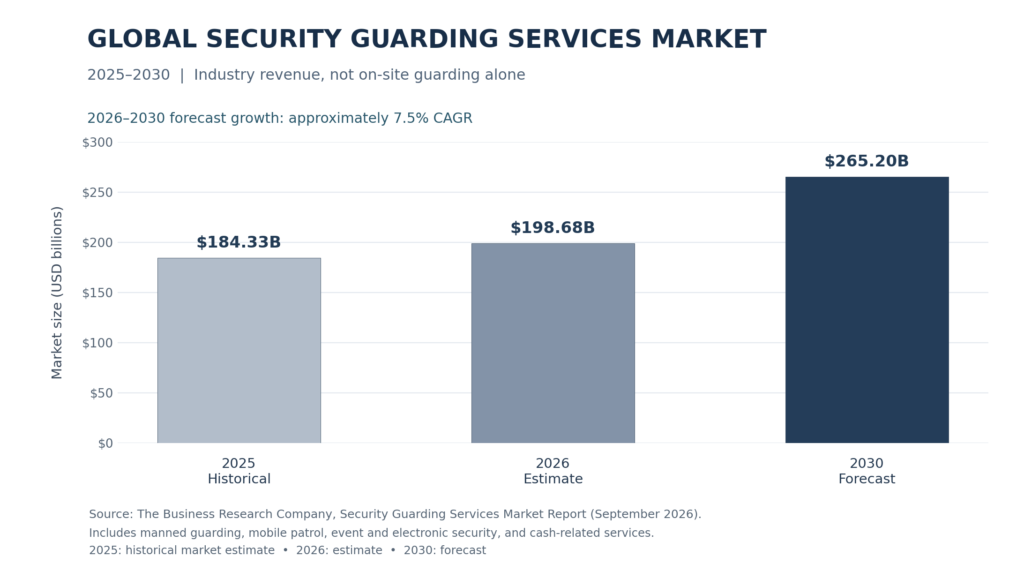
Source: The Business Research Company, September 2026. Values in USD billions. This market includes manned guarding, mobile patrol, event security, electronic security services and cash-related security services; it is not guard-staffing revenue alone. The 2026 figure is an estimate and 2030 is a forecast.

Demand is supported by outsourced site protection, commercial and infrastructure development, mobile patrol services and technology-assisted monitoring. The report identifies North America as the largest regional market in 2025 and Asia-Pacific as the fastest-growing forecast region.

For a new company, the more useful questions are local: Which properties need coverage? How crowded is the supplier market? What are employers legally required to pay guards? Can clients support rates that leave a margin?

An expanding industry creates opportunities; profitable contracts still have to be earned.

3. Licensing, Training, Insurance and Startup Costs

Security businesses take responsibility for people, property and employees. Legal permissions and sufficient payroll funding matter as much as recruiting your first guard.

Check the rules for companies and guards

Requirements vary by country and region. You may need agency licensing, business registration, background screening, approved managers, employee registration and prescribed training.

For example, California requires qualifying private guarding companies to hold a Private Patrol Operator licence, while guards have separate registration requirements. In the UK, relevant private security operatives and certain managers need appropriate Security Industry Authority licences; its company Approved Contractor Scheme is voluntary. These are jurisdiction-specific examples, not worldwide rules.

Training may include access control, incident reporting, emergency response, communication, de-escalation and legal limits on an officer’s authority. Do not offer armed or other specialized services without the necessary authorization, staff qualifications and insurance.

Budget for the business, not just uniforms

A small, unarmed guarding company might use this illustrative USD startup budget:

Startup Item Example Cost
Licensing and compliance $2,000
Initial insurance premiums $2,500
Uniforms and communications $1,200
Scheduling and reporting tools $500
Website and launch marketing $800
Initial payroll reserve $12,000
Contingency $2,000
Total $21,000

Hypothetical planning amounts, not industry averages. Vehicles, premises, additional equipment and larger contracts can raise the investment substantially.

Investigate liability and employer insurance requirements. Most importantly, calculate how you’ll pay guards while waiting for client invoices to clear.

4. Create a Security Business Plan and Price Contracts Profitably

A large monthly contract can look impressive until you subtract wages, paid leave, replacement coverage, insurance and supervision.

If you’re learning how to start a security business, your financial plan should connect contracted hours to staffing requirements, full employment costs, billing rates and cash reserves. A detailed business plan can help test whether the numbers work before you sign.

Calculate the margin on one contract

Suppose an unarmed post needs 160 hours of coverage over a four-week billing period, and you bill $35 per hour:

Four-Week Contract Amount (USD)
Client revenue (160 × $35) $5,600
Guard wages (160 × $20) −$3,200
Employer costs and benefits −$640
Replacement coverage allowance −$320
Insurance, supervision and administration −$600
Equipment and transport −$200
Remaining before taxes and other costs $640

Illustrative figures, not prevailing market rates. The remaining $640 is roughly 11.4% of revenue; unbudgeted costs could reduce it further.

Now consider a 24-hour post: it requires 168 coverage hours per week, normally shared among several employees. Never price continuous coverage as if one person could work every shift.

Define in writing the contracted hours, relief arrangements, overtime billing, incident-reporting duties and payment terms. Winning a contract at an unsustainable rate is not growth.

5. Build Reliable and Compliant Security Operations

Your reputation depends on what happens when nobody from the management team is standing beside the guard.

Use a repeatable workflow: Client Assessment → Site Instructions → Staff Assignment → Scheduling → Coverage → Reporting → Review.

Document access procedures, emergency contacts, escalation rules and the limits of each officer’s role. Arrange properly qualified relief staff for sickness and leave; follow applicable working-time and rest requirements.

Make reports and supervision useful

Guards need clear instructions for recording incidents, identifying concerns and contacting supervisors or emergency services. Clients should receive reporting appropriate to their contract, without unnecessary disclosure of personal or confidential information.

Track guard attendance, overtime, replacement shifts, complaints, incident-report quality and profit by contract. Software can support rostering and reporting, but it won’t replace trained supervisors or sound judgment.

Expand staffing only when your recruitment pipeline, licence compliance and payroll reserves can sustain additional contracts.

6. Find Clients and Grow Your Security Business

Commercial buyers want evidence that you’ll provide the agreed coverage—not just a claim that your guards are professional.

A business website should explain your services, service area, relevant licences, supervisory processes and how a client can request a quotation. Don’t advertise credentials or capabilities your company cannot prove.

Reach the people who purchase security

Potential customers include property managers, construction firms, warehouses, hotels, residential developments and event organizers. Ask about site risks, coverage hours and reporting expectations before proposing a service.

Local search and an accurate Google Business Profile, where available and eligible, can make your company easier to find. But direct outreach, qualified referrals and well-prepared proposals often matter more than general social-media reach.

A useful proposal spells out staffing, service hours, supervision, incident reporting, replacement coverage and pricing. A focused digital marketing strategy can then support lead generation without promising unmanageable growth.

Measure qualified enquiries, proposals won, client retention and profit per contract, not just total contract value.

7. Common Security Business Startup Mistakes

Security contracts can look straightforward when a client agrees to your rate, but the real test begins when guards need replacing, reports are due and payroll must be funded. New operators can underestimate how quickly licensing gaps, unreliable shift coverage or poor supervision affect both safety and client confidence. A single underpriced contract can also drain cash even when every shift is filled. Recognizing these mistakes before taking on additional sites helps you protect your reputation, meet contractual obligations and build a company that can grow sustainably.

  • Underbidding to win the first contract
  • Low rates can leave too little to cover employer obligations, insurance, overtime and supervision. Cost the full assignment before quoting.
  • Recruiting without verifying qualifications
  • Check the required licences, registrations, training and eligibility before assigning anyone to a site. An unfilled shift is better than unauthorized coverage.
  • Ignoring payroll cash flow
  • A client may pay after 30 days or more, while guards must be paid on schedule. Maintain a realistic wage reserve and agree clear payment terms.
  • Promising coverage you cannot staff
  • A contract isn’t secure revenue if absences routinely leave posts unattended. Plan relief capacity before signing.
  • Growing before building supervision systems
  • Additional contracts multiply incidents, scheduling demands and client expectations. Standardize reporting and site instructions first.

The Takeaway: Reliable Coverage Is the Real Product

Learning how to start a security business means more than registering a company and hiring guards. It means being able to deliver dependable coverage at a price that pays employees properly, meets regulatory obligations and leaves a sustainable margin.

Return to the Contract-to-Coverage Framework: Positioning → Compliance → Contract Economics → Operations and Growth.

If you’re planning your first contracts or expanding an existing firm, ZH Consultancy can help you assess startup costs, prepare financial projections and create a practical growth plan.

Faq

Frequently Asked Questions About Starting a Security Business

How much does it cost to start a security company?

Costs depend on licensing, staffing, insurance, equipment and how long you must finance payroll before clients pay. The $21,000 example above is a planning scenario, not a universal minimum.

Do I need a licence to run a private security company?

Often, yes, but requirements vary. Companies and individual guards may require different licences or registrations. Confirm the rules with the relevant local authority before offering services.

Can I start with unarmed security services?

Yes, where properly licensed and authorized. Unarmed guarding may be operationally simpler than armed protection, but it still requires qualified staff, insurance and lawful procedures.

How do security companies make money?

They commonly bill clients for agreed guarding hours, patrol services or event assignments. Profit is the amount remaining after wages, payroll obligations, insurance, supervision, equipment and overhead.

How many guards do I need to start?

That depends on your contracts and legally permitted working hours. Plan enough qualified people to cover every shift, breaks, absences and relief duties; don’t assume one person can staff a round-the-clock post.

How do I win my first security contract?

Approach relevant property and facilities decision-makers, present verified credentials, assess the site’s needs and offer a clear, accurately priced proposal with dependable staffing arrangements.

Portrait of Zain Hameed
Read & reviewed by

Zain Hameed

CEO · ZH Consultancy

Business strategy specialist helping a global client base of 800+ businesses build credible plans, financial models and investor-ready presentations.

4.9/5 Upwork rating
800+ Businesses worldwide
4.8/5 PeoplePerHour rating

Book a Free Consultation

Have a business idea, growth challenge or investor deadline? Book a free consultation and get clear next steps from our team.

Call our team

+923104049517

Untitled design (2)

Business topics

Continue reading

Related insights