

In this article
A property manager asks for a quote. “We just need one guard, Monday through Friday.” It sounds like a manageable first account.
Then you learn that the post runs twelve hours daily, invoices require approval, and payment arrives thirty days after billing. That “one guard” represents sixty weekly coverage hours, several employees, relief arrangements, and payroll you must fund before collecting anything.
Learning how to start a security business means understanding those commitments before promising coverage. A uniform gets someone through the door. Licensing, supervision, careful pricing, and dependable staffing keep the company there.
This U.S. founder’s guide focuses on a private guarding company, especially unarmed commercial assignments. Armed protection, investigations, cybersecurity, and alarm installation require different expertise and may involve additional authorizations. Start with a service you can lawfully deliver, then build the business around its actual operating demands.
How to Start a Security Business With a Defined Service
A security company sells an agreed protective service: controlling access, observing a property, documenting incidents, or supplying qualified personnel for specified duties. Customers buy accountability as well as staffed hours.
Choose one initial customer group and a limited operating area. A warehouse manager needs a different service from a concert promoter, and promising both immediately can multiply training, scheduling, and insurance problems.
Model | Typical customer | Main operating challenge |
|---|---|---|
Unarmed fixed posts | Offices, warehouses, residential properties | Continuous staffing and clear post instructions |
Mobile patrol | Commercial property portfolios | Travel time, route capacity, and vehicle costs |
Event security | Venues and event organizers | Variable demand and concentrated staffing needs |
Armed protection | Clients with assessed specialist needs | Additional authorizations, training, and insurance |
Do not describe a guard agency as an alarm installer or investigator unless it holds the permissions those activities require. The Census NAICS definitions distinguish guard and patrol services, investigation services, and security systems services. An industry code classifies activity; it does not grant permission to perform it.
Revenue usually comes from hourly coverage, defined patrol visits, or a scoped event assignment. Recurring security contracts can support predictable revenue, but only if you can cover every promised shift without expensive improvisation.
Research Demand Before Buying Equipment
Start locally. Identify property managers, logistics facilities, construction firms, and commercial associations within a realistic service radius. Ask who buys security, when they rebid, what coverage they require, and why previous providers disappointed them.
National evidence establishes scale. The Census Service Annual Survey series distributed through FRED reports $32.222 billion in 2022 U.S. employer-firm revenue for security guards and patrol services. This archived series ends in 2022; it is historical evidence, not a 2026 market estimate or a global security-industry total.
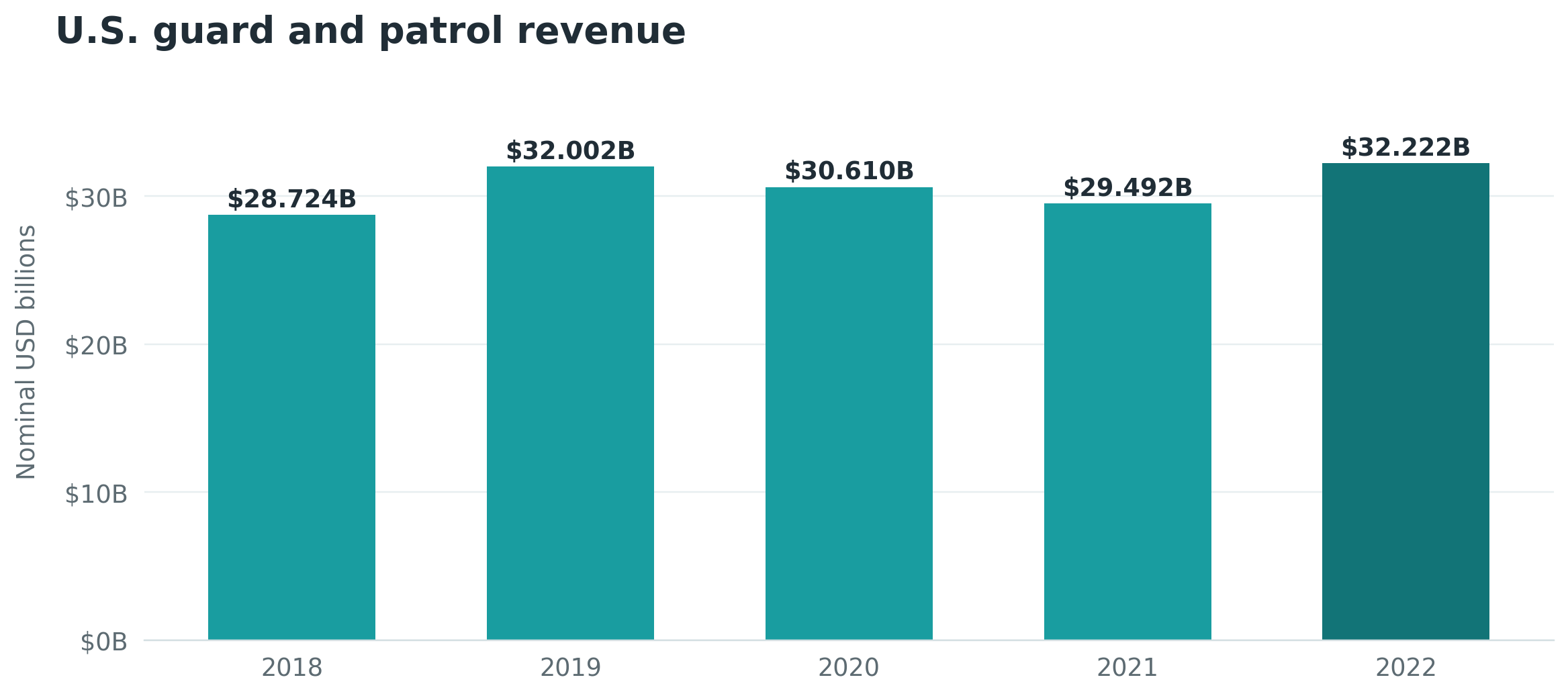
Figure 1. U.S. guard and patrol employer-firm revenue, 2018–2022, in nominal USD billions. Values are 28.724, 32.002, 30.610, 29.492, and 32.222 respectively. These annual survey estimates are not adjusted for inflation and do not cover every security-related business.
Source: U.S. Census Service Annual Survey via FRED.
The Bureau of Labor Statistics reports approximately 1.3 million security guard jobs in 2025. Its combined guard and gambling-surveillance category has projected employment growth of only 1% over 2025–2035. A large workforce does not establish a fast-growing local sales opportunity.
For anyone evaluating how to start a security business, the useful question is narrower: which nearby buyers have an unresolved coverage problem and a budget to address it?
Interview ten to fifteen potential purchasers before choosing your offer. Separate recurring industrial demand from seasonal events or temporary construction assignments. ZH Consultancy’s market research services can help organize buyer interviews, competitor comparisons, and demand assumptions when the local opportunity remains unclear.
Weigh the Advantages and Disadvantages
Recurring commercial accounts can make scheduling and revenue more predictable. A focused unarmed company may also avoid the heavy equipment investment required by many trades. Good reporting and responsive supervision create practical ways to compete beyond price.
The disadvantages deserve equal attention. You manage people across inconvenient hours, cover absences, investigate complaints, and carry exposure when someone acts outside instructions. Customer concentration can become severe: losing one large account may remove much of your revenue overnight.
Understanding how to start a security business includes accepting that modest equipment costs do not mean modest financial risk. Payroll arrives on schedule even when customers dispute invoices.
This model suits founders who can manage compliance, people, and business-to-business sales consistently. It is less attractive if you need immediate income, cannot finance a payment delay, or expect to supervise only during ordinary office hours.
Estimate Security Company Startup Costs
Build security company startup costs from a defined launch workload. The following hypothetical USD budgets assume unarmed fixed-post work, no purchased patrol vehicle, no leased office, and an owner who already meets the relevant qualifying requirements. A separately paid qualifying manager would increase the budget.
Cash needed before launch | Lean launch | Small team launch |
|---|---|---|
Formation, licensing, and legal setup | $2,500 | $5,000 |
Initial insurance payments | $3,000 | $6,000 |
Uniforms, radios, and field equipment | $1,800 | $5,000 |
Recruitment and initial training | $2,000 | $5,000 |
Software and reporting setup | $600 | $1,800 |
Branding, website, and print materials | $2,200 | $5,200 |
Initial sales and marketing | $1,400 | $3,000 |
Payroll and operating reserve | $12,000 | $30,000 |
Contingency | $4,000 | $5,000 |
Total illustrative funding | $29,500 | $66,000 |
These are planning allocations, not surveyed averages, vendor quotations, or mandatory minimums. Insurance payments represent initial cash outlays, not guaranteed annual premiums. Licensing fees and eligibility differ by jurisdiction.
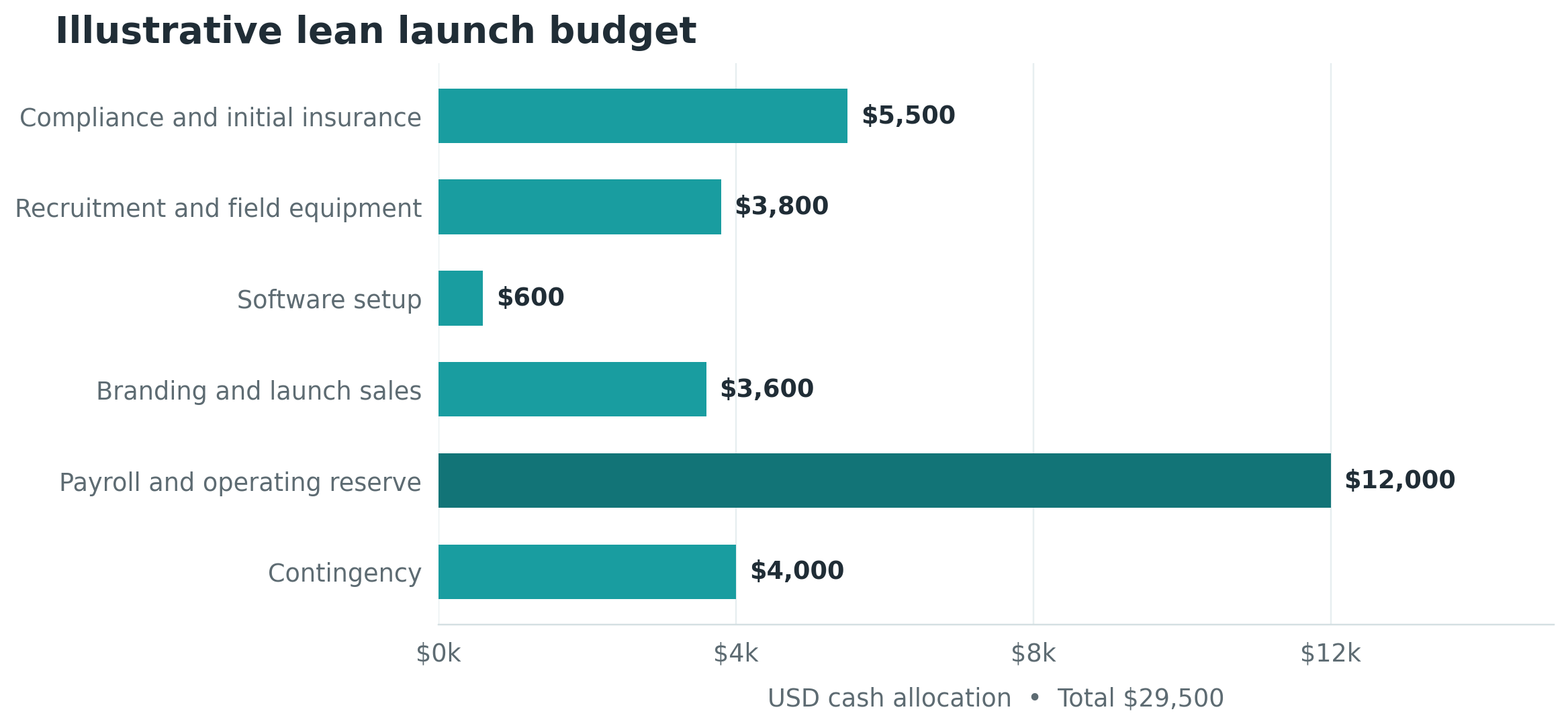
Figure 2. Illustrative lean launch cash allocation in USD, prepared November 2026. The $29,500 total includes a $12,000 payroll and operating reserve; actual requirements depend on staffing, insurance, licensing, and collection timing.
Source: Author calculations from the illustrative budget above; use the SBA startup-cost framework to develop your own budget.
Formation and initial equipment are generally startup outlays. Wages, payroll taxes, insurance renewals, software, recruitment, and marketing continue after launch. Account for both when comparing security company startup costs.
Calculate the reserve from your payment cycle
Assume loaded wages of $25 per staffed hour: $20 wages plus a hypothetical $5 employment-cost allowance. Forty weekly hours require $1,000 weekly; 160 require $4,000.
Six weeks therefore requires $6,000 or $24,000 for payroll alone. The reserves above leave $6,000 in either scenario for other operating payments. This assumes an approximately six-week collection gap and must be tested against actual invoice terms.
Monthly invoicing followed by net-30 payment can create roughly eight weeks or more between starting service and collecting cash. At 160 hours weekly, eight weeks of payroll plus $6,000 for other payments needs $38,000, exceeding the team scenario’s reserve by $8,000. Adjust security company startup costs before signing the account.
Build a Security Business Plan That Tests the Numbers
A useful security business plan explains how a specific service becomes a dependable operation and a viable company. Its executive summary should identify the buyer, service, operating area, qualifying leadership, required funding, and first-year milestones.
Describe your customers precisely. “Commercial clients” is too broad. “Warehouse operators needing staffed overnight entrances within a twenty-mile radius” tells you whom to interview, how to recruit, and where travel costs arise.
Your competitor analysis should compare service scope, reporting quality, supervision, buyer complaints, and contract terms. Turn the findings into a defensible proposition, such as documented shift handovers and a named account supervisor. Promise only standards you can measure and deliver.
For example, an illustrative founder might target one forty-hour weekly warehouse account first, then add a second only after thirty days of reliable delivery and confirmed collections. That milestone connects sales ambition to staffing capacity rather than an arbitrary revenue target.
Build the security business plan around:
- Services, exclusions, target customers, and reasons buyers would switch.
- Recruiting, qualification checks, relief coverage, and supervisory responsibilities.
- Billing rates, wage assumptions, direct costs, and monthly overhead.
- A twelve-month profit-and-loss forecast and weekly cash-flow forecast.
- Break-even hours, payment-delay scenarios, funding sources, and reserve limits.
- Customer acquisition activity, delivery standards, and milestones for expansion.
Model a delayed first sale, an unexpected wage increase, and losing your largest client. Identify which commitments you can reduce and which bills continue regardless.
When considering how to start a security business, avoid treating an optimistic spreadsheet as validation. Connect every revenue forecast to prospective buyers, probable start dates, and available personnel. Keep a separate assumptions register showing the source and confidence level for each important number.
ZH Consultancy’s business plan writing services and financial modeling services can support that analysis. Outside assistance should challenge assumptions; local legal and licensing decisions still require qualified jurisdiction-specific advice.
Confirm Licenses Registration and Insurance
A security business license and an individual guard credential serve different purposes. Forming an LLC, obtaining a guard card, or having military experience does not automatically authorize a company to sell guarding services.
Anyone researching how to start a security business should check the regulator’s company-level requirements before spending heavily. These examples illustrate differences; they are not a complete application checklist.
State | Company-level example | What to verify separately |
|---|---|---|
California | Private Patrol Operator licensing and an approved qualified manager | Qualifying experience, examination, fingerprints, guard registrations, and required insurance |
Texas | Company license and a qualifying company representative | Service categories, experience, examination, and individual authorizations |
New York | Watch, Guard or Patrol Agency license | Qualifying principal, examination, fingerprints, bond, and insurance |
California BSIS sets out its company and manager process. Texas DPS requires guard-company representatives to be at least 21, with specified experience and an examination. New York’s application guidance lists a minimum age of 25, qualifying experience, an examination, and a $10,000 surety bond. The bond amount is not the premium you necessarily pay.
Create a security business license checklist for your actual service and operating locations. Confirm ownership disclosures, manager eligibility, training, renewals, advertising restrictions, branch requirements, and any firearm-specific permissions. Ask the regulator about ambiguous activities before offering them.
Form the entity and establish employer obligations
Compare an LLC with sole proprietorship or incorporation using legal and tax advice. Liability protection has limits and does not replace insurance, proper supervision, or individual professional obligations.
Register the entity and any required trade name, establish a business bank account, and obtain applicable state employer accounts. The IRS provides EINs free; creating a legal entity should precede its EIN application. Confirm local zoning, business permits, service-tax rules, payroll withholding, unemployment obligations, and workers’ compensation requirements.
Expansion into another state may require both entity registration there and separate security authorizations. Your existing security business license should never be assumed portable.
Match insurance to the work
Discuss security guard insurance with a broker experienced in contract guarding. Describe the actual assignments, client types, armed or unarmed status, subcontractors, vehicles, and expected revenue. A generic small-business policy may exclude activities you intend to perform.
Review general and professional liability, workers’ compensation where required, commercial auto where applicable, and employment-related coverage. Ask specifically about assault-and-battery exclusions, negligent supervision, defense costs, deductibles, and contractual indemnities.
California’s PPO insurance rules require at least $1 million of general liability coverage per occurrence. That is a state example, not a nationwide limit. Clients can require additional coverage or endorsements.
Price security guard insurance before submitting bids. Match policy terms with the proposed agreement, and obtain legal review of indemnity and liability clauses. A certificate of insurance summarizes coverage; it does not rewrite exclusions.
Equip Staff and Build Reliable Operations
The operational answer to how to start a security business begins with a roster that survives real life. A continuous post needs 168 hours each week. Dividing by forty produces 4.2 full-time equivalents before leave, training, breaks, absences, or scheduling constraints.
That calculation is a staffing baseline, not a recommendation to employ 4.2 people. Design a feasible rotation and retain qualified relief capacity. Never schedule someone beyond legal or safe limits simply because a spreadsheet balances.
Recruit and train for the assignment
Verify identity, work authorization, credentials, references, and applicable background requirements. Keep renewal reminders and training evidence. If using third-party consumer reports, follow FTC background-check guidance, including disclosure, written authorization, and required pre-adverse and adverse-action procedures. Apply relevant discrimination and state hiring rules too.
Teach site orientation, public communication, de-escalation, incident documentation, emergency escalation, and the limits of the role through qualified instruction. Client orientation supplements required training. It does not replace statutory credentials.
Under the DOL security-guard fact sheet, covered nonexempt employees generally earn overtime after forty hours in a workweek. Hours across posts must be combined, and travel between worksites counts as work. Check stricter state rules and compensable training or break requirements with payroll advisers.
Do not assume a contractor agreement determines worker status. Obtain advice on federal and state classification tests and security-specific subcontracting rules before outsourcing labor.
Choose practical equipment and software
Start with authorized uniforms, suitable footwear, communication equipment, identification, weather protection, and site-specific safety supplies. Compare suppliers on durability, replacement availability, warranty, delivery time, and compatibility. Do not buy vehicles or specialist equipment before the workload justifies them.
Choose scheduling and reporting software by testing missed-shift alerts, supervisor escalation, payroll exports, mobile usability, data access, and record export. Check whether its evidence trail supports invoices and complaints. Keep an offline reporting procedure for outages.
Every post needs written instructions covering duties, prohibited activities, authorized contacts, escalation, handover, and emergency coordination. Arrange check-ins and a named replacement procedure. Audit a sample of reports weekly for accuracy, completeness, and timely client delivery.
Price Coverage Before Signing Security Contracts
Learning how to start a security business without learning contract economics is expensive. A customer’s hourly rate must cover more than the guard’s hourly wage.
The BLS national median annual wage for guards was $38,020 in May 2025. It is a historical pay benchmark, not a local hiring quote or an adequate billing rate.
Here is a hypothetical monthly model for 1,000 billable hours, all paid at regular time. Replace every assumption with local wages, employment obligations, insurance quotations, and actual site costs.
Monthly model | Calculation | Amount |
|---|---|---|
Revenue | 1,000 hours × $36 | $36,000 |
Guard wages | 1,000 hours × $20 | $20,000 |
Employment-cost allowance | 1,000 hours × $5 | $5,000 |
Other variable site costs | 1,000 hours × $2 | $2,000 |
Contribution before fixed costs | Revenue less $27,000 | $9,000 |
Fixed operating overhead | Assumed monthly | $4,500 |
Surplus before owner compensation | $9,000 less $4,500 | $4,500 |
The $5 allowance represents estimated employer taxes, employment insurance, and paid relief or training costs allocated to hours; it is not a statutory percentage. The $2 includes variable supplies, travel, and site supervision. Fixed overhead includes office administration, software, base insurance, and sales activity without double-counting those variable costs.
Contribution is $9 per hour, or 25% of revenue. The $4,500 operating surplus is 12.5% before owner compensation, financing, and income taxes. If you reserve $3,000 for the owner’s management work, $1,500 remains before financing and income taxes. Owner draws and compensation have different tax treatment depending on entity structure.
Break-even before owner compensation is $4,500 divided by $9, or 500 hours. Including that $3,000 management allowance raises the planning threshold to 834 whole billable hours. This is not a guaranteed industry margin.
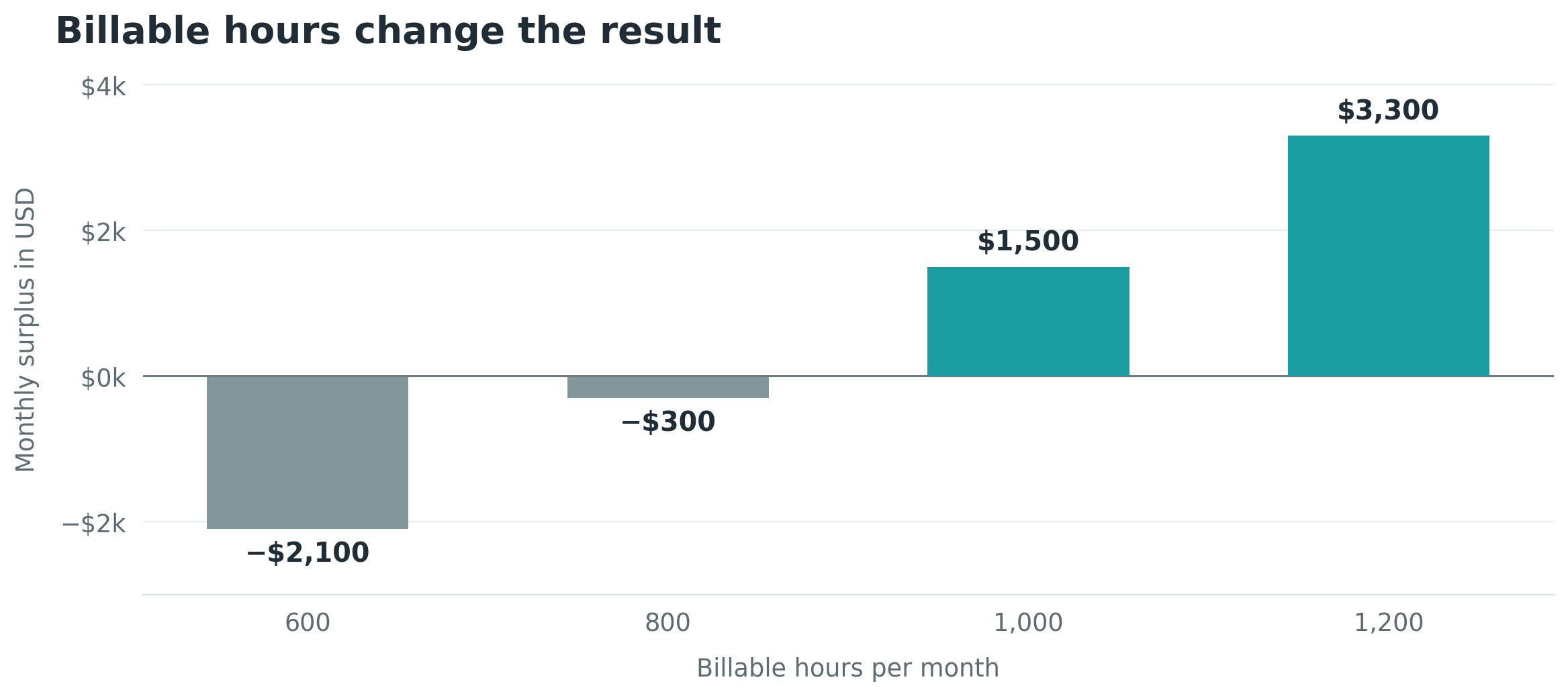
Figure 3. Illustrative monthly surplus after a $3,000 owner-management allowance, before financing and income taxes. Assumptions: $36 billed per hour, $27 variable cost per hour, and $4,500 fixed overhead. Surplus at 600, 800, 1,000, and 1,200 hours is −$2,100, −$300, $1,500, and $3,300.
Source: Author calculations using the model above; see the SBA break-even explanation.
In security contracts, specify minimum hours, scope, approved changes, holiday and overtime rates, invoice evidence, payment terms, cancellation, and annual pricing review. A four-hour service extension should trigger a priced change, not an informal favor that quietly erases margin.
Review security guard insurance allocations whenever the scope changes. Add-on patrols or additional sites should be separately costed rather than bundled into an unexplained discount.
Choose a Name Logo and Brand Customers Can Trust
Check the proposed business name with the relevant registration and security authorities, then review trademark conflicts and domain availability. Name approval in one database does not establish trademark rights everywhere.
Keep the identity clear and credible. Avoid graphics or wording that could misleadingly imply police or government authority. Use a readable logo, consistent uniform identification, restrained colors, and typography that works on reports and vehicle signage.
The branding side of how to start a security business is practical: can a visitor identify your officer, and can a buyer recognize your proposal? A complicated badge graphic that becomes illegible at small sizes fails that test.
ZH Consultancy’s logo design services can support a consistent identity. Carry it through email signatures, business cards, visiting cards, proposal templates, and staff materials. Spend on clear application before elaborate merchandise.
Prepare a Useful Company Profile and Sales Pack
If you are deciding how to start a security business for commercial buyers, prepare a concise sales pack that lets them assess credibility quickly. A short company profile should explain your service area, permitted services, management qualifications, supervision process, and how to verify credentials.
Attach a relevant capability statement, service proposal, sample reporting format, and insurance evidence when requested. Use anonymized examples; obtain permission before naming clients or displaying their premises. Never invent projects, testimonials, or staffing capacity.
Keep the sales pack specific to the buyer. A facilities manager reviewing security contracts wants staffing accountability and reporting. A large event buyer needs a scoped delivery plan and evidence that you can supply suitable personnel.
Professional company profile design becomes useful when approaching these commercial accounts. A founder pursuing one small local site may need a concise two-page profile and a sound proposal rather than an expensive brochure.
Build a Website That Helps Buyers Request a Quote
Your website should answer four questions quickly: what do you provide, where do you operate, what credentials can buyers verify, and how do they discuss a site?
The digital side of how to start a security business involves reducing uncertainty. “Complete security solutions” says little. A page explaining unarmed warehouse access control, coverage hours, supervision, and the quotation process gives a buyer something concrete to evaluate.
Own the domain and compare ongoing costs
Register the domain in a business-controlled account with recovery access and multifactor authentication. Record renewal dates and keep billing current. Your developer can receive delegated access without becoming the permanent owner of the domain.
Compare registration, renewal, transfer terms, email costs, and support. Cloudflare’s live domain price list separates those charges; registrar pricing changes, so check the selected extension before paying. A domain purchase does not automatically include suitable website hosting or business email.
For hosting, assess renewal costs, backups and restoration, support availability, performance, SSL, storage, and room to grow. For a managed website builder, identify what the subscription includes and which forms, integrations, or email tools cost extra. Compare the total over three years rather than the introductory offer alone.
Platform | Suitable starting point | Tradeoff to check |
|---|---|---|
Self-hosted WordPress | Flexible service pages and integrations | Hosting, plugin choices, updates, and backups need ownership |
Wix | A small site with hosted editing | Confirm subscription features and integration limits |
Squarespace | A straightforward brochure and inquiry site | Check forms, integrations, and portability needs |
Shopify or specialist systems | Relevant retail sales or an actual operational need | A store or booking platform may be unnecessary for quoted guarding work |
WordPress offers extensibility; Wix and Squarespace describe bundled hosting options. Request a demonstration of your required workflow before committing to any platform.
Include the content and safeguards buyers need
Create clear service and service-area pages, accurate licensing information where publication is required, genuine testimonials, contact details, and a quote form. Ask initially for site type, broad location, coverage needs, and contact information. Move sensitive site plans and access details into an appropriately controlled process.
Make telephone links work on mobile, use readable contrast and labeled forms, and test keyboard access. Optimize image sizes, page speed, and form delivery. Track inquiries and qualified opportunities rather than counting visits alone.
Use SSL, restricted administrator access, updates, tested backups, and a maintenance owner. Collect payments through an appropriate provider when needed; do not collect card details through a basic contact form.
A local agency can support in-person discovery; a freelancer can suit a tightly defined project; a remote team can offer different cost and staffing options. Compare scope, communication, testing, ownership, and maintenance in writing. ZH Consultancy is based in Pakistan and provides website development for international clients; ask for a tailored quote rather than assuming a fixed saving. Arrange website maintenance alongside launch responsibilities.
Find Customers Through Focused Outreach and Local Search
Once you understand how to start a security business legally, turn the customer profile in your security business plan into a focused marketing campaign. Build a prospect list, identify the decision-maker, and offer a relevant conversation about coverage requirements rather than emailing a generic brochure to everyone.
For example, approach local warehouse operators with a concise explanation of your licensed scope and reporting process. Seek permission for a site assessment, document the requirement, and submit a costed proposal. Track follow-ups and procurement deadlines.
For local search, follow Google’s business representation guidelines. Use an eligible business location or service-area configuration; do not create fictitious offices to appear in more cities. Relevant Google Business Profile support can help keep the profile accurate and useful.
Combine focused service-page SEO with genuine reviews, referrals, and relationships with property managers or complementary licensed providers. LinkedIn and professional associations can support commercial outreach. Social media should demonstrate standards and expertise without exposing clients’ sensitive information.
Test advertising cautiously. An illustrative $900 monthly advertising-and-landing-page budget producing twelve qualified inquiries, four proposals, and one customer has a $900 channel acquisition cost before sales labor. If the resulting account contributes $900 monthly after direct costs, it takes one month of that contribution to recover the spend before overhead and collection delays.
Specialist Google Ads management can support targeting and measurement, but campaigns need evidence of profitable conversion. Report inquiry quality, proposal wins, acquisition cost, billed hours, collections, and client retention. For security contracts, a signed agreement that never pays is a weak marketing result.
Solve Delivery Problems Before They Become Client Losses
Learning how to start a security business also means designing responses to predictable failures. A client complaint usually exposes a process weakness before it becomes a reputational crisis.
Missed shifts
The cause may be an overcommitted roster or unclear escalation. The consequence is uncovered service and damaged trust. Confirm assignments, require check-ins, alert a supervisor to missed arrivals, and keep qualified relief arrangements. Track uncovered minutes and investigate every occurrence.
Payment disputes
Poorly matched schedules, reports, and invoices create approval delays. Agree the evidence required before service begins, reconcile billed hours weekly, and obtain written approval for changes. Better documentation reduces avoidable disputes and makes cash forecasting more credible.
Scope creep and unsafe requests
An officer may be asked to undertake duties outside training, authorization, insurance, or the agreement. Give staff an escalation route and obtain management approval before changing assignments. Review security guard insurance and legal scope before agreeing. The benefit is controlled delivery rather than an unpriced expansion of liability.
Quality drift
Repeated copy-and-paste reports can hide weak observation or poor supervision. Review samples, investigate inconsistencies, coach staff, and discuss service quality with the client. Track corrective actions through completion rather than accepting a reassuring email as proof of improvement.
Avoid Common Startup Mistakes
The largest mistake is accepting a contract whose hours you cannot staff or finance. A growth opportunity becomes a liability when it consumes the reserve supporting every other customer.
Other avoidable errors include buying patrol vehicles before proving demand, copying competitors’ rates without knowing their cost structure, and assuming last year’s policy covers a new service. Recheck security company startup costs whenever staffing or scope expands.
Do not let one customer dominate unnoticed. Set a concentration limit appropriate to your finances and maintain a prospect pipeline. Review the consequences of a large cancellation before adding permanent costs.
Finally, do not outsource responsibility along with a task. Verify that advisers, trainers, software suppliers, and subcontractors provide what the business actually needs. Review the security business plan against real monthly results, particularly wage costs, overtime, collections, and customer churn.
How to Start a Security Business That Can Grow
Surveillance technology is changing the staffing conversation. BLS expects increased surveillance use to constrain guard demand to some degree. That supports a cautious strategy: understand what customers need people to do alongside technology instead of forecasting unlimited headcount growth.
Digital reporting, scheduling automation, and invoice reconciliation can reduce administrative mistakes. AI may assist with drafting routine text, but a responsible person must verify incident records. Do not upload confidential client footage or personal information into an unapproved tool.
Growth can come from deeper relationships, adjacent sites, better supervision, and carefully assessed additional services. Reprice when wage obligations change, preserve cash for recruitment, and test whether your managers can support more accounts before expanding geography.
Monitor retention, staffing costs, and collections before adding another site. Those measures tell you whether growth is strengthening the company or stretching it too far.
How to Start a Security Business With a 90 Day Launch Plan
This schedule organizes preparation; licensing or manager-qualification requirements may take longer. Do not begin regulated work or restricted advertising until authorized.
Period | Main actions | Evidence before moving ahead |
|---|---|---|
Days 1–15 | Interview buyers, compare competitors, choose service and area | Specific demand and a feasible qualifying route |
Days 16–30 | Build forecasts, arrange advisers, begin formation and applications | Cost assumptions and funding requirement documented |
Days 31–45 | Obtain insurance quotations, assess suppliers, recruit and plan training | Eligible personnel and workable relief coverage |
Days 46–60 | Prepare branding, website, procedures, and proposal templates | Tested inquiry process and complete service documentation |
Days 61–75 | Conduct permitted outreach and site assessments, finalize pricing | Commercial terms and cash impact reviewed |
Days 76–90 | Start only when authorized, supervise delivery, reconcile invoices | Credential checks, funded payroll, and client feedback |
Use a weekly readiness meeting to check applications, insurance, roster gaps, buyer conversations, and the cash forecast. Update the security business plan when evidence changes. Confirm your security business license remains valid for the activities scheduled. A delayed approval should change the launch date and spending plan. It should not become a reason to bypass the requirement.
The Takeaway
The practical answer to how to start a security business is to establish permission, prove demand, and price reliable coverage before pursuing scale. Begin with a clear service, enough qualified people, and cash that lasts until customers pay.
Your strongest early asset is a delivery system you can repeat. Keep promises measurable, contracts understandable, and financial assumptions visible. ZH Consultancy can support the planning, branding, and digital preparation while you work with qualified local advisers on legal and operational requirements.
Faq
Frequently Asked Questions
This guide’s hypothetical unarmed launches allocate $29,500 and $66,000. Your security company startup costs may be higher or lower. Calculate the payroll gap, licensing route, insurance payments, and actual workload rather than treating either example as a minimum.
Company-level qualifying experience varies by state and service. Some founders may need an approved qualifying manager or representative. Confirm a lawful route with the regulator before paying application or recruitment costs; do not assume ownership alone satisfies management requirements.
A security business license depends on your location and services. Confirm company authorization, qualifying leadership, individual credentials, training, and any armed-service permissions. California, Texas, and New York illustrate different systems; none is a nationwide template.
Choose a buyer group, identify decision-makers, and offer a relevant assessment within your authorized scope. Present verifiable credentials, a clear service plan, reporting expectations, and sustainable pricing. Follow the buyer’s procurement process and avoid guarantees that you can prevent every incident.
It can be viable when rates cover full employment costs, relief, supervision, insurance, and overhead. The example generates $4,500 before owner compensation, financing, and income taxes on $36,000 revenue. It is a calculation, not an earnings prediction.
Possibly, depending on licensing-office rules, zoning, lease restrictions, records requirements, and your activities. Confirm these before choosing the address. A home office also requires secure records and a truthful service-area presence; it does not remove supervision or staffing obligations.
Only when the business has the necessary permissions, qualified personnel, appropriate training, suitable coverage, and a clear customer need. Confirm security guard insurance expressly matches the assignment. A higher billing rate alone does not establish that the added obligations are worthwhile.

Zain Hameed
Business strategy specialist helping a global client base of 800+ businesses build credible plans, financial models and investor-ready presentations.
In this article
Book a Free Consultation
Have a business idea, growth challenge or investor deadline? Book a free consultation and get clear next steps from our team.
Call our team
+923104049517
Email us

Business Topics
Business topics
Continue reading
Related insights

How to Start an Electrical Business
Learn how to start an electrical business in the U.S., with

How to Start a Junk Removal Business
Learn how to start a junk removal business with U.S. startup

How to Start a Lash Business and Build a Loyal Client Base
Learn how to start a lash business in the U.S., compare

How to Start a Mobile Drug Testing Business
Learn how to start a mobile drug testing business in the

How to Start a Pest Control Business in the United States
Learn how to start a pest control business in the U.S.

How to Start a Pool Cleaning Business With Costs and a Launch Plan
Learn how to start a pool cleaning business, estimate startup costs,