

Imagine landing five landscaping customers this week. One needs regular mowing, another wants an overgrown garden transformed, and a third requests new plants and edging.
Then your mower breaks down. Rain delays a job. A garden installation needs more materials than you quoted, and fuel costs eat into what looked like a great week.
Knowing how to maintain beautiful outdoor spaces and knowing how to run a profitable landscaping company are different skills.
If you’re researching how to start a landscaping business, think beyond tools and your first few bookings. You need a market you can serve, safe working practices, accurate pricing and repeatable systems.
Our Groundwork-to-Growth Framework brings those essentials together:
- Market positioning: Choose services and customers with genuine demand.
- Skills and compliance: Match qualifications, equipment and insurance to the work.
- Job economics: Cover labor, materials, travel, overhead and profit.
- Customer acquisition and operations: Earn trust, deliver consistently and encourage repeat work.
Here’s how to build a sustainable company.
In This Article
1. Decide What Type of Landscaping Business to Start
2. Global Landscaping Services Market Outlook and Growth Opportunities
3. Licensing, Equipment, Insurance and Startup Costs
4. Create a Landscaping Business Plan and Set Profitable Prices
5. Build Safe and Efficient Landscaping Operations
6. Find Customers and Grow Your Landscaping Business
7. Common Landscaping Business Startup Mistakes
1. Decide What Type of Landscaping Business to Start
Before buying equipment or hiring staff, choose the services you’ll sell. A recurring lawn-care route requires different equipment and cash flow from a major garden installation.
Choose a focused service offering
- Lawn and garden maintenance: Mowing, edging, weeding, pruning and seasonal care.
- Landscape installation: Planting, garden beds, soil improvement and decorative features.
- Commercial grounds maintenance: Regular upkeep for offices, apartments and managed properties.
- Specialist services: Irrigation, hardscaping and drainage work where appropriately qualified and authorized.
You don’t need to offer everything. Starting with maintenance can make scheduling and equipment needs more predictable; installation projects can earn larger fees but carry more materials risk.
Choose customers and assess demand
Homeowners generally value dependable appointments and an attractive garden. Property managers may prioritize service agreements, consistent quality and responsive communication. Developers need contractors who can coordinate with construction schedules.
Review competitors’ services, customer feedback and maintenance packages. Consider growing seasons, rainfall and whether customers need climate-appropriate, water-efficient planting. Recurring contracts can smooth revenue, but only if priced to cover every visit.
If choosing a niche feels uncertain, ZH Consultancy’s business consultancy services can support your positioning and feasibility analysis.
Start with services you can deliver reliably—not the longest possible menu.
2. Global Landscaping Services Market Outlook and Growth Opportunities
Landscaping services represent a sizable worldwide market, but industry growth doesn’t guarantee demand in your specific area.
The Business Research Company’s September 2026 report estimates the global landscaping services market at $668.97 billion in 2025 and $741.53 billion in 2026, forecasting $1,123.53 billion by 2030. The implied annual growth rate for 2026–2030 is approximately 10.9%.
Global Landscaping Services Market Forecast, 2025–2030
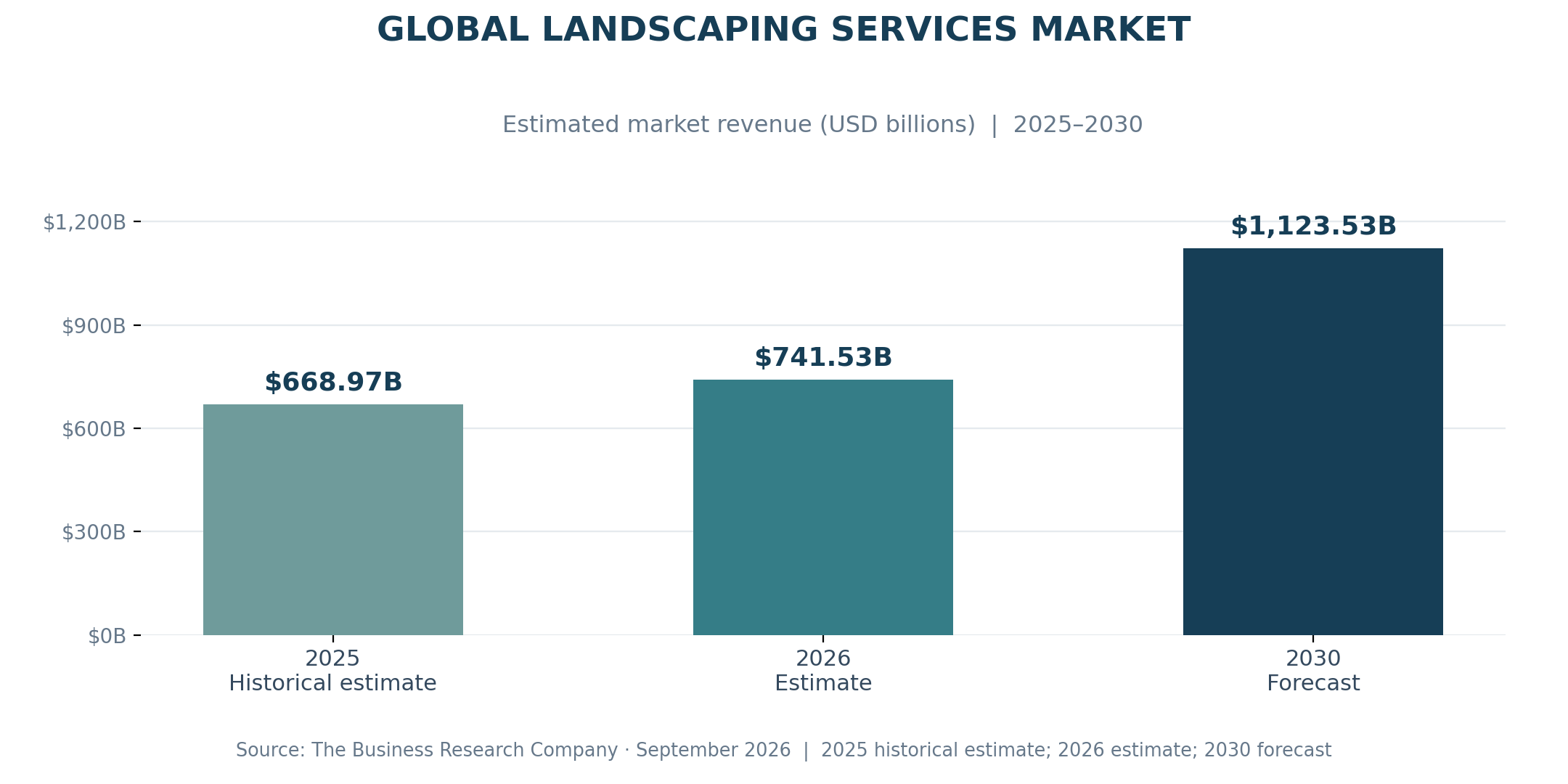
Source: The Business Research Company, Landscaping Services Market Report, September 2026. 2025 is a historical estimate; 2026 is an estimate; 2030 is a forecast. Figures concern landscaping services and may include related goods sold within those services, not standalone lawn-equipment retail.
Where opportunities are emerging
- Residential improvements: Homeowners want usable outdoor spaces and garden care.
- Commercial contracts: Offices, residential complexes and hotels need consistent grounds maintenance.
- Sustainable landscaping: Native plants, biodiversity and climate-resilient designs influence customer choices.
- Water efficiency: Appropriate irrigation and drought-tolerant planting can create specialist opportunities.
- Public green spaces: Municipalities and developers require landscaping installation and upkeep.
North America was the largest region in the cited report. Estimates vary across providers: Grand View Research estimates $372.2 billion for 2026, versus $741.53 billion from The Business Research Company. These are different research estimates; don’t combine them into one growth series.
For a startup, local climate, demand, competition and achievable margins matter more than worldwide totals. A recurring route of well-priced maintenance customers may be more valuable than occasional oversized projects.
3. Licensing, Equipment, Insurance and Startup Costs
You can start small, but proper compliance and safety are essential. Registration and licensing depend on your jurisdiction and what you actually do.
In the United States, people applying or supervising restricted-use pesticides must meet applicator certification rules; some states regulate additional commercial pesticide work. EPA guidance explains these requirements. In England, transporting garden waste can trigger waste-carrier registration. Irrigation, hardscaping and tree work may also require local permits or specialist qualifications.
Equip your first landscaping operation
For basic lawn and garden services, consider a mower, trimmer, blower, hand tools, suitable protective equipment, transport and storage. Schedule routine checks and train workers. OSHA identifies machinery, noise, lifting, chemicals and weather exposure among landscaping hazards.
Arrange appropriate general liability, commercial vehicle and equipment insurance, plus legally required employee coverage. Rent specialist machinery until demand justifies ownership.
Illustrative startup budget
|
Startup expense |
Example cost (USD) |
|---|---|
|
Commercial lawn mower |
$1,400 |
|
Trimmers, blower and hand tools |
$850 |
|
Protective equipment |
$300 |
|
Trailer and transport accessories |
$1,600 |
|
Registration and administration |
$450 |
|
Initial insurance allowance |
$1,200 |
|
Website, software and launch marketing |
$500 |
|
Working capital reserve |
$2,400 |
|
Total |
$8,700 |
Hypothetical planning figures, not market averages. Assumes you already have a suitable vehicle and storage; excludes employees and specialist installation machinery.
Keep a cash reserve for fuel, repairs, seasonal slowdowns and late payments.
4. Create a Landscaping Business Plan and Set Profitable Prices
A $1,200 garden refresh can look attractive until you discover that planting takes longer than expected and extra materials are required.
Understanding how to start a landscaping business means quoting the complete job, not just your time on site.
Plan your finances and services
Your business plan should identify customers, initial services, equipment costs, seasonal demand, staffing, marketing and expected cash flow. Estimate how many jobs you can realistically complete, not merely how many you’d like to sell. ZH Consultancy’s business plan services can help turn those assumptions into practical forecasts.
Choose pricing that fits the job: fixed quotes for clearly defined installations, hourly rates for uncertain tasks and recurring contracts for scheduled maintenance. Include travel and setup time in every method.
Example: $1,200 garden improvement project
|
Item |
Amount (USD) |
|---|---|
|
Customer payment |
$1,200 |
|
Plants, mulch and materials |
−$300 |
|
Labor: 12 hours × $25 |
−$300 |
|
Employer payroll costs |
−$60 |
|
Fuel and transportation |
−$50 |
|
Equipment maintenance allocation |
−$60 |
|
Insurance and overhead |
−$100 |
|
Contingency |
−$60 |
|
Remaining before taxes and other costs |
$270 |
Illustrative assumptions, not industry benchmarks. Labor includes an assumed cost of the owner’s or employees’ productive time.
That leaves 22.5% of revenue after listed expenses—not $1,200 of profit. Additional labor or plant replacements reduce the margin.
Use written quotations covering materials, deliverables, schedule, payment terms and extra work. For material-heavy projects, consider legally permissible deposits or milestone payments. Review maintenance pricing whenever labor, fuel or travel costs change.
5. Build Safe and Efficient Landscaping Operations
A packed schedule can still lose money through excessive travel and breakdowns.
Use a consistent workflow:
Enquiry → Site Assessment → Quote → Schedule → Prepare → Complete Work → Quality Check → Invoice → Follow-up
Confirm property access, service scope, materials and expected duration before arriving. Group nearby maintenance appointments to reduce travel and fuel costs. Allow realistic time for loading, delays and customer communication.
Train workers, provide appropriate protective equipment and follow manufacturer instructions. Remove unsafe machinery from use; specialist pesticide or tree work belongs with authorized, competent personnel.
Track actual labor hours, materials, fuel, equipment downtime and customer feedback against estimates. Photograph completed work with permission and resolve problems promptly.
Before expanding, confirm demand and cash flow. The best growth comes from repeatable quality, not a permanently overfilled calendar.
6. Find Customers and Grow Your Landscaping Business
Even excellent landscaping work needs visibility. Your first marketing goal is simple: help nearby property owners understand and trust your work.
Show your results online
A professional landscaping website should list services, locations, contact details, customer testimonials and genuine before-and-after photos. Ask property owners’ permission before publishing project images.
Create useful pages for services and areas you cover. Keep your Google Business Profile accurate where eligible and encourage genuine reviews. Customers searching for “lawn care near me” are often closer to booking than casual social-media viewers.
Develop recurring business
Property managers, landlords, real estate agents, developers and commercial facilities may need ongoing maintenance. Offer written packages defining visit frequency, tasks, seasonal changes and prices. Reliable scheduling helps convert one-off garden projects into repeat work.
A focused digital marketing strategy can combine local SEO, project photographs, referrals and targeted advertising. Measure actual enquiries, accepted quotes, customer acquisition cost and profit per job rather than social followers alone.
Don’t advertise more work than your team can safely complete. Your reputation grows when the experience matches the promise.
7. Common Landscaping Business Startup Mistakes
Landscaping mistakes rarely arrive as one dramatic failure. They build quietly when a business buys machinery before securing regular work, quotes projects without accounting for travel or equipment wear, or assumes every season will be equally busy. Taking on specialized tasks without the right skills or permissions adds safety and legal exposure, while expanding crews too quickly can put cash flow under pressure. New owners also risk damaging customer trust when schedules become unreliable or extra work is not clearly agreed in advance. Reviewing these pitfalls early helps protect your margins, your reputation and the financial stability needed for sustainable growth.
Avoid these costly early decisions:
- Buying equipment too soon. Rent specialist machines until bookings support the purchase.
- Quoting only labor and plants. Include travel, fuel, insurance, maintenance, overhead and contingencies.
- Ignoring seasonality. Forecast slower months and maintain cash reserves.
- Working beyond your qualifications. Verify permissions for pesticide application, irrigation, tree work and construction.
- Expanding without systems. Track job margins and service quality before hiring or adding routes.
The strongest operators don’t necessarily have the largest fleets. They know what each service costs and deliver it consistently.
The Takeaway
Learning how to start a landscaping business is about much more than buying a mower and finding customers.
Return to the Groundwork-to-Growth Framework: Market Positioning → Skills and Compliance → Job Economics → Customer Acquisition and Operations.
Choose a focused offering, operate safely, quote accurately and earn repeat customers. That’s how practical landscaping skills become a sustainable business.
If you’re planning a launch or expansion, ZH Consultancy can help evaluate startup costs, financial forecasts and a realistic business strategy.
Frequently Asked Questions
How much does it cost to start a landscaping business?
Costs depend on equipment and service scope. Our illustrative $8,700 budget covers an owner-operated maintenance setup but excludes buying a vehicle and hiring staff.
Do you need a licence to start a landscaping business?
Requirements vary by location and activity. Basic lawn care may differ from regulated pesticide application, tree work, irrigation or hardscaping. Verify applicable rules before offering a service.
Can you start a landscaping business without experience?
You can plan and train first, but only accept work you’re competent and legally authorized to perform. Practical experience and equipment-safety training build credibility.
Is a landscaping business profitable?
It can be, if prices cover labor, materials, travel, equipment, insurance and overhead. Efficient routes and properly priced recurring contracts can help.
What equipment do you need initially?
A mower, trimmer, blower, basic gardening tools, protective equipment and suitable transport may be enough for maintenance.
How do you find your first landscaping customers?
Show genuine project results, establish local search visibility, request customer referrals and build relationships with homeowners and property managers. Prioritize dependable service over aggressive discounts.