

In this article
You’re standing inside an empty storefront, and you can already picture the line. The espresso machine goes by the window. Regulars pick up breakfast on their way to work. The landlord says another tenant is interested, so you have until Friday to decide.
Now picture a wet Tuesday in February. How many people will come through that door before noon? What will they spend? And how long can you pay the staff if it takes a few months for the neighborhood to build a habit?
If you’re figuring out how to start a cafe business, those are the questions to answer while you can still walk away from a lease. We’ll work through them with Morning Oak Café, a fictional 1,200-square-foot U.S. shop with 25 to 35 seats, espresso, a short breakfast menu, and pickup and delivery. You’ll see what it takes to find a location, get permission to open, fund the buildout, and get enough customers to cover the bills.
How Big Is the Café Market
The global report covers a broad café market. The U.S. series tracks branded coffee shops, including chains whose sales mix can look very different from that of an independent café.
Global Café Market Size and Outlook
Grand View Research estimates the global café market at $298.72 billion in 2023 and puts its 2024 estimate at $313.65 billion. Its forecast reaches $430.02 billion in 2030, with 5.4% compound annual growth projected for 2024 through 2030. Grand View Research café market report.
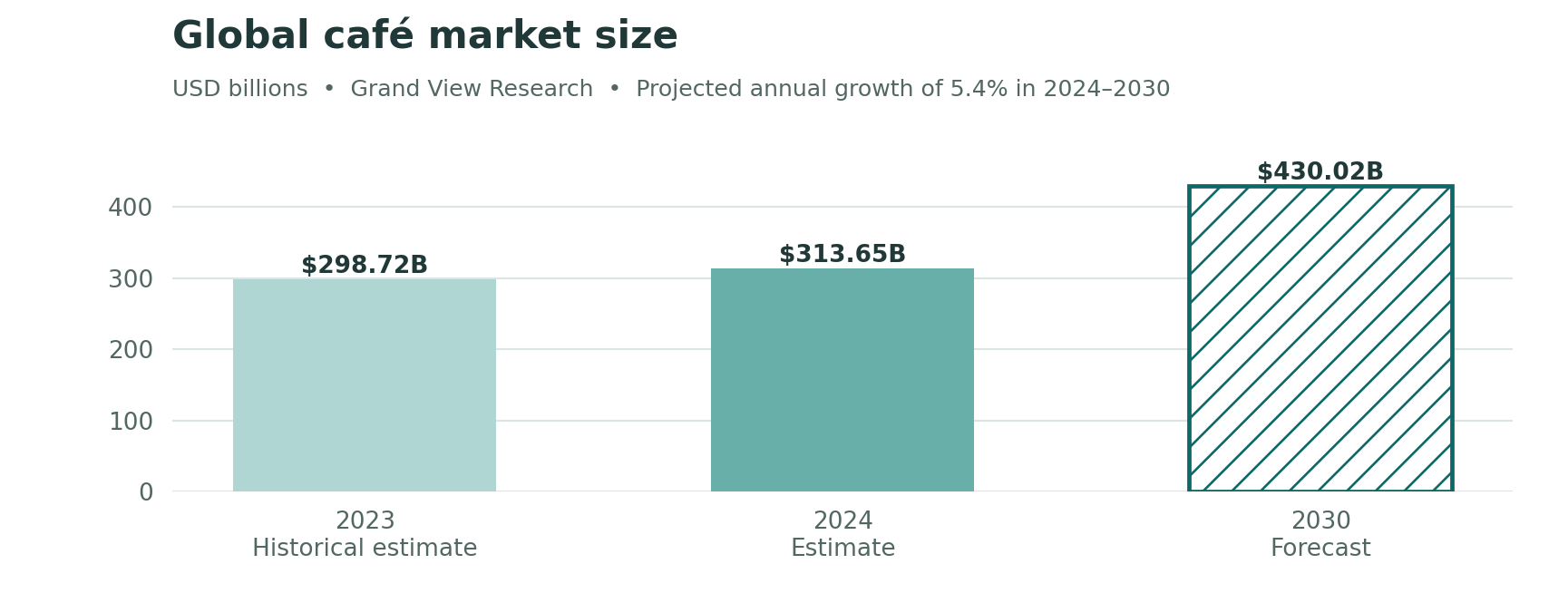
Figure 1. Global café market estimates and 2030 forecast. Source is Grand View Research.
U.S. Coffee Shop Market Size and Outlook
Statista’s U.S. industry overview puts the 2025 coffee shop market above $58 billion. For the exact year-by-year branded series, World Coffee Portal’s public releases report $45.8 billion in 2022, $49.5 billion in 2023, $54 billion in 2024, and $58.5 billion in 2025. These are estimates published in those years. Its 2025 outlook projects branded sales above $82 billion by 2030. Using $82 billion as the threshold, that implies roughly 7% annual compound growth over five years. Statista’s U.S. coffee shop overview and World Coffee Portal’s U.S. outlook.
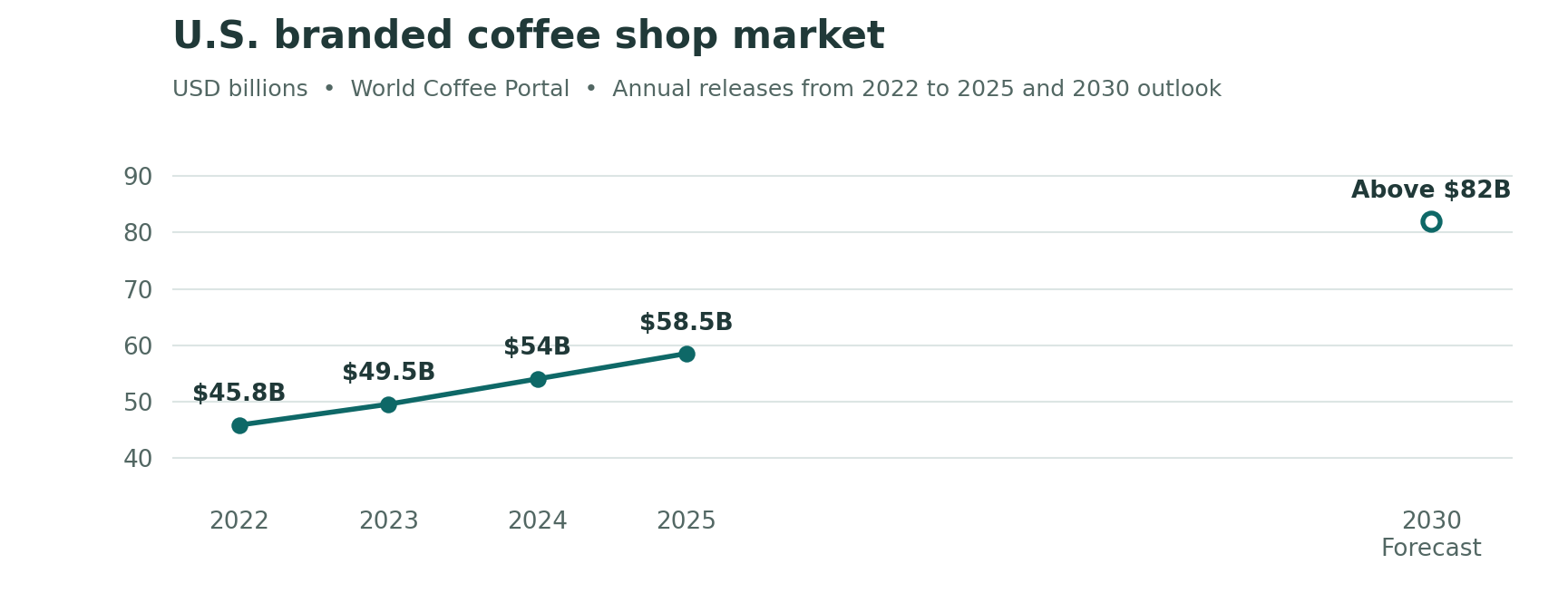
Figure 2. U.S. branded coffee shop market estimates and 2030 outlook. Source is World Coffee Portal.
For a decision about how to start a cafe business on your block, you’ll need local demand figures you can connect to a daily sales target.
How Many U.S. Businesses Already Compete in This Category
World Coffee Portal counted 47,195 U.S. branded coffee shop locations in October 2026, up 3.4% year over year on its reporting basis. For a count of businesses, the 2022 Economic Census recorded 58,462 U.S. employer firms in NAICS 722515, the broader category for snack and nonalcoholic beverage bars. The category also covers businesses such as juice and ice cream shops. County Business Patterns counted 85,140 employer locations in that category in 2023. A firm can run several locations, and the two Census figures cover different years. World Coffee Portal’s 2026 outlet update and Census figures for NAICS 722515.
Choose a Café Format and Prove Local Demand
The format you choose should fit the way people already shop and eat on the block.
Decide What the Customer Comes For
Imagine the first regular at Morning Oak. She has ten minutes before her bus leaves and wants a coffee and a breakfast sandwich she can carry in one hand. The owner can design around that visit. Open before the busier departures, make the top breakfast items quick to assemble, and put prepaid orders somewhere customers can pick them up easily.
A cart depends on permission to trade where people gather and enough transactions during those hours. A takeaway bar makes speed and counter layout especially important. A seated shop adds space for people to stay, with more room to furnish, staff, and clean. A drive-through adds questions about vehicle queues, site access, and approvals. Deciding how to start a cafe business gets easier once you can describe the visit you want to earn. Start your coffee shop business plan with the customer’s routine and the format that serves it.
Spend a Few Mornings Outside the Storefront
Pick two or three addresses. Visit each during weekday breakfast, at lunch, and on a weekend. Count people who actually pass the entrance in 15-minute blocks. Note where they’re coming from, how long they’ll wait at a nearby shop, and what happens to foot traffic when the weather turns. Record competitor prices, hours, queue length, pickup options, and recurring complaints. A competitor with slow pickup gives you something to test. See whether customers will pay for faster service and whether you can deliver it during the rush.
Say you count 600 relevant passersby during the morning window and model a 5% capture rate. That’s 30 transactions, and the 5% is an assumption you still need to test. If your operating target is 110 a day, show where the other 80 could come from. Test an office breakfast order, a permitted pop-up, or a short survey that asks people about their last coffee purchase. Add the assumptions and their sources to your coffee shop business plan. For a comparison of competing sites and customer segments, see ZH Consultancy’s market research services.
Register the Business and Check the Premises
“Another café used to be here. Can I open as soon as I get the keys?” Ask the city and health department before you sign. The address, floor plan, equipment, and proposed menu all matter. Serving packaged pastries and cooking breakfast on-site can lead to different ventilation, plumbing, and food-service requirements. A permit tied to the previous operator may require a new application or review.
If you’re learning how to start a cafe business in the U.S., put the paperwork in the order you’ll need it. Keep a list of the agency, application, fee, decision, and earliest realistic approval date for each item.
- Check the address and menu. Ask local planning, building, fire, and health officials about permitted use, plan review, occupancy, signage, accessible routes, ventilation, and any required grease or wastewater arrangements. Ask which approvals must come before construction. Take the replies and a contractor’s estimate into the lease discussion.
- Set up the business and taxes. Choose a structure with state-specific legal and tax guidance. File entity or trade-name paperwork as applicable, obtain an employer identification number from the IRS when needed, and open a dedicated business account. Check state and local sales tax obligations, employer registrations, and payroll withholding before hiring or taking payments.
- Apply for food-service approvals. Submit the plans and equipment specifications your health authority requires, confirm manager and employee training rules, and book the required inspections. Ask which food code the jurisdiction has adopted. The FDA’s 2026 edition is a model that jurisdictions can adopt. FDA Food Code.
- Plan for staffing and opening. Confirm applicable wage, overtime, tip, and workers’ compensation rules. Have an insurance broker quote liability and property coverage for the menu, equipment, and lease. Train staff on allergens, temperature control, cleaning, and employee illness procedures. Get the applicable approvals before you open to customers.
If an engineer or health inspector flags a costly change, update your cafe startup costs and projected opening date before ordering equipment. Have a commercial lease attorney review who pays for required work, when rent begins, and what happens if approval takes longer than planned.
Calculate the Funding You Need to Open
Morning Oak’s owner receives a $70,000 quote for the buildout. That number is useful. The next call is to ask what the quote covers, when each payment is due, and what the café will owe while it waits to open.
If you’re working out how to start a cafe business, price the buildout and equipment first. Add the deposit, permits, pre-opening payroll, marketing, and enough cash to get through the ramp-up. The amounts below are illustrative U.S. dollars for one seated café. Replace them with quotes for your site and menu.
Startup item | Illustrative cost |
|---|---|
Lease deposit and pre-opening rent | $12,000 |
Registration, permits, plans, and professional fees | $9,000 |
Renovation and fit-out | $70,000 |
Espresso equipment, grinders, and brewing | $25,000 |
Refrigeration and light kitchen equipment | $18,000 |
Furniture and signage | $12,000 |
Point-of-sale hardware and network | $4,000 |
Opening stock and packaging | $6,000 |
Logo and visual identity | $3,000 |
Website and online ordering | $4,000 |
Market research and business planning | $3,000 |
Recruiting and pre-opening training | $8,000 |
Opening promotion | $4,000 |
Construction and setup contingency | $15,000 |
Total pre-opening cash requirement | $193,000 |
Opening operating reserve | $70,000 |
Total funding requirement | $263,000 |
The $193,000 is what you need available before opening, including the lease deposit and a contingency allowance. The $70,000 is cash set aside for trading. Put those figures on separate lines in your coffee shop business plan so you can see what happens to the reserve when a supplier wants a deposit or an opening date moves. Compare cafe startup costs for fitted and unfitted spaces after pricing the actual work required at each address.
Suppose the owner puts in $83,000, a partner invests $40,000, and the business borrows $140,000. At an illustrative 10% annual interest rate and a 10-year amortization, the loan payment is about $1,850 a month, before any financing fees. Update the model using your actual loan terms, funding dates, and required cash injection. Six months of the $22,900 fixed monthly budget would require $137,400 before debt service and before allowing for sales. How much reserve you need depends on the sales ramp, payment dates, and your downside case.
Build a Coffee Shop Business Plan Around Daily Orders
Once you’ve decided how to start a cafe business at this address, show a lender how your traffic counts turn into an hourly sales forecast. A coffee shop business plan should give them the assumptions behind revenue, rent, payroll, and ingredients, alongside a monthly cash forecast for year one and a longer outlook. Start with the cost of serving one customer and work up to the whole shop.
Work Out What Each Sale Contributes
A $5.50 latte made with $1.35 of ingredients leaves $4.15 before payment processing, packaging, labor, and other costs. Price each recipe from supplier invoices and actual yields. Then look at the whole order. When a customer adds a pastry, the ticket rises, and so do your food costs. Your pricing model should show how much the order contributes to keeping the doors open.
Morning Oak assumes 27% of sales go to ingredients, 6% to packaging and payment costs, and 5% to blended marketplace commission. That last line assumes 20% of sales come through a marketplace charging 25%. With total variable costs of 38%, each dollar of sales leaves $0.62 to cover fixed costs. All sales figures exclude collected sales tax and tips.
Add Monthly Operating and Marketing Costs
Recurring budget item | Per month |
|---|---|
Rent and other occupancy costs | $4,500 |
Payroll, employer costs, and owner allowance | $14,000 |
Utilities | $1,100 |
Insurance | $400 |
POS, software, and internet | $350 |
Cleaning and maintenance | $600 |
Administration | $350 |
Google Search ads | $900 |
Meta ads | $350 |
Local promotions and loyalty | $250 |
Website and review tools | $100 |
Total fixed monthly budget | $22,900 |
Over twelve months, that’s $274,800 in modeled fixed costs, including $19,200 for marketing and related tools. Budget wages from a shift schedule, with paid opening and closing time and employer costs. Ask what happens if you have to add a person for the rush. Payroll is treated as fixed in the modeled range, so rerun the forecast if order volume requires extra shifts.
Calculate Operating and Cash Break-Even
Divide $22,900 by 0.62. The result is about $36,935 of monthly sales to cover operating costs. At an average ticket of $11.25 and 30 trading days, round up to 110 orders a day. Adding about $1,850 in monthly loan payments puts simplified cash break-even at about $39,919 in sales, or 119 daily orders. If the ticket drops to $10.25 with operating costs and margin held steady, the operating target rises to 121 orders a day.
Orders per day | Monthly sales | Operating result |
|---|---|---|
70 | $23,625 | −$8,253 |
90 | $30,375 | −$4,068 |
110 | $37,125 | $118 |
125 | $42,188 | $3,256 |
140 | $47,250 | $6,395 |
Results are rounded and exclude debt service, income taxes, depreciation, major replacements, and changes in working capital. At 125 daily orders for twelve identical 30-day months, the model produces $506,250 in sales and $39,075 in operating surplus. Twelve $1,850 loan payments leave $16,875 before the other cash movements. Build a lower-volume case, too, and put rent and payroll on the dates they’re actually due. A lender reviewing your cafe startup costs will want to see that timing. For help building a forecast around your quotes, see ZH Consultancy’s business plan writing services.
Set Up the Café and Build Its Brand
Plan the customer’s visit from the sidewalk to the pickup counter before you buy equipment or approve artwork.
Walk an Order Through the Room
To see how to start a cafe business that can handle its first rush, take a stack of sample orders into the empty space. One person acts as cashier, one makes drinks, and one puts the food together. Give them six orders in a few minutes, including two paid pickups. Watch where they cross paths. If a barista has to reach across the pickup counter every time they need milk, move the refrigerator on the plan while the change is cheap.
The $43,000 equipment budget in this example covers espresso, brewing, refrigeration, and the light kitchen. Ask suppliers which quotes include installation, water filtration, warranties, and service. Price a backup for key perishables and record who can service the espresso machine locally. Use recipe cards so the morning and afternoon shifts make the same drink. Test opening prep, cleaning, restocking, and order handoff in the mock rush so the staffing plan covers the whole shift.
Make the Logo, Menu, and Sign Work Together
Morning Oak wants the person walking to the bus to know at a glance that breakfast is ready early. The sign should be readable from the sidewalk. The takeaway menu should help a customer choose before reaching the register. The coffee sleeve and the menu on a phone should be recognizable as the same café. Check business-name availability, relevant trademarks, and the domain before paying for signage.
The illustrative $3,000 design budget covers the visual identity, menu, and takeaway artwork. Ask for a logo that works in one color and stays legible at small sizes. Print one test menu at actual size and read it from where a customer would stand. If a branded cup adds $0.15 and you use 3,000 a month, that adds $450 in monthly costs. Put the packaging quote into the model before you commit. See ZH Consultancy’s logo design services.
Write a Company Profile for People Who May Buy in Bulk
An office manager considering a breakfast order wants to know what you can deliver at 8 a.m., how to order for 30 people, and whom to call if plans change. Put the answers in a short company profile with your concept, menu capacity, service area, genuine team experience, and contact details. Use it when you approach office buyers, suppliers, or potential partners. Describe the proposed operation in the future tense while you’re getting ready to open. See ZH Consultancy’s company profile design services.
Build a Website a Hungry Customer Can Use
If you’re figuring out how to start a cafe business with online pickup, open the draft site on your phone as if you’re standing at the bus stop. Can you see today’s hours and breakfast prices? Can you order one sandwich and choose a pickup time in under a minute? Put the menu, location, hours, and order button where people can reach them quickly. Give catering a separate page with order lead times, minimum quantities, and a contact route if you offer it.
Run a real test order from a phone through payment, kitchen receipt, pickup, and refund. Check that sold-out products disappear or become unavailable to order. Tell customers how pickup, cancellations, and refunds work, and check the site for accessibility and appropriate privacy disclosures. For local search, use the same address and business name on the site and profile. Track completed orders and reconcile them with the POS. See ZH Consultancy’s website development services.
Bring In Local Customers With Google Maps and Ads
A customer may discover your café on Maps or in their feed. Give them a clear path to ordering.
Google Business Profile Optimization for a Café
When someone searches for coffee near the station, your listing may be the first thing they see. They should be able to tell when you open, which door to use, what’s on the menu, and whether they can order ahead. That’s why Google Business Profile optimization belongs early in the plan for how to start a cafe business that relies on nearby customers.
Claim or create the eligible storefront profile and follow Google’s verification steps. Use the real-world name from your sign, select the most specific accurate primary category, and enter your address, phone, hours, and website. If you qualify for a future opening date, use it so people know when service begins. Add actual photos of the entrance, counter, menu, and products. Test the menu and pickup links on a phone. They should land where the customer can do the thing they tapped.
Give one person responsibility for Google Business Profile optimization each week. Have them check holiday hours, update menu photos and links as needed, and respond to recent reviews. Google describes local results in terms of relevance, distance, and how well known a business is. Compare profile interactions with pickup and walk-in sales by week, and treat directions and calls as signals. See ZH Consultancy’s Google Business Profile optimization services.
Ask for Reviews After Real Visits
Print the Google review QR code on receipts or put it where customers can scan it after a visit. A simple invitation works. “If you’d like to tell us how we did, you can leave a Google review here.” Ask for honest feedback from customers generally and keep discounts and rewards separate from reviews. Google’s policy bars incentives and selective solicitation of positive reviews. Google Maps review policy.
If three people mention late pickup in the same week, watch an order travel from checkout to the shelf. Perhaps the promised time leaves too little room during the rush. Adjust the schedule or add realistic pickup slots, then check whether the complaints drop. A brief public reply can acknowledge the experience and give the customer a private way to follow up.
Start Google Ads for Cafes With Search Intent
A search for “breakfast pickup near Union Station” tells you what the customer needs and roughly where they need it. Send that person to an order page with breakfast items and available pickup times. The first test of Google Ads for cafes is whether you can connect a search, an offer, and a completed transaction. Split pickup and catering into separate ad groups or campaigns if their order values and service areas differ.
Put the Search campaign around your trading area. Review Google’s location options and consider the presence setting for customers who need to visit the storefront. Look at the actual search terms each week and exclude irrelevant ones such as job listings or wholesale coffee. Schedule ads around the hours you can handle the orders. Set up purchase tracking and review orders against the POS before raising the budget.
At the example’s $900 monthly Search budget, an illustrative $3 cost per click buys 300 clicks. If 12% turn into first orders with a $15 ticket, that’s 36 orders and $540 in sales. At 62% contribution, they generate $334.80 toward the ad cost. Acquisition costs $25 per first order in this test, and each comparable order contributes $9.30. Covering $900 takes 97 incremental orders at that contribution. Before scaling Google Ads for cafes, check real repeat purchases or revise the offer, audience, or landing page. See ZH Consultancy’s Google Ads management services.
Decide Where Meta Ads Fit
“Should I start with Instagram because the café photographs well?” If your priority is to introduce a new breakfast offer before people know your name, a short Instagram or Facebook video can show the food, the location, and how pickup works. If you need orders from people already searching for breakfast nearby, start with Search and a working pickup page. Use the Google profile in both cases so people who look you up can see accurate hours, the menu, and directions.
Morning Oak budgets $900 for Google Search, $350 for Meta, $250 for local promotions and loyalty, and $100 for website and review tools. That’s the $1,600 per month included in the operating table. Start with one or two offers you can fulfill consistently. Give the Meta creative a location and a specific action, such as ordering a breakfast combo for pickup. Compare completed transactions, what the orders contribute, and how often customers come back. A customer can see a reel and later click a Search ad, so reconcile channel reports with total orders. See ZH Consultancy’s Meta Ads management services.
Add Pickup and Delivery You Can Fulfill
How you handle a takeaway order is part of how to start a cafe business with regular customers. Start by separating direct pickup, marketplace orders, and direct delivery in the POS. The customer sees an order for coffee and breakfast. You see three ways of fulfilling it, each with its own fees, prep time, and handoff. Compare cafe delivery services on the actual contract, including commission, promotions, refunds, and payout dates.
Try a $25 marketplace order. Ingredients cost $7, packaging $1.50, incremental labor $4, and a hypothetical 25% commission costs $6.25. That leaves $6.25 before fixed overhead and any separate processing fee. A direct order has its own payment and fulfillment costs, including transport if you deliver it yourself. Build your cafe delivery services forecast using the contribution from each channel. If marketplace orders rise from 20% to 35% of sales at a 25% commission, the model’s blended commission rises from 5% to 8.75% of sales. With everything else held constant, operating break-even rises to about $39,313 a month.
Pack one order and take it on a drive about as long as a typical delivery. Open it when you arrive. Check the lid, the sandwich, and the temperature controls your menu requires. Build cafe delivery services around items that travel well, the radius you can serve, and an order verification step at handoff. During the breakfast rush, cap available slots at the volume the kitchen can reliably prepare.
Manage the First 90 Days and Catch Mistakes Early
Before opening, run the trial shift, test order payments and refunds, check your approvals, and confirm that online hours match the sign.
Give Each Month a Job
The $4,000 opening promotion comes from the pre-opening budget. The $1,600 monthly allowance starts with the trading model. Keep the dates and invoices for each in your cash forecast.
- Days 1 to 30. Open in a controlled way and record orders by hour, average ticket, remakes, waste, and pickup delays. Put the biggest service problem on the next shift’s checklist. Finish Google Business Profile optimization with real photos, correct opening hours, and working order links.
- Days 31 to 60. Review Google Ads for cafes against confirmed orders and actual contribution. Check the repeat rate for first-time buyers and reconcile delivery payouts. Adjust the menu or schedule where an item takes longer to make than its price supports.
- Days 61 to 90. Compare actual results with your cash forecast. Try an office breakfast order if the kitchen has capacity after the rush. Use cafe delivery services figures to decide which items or channels deserve more volume.
Suppose the first three months produce $22,000, $28,000, and $32,000 in net sales. At 62% contribution and $22,900 in fixed monthly costs, the operating losses are $9,260, $5,540, and $3,060. Add $5,550 for three loan payments and the café uses $23,410 of its $70,000 reserve, leaving about $46,590 before other cash movements. That balance gives the owner time to act if sales rise more slowly than expected. Keep a rolling 13-week forecast for payroll, rent, invoices, taxes, and payouts. The cafe startup costs worksheet gets the doors open. The weekly cash forecast tells you what the next few months require.
Fix the Problems That Put the Shop at Risk
The expensive mistakes in how to start a cafe business often show up as small details you can catch early.
- Signing before checking the site. Put the menu and plan in front of the local authorities before committing. Price required work and check the lease terms before your deposit is at risk.
- Planning for a steady crowd from week one. Add the reserve to your funding plan, keep it separate from the buildout, and run the lower-sales case. Set a date to act if actual orders keep falling short.
- Seeing a packed counter and assuming the shop is profitable. Compare order contribution, labor, waste, and refunds. At $32,000 in monthly sales, the example still has a $3,060 operating loss. At the same 62% contribution rate, $5,000 in additional monthly sales adds $3,100 before any new fixed costs. Check whether the kitchen can serve that volume with the staff already scheduled.
- Turning up the advertising while orders run late. Look at how many paid orders are ready at the promised time. Fix the queue, pickup slots, or menu capacity before trying to send more people through it.
Grow With the Capacity You Already Have
At 140 daily orders, moving the average ticket from $11.25 to $12.25 adds $4,200 in monthly sales over 30 days. If the incremental contribution rate is 62%, that adds $2,604 before extra fixed costs. Test a breakfast pairing and cost it from the actual recipe. Office orders can also use quieter hours if the team can prepare them reliably. Before adding another lease, check whether the first shop can cover its cash needs, run reliably under a manager, and keep customers coming back.
The Takeaway
If you’re weighing how to start a cafe business, stand outside the address on that wet Tuesday before you decide. Count the people who pass, get written answers about the premises, and work out how many daily orders your own rent, payroll, and prices require. Morning Oak needs 110 daily orders to cover modeled operating costs and 119 to cover those costs plus its loan payment. Your first decision is whether your block can plausibly deliver your number.
The budget and permits for a café depend on the address, menu, and service model.
Faq
Frequently Asked Questions
The seated café in this guide needs $193,000 to reach opening and $70,000 in operating reserve, or $263,000 in total. Your cafe startup costs depend on the premises, buildout, equipment, menu, and local wages. Still deciding how to start a cafe business on a smaller budget? Price a fitted unit or cart and calculate the reserve for that format.
Start with your city or county and the health authority for your address. Ask about zoning, the food establishment application, plans, occupancy, inspections, and staff certifications. As you work out how to start a cafe business in your state, check entity registration, taxes, payroll, insurance, and any rules that apply to the exact menu.
At a $22,900 fixed monthly budget, a 62% contribution margin, and an $11.25 ticket, Morning Oak needs 110 daily orders over 30 trading days. Add the illustrative loan payment and it needs 119. To calculate your target, divide fixed costs by your contribution rate, then divide by your average ticket and trading days. Round the order count up.
Create or claim and verify the eligible profile. Keep its name, address, categories, hours, menu, and pickup links accurate as part of Google Business Profile optimization. Check how the listing looks to a customer on a phone and confirm each link works.
Give real customers the review link or QR code on receipts and invite honest feedback. Keep any loyalty offer separate from the review request. Read comments weekly and see which part of the visit needs attention.
Start with Google Ads for cafes if people nearby are already searching for your offer and can complete an order. Meta can help people discover a product or opening in their feed. Measure cost per first order, order contribution, and repeat visits. Use actual sales to check how the channels work together.
Start with the menu items you can prepare and deliver in good condition. Model marketplace fees, payment costs, packaging, labor, refunds, and courier expenses for each order. Try cafe delivery services at a volume your staff can handle during a rush and review contribution before expanding the radius.

Zain Hameed
Business strategy specialist helping a global client base of 800+ businesses build credible plans, financial models and investor-ready presentations.
In this article
Book a Free Consultation
Have a business idea, growth challenge or investor deadline? Book a free consultation and get clear next steps from our team.
Call our team
+923104049517
Email us

Business Topics
Business topics
Continue reading
Related insights

How to Start a Laundromat Business: A Complete U.S. Founder’s Guide
Learn how to start a laundromat business in the USA: market

How to Start a Construction Business in the USA
A homeowner wants to sign a $75,000 remodeling contract on Friday.

How to Start a Plumbing Business in the USA
At 7:15 on Monday morning, a homeowner calls about water coming

How to Start a Car Rental Business in the USA: A Founder’s Practical Guide
A family lands after midnight. They do not care whether your

How to Start a Landscaping Business: Costs, Licenses, Marketing and Profit
Picture two lawns on the same street. One homeowner wants a

How to Start a Cafe Business in the USA: Costs, Licenses, Marketing and Profit
You’re standing inside an empty storefront, and you can already picture