

BUSINESS STRATEGY / FOUNDER GUIDE

How to Start a Self Storage Business: From Empty Units to Recurring Revenue

Learn how to start a power washing business, estimate startup costs, check permits, price jobs for profit, choose equipment and attract customers.

ZH Research Team

Reviewed by Zain Hameed

Date Published

October 26, 2026

ZH Editorial Team

Business Strategy Desk

Imagine owning 100 storage units. Customers rent space and pay monthly. It sounds like straightforward recurring income.

Then imagine only 35 units are occupied.

The other 65 earn nothing, while insurance, security, maintenance and loan payments keep arriving.

That’s the challenge behind how to start a self storage business: you’re not simply building or buying storage space. You’re making a location-sensitive property investment that must earn enough rental revenue to justify its costs.

Think of the Space-to-Revenue Framework as four decisions working together:

  • Market demand and location: Who needs storage nearby, and what will they pay?
  • Property and compliance: Will you build, buy, convert or manage a facility—and can it legally operate?
  • Investment economics: What occupancy and rent levels will cover expenses and financing?
  • Occupancy and operations: How will you secure the site, attract renters and keep units occupied?

Get them wrong, and even a modern facility can struggle to pay for itself.

1. Decide What Type of Self Storage Business to Start

Before purchasing land, decide what you’re actually offering. A basic drive-up storage facility has different costs and customers from a multi-story, climate-controlled building.

Your main options include:

  • Traditional units: Indoor or drive-up storage for household belongings and business inventory.
  • Climate-controlled units: More controlled temperature or humidity conditions, usually with higher construction and energy costs.
  • Container or vehicle storage: Secure spaces for containers, cars, boats or recreational vehicles, subject to local approvals.
  • Third-party management: Operating a facility for its owner rather than purchasing the property yourself.

You might develop a new facility, acquire an operating one or convert a suitable building. The financing needs and risks differ considerably.

Define your customers before choosing a unit mix. People moving homes may need short-term space; ecommerce sellers may need regular access to inventory; small businesses may want predictable monthly costs.

Study nearby facilities, advertised prices, available unit sizes, accessibility and reviews. A busy neighborhood can still have too much storage capacity.

If you’re comparing development, acquisition and management models, business consultancy support can help assess the commercial case before you commit capital.

Your advantage starts with the right storage product in the right location—not the greatest number of units.

2. Global Self Storage Market Outlook and Growth Opportunities

The worldwide self-storage market is expanding, but broad industry growth doesn’t guarantee that a particular site will fill up.

According to The Business Research Company’s Self Storage Market Report 2026, global market revenue reached USD 68.31 billion in 2025, is estimated at USD 73.54 billion in 2026, and is forecast to reach USD 98.46 billion by 2030. The report projects approximately 7.6% compound annual growth from 2026 to 2030.

What’s supporting demand? Residential moves, limited space in some urban homes, small-business inventory storage, climate-controlled options and easier online reservations are all relevant drivers. Smart access and security tools can also simplify operations.

North America led in 2025; the report forecasts faster growth in Asia-Pacific.

For a new operator, though, the decisive research is local: competing supply, achievable rent per unit, expected lease-up speed and whether customers can conveniently reach your site.

A promising global forecast cannot rescue an unsuitable location.

Global Self Storage Market Forecast, 2025–2030
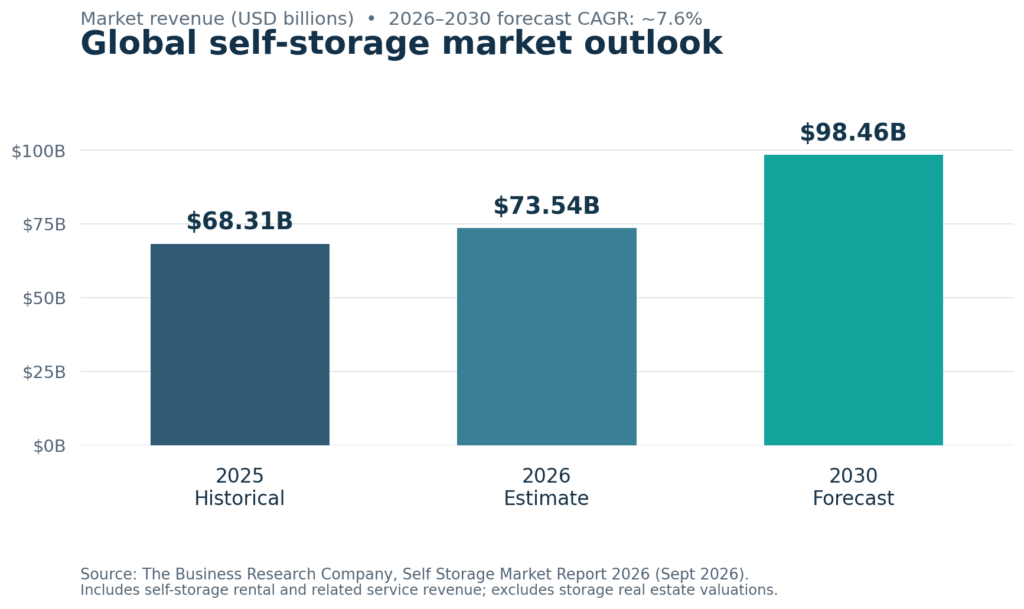
Global self-storage market forecast: USD 68.31 billion in 2025, USD 73.54 billion estimated in 2026, and USD 98.46 billion forecast in 2030.

Source: The Business Research Company, September 2026. USD billions. Its self-storage market includes rental and related services, and associated goods included in the service offering; it does not represent the capital value of storage real estate or construction spending. The 2026 figure is an estimate and 2030 a forecast.

3. Location, Zoning, Financing and Startup Cost

A cheap plot of land is not necessarily a bargain. If customers find it inconvenient, the zoning is unsuitable or utility work becomes expensive, the project may never produce an adequate return.

Validate the site and legal requirements

Assess road access, visibility, nearby homes and businesses, competitors, flood exposure, utilities and room for expansion. Then confirm that storage is a permitted use and investigate planning, construction, fire-safety, accessibility and operating requirements.

Rules differ by jurisdiction. In England, for example, storage and distribution appears under Use Class B8, but building works or a change of use may still require approval. Check with local planning officials and qualified advisers before buying or converting property.

Plan the financing and full investment

Funding may involve commercial property lending, equity partners or purchasing an established facility. Lenders will examine demand, projected occupancy, cash flow and debt repayments. Don’t assume a particular small-business loan is available: for example, the U.S. SBA’s 504 program does not fund speculative investment in rental real estate.

Consider this illustrative USD budget for a small purpose-built facility:

Investment Item Example Cost
Land acquisition $300,000
Site preparation and utilities $120,000
Storage building construction $650,000
Security, access and fire-safety systems $90,000
Design, permits and professional fees $75,000
Software, website and launch marketing $15,000
Contingency and working capital $150,000
Total Example Investment $1,400,000

Planning assumptions only—not market averages, contractor quotations or a prediction for your project. Location, size, construction method, climate control and finance terms can change costs substantially.

Reserve funding for the months when the facility is operating but still has many vacant units.

4. Create a Self Storage Business Plan and Set Profitable Rental Rates

Anyone researching how to start a self storage business should learn one metric early: break-even occupancy. A facility with 100 units does not earn rent from 100 units unless all 100 are paying.

Your business plan should model unit sizes, achievable rents, the pace of new rentals, operating expenses, financing costs, maintenance reserves and slower-than-expected lease-up.

Calculate the impact of empty units

Suppose a facility has 100 identical units at $150 per month. In a simplified month, all occupied tenants pay in full and operating costs stay constant:

Monthly Calculation Example Amount
Available units 100
Occupied units 70
Average rent per occupied unit $150
Rental revenue $10,500
Operating expenses −$6,000
Net operating income (NOI) $4,500
Loan payments −$3,500
Cash remaining before taxes and reserves $1,000

Illustrative scenario only, separate from the development budget above. NOI excludes financing, income taxes and capital expenditure. The model ignores discounts, nonpayment and variations in unit size.

At 50% occupancy, revenue falls to $7,500. With the same costs and payments, monthly cash flow becomes negative $2,000. Under these assumptions, cash-flow break-even requires about 64 paying units, or 64% occupancy.

Set rents on evidence, not optimism

Compare local rates for similar unit sizes and amenities. Climate control and premium access might justify higher prices, but they also cost more to provide.

Monitor both physical occupancy (units rented) and economic occupancy (how effectively available rental value converts into revenue). Free months and heavy discounts can make a busy facility less profitable than it looks.

Aim for durable rental income, not occupancy at any price.

5. Build Efficient and Secure Self Storage Operations

Storage doesn’t have to be labour-intensive, but it does need disciplined management. Customers expect clear contracts, reliable billing and a secure property.

Create a simple workflow: Enquiry → Unit Selection → Agreement → Payment → Access Setup → Monthly Billing → Move-Out.

Agreements should explain permitted contents, access, rent increases, late-payment procedures, insurance responsibilities and move-out rules. Laws about liens, overdue accounts and selling stored property differ; obtain locally appropriate legal documents rather than copying a generic contract.

Invest in security appropriate to the site: controlled entry, lighting, cameras, secure locks and functioning fire systems. Avoid claiming that surveillance eliminates theft or damage. Inspect roofs, drainage, doors, gates and ventilation routinely; climate-controlled sites also need suitable environmental monitoring.

Facility software can manage availability, online reservations, recurring payments and overdue-account reminders. Review occupancy by unit size, rent collected, arrears, maintenance spending and customer move-outs.

If small units rent quickly but large ones remain empty, investigate the pricing and unit mix before building an expansion.

Good operations protect both customer confidence and your investment return.

6. Attract Customers and Increase Storage Unit Occupancy

Empty units cost money even when nobody is using them. Marketing should therefore begin before opening—not after months of poor occupancy.

Make it easy to find and rent a unit

A professional website should show available sizes, honest pricing, location, access hours, security features, photos and a clear reservation process.

Local search matters. Keep an eligible Google Business Profile accurate, collect genuine customer reviews and make sure your facility’s address and hours match across listings.

Build partnerships close to the point of need

Moving companies, estate agents, renovation contractors, universities and local ecommerce businesses regularly meet people who may need temporary or ongoing storage.

Track which referrals become paying renters. Offer promotions carefully: a discount that increases occupancy but attracts rapid move-outs might not deliver the return you expect.

A focused digital marketing strategy can combine local SEO, targeted advertising and easier online booking. Measure cost per new rental, occupancy by unit type, average rent collected and move-out rates rather than website visits alone.

The best marketing fills units with paying customers—not just enquiries.

7.Common Self Storage Business Startup Mistakes

Self-storage may look like a simple property investment: provide space, collect rent and maintain the site. Yet costly mistakes often begin before the first customer moves in. Choosing the wrong location, forecasting unrealistic occupancy or overlooking development expenses can leave even a well-designed facility short of cash. After opening, weak security, neglected maintenance and expansion too early can compound those problems. Recognizing these risks in advance helps protect your investment, improve customer retention and build a facility that can generate dependable long-term returns.

  • Choosing land only because it’s cheap. Weak access or limited local demand can outweigh the initial saving.

  • Assuming high occupancy from opening day. Model slower lease-up and keep enough working capital to survive it.

  • Underestimating development and debt costs. Permits, utilities, interest and construction overruns can transform the project’s returns.

  • Neglecting security and maintenance. Broken gates, leaks and poor communication make customers less willing to stay.

  • Expanding before the first facility stabilizes. More capacity is not a solution to insufficient demand.

The Takeaway: Empty Space Isn’t Passive Income

Learning how to start a self storage business is ultimately about making a disciplined property investment—not merely collecting rent from empty rooms.

The Space-to-Revenue Framework keeps the essential decisions connected: Market Demand and Location → Property and Compliance → Investment Economics → Occupancy and Operations.

Validate demand before you build, test conservative occupancy scenarios and develop systems that protect your facility and the people who rent from you.

If you’re assessing a self-storage project, ZH Consultancy can help with commercial feasibility, investment forecasts and a practical growth plan.

Faq

Frequently Asked Questions About Starting a Self Storage Business

How much does it cost to start a self storage business?

There is no universal budget. Land, construction, utilities, security and financing can make a new facility capital-intensive. Acquisitions, conversions and third-party management require different levels of investment.

Is a self storage business profitable?

It can be, when rent and occupancy support property expenses, debt payments, maintenance reserves and a suitable return on invested capital. A global growth forecast does not guarantee local profitability.

Can I start without owning land?

Potentially. You might lease suitable premises, partner with an owner or manage another investor’s facility, subject to the contracts, permissions and financing involved.

Do I need a licence or planning permission?

Requirements depend on the jurisdiction and property. Investigate business registration, land use, construction, fire safety and operating approvals before committing capital.

How many storage units do I need to make money?

There is no fixed number. Calculate break-even occupancy using your projected rents, operating costs and loan payments; then test less favourable scenarios.

How can a new facility attract renters?

Use clear online pricing and reservations, local search visibility, genuine reviews and partnerships with movers or real estate professionals. Track signed rentals and tenant retention, not only enquiries.

Portrait of Zain Hameed
Read & reviewed by

Zain Hameed

CEO · ZH Consultancy

Business strategy specialist helping a global client base of 800+ businesses build credible plans, financial models and investor-ready presentations.

4.9/5 Upwork rating
800+ Businesses worldwide
4.8/5 PeoplePerHour rating

Book a Free Consultation

Have a business idea, growth challenge or investor deadline? Book a free consultation and get clear next steps from our team.

Call our team

+923104049517

Untitled design (2)

Business topics

Continue reading

Related insights