

In this article
Your first ten customers could make you busy and still leave you short of money. Imagine charging the same monthly fee for a small screened pool around the corner and a leaf-filled pool thirty minutes away. Both count as one account. Only your calendar knows the difference.
Learning how to start a pool cleaning business means learning to manage those differences before they consume your margin. Clear water is the service customers see. Behind it sit chemistry, driving time, safe handling, scheduling, insurance, and a price that pays for your work.
This U.S. guide explains the decisions that connect those pieces. You will find current research, an illustrative startup budget, a worked financial example, and a launch sequence you can adapt to your state and season.
Understand the Service and Choose Your Business Model
A pool service company typically removes debris, brushes appropriate surfaces, vacuums, tests water, adjusts treatment within its competence, and reports equipment concerns. Customers buy convenience and consistent care. They also want someone who notices a developing problem before the weekend swim.
Recurring residential service is a practical starting model: homeowners receive scheduled visits and pay monthly or per visit. Chemical-only plans have a narrower scope. Seasonal markets add openings and closings; neglected-pool recovery needs separate estimates and adequate expertise.
Commercial pools introduce different supervision, documentation, testing, and health-code obligations. Repair and installation are separate activities that may require trade licenses. Do not advertise them simply because you can purchase the parts.
Deciding how to start a pool cleaning business begins with a precise offer: which properties, which tasks, which service area, and which exclusions. Write it down before buying a route or promising an all-inclusive package.
Study Market Demand Before Choosing Your Route
Pool Corporation’s 2025 Form 10-K describes approximately 5.5 million U.S. in-ground swimming pools. That is an installed-base estimate, not a count of homeowners hiring cleaners. Its broader figure exceeding 14 million includes pools and hot tubs, so the two numbers should not be substituted for one another.
Arizton estimates the U.S. pool maintenance and cleaning services market at $8.08 billion in 2023 and forecasts $10.33 billion by 2029, a 4.17% compound annual growth rate. This includes maintenance beyond routine cleaning. The forecast describes a possible industry trajectory, not guaranteed sales for a new operator.
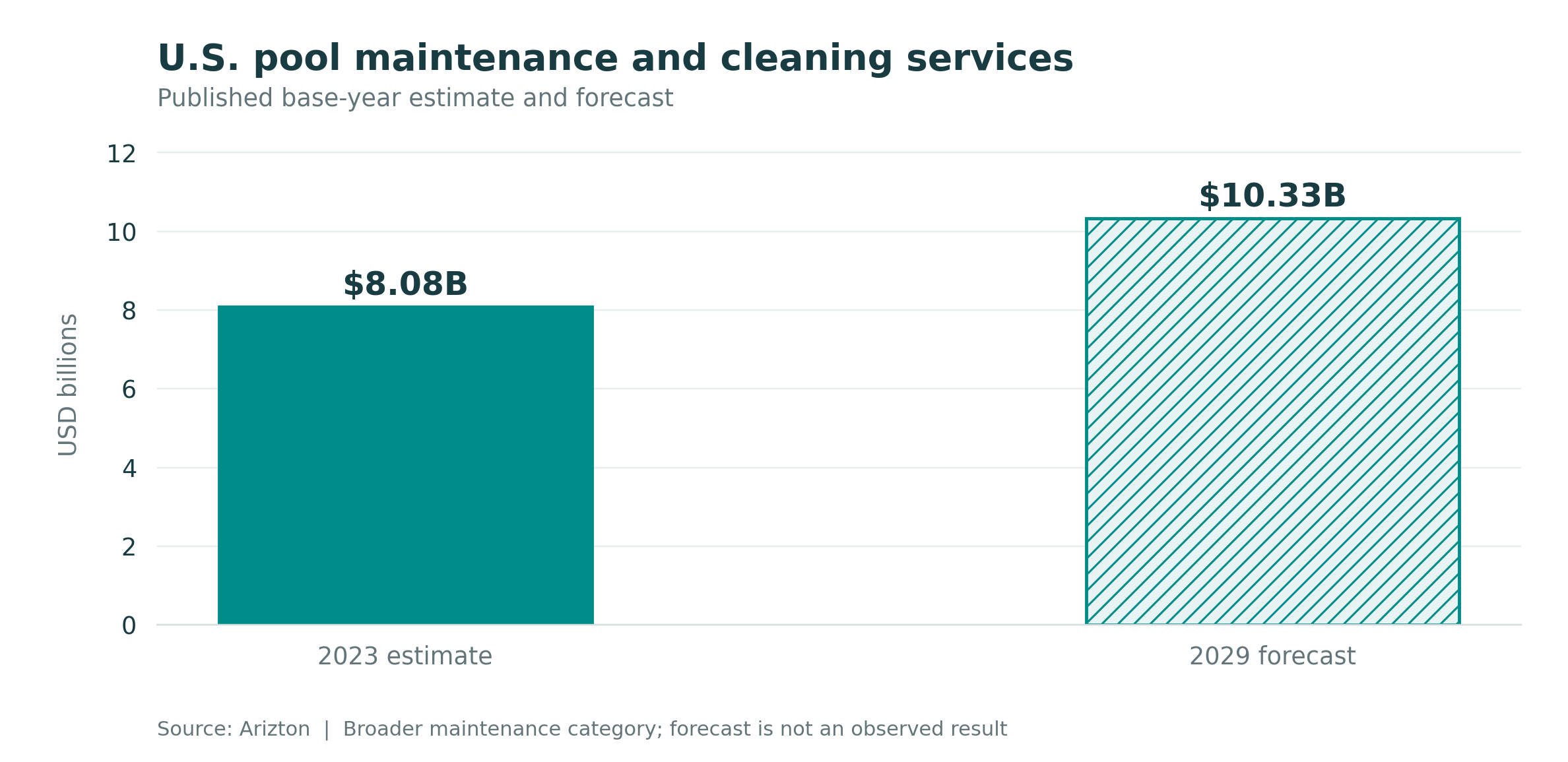
U.S. pool maintenance and cleaning services market, USD billions: 2023 estimated base year and 2029 forecast. These are two published endpoints, not annual observations or a cleaning-only market measure.
Source: Arizton market report and scope.
For global context, The Business Research Company estimates $26.77 billion in 2025 and forecasts $38.4 billion in 2030 for pool cleaning and maintenance services. Its geography and definitions differ from Arizton’s; do not combine them to calculate U.S. market share.
Your actionable market is smaller. Map pool-heavy neighborhoods within a realistic driving radius. Interview homeowners, property managers, and pool retailers about service gaps, seasonal demand, and frustrations. Compare five competitors’ inclusions and response times without posing as a customer.
Understanding how to start a pool cleaning business in Phoenix differs from doing so in a northern seasonal market. Validate operating months and climate exposure. ZH Consultancy’s market research services can help test assumptions before equipment spending.
Weigh the Advantages and Disadvantages
Recurring work can make scheduling and collections more predictable. A small owner-operated route also lets you learn service standards directly. However, recurring billing does not remove cancellations, bad weather, or physical limits.
Potential advantage | Tradeoff to plan for |
|---|---|
Repeat service relationships | Missed visits can quickly damage trust |
Gradual expansion by neighborhood | Scattered accounts increase unpaid driving |
Starting with one operator | Illness or vehicle failure needs backup coverage |
Additional services over time | Training, licensing, and insurance must match the work |
If you are assessing how to start a pool cleaning business alongside another job, check daylight availability, supplier hours, and emergency response expectations. A part-time route must still deliver the schedule customers purchased.
Estimate Pool Cleaning Startup Costs Without Ignoring Cash Reserves
Advice on how to start a pool cleaning business often emphasizes inexpensive tools. The larger question is how you will fund slow customer acquisition, chemical replenishment, and your own living expenses.
The following pool cleaning startup costs are illustrative U.S. planning allowances in USD, not verified national averages or supplier quotes. Both scenarios assume an existing suitable vehicle, lawful storage, one operator, and no purchased customer route.
Initial cash requirement | Lean launch | More equipped launch |
|---|---|---|
Testing kit and diagnostic tools | $600 | $1,100 |
Vacuum, poles, brushes, nets, and hoses | $900 | $1,900 |
PPE, containment, and storage setup | $500 | $1,000 |
Opening chemical inventory | $500 | $1,000 |
Registration, training, and professional advice | $700 | $1,600 |
Initial insurance payments | $700 | $1,400 |
Vehicle preparation and storage deposits | $600 | $1,600 |
Brand identity and basic print materials | $400 | $1,000 |
Website, domain, and initial hosting | $900 | $2,200 |
Software and communications setup | $200 | $400 |
Initial promotion | $500 | $1,200 |
Working capital reserve | $3,000 | $6,000 |
Total initial cash | $9,500 | $20,400 |
These pool cleaning startup costs exclude vehicle purchase, loan payments, owner living costs, employees, and specialized commercial systems. Replace every allowance with local quotes. Licensing costs can make a repair-focused launch materially different.
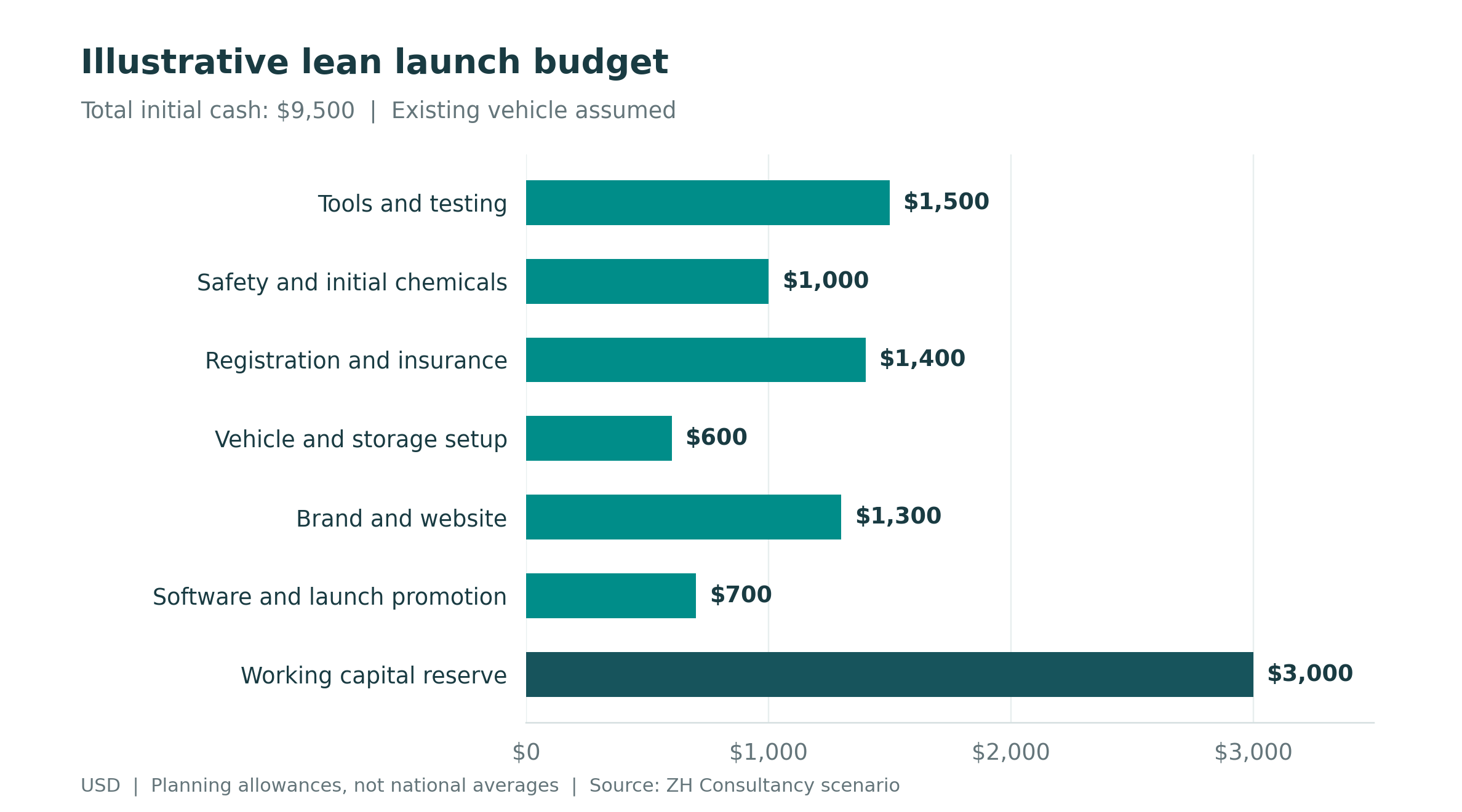
Illustrative lean launch allocation, USD, for the $9,500 scenario above. One-time purchases, initial payments, inventory, and a cash reserve are grouped together; this is not an annual expense forecast.
Calculation source: ZH Consultancy’s budget above. Planning reference: SBA business planning and startup-cost guidance.
Separate recurring obligations from initial cash: insurance, fuel, chemicals, software, storage, bookkeeping, marketing, and replacements continue after launch. Initial payments are not necessarily annual premiums.
Stress-test pool cleaning startup costs against a delayed launch. The lean reserve covers only 2.5 months of the $1,200 fixed overhead used later, before variable costs or living expenses. Build a separate personal runway and keep contingency cash available.
Before financing pool cleaning equipment, compare the payment commitment with signed work and cash reserves. Track tools and inventory separately from deposits and prepaid services. A purchase may consume cash immediately while its accounting treatment spreads over time; ask your accountant how to record it.
Build a Pool Service Business Plan That Can Guide Decisions
A credible pool service business plan connects customer demand to operating capacity and cash. A useful executive summary might describe an owner-operated residential route serving two neighboring ZIP codes, with weekly care, digital visit reports, and separately quoted restoration work.
For anyone researching how to start a pool cleaning business, the plan should answer these questions:
- Customer and competition: Which homeowners will pay, what alternatives exist, and what problem will you solve better?
- Offer and positioning: What is included, what is excluded, and why should a customer trust you?
- Operations and staffing: How many visits fit into each day, and who covers absence or equipment failure?
- Pricing and sales: How will you quote different pools, acquire accounts, and retain them?
- Financial requirements: What cash is needed, when will revenue arrive, and what happens if growth is slower?
Add a competitor comparison, customer profiles, supplier arrangements, and a marketing calendar. Your unique selling proposition could be reliable weekday visits with documented readings and prompt follow-up. Use a promise you can demonstrate.
The financial portion of your pool service business plan should include monthly revenue, direct costs, overhead, owner compensation needs, profit and loss, cash flow, and break-even. Keep opening cash, borrowing, and equipment purchases visible; they do not all behave like operating expenses.
Model a base case, a slower acquisition case, and a high-chemical-cost month. For a seasonal operation, show winter collections and expenses separately instead of multiplying summer revenue by twelve.
Set measurable milestones, such as ten paid recurring accounts before a major equipment upgrade. Update the pool service business plan using actual job times and chemical consumption. For financing or a more complex launch, professional business plan writing can organize the evidence and assumptions into a coherent funding case.
Check Registration Licensing Insurance and Safety Obligations
The legal answer to how to start a pool cleaning business depends on both location and activity. Check the state licensing board, local business office, health department, fire authority, and tax agency before accepting work.
Register the Business and Arrange Taxes
A sole proprietorship is simple but does not create a separate liability shield. An LLC may separate certain business liabilities when properly maintained; it does not replace insurance or excuse personal negligence. Review the SBA’s structure guidance with a qualified adviser, then register the entity or assumed name as required.
Open a separate bank account. Obtain an EIN when required; the IRS issues EINs free. Confirm federal income and self-employment tax treatment, estimated payments, and state or local sales-tax rules for your particular services and products.
Separate Cleaning From Licensed Repairs
Florida DBPR distinguishes cleaning swimming pools from compensated pump repair or replacement, which requires appropriate licensure. In Texas, TDLR’s residential appliance installer guidance explains limited authority for pool electrical devices; new or upgraded line circuits require an electrical contractor with a designated master electrician. Neither example establishes nationwide permission.
PHTA’s CPO training develops operating knowledge. Certification and contractor licensing serve different purposes. Ask the health authority which credentials and supervision your commercial accounts require. The CDC Model Aquatic Health Code is model guidance; local adoption determines enforceable requirements.
Match Insurance and Contracts to the Work
Discuss general liability, commercial auto, equipment coverage, chemical or pollution exclusions, and workers’ compensation requirements with a broker. Confirm whether care, custody, and control exclusions affect pool damage claims.
Have counsel review agreements covering access, pets, weather rescheduling, treatment exclusions, repair approvals, billing, cancellation, and responsibility between visits. Before hiring, address payroll, employment classification, training, and applicable safety obligations. Obtain advice on your actual operation rather than relying on a generic license list.
Choose Equipment Suppliers and a Repeatable Service Workflow
Knowing how to start a pool cleaning business includes knowing when to stop and refer a job. Hands-on supervised training is especially valuable for water testing, different pool finishes, filtration systems, and equipment hazards.
Essential pool cleaning equipment includes a professional test kit with fresh reagents, telescopic poles, compatible brushes, leaf nets, a vacuum system, hoses, and basic inspection tools. Choose equipment suited to the pool surface. Carry labeled spares so a broken pole or depleted reagent does not derail the day.
Evaluate suppliers on reliable stock, product authenticity, technical support, returns, and safe delivery. Standardize supplies before chasing discounts across multiple brands. Record purchase dates and storage conditions for test reagents.
Store pool cleaning equipment separately from incompatible chemicals. Follow product labels and safety data sheets, use specified PPE, and keep chemicals in original labeled containers. CDC chemical-safety guidance emphasizes training, separation, and protection from heat and moisture. Never mix chemicals. Ask suppliers and the relevant authorities about transport, storage, fire-code, and disposal requirements for the products and quantities you carry.
Create a visit checklist: confirm safe access, inspect visible conditions, test and record water, complete agreed cleaning, perform only authorized treatment, document concerns, and secure gates on departure. Record actual quantities and before-and-after observations. A photograph is useful evidence, but it cannot establish water safety by itself.
For employees exposed to hazardous chemicals, OSHA hazard communication requirements can include written programs, labels, accessible safety data sheets, and training. Arrange a trained backup operator and an incident procedure for contamination, dangerous equipment, or an inaccessible property.
Keep pool cleaning equipment maintenance and replacement dates in your scheduling system. Software should handle route planning, readings, photos, invoicing, and customer messages. As checked in November 2026, Skimmer’s entry plan starts at $49 monthly for up to 49 serviced locations; compare current limits, payment fees, and add-ons before committing.
At onboarding, document the pool finish, approximate volume, existing damage, equipment model numbers, gate arrangements, and emergency contacts. Photograph pre-existing defects with permission and confirm the starting condition in writing. Clean and inspect pool cleaning equipment between stops according to manufacturer guidance. This creates a usable service history when a later concern needs investigation.
Set Prices That Pay for Your Time and Operating Costs
The financial question behind how to start a pool cleaning business is simple: can the route fund reliable care and a reasonable return for the person doing it?
Set pool cleaning prices after inspecting pool size, access, debris, condition, equipment, service frequency, and travel. Define chemical inclusion and separately priced items in writing. A neglected pool should not quietly become a normal weekly account at a normal weekly fee.
Compare local offers on equal terms. Skimmer’s Service Rate Index separates billing models and regions using platform billing data. It is a benchmark from participating companies, not a universal price list.
Work Through a Monthly Example
Assume forty residential accounts at $180 each monthly, with weekly visits across 52 service weeks. Direct cash costs average $45 per account: $30 chemicals, $10 allocated travel costs, and $5 payment fees and consumables. Assume fixed overhead of $1,200 for insurance, software, communications, marketing, administration, and vehicle-related overhead without double-counting travel.
Monthly calculation | Illustrative amount |
|---|---|
Revenue from 40 accounts at $180 | $7,200 |
Direct cash costs at $45 per account | $1,800 |
Contribution toward overhead and owner return | $5,400 |
Fixed operating overhead | $1,200 |
Available before owner pay and other exclusions | $4,200 |
Planning allowance for owner labor at 150 hours × $25 | $3,750 |
Residual after that labor allowance | $450 |
The $4,200 is before owner compensation, taxes, debt service, and major reinvestment. The $3,750 is an economic planning allowance, not automatically a deductible owner wage. The remaining $450 shows why calling the full $4,200 passive profit would be misleading.
Forty weekly accounts produce about 173 visits monthly. At thirty minutes on site plus twelve minutes travel per visit, service and driving take about 121 hours, leaving roughly 29 of the assumed 150 hours for purchasing, sales, and administration. Measure your own route; difficult pools change the calculation.
Contribution is $180 minus $45, or $135 per account. Covering $1,200 overhead alone takes nine accounts after rounding up. Covering overhead plus the $3,750 owner allowance takes thirty-seven. Neither threshold includes tax, debt repayment, or unexpected major purchases.
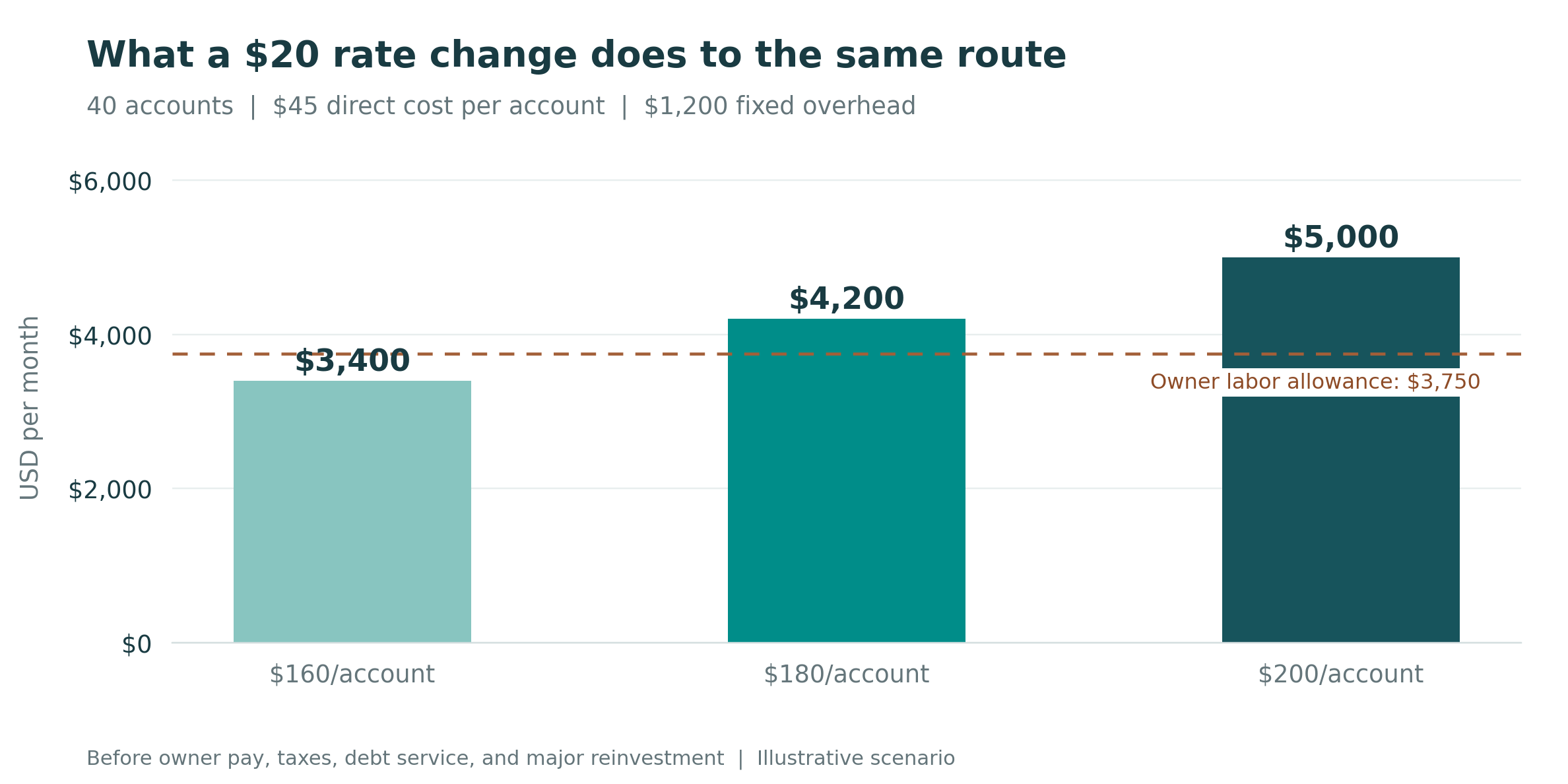
Illustrative monthly amount available before owner pay, taxes, debt service, and major reinvestment at 40 accounts. Rates of $160, $180, and $200 produce $3,400, $4,200, and $5,000 respectively, holding direct costs and overhead constant.
Calculation source: ZH Consultancy’s worked scenario above. Method reference: SBA financial planning guidance.
Review pool cleaning prices when costs or scope change. Charging $20 less across forty accounts removes $800 monthly under these assumptions. ZH Consultancy’s financial modeling services can help connect pool cleaning prices, route capacity, and cash flow before hiring or borrowing.
Run a cost shock as well. If monthly chemical spending rises $15 per account, total direct costs become $2,400 and the amount available falls to $3,600. That leaves a $150 shortfall against the labor allowance. Set a written review process rather than hoping the next customer will absorb the difference.
Collections also matter. A profitable invoice does not buy supplies until it is paid. Agree on due dates, payment authorization, failed-payment follow-up, and suspension terms before starting. Keep a rolling cash forecast showing expected receipts against supplier bills, insurance payments, and planned purchases.
Choose a Name and Build a Recognizable Brand
When planning how to start a pool cleaning business, choose a name a homeowner can pronounce, remember, and search. Check state business records, relevant trademarks, domain availability, and social handles before printing signs. Business-name registration alone does not establish trademark clearance.
A usable identity works on a phone, invoice, shirt, and vehicle. Favor legible typography, a small consistent color palette, and a logo that remains recognizable at small sizes. A complicated illustration can disappear on a business card.
Write one positioning sentence explaining your actual advantage: for example, scheduled residential care with visit records and clear chemical billing. Avoid unsupported claims about being the cheapest or safest.
If you commission logo design, request vector files, clear usage rights, and versions for light and dark backgrounds. Consistency helps customers recognize the technician arriving at their property.
Prepare Marketing Materials for the Customers You Want
A residential startup usually needs a clear quote template, service agreement, invoice, business cards, and a brief digital explanation of its packages. These materials should answer practical questions about inclusions, timing, access, and billing.
A company profile or capability document becomes more useful when approaching property managers, apartment operators, or hospitality buyers. Include service capacity, coverage, qualifications, insurance availability, reporting examples, and a credible escalation process.
Do not invent case studies. Ask permission before using customer photographs or testimonials. Targeted graphic design for brochures and print materials makes sense when there is a specific sales use; a tiny residential route rarely needs an expensive sales deck.
Build a Website That Turns Local Interest Into Qualified Inquiries
Someone learning how to start a pool cleaning business should test the website from a homeowner’s perspective. Can a visitor confirm coverage, understand the service, and request a quote without hunting through five pages?
Show your real service area, package inclusions, exclusions, contact details, response window, and authentic reviews. Add separate pages for distinct services, genuine local photographs, and a short explanation of what happens after an inquiry. Display starting pool cleaning prices only when the conditions are clear.
Choose a Platform for the Actual Workflow
Platform | Best fit | What to check |
|---|---|---|
WordPress | Flexible service pages, content, and integrations | Hosting, plugin maintenance, backups, and form reliability |
Wix or Squarespace | Owner-managed brochure and inquiry sites | Booking features, plan limits, renewals, and export options |
Shopify | Businesses also selling products online | Whether commerce features justify the service-site complexity |
Specialist pool software | Routes, billing, readings, and customer reporting | Website integration, customer-data export, fees, and scalability |
These are selection judgments, not performance rankings. Review the official WordPress feature overview, Wix booking tools, Squarespace scheduling, and Shopify store features against your requirements. Instant appointment booking should not promise a slot before you check route availability and pool condition.
Keep Control of Your Domain and Long-Term Costs
Register the domain in your own business account, enable two-factor authentication and renewal reminders, and retain recovery access. Your designer can receive delegated access. Hosting and domain registration are different purchases even when bundled.
Provider example | Verified advertised USD pricing | Decision point |
|---|---|---|
Cloudflare Registrar | Standard .com registration and renewal listed at $11.17 each | At-cost model; check supported extensions and DNS requirements |
Namecheap | .com new-customer first-year offer $6.48; renewal $19.98 | Eligibility restrictions and applicable ICANN fees affect checkout |
Hostinger Premium hosting | $1.99 per month equivalent, paid as $95.52 for 48 months; renews at $10.99 per month for the same term | Long upfront commitment; advertised weekly backups and first-year domain |
Prices checked November 4, 2026, on the official Cloudflare price list, Namecheap .com page, and Hostinger hosting page. Promotions, taxes, eligibility, and future renewals can change. These examples compare different purchases; a domain price is not a hosting price.
Compare total renewal costs, SSL, restore procedures, support availability, server location, performance limits, and the ability to upgrade. Test backups rather than assuming a backup label guarantees easy recovery.
Specify Conversion Usability and Maintenance Requirements
Build fast mobile pages, readable contrast, labeled forms, keyboard access, compressed images, and obvious tap-to-call controls. Ask only for information needed to qualify the inquiry, such as ZIP code, pool type, and current condition.
Use secure payment processing if collecting deposits or recurring fees; avoid storing card details yourself. Track completed forms and calls, test confirmation messages, patch software, and maintain recoverable backups. Establish responsibility for ongoing website maintenance before launch.
A local agency may offer nearby meetings and broader coordination; a freelancer can suit a tightly scoped project. A remote team requires clear communication, handover, and support arrangements. ZH Consultancy provides website development remotely from Pakistan for international clients. Compare written scope, ownership, quality checks, timeline, and support rather than assuming a provider’s location determines quality or savings.
Find Customers Through a Focused Local Marketing Plan
Learning how to start a pool cleaning business includes learning which inquiries to accept. The best pool cleaning customers for a new route may be clustered homeowners needing the same service schedule.
Create an eligible Google Business Profile with accurate services, hours, and coverage. Google’s service-area guidance says businesses that visit customers without serving them at their address should use the appropriate service-area setup. Hide a residential address when applicable; avoid virtual offices or false locations.
Explain actual neighborhood coverage on useful service pages. For help with Google Business Profile optimization, focus on accurate information and conversion tracking rather than promises of a guaranteed map position.
Find early pool cleaning customers through pool retailers, landscapers, real estate contacts, neighborhood groups that permit promotions, and referrals. Request honest reviews after delivering good service; never buy reviews or make rewards conditional on positive ratings.
Use a small, clearly labeled marketing experiment. For example, an illustrative $600 campaign generating twenty qualified inquiries and six paying accounts has a 30% inquiry-to-sale rate and $100 acquisition cost. At the earlier $135 monthly contribution per account, contribution-based payback is about 0.74 months before overhead allocation, onboarding costs, or churn.
Track inquiry quality, accepted quotes, acquisition cost, cancellations, and retained contribution. Ask pool cleaning customers what prompted their search. Coordinate digital marketing around the route you can serve, and pause campaigns that attract distant or unsuitable jobs.
Review new pool cleaning customers after thirty days. Did the quoted scope match the work, did payment arrive, and did the location fit the route? Early corrections are easier than changing an arrangement after six months of unspoken expectations.
Solve Operational Problems Before They Become Customer Complaints
The practical test of how to start a pool cleaning business is what happens when the schedule stops behaving.
Scattered accounts create long drives, which reduce visit capacity and delay arrivals. Group neighborhoods by day, quote travel honestly, and stop accepting isolated jobs at your standard rate. The expected benefit is more service time from the same working hours.
Chemical overruns often begin with unclear inclusions or an untreated equipment problem. Record usage, investigate the cause, and agree on an adjusted scope before the next invoice. Transparency protects the relationship and prevents a high-consumption account from absorbing the route’s margin.
Customers may complain that a visit looked too short because they received no explanation. Send readings, completed tasks, and follow-up notes rather than defending service by minutes alone. Give pool cleaning customers a clear contact route and a response target you can sustain.
Weather disruption needs a rescheduling policy and spare capacity. Do not promise routine work during dangerous conditions. Vehicle or vacuum failure needs contingency equipment or an agreed backup provider, not a string of unanswered messages.
For public pools, a weekly contractor visit cannot substitute for required on-site monitoring. CDC operating guidance calls for frequent testing and accurate records. Agree in writing who carries out required checks between your visits and how unsafe conditions are escalated.
Avoid the Startup Mistakes That Make Growth Expensive
Buying tools before validating demand ties up money you may need for insurance or slow collections. Confirm the offer, jurisdiction, and customer interest first. Revisit pool cleaning startup costs after real quotations rather than copying another operator’s budget.
Buying an existing route without verifying records can be worse. Check recurring invoices, payment history, account locations, chemical consumption, equipment condition, customer retention, transfer terms, and whether customers agree to continue. A seller’s gross revenue is not the buyer’s future profit.
Hiring before the route supports wages creates a fixed obligation ahead of dependable income. Demonstrate the workflow and include payroll costs, training, travel, supervision, and absence cover in the decision.
Finally, revise your pool service business plan when evidence changes. Continuing to quote a rate that cannot fund safe, consistent service is a decision to subsidize customers with your own time.
Watch Industry Changes and Expand With Evidence
The next few years are likely to reward better coordination as much as additional equipment. In its 2026 industry study summary, Skimmer reports findings from over 1,600 surveyed professionals alongside platform data. It describes greater emphasis on route efficiency, digital communication, and itemized or hybrid chemical billing. These findings reflect its research population, not a census of all operators.
Robotic cleaners and remote monitoring may reduce some manual tasks while increasing demand for troubleshooting and interpretation. That is a business implication, not a guarantee of higher margins. AI can draft reminders or summarize records, but qualified people must verify treatment decisions and customer advice.
Anyone deciding how to start a pool cleaning business should build records that support future choices. Add adjacent neighborhoods, trained staff, seasonal work, or appropriately licensed repair partners after measuring retention and contribution. Price new services separately and verify insurance before expanding the promise.
Follow a Practical 90-Day Launch Plan
Use this sequence to turn research on how to start a pool cleaning business into evidence. Adjust for local approvals, training availability, and the swimming season; ninety days is a planning framework, not a promise that every permit will arrive.
Period | Main work | Evidence before moving ahead |
|---|---|---|
Days 1–15 | Map demand, interview prospects, compare competitors | Defined customer segment and compact service area |
Days 16–30 | Finalize plan, obtain quotes, check licenses and taxes | Affordable funding plan and confirmed legal scope |
Days 31–45 | Complete training, arrange insurance, buy essentials | Demonstrated safe workflow and backup arrangements |
Days 46–60 | Build brand, website, agreements, and reporting | Tested inquiries, payments, and customer documents |
Days 61–75 | Run focused outreach and supervised pilot work | Paid accounts with measured time and chemical use |
Days 76–90 | Launch within capacity, review feedback and cash | Sustainable schedule and evidence for the next investment |
Use actual quotations to finalize the launch budget. Adjust pool cleaning prices from pilot results, and replace projected job times with measured ones. Keep notes on why prospects declined so the next marketing decision addresses a real obstacle.
The Takeaway
Knowing how to start a pool cleaning business is knowing how to keep a small promise repeatedly: arrive when agreed, perform competent work, communicate clearly, and charge enough to keep doing it.
Start with a tight route, a specific service scope, and a cash forecast that values your labor. Use real job records to guide growth. Good tools support the work; dependable processes make it repeatable. When planning or digital delivery needs more structure, seek support tied to the decision you are making next.
Faq
Frequently Asked Questions
The illustrative budgets here are $9,500 and $20,400, assuming an existing suitable vehicle and no route purchase. Your pool cleaning startup costs depend on equipment, local licensing, insurance, storage, and reserves. Add vehicle purchase and personal living expenses separately, then replace allowances with actual quotes.
Requirements vary by state, locality, and activity. Routine cleaning may be treated differently from equipment repair, electrical work, or commercial operation. Ask the licensing board and health authority about your written service scope. CPO certification does not automatically authorize contractor work.
Begin with formal instruction and supervised practical work before servicing customers independently. Learn testing, chemical handling, surface compatibility, and incident response. A limited residential offer can reduce complexity, but it does not remove the need to demonstrate competence or obtain required credentials.
Prioritize an appropriate professional test kit, compatible poles and brushes, nets, vacuum equipment, hoses, and required protective and containment supplies. Add spares for items whose failure stops service. Buy specialized tools after training and confirmed demand justify them.
Set pool cleaning prices from inspected conditions, service scope, chemical inclusion, visit frequency, and travel. The $180 monthly rate in this guide is a modeling assumption, not a national average. Account for 52 weekly visits across twelve monthly bills when service continues year-round.
Start in a compact area using retailer relationships, referrals, permitted neighborhood outreach, and an accurate Google Business Profile. Respond promptly, inspect before quoting, and explain inclusions. Track which sources produce paying accounts that remain profitable to serve rather than counting inquiries alone.
It can be, but route density, retention, service costs, and pricing determine the result. Prepare a pool service business plan that includes owner labor and seasonal cash flow. In this guide’s forty-account example, $7,200 revenue leaves $4,200 before owner pay and other exclusions, and only $450 after the illustrative labor allowance.

Zain Hameed
Business strategy specialist helping a global client base of 800+ businesses build credible plans, financial models and investor-ready presentations.
In this article
Book a Free Consultation
Have a business idea, growth challenge or investor deadline? Book a free consultation and get clear next steps from our team.
Call our team
+923104049517
Email us
info@zhconsultancy.com

Business Topics
Business topics
Continue reading
Related insights
How to Start a Laundromat Business: A Complete U.S. Founder’s Guide
Learn how to start a laundromat business in the USA: market

How to Start a Construction Business in the USA
A homeowner wants to sign a $75,000 remodeling contract on Friday.

How to Start a Plumbing Business in the USA
At 7:15 on Monday morning, a homeowner calls about water coming

How to Start a Car Rental Business in the USA: A Founder’s Practical Guide
A family lands after midnight. They do not care whether your

How to Start a Landscaping Business: Costs, Licenses, Marketing and Profit
Picture two lawns on the same street. One homeowner wants a

How to Start a Cafe Business in the USA: Costs, Licenses, Marketing and Profit
You’re standing inside an empty storefront, and you can already picture