

In this article
The driveway looks terrific. The customer pays $300. You drive home feeling like you have found a business that practically prints money.
Then you add the time spent quoting, loading, driving, protecting plants, collecting wash water, cleaning equipment, and chasing the next booking. That impressive payment starts looking considerably less impressive.
If you are researching how to start a power washing business, this is the calculation that deserves your attention before the machine does. A good operator sells a clear result, controls the risks around achieving it, and charges enough to keep delivering it.
This U.S. founder guide explains the decisions behind that operation: choosing customers, validating demand, buying the right equipment, checking local requirements, and turning inquiries into profitable jobs. The budgets and earnings models are illustrative planning scenarios in U.S. dollars, not promised results or national averages. Research and provider offers were checked on November 4, 2026.
Start with a small service you can perform safely and repeatedly. Expand when your completed jobs show that the economics work.
Understand the Services You Will Sell
Power washing commonly means cleaning with pressurized heated water, while pressure washing often refers to cold-water equipment. Customers regularly use the terms interchangeably. Soft washing uses a different combination of lower pressure and suitable cleaning products; it is not simply blasting a delicate surface from farther away.
Your offer should describe the surface, method, exclusions, and expected result. Driveways, patios, storefront approaches, and suitable exterior walls present different challenges. Kärcher’s commercial equipment guidance explains why hot-water machines are particularly relevant to oily or greasy contamination.
A residential model usually involves individual quotes and payment after completion. Commercial accounts can provide scheduled maintenance, but introduce procurement requirements, restricted working hours, and slower payment. Subcontracting may reduce selling time while giving another contractor control over your margin and schedule.
When learning how to start a power washing business, choose one initial customer group and a tight service radius. For example, focus on suitable residential concrete rather than offering roofs, fleet washing, and restaurant cleanup immediately. The narrower offer makes training, quoting, and purchasing decisions easier to evaluate.
Evaluate Market Demand Before Buying
National demand is useful context. Your real market is the group of customers you can reach economically.
The Harvard Joint Center for Housing Studies reports that U.S. homeowner maintenance spending reached $105 billion in 2023, up 61% from 2019 in nominal dollars. That is broad housing maintenance, not the revenue of power washing companies. It indicates spending on upkeep without proving that your neighborhood will support another operator.
For global context, Grand View Research estimates pressure-washer equipment sales at $2.2 billion in 2025 and forecasts $2.9 billion by 2033. These figures describe machines sold worldwide, including DIY purchases. They must not be presented as the cleaning-services market.
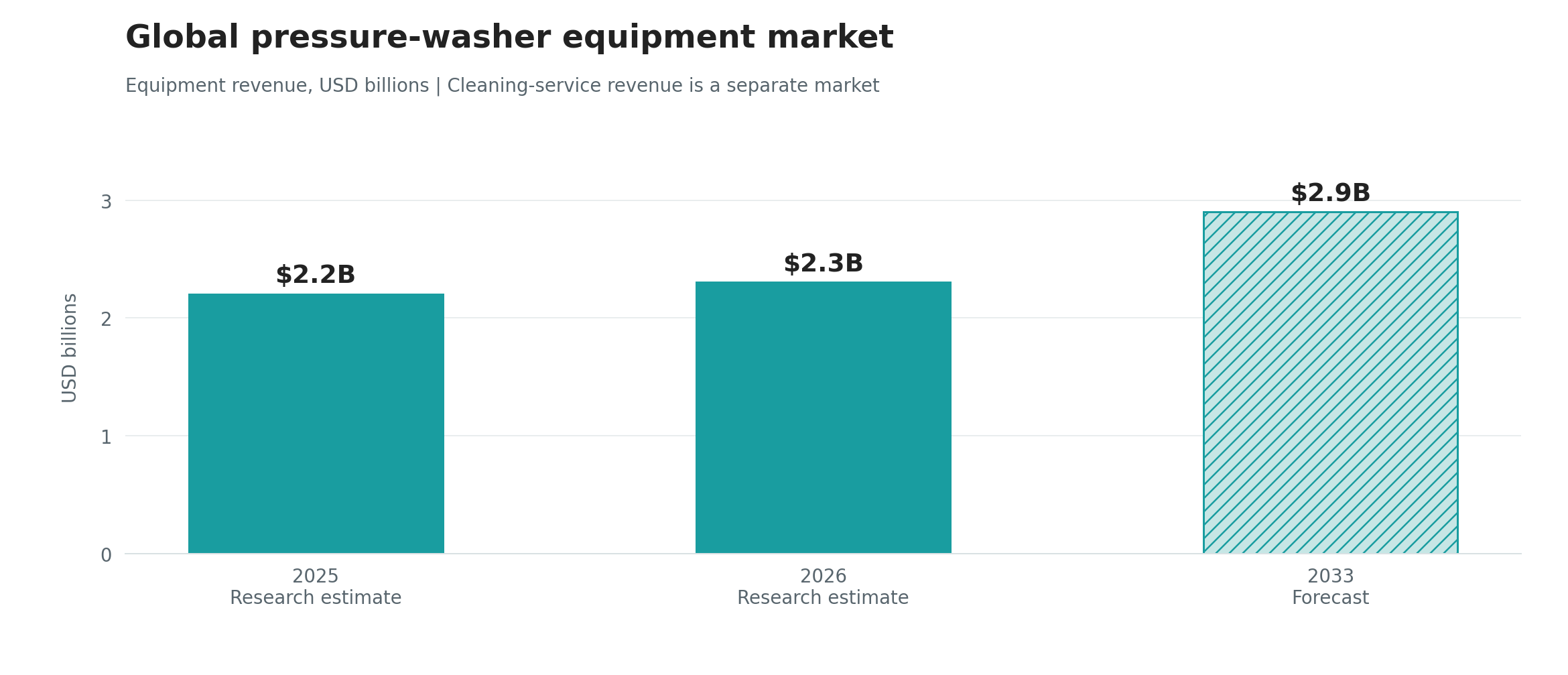
Chart 1. Global pressure-washer equipment market, USD billions. The 2025 and 2026 values are commercial research estimates; 2033 is a forecast from the June 2026 report. Equipment sales do not measure cleaning-service revenue.
Source: Grand View Research market report.
Validate locally by reviewing competing offers and interviewing homeowners, property managers, or real estate agents. Ask what needs cleaning, how often, how suppliers are selected, and what caused previous disappointments. Obtain permission before inspecting private property.
Regional conditions matter: freezing weather can shorten operating seasons, while humid conditions may create different cleaning needs. Confirm local water restrictions and customer willingness to pay. Evidence gathered for your local market research should explain why buyers would choose you, beyond a national growth headline. That is how to start a power washing business with a defensible customer hypothesis.
Someone investigating how to start a power washing business in a spread-out suburb should compare travel time with a denser neighborhood before committing advertising money. Ten attractive inquiries across a county may produce fewer billable hours than six nearby bookings. Map likely customers and test route assumptions during the hours you expect to work. Commercial districts introduce another constraint: access may be available only before opening or after closing, when noise and staffing need separate consideration.
Weigh the Advantages and Disadvantages
A small operation can avoid a storefront and begin with a focused service menu. Visible results are useful for referrals, and maintenance relationships may generate repeat work. However, someone still has to sell, schedule, clean, collect payment, and handle problems.
Potential advantage | Practical tradeoff |
|---|---|
Modest premises overhead | Storage, transport, and insurance still cost money |
Flexible initial schedule | Weather and customer access constrain working hours |
Repeat maintenance opportunities | Contracts require consistent delivery and follow-up |
Visible before-and-after results | Surface damage can overwhelm a job's profit |
Treat power washing business insurance as part of the operating model. A cheap policy with unsuitable exclusions can leave expensive gaps.
Knowing how to start a power washing business also means deciding whether you enjoy the less photogenic work: estimates, maintenance, bookkeeping, and answering customers while managing a physical workload. Try supervised training and small permitted practice projects before committing substantial savings.
How to Start a Power Washing Business With a Realistic Budget
Power washing startup costs depend heavily on your vehicle, service scope, local compliance obligations, and whether you rent or purchase equipment. The scenarios below are planning allowances prepared for this guide, not supplier quotations.
Initial cash allocation | Lean validation | Equipped solo operator |
|---|---|---|
Washer or initial equipment rental | $1,200 | $3,000 |
Hoses, surface cleaner, and accessories | $450 | $1,000 |
Runoff controls, PPE, and training | $650 | $1,500 |
Registration and permit allowance | $200 | $400 |
Initial insurance payment allowance | $350 | $650 |
Branding and print materials | $200 | $500 |
Website design and setup | $600 | $1,500 |
Initial domain and hosting allowance | $150 | $200 |
Software and launch marketing | $400 | $800 |
Working capital and contingency | $1,800 | $3,000 |
Total initial cash | $6,000 | $12,550 |
These power washing startup costs assume a suitable vehicle already exists. They exclude vehicle purchase, a dedicated trailer, personal living expenses, financing charges, and any additional tax or freight on purchases. Replace every allowance with local quotes before borrowing or committing funds. Extensive recovery requirements or commercial hot-water work can require a larger budget.
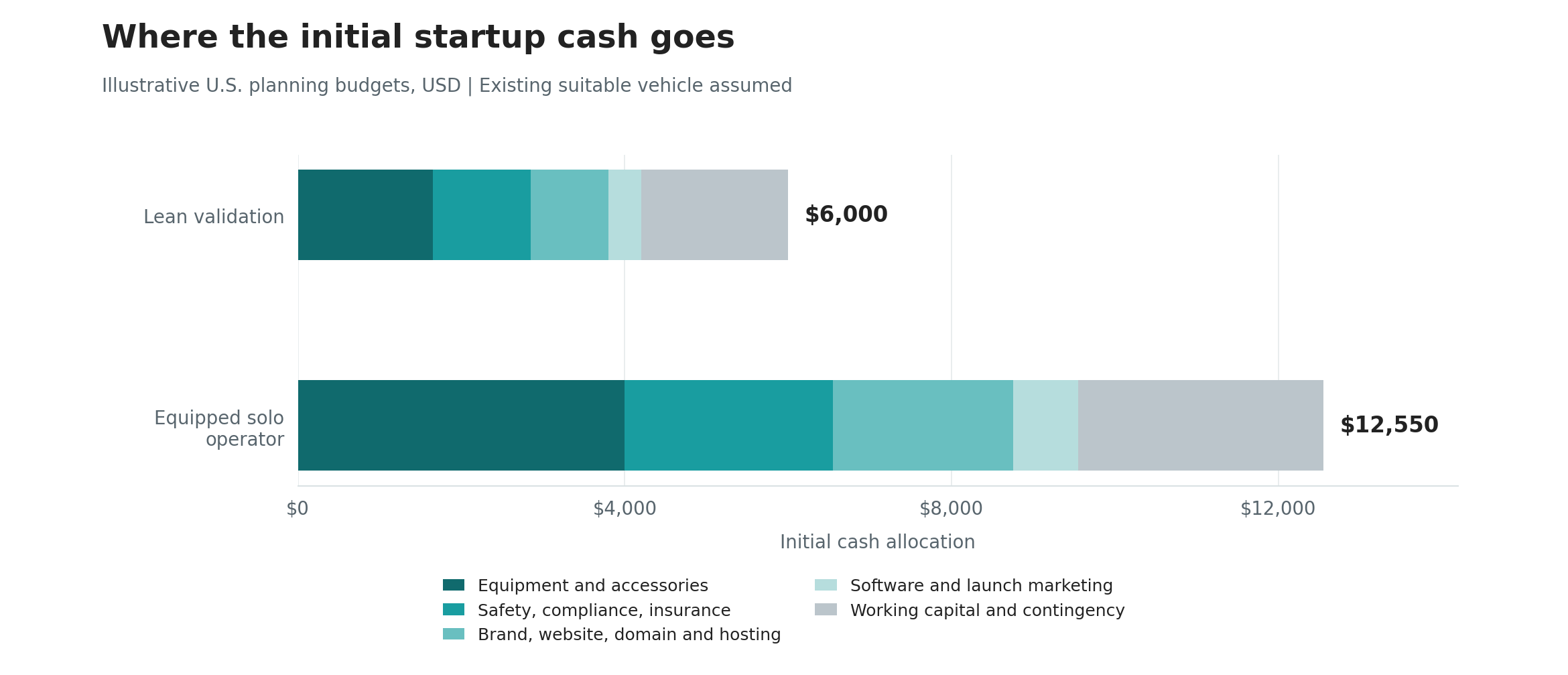
Chart 2. Illustrative initial cash required for two U.S. startup scenarios, USD, prepared November 2026. Assumes an existing suitable vehicle; includes reserves. These are planning assumptions, not measured industry averages.
Source: ZH Consultancy calculations from the budget table above.
Separate purchases from recurring cash commitments. Insurance installments, subscriptions, advertising, maintenance, storage, and fuel continue after launch. The insurance row funds an initial payment, not a guaranteed annual premium. Working capital stays available for operating expenses; it is not profit. Review power washing startup costs again after your first supplier and insurer conversations.
Calculate personal runway separately. If your household needs $2,500 monthly and the business cannot initially pay you, three months requires another $7,500 outside these operating budgets. This is an illustrative household assumption. Keeping it separate prevents personal withdrawals from silently consuming the reserve assigned to repairs and customer work. Funding discussions should cover both needs without describing living expenses as power washing startup costs.
Build a Business Plan You Can Actually Use
A power washing business plan should connect customers, capacity, and cash. A beautifully written revenue target does little good if it requires more jobs than your week can accommodate.
Start with an executive summary explaining the business concept, owner responsibilities, startup funding, and first milestones. Define customer profiles and compare competitors on scope, response time, evidence of quality, service coverage, and quoting process. Identify a credible selling proposition, such as dependable appointment windows and documented property protection.
Next, specify services, exclusions, pricing rules, suppliers, staffing, operating procedures, and the marketing channels you will test. A useful power washing business plan might initially target homeowners within a compact area, offering suitable concrete cleaning with a written minimum charge and optional patio work assessed separately.
Build monthly revenue projections from inquiries, quote acceptance, completed jobs, and average invoice value. Include bad-weather cancellations and time reserved for maintenance and administration. Your profit-and-loss forecast should separate revenue, job costs, overhead, and profit. The cash-flow forecast should show when customers actually pay and when annual bills or loan installments leave the bank.
Put a break-even calculation beside those forecasts. Stress-test fewer bookings, slower commercial payments, repairs, and a lower average ticket. Record the amount of cash you need to survive each scenario without relying on next week’s hoped-for sales.
The power washing business plan should end with measurable milestones: complete training, obtain coverage, secure the first five paid jobs, and compare estimated hours with actual hours. Business plan writing support can help organize the strategy; financial modeling services can help connect the assumptions to cash requirements.
Test payment timing explicitly. A hypothetical $2,000 commercial invoice collected next month does not fund this month’s fuel or wages. Track receivables separately from bank cash, agree invoice dates and approval contacts in advance, and avoid financing a slow-paying customer with money reserved for taxes. Where deposits are appropriate and lawful, state their terms clearly.
This is how to start a power washing business with a decision tool you can update, rather than a document that disappears into a drawer.
Check Registration Taxes and Local Rules
There is no single national checklist that settles every power washing job. Requirements depend on your state, municipality, business activities, and site. The SBA launch guidance provides a starting framework for registration, licenses, permits, and insurance.
Set Up the Business and Tax Records
Compare a sole proprietorship with an LLC using state rules and professional advice. An LLC generally separates the entity from its owners, but does not replace insurance or excuse unsafe work. Check business-name registration, any DBA, local business licenses, home-storage zoning, and whether restoration or coating preparation requires a contractor classification.
Open a separate business bank account and establish bookkeeping. Get an EIN when required; the IRS issues EINs free. Ask a tax professional about estimated taxes, deductions, and state sales-tax registration. For example, the Texas Comptroller explicitly treats pressure washing buildings, sidewalks, and parking lots as taxable building or grounds cleaning. Do not apply Texas treatment to another state automatically.
Resolve Wastewater and Surface Restrictions
Ask the stormwater authority and sewer utility how your particular wash water must be contained and disposed of. In Portland’s pressure-washing rules, discharge to stormwater is prohibited, and sanitary-sewer discharge requires approval. Other jurisdictions have their own requirements. A product labeled biodegradable does not grant permission to discharge it.
Paint disturbance adds another decision. Certain work affecting painted surfaces in pre-1978 homes or child-occupied facilities can trigger EPA lead-safe renovation requirements. Confirm applicability before accepting such work; ordinary cleaning and regulated renovation are not interchangeable categories.
Match Contracts and Insurance to the Work
Discuss general liability, commercial auto, equipment coverage, and pollution-related exposure with an insurance professional. Power washing business insurance should explicitly fit your surfaces, cleaning methods, and working heights. Ask about care-custody-control and damage-to-your-work exclusions. Before hiring, confirm workers’ compensation, payroll, wage, and training obligations.
A written agreement should define access, water supply, scope, exclusions, weather delays, payment, and complaints. Understanding how to start a power washing business includes paying for qualified legal, tax, or insurance advice where your circumstances require it.
Choose Equipment and Organize Safe Operations
Choose power washing equipment around surfaces and production needs. Pressure is only one specification; flow rate, duty cycle, parts availability, hose ratings, and local repair support also affect useful capacity. Rent or test suitable models before buying an oversized rig.
Your core setup may include a washer, compatible surface cleaner, rated hoses and fittings, nozzles, application tools, appropriate cleaning products, PPE, runoff controls, and secure transport. Confirm compatibility with the manufacturer’s documentation. Obtain written supplier terms for warranty, repairs, consumables, and spare parts.
Budget power washing equipment for the whole workflow, including recovery where required. A larger tank also creates a transport problem. At approximately 8.34 pounds per U.S. gallon, 100 gallons adds roughly 834 pounds before the tank and other equipment. Check payload, axle, trailer, towing, and securement limits. The USGS conversion reference supports the water-weight calculation.
Use a Repeatable Job Procedure
Assess the site, identify drains and electrical hazards, document existing damage, confirm scope, and test an inconspicuous area using the approved method. Protect occupants, plants, and nearby property. Set up safe access and runoff control before cleaning; inspect the result and document customer acceptance afterward.
Follow labels and safety data sheets when handling chemicals. Employee chemical instruction should reflect applicable OSHA hazard-communication requirements. Do not improvise chemical mixtures. Keep labeled containers secured in storage and transport.
The CDC’s pressure-washer safety guidance warns that injection wounds may initially appear minor and calls for prompt medical attention. Never direct spray toward anyone. Keep gasoline engines outdoors, at least 20 feet from doors, windows, and vents. Use manufacturer-specified electrical protection and task-appropriate PPE.
Inspect power washing equipment routinely, keep maintenance records, and arrange backup rental access. Decline unfamiliar roofs, fragile finishes, or contaminated sites until training, coverage, and procedures support them. That discipline belongs in any serious answer to how to start a power washing business.
Schedule shutdown and cleanup time as well. Drain, winterize, or store power washing equipment according to its manual and local conditions. Reconcile product inventory, replenish job supplies, and keep service records accessible. A missed maintenance interval can erase tomorrow’s appointments even when today’s cleaning went perfectly.
Set Prices and Understand Profitability
Pressure washing prices should reflect the work required to deliver the agreed result. Measure area, surface condition, access, travel, setup, recovery, cleanup, and risk. A square-foot rate can support an estimate, but a small awkward job may still need a minimum charge.
Here is one illustrative residential job, excluding sales tax. It is a model to test, not a statement of prevailing pressure washing prices.
Per-job model | USD |
|---|---|
Customer invoice | $300 |
Chemicals and consumables | $20 |
Travel fuel and vehicle allowance | $20 |
Payment-processing allowance | $9 |
Maintenance reserve | $11 |
Customer-acquisition allowance | $20 |
Contribution before owner labor and fixed overhead | $220 |
Owner labor value at 3 hours × $30 | $90 |
Contribution after owner labor allowance | $130 |
Assume $1,200 monthly fixed overhead, excluding owner labor and the job costs above. Ten completed jobs cover that overhead after the modeled owner labor allowance: $1,200 ÷ $130 = 9.23, rounded up. Six jobs cover overhead before that labor allowance, but would not fully compensate the owner at the assumed rate.
The overhead allowance covers insurance, software, storage, communications, and other fixed operating commitments. It excludes debt service and income taxes. Maintenance and customer acquisition are already allocated per job and are not deducted a second time. These planning reserves should not be mistaken for tax-accounting expense classifications.
At 30 jobs, revenue is $9,000. Job costs total $2,400, leaving $6,600. Subtract $1,200 fixed overhead to obtain $5,400 before tax and owner compensation. After valuing 90 owner hours at $30, the economic remainder is $2,700, or 30% of revenue. Owner drawings and labor allowances are not automatically deductible wages; tax treatment depends on structure.
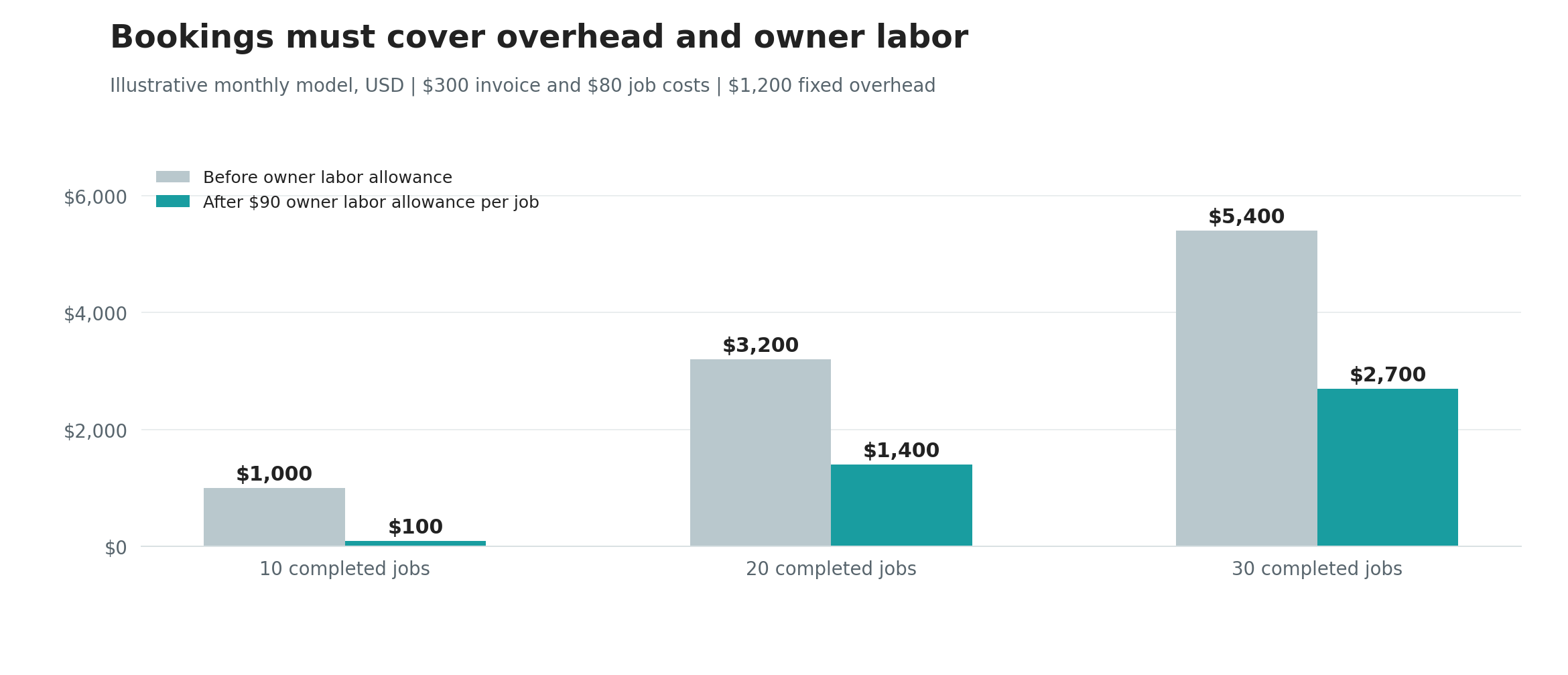
Chart 3. Illustrative monthly results at $300 per completed job, USD. Fixed overhead is $1,200; job costs are $80 each; owner labor allowance is $90 each. Model prepared November 2026; excludes income tax, debt service, and unlisted costs.
Source: ZH Consultancy calculations using the assumptions in this section.
Capacity still needs checking. Thirty jobs require 90 modeled job hours plus administration, training, and any uncounted selling time. Review actual hours before accepting that workload. A commercial customer paying after 30 days creates a funding gap even when the job shows a profit.
Revisit pressure washing prices when recovery requirements, labor, or acquisition costs change. Include equipment replacement and account for power washing business insurance in fixed overhead. Learning how to start a power washing business becomes much easier when each completed invoice improves the next estimate.
Create a Recognizable Name and Brand
Choose a name customers can pronounce, remember, and find again. Check state registration, relevant trademark conflicts, domain availability, and social handles before printing materials. A registered business name does not automatically settle trademark rights.
Your brand should communicate the service and the experience you can deliver. A simple, legible logo must remain recognizable on a phone, work shirt, estimate, and vehicle. Two usable colors and consistent typography usually accomplish more than a detailed illustration that disappears at small sizes.
Professional logo design can establish those basics. Keep practical applications consistent through graphic design services, including cards, signage, and proposal templates. Avoid claims such as fully insured until your documentation supports the work advertised.
If you are deciding how to start a power washing business on a tight budget, prioritize legibility and consistency. Repainting a truck because the phone number is unreadable is an expensive branding lesson.
Prepare Marketing Materials Buyers Will Use
A homeowner may only need a clear estimate, credible photographs, and payment instructions. A property manager may also require an insurance certificate, service schedule, safety information, and vendor details.
A short capability statement can describe your services, coverage area, operating procedures, and contact information. Include genuine project photographs with permission; label demonstration work honestly. Do not invent client logos or testimonials to make a new business appear older.
Company profile design becomes useful when you approach commercial buyers with a repeatable offer. Start with a concise digital document before ordering a stack of glossy brochures.
Keep the scope language in your brochure, website, and estimates consistent. A power washing business plan aimed at residential work should not accidentally advertise specialist industrial capabilities you cannot deliver.
Build a Website That Helps Customers Request Quotes
A visitor arrives between errands, looking at a stained patio on a phone. They need to know whether you serve their address, handle that surface, and can provide an estimate. Put those answers near a visible call or quote button.
Create separate pages for services with genuinely different customer questions. Show service areas accurately, real before-and-after photographs, customer testimonials with permission, and the factors affecting pressure washing prices. Your quote form should collect the address, surface, approximate size, photographs, and contact preference. Confirm receipt and state a realistic response window.
For anyone learning how to start a power washing business, website quality means making those tasks easy. Use readable text, keyboard-accessible controls, labeled fields, adequate contrast, compressed images, and fast mobile pages. Check the form on a real phone. Analytics should track calls and completed inquiries, with appropriate privacy and consent controls.
Choose a Platform Around Your Workflow
Platform | Useful fit | Decision to check |
|---|---|---|
WordPress | Flexible service pages and integrations | Hosting, updates, and plugin upkeep |
Wix | Managed site with booking tools | Plan limits and export flexibility |
Squarespace | Compact visual site with scheduling | Separate scheduling costs and features |
Shopify | Product sales alongside services | Booking apps and added complexity |
Specialist tools such as Jobber | Field-service requests and scheduling | Subscription, workflow, and website integration |
These are practical fit judgments; verify current features with each provider. Jobber’s booking documentation illustrates the distinction between a marketing website and an operational scheduling tool. Site inspection may still be necessary before confirming a fixed-price booking.
Own the Domain and Compare Renewal Costs
Register the domain in your own business account, enable two-factor authentication, and retain DNS and transfer access. Cloudflare Registrar advertises registration and renewal at cost; Namecheap’s domain table separates introductory and renewal prices. Compare the extension and eligibility conditions rather than assuming every promotion renews at the same amount.
For a verified hosting example, Hostinger Premium displayed $1.99 monthly with 48 months paid upfront at $95.52, renewing at $10.99 monthly for the same term, when checked November 4, 2026. Taxes and domain renewals may add cost; offers change. Check support, U.S. visitor performance, SSL, backup frequency, restoration, and expansion options before buying.
A freelancer may suit a focused build; an agency may offer broader coordination; a remote team needs clear communication and handover. Compare scope, ownership, QA, timelines, and support. ZH Consultancy provides website development remotely from Pakistan. Ask for a project-specific quote rather than assuming a published fixed price or guaranteed savings. Arrange updates, security, and website maintenance after launch.
Find Customers and Measure What Works
Start where customers already seek your service. An eligible service-area company can use Google Business Profile. Follow Google’s business-representation guidelines: use accurate information and hide a residential operating address when customers are not served there. Do not create fictitious storefronts to enter more cities.
Build useful local pages showing actual coverage, service limitations, and genuine work. Ask customers for honest reviews after completing the job, without buying praise. Google Business Profile support can help organize the setup, but rankings and inquiry volume cannot be guaranteed.
Test a Small Acquisition Campaign
Suppose you spend $400 on local advertising and receive 20 qualified inquiries. If eight become paid jobs, customer acquisition costs $50 per booked customer. That exceeds the $20 allowance in the earlier job model by $30 per job. At a $300 invoice, contribution after the same owner labor allowance becomes $100 rather than $130 for those customers.
This hypothetical test shows why clicks alone cannot establish campaign success. Record spend, lead source, qualified inquiries, quotes, bookings, cancellations, average invoice, contribution, and repeat purchases. Do not average away an unprofitable channel with referrals that cost little.
Digital marketing support should connect the campaign to these outcomes. Begin with one manageable area and service, then expand after collecting enough completed-job data to judge performance.
Develop referral relationships with real estate agents and property managers. Use social media for genuine results and explanations, and obtain permission for images. Offer seasonal reminders or maintenance reviews by email with appropriate consent and unsubscribe options. Send a useful follow-up rather than a weekly sales pitch.
Your first customers also improve your power washing business plan. Ask why they chose you and what nearly stopped them. This is how to start a power washing business with marketing that becomes more precise as evidence accumulates.
Solve Problems Before They Become Expensive
Slow inquiries often begin with unclear service coverage or a difficult form. Prospects abandon the process, leaving the owner blaming demand. Shorten the form, show the service area, and test response time. Measure whether qualified inquiries convert more often afterward.
Unprofitable jobs often begin with estimates that ignore setup or recovery. The invoice stays fixed while labor expands. Compare quoted and actual hours by surface, introduce minimum charges, and revise exclusions. The expected benefit is more dependable contribution per hour.
Weather gaps become cash crises when every dollar has already been committed. Keep reserves, use written rescheduling terms, and avoid assuming every available day is billable. Recalculate power washing startup costs if seasonal cash needs exceed the original reserve.
Damage disputes escalate when no one documented the property’s condition. Record inspection findings, test safely, explain limitations, and stop when conditions change. Review incidents with your insurer. Reassess power washing business insurance before adding unfamiliar services.
Learning how to start a power washing business involves building these feedback loops early, while correcting one estimate or procedure is still relatively inexpensive.
Avoid the Most Common Startup Mistakes
Buying for imagined future contracts locks cash into idle machinery. Test demand and verify access, capacity, and recovery needs before upgrading power washing equipment. A supplier’s most impressive rig may solve a problem you do not yet have.
Copying competitors’ pressure washing prices without knowing their costs can make a full calendar financially exhausting. Track your own job duration and acquisition costs. Keep enough cash for taxes, repairs, and customer payment delays.
Other avoidable errors include depending on one lead platform, promising complete stain removal without testing, hiring before documenting procedures, and advertising services outside your competence. Use written scope and change approvals when conditions differ from the estimate.
If you are learning how to start a power washing business while still employed, protect both schedules. Do not promise weekday appointments or emergency response you cannot reliably provide. A smaller honest commitment is easier to build on than a reputation for missed visits.
Prepare for Future Growth
Growth can come from better route density, repeat maintenance, and reduced rework before it comes from another truck. Add services only when training, demand, equipment capacity, and coverage support them.
Online requests, reminders, scheduling, and payment links can reduce administrative effort. AI can help draft routine replies or summarize job notes, but a person should verify prices, site risks, and customer commitments. Never manufacture before-and-after images as proof of completed work.
Equipment forecasts suggest continued investment in the category, but do not establish future profit for an individual operator. The October 2026 Harvard remodeling outlook projects relatively flat homeowner improvement and repair spending into late 2027. That broader context supports conservative planning rather than assuming a booming local cleaning market.
Review power washing equipment utilization, customer retention, and power washing business insurance before expanding. Take a second crew seriously only when your records show repeatable demand and enough margin to fund supervision.
Follow a Practical 90 Day Launch Plan
Days | Main work | Evidence before progressing |
|---|---|---|
1–15 | Interview buyers and compare local offers | Defined customer and service hypothesis |
16–30 | Plan finances and check legal requirements | Quotes, cash forecast, and compliance checklist |
31–45 | Train and test operating procedures | Safe practice results and suitable equipment |
46–60 | Build branding, website, and estimate templates | Tested phone and inquiry workflow |
61–75 | Run small campaigns and secure initial work | Paid-job costs and customer feedback |
76–90 | Refine prices, routes, and follow-up | Evidence supporting the next spending decision |
Adjust this schedule for permits, weather, and training. A 90-day plan is a working sequence, not a reason to accept work before you are ready.
The Takeaway
The best answer to how to start a power washing business begins with a small, well-defined service and a customer who has a reason to buy it. Validate demand, learn safe methods, confirm local requirements, and price the entire job.
Use your power washing business plan to connect those decisions. Protect cash, document results, and expand only when completed work supports the next commitment. If you need help turning those assumptions into a practical launch strategy, ZH Consultancy can support planning, branding, and digital delivery remotely from Pakistan.
Faq
Frequently Asked Questions
The illustrative power washing startup costs in this guide are $6,000 for lean validation and $12,550 for an equipped solo operation. Both assume an existing suitable vehicle. Your local equipment, insurance, recovery, tax, and personal living requirements can change the amount substantially. Obtain quotes first.
Check state and municipal business requirements and any contractor rules applying to your activities. There is no single national license that settles every service. Wastewater authorization, sales-tax registration, storage restrictions, and paint-disturbance requirements may also apply to particular work.
Discuss general liability, vehicle use, equipment, workers’ compensation when relevant, and pollution exposure. Power washing business insurance needs to match your actual surfaces and methods. Ask an insurance professional to explain exclusions in writing rather than treating an insurance certificate as proof that every job is covered.
Estimate total time, direct expenses, travel, recovery, overhead contribution, and an appropriate return. Pressure washing prices should also reflect access and surface condition. Use a minimum charge where justified and give customers a written scope. Reconcile the estimate with actual costs after completing the job.
Yes, a limited service and rental arrangement can test demand before a larger purchase. Confirm availability, compatibility, training, transport, and insurance first. Customers still need clear appointment windows and safe professional delivery; part-time status does not reduce those obligations.
Do not assume that permission exists. Wash water can contain pollutants even without detergent. Ask the local stormwater authority and sewer utility about containment and disposal for your work. Portland’s prohibition and sewer-approval process are a local example, not a substitute for your own jurisdiction’s rules.
Use a focused service area, an eligible Google Business Profile, a clear quote page, genuine project evidence, and referral outreach. Test modest advertising and track paid bookings and contribution. Secure a few safely completed jobs, learn from them, and ask satisfied customers for honest reviews.

Zain Hameed
Business strategy specialist helping a global client base of 800+ businesses build credible plans, financial models and investor-ready presentations.
In this article
Book a Free Consultation
Have a business idea, growth challenge or investor deadline? Book a free consultation and get clear next steps from our team.
Call our team
+923104049517
Email us

Business Topics
Business topics
Continue reading
Related insights

Website Development Cost UK (2026): Pricing Guide 2027
Compare UK website build prices in pounds and plan a 2027

UK Web Development Agency vs Remote Agency: Costs, Quality and Support
Choosing a UK web development agency vs remote agency? Compare first-year

How to Choose a Website Development Agency in Sussex
Three quotes land in your inbox for a new website for

How to Start a Laundromat Business: A Complete U.S. Founder’s Guide
Learn how to start a laundromat business in the USA: market

How to Start a Construction Business in the USA
A homeowner wants to sign a $75,000 remodeling contract on Friday.

How to Start a Plumbing Business in the USA
At 7:15 on Monday morning, a homeowner calls about water coming