

In this article
A warehouse manager has new hires arriving Monday, a driver waiting for clearance, and nobody available to escort employees across town. A mobile collector can remove the travel problem. But the employer still needs a lawful testing program, an appropriate collection site, and results delivered through the right channels.
That is the opportunity: make a demanding process easier without weakening it.
Learning how to start a mobile drug testing business begins with defining your role. Most new operators should evaluate specimen collection and coordination with established laboratories before considering analytical testing. A branded van does not turn a collection company into a laboratory.
This U.S. founder guide covers customer validation, qualifications, illustrative budgets, employer contracts, and digital marketing. Federal transportation requirements are distinguished from non-DOT workplace policies. State rules and your actual services determine additional obligations; have qualified advisers review them before launch.
The practical route is to prove demand within a manageable territory, qualify for specific services, secure reliable partners, and price the entire visit. Buy a larger vehicle when confirmed work justifies it.
How to start a mobile drug testing business with a clear service model
Mobile drug testing services bring trained personnel and collection equipment to an employer or another approved location. Customers may include transportation employers, staffing agencies, industrial businesses, and occupational health providers needing additional coverage. Their requirements differ, so choose one initial segment.
In a collection-only model, the client or its consortium/third-party administrator, known as a C/TPA, arranges the laboratory and medical review. You invoice for collecting and transferring specimens. In a coordinated model, you arrange those partners and invoice an agreed package. Your margin must cover their charges.
DOT drug testing applies to covered transportation programs and follows federal procedures. Non-DOT testing follows the applicable employer policy and laws. Hair collection or permitted rapid screening can belong to a non-DOT offering, but neither automatically substitutes for a federally required test.
For anyone deciding how to start a mobile drug testing business, service boundaries belong in writing. Specify specimen types, programs, operating hours, travel limits, and exclusions. Add alcohol testing only after arranging the separate training, equipment, and maintenance it requires.
On-site drug testing may use a suitable employer restroom rather than a vehicle restroom. You are selling a controlled service delivered at the right location, not necessarily a mobile clinic.
Research market demand before buying equipment
Grand View Research values the global drug testing market at $7.1 billion in 2025, estimates $7.5 billion for 2026, and forecasts $11.5 billion by 2033. Its projected 2026–2033 annual growth rate is 6.3%. These are the research firm’s estimates across products and services, including workplace and hospital applications, not measured revenue for U.S. mobile collectors.
No verified nationwide count of mobile collection businesses is established here. A more useful local demand signal is the number of covered employers, their workforce sizes, and their dissatisfaction with existing collection arrangements.
DOT’s 2026 rate schedule sets minimum annual random drug-testing rates of 50% for FMCSA, FTA, and PHMSA covered programs, and 25% for FAA. These apply to covered populations and programs, not every employee at every transportation business.
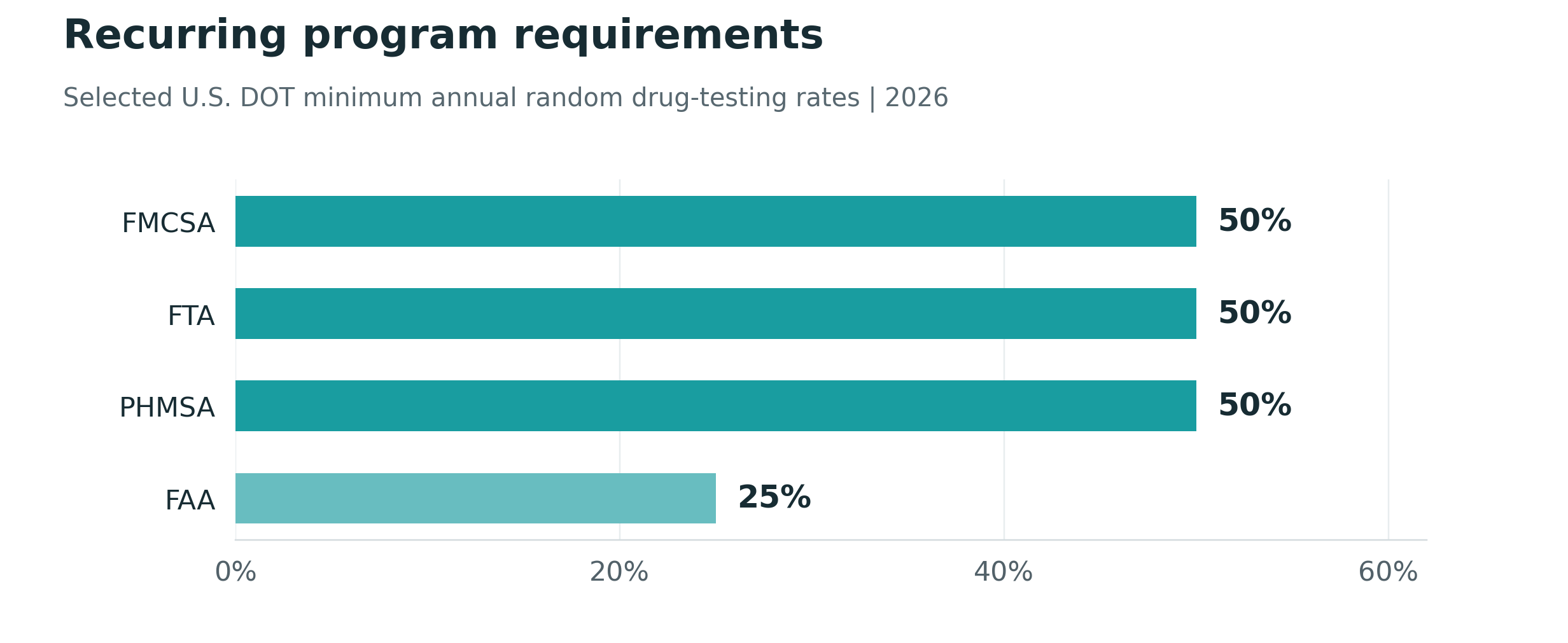
Figure 1. Selected U.S. DOT minimum annual random drug-testing rates for 2026, percent. These requirements indicate recurring program activity, not mobile-provider market share or guaranteed appointments. Railroad programs have separate category-specific rates and are omitted.
Source: U.S. Department of Transportation 2026 random testing rates.
Interview 15–20 local buyers about current providers, travel disruption, appointment delays, collection volumes, and purchasing authority. Ask whether they can authorize a paid pilot. Test demand for mobile drug testing services with actual buying conversations rather than general enthusiasm.
Ask which on-site drug testing arrangements they have actually used, when clinics are unavailable, and what would justify switching. Account for shift patterns and weather-related travel disruption. A nearby industrial client with regular group visits may be more valuable than a distant account with occasional urgent calls.
Research industrial parks, freight corridors, and clinic coverage gaps. ZH Consultancy’s market research services can help structure competitor and customer analysis. Your resulting territory should reflect drive time and viable contracts, not a large circle drawn on a map.
Weigh the advantages and disadvantages
The attractions are real: employer relationships can generate repeat work, scheduled group visits spread travel costs, and a collection-only launch may avoid a permanent clinic lease. An owner can also begin with a narrow service area and expand selectively.
The constraints deserve equal attention. Hiring-related demand fluctuates, documentation mistakes can require repeat visits, and a long emergency call can disrupt scheduled appointments. Laboratory invoices may fall due before an employer pays you.
Potential advantage | Operational tradeoff |
|---|---|
Repeat employer work | Contracts may promise no minimum volume |
Lower premises overhead | Every temporary collection site still needs assessment |
Group collection efficiency | Staffing and arrival schedules must be coordinated |
After-hours opportunities | Reliable backup coverage adds cost |
When weighing how to start a mobile drug testing business, consider your tolerance for paperwork and unpredictable calls. Clinical experience can help with professional communication, but it does not replace program-specific qualification. This business rewards disciplined operators more than enthusiastic equipment buyers.
Estimate drug testing startup costs
The following drug testing startup costs are illustrative U.S. planning allowances prepared for this guide in November 2026. They are not supplier quotations, industry averages, or official ZH Consultancy prices. Both scenarios assume access to an existing suitable vehicle and compliant client facilities.
Startup item | Focused launch USD | Expanded launch USD |
|---|---|---|
Training and proficiency work | $1,200 | $2,500 |
Registration and legal review | $800 | $1,500 |
Initial insurance payments | $1,500 | $3,000 |
Collection and shipping supplies | $900 | $1,800 |
Secure technology setup | $1,200 | $2,200 |
Vehicle preparation and storage | $1,000 | $4,500 |
Branding and print materials | $500 | $1,200 |
Website domain and hosting setup | $1,800 | $3,500 |
Initial customer outreach | $600 | $1,500 |
Working capital reserve | $6,500 | $12,000 |
Total planning cash | $16,000 | $33,700 |
A purchased vehicle, restroom conversion, financing, alcohol instruments, employees, and unusually demanding local licensing could increase these totals substantially. Obtain written quotations before committing. Registration and design are usually setup expenses; laboratory charges, subscriptions, fuel, insurance renewals, and replenishment recur.
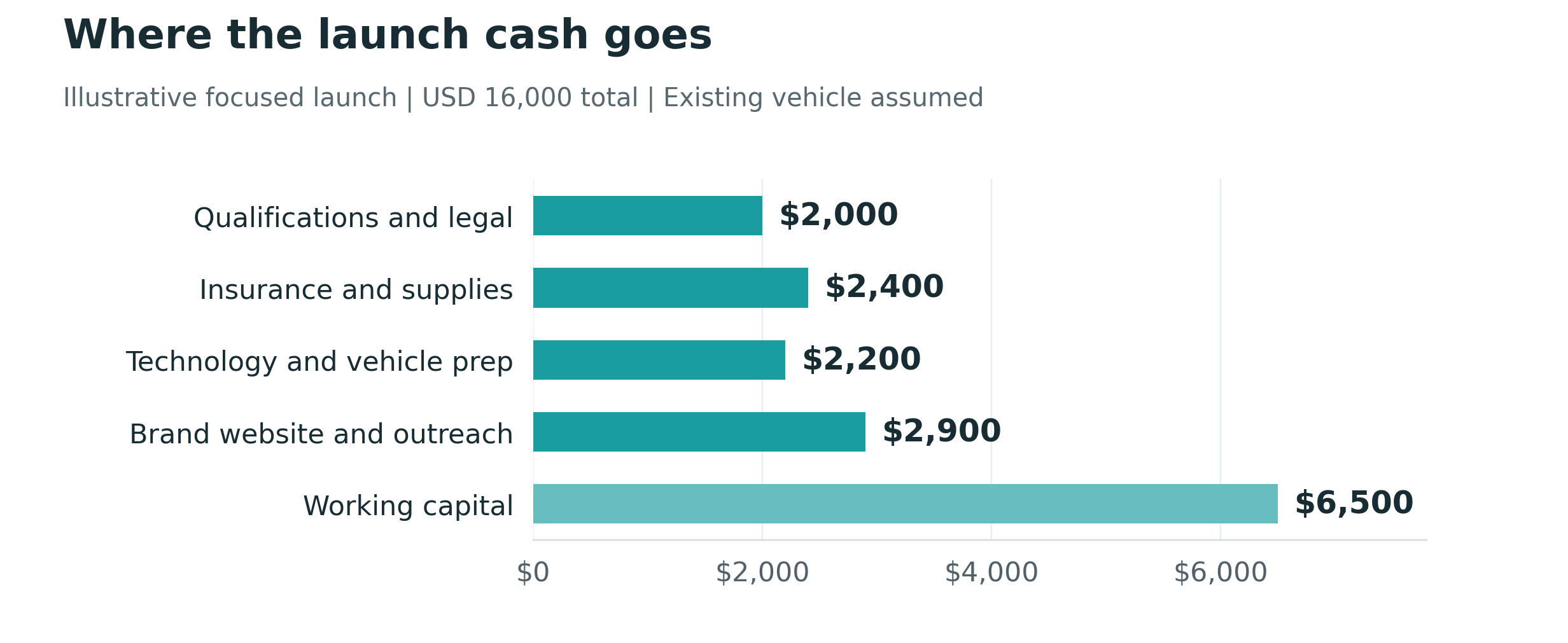
Figure 2. Illustrative focused-launch cash allocation, USD, November 2026. Setup categories total $9,500 and working capital adds $6,500. Existing vehicle assumed; vehicle purchase and clinic conversion excluded. Actual requirements vary.
Source: Author’s planning example in this guide; arithmetic derives from the startup table above, not an industry survey.
In learning how to start a mobile drug testing business, protect liquidity first. Working capital pays partner invoices while contracts develop. Keep a separate household reserve: the table does not fund your personal living expenses or guarantee enough runway for every business.
Build a drug testing business plan around real buyers
A useful drug testing business plan connects demand, delivery capacity, and cash. Write an executive summary explaining the customer, territory, service scope, and reason buyers would switch. An example concept is scheduled collections for small local fleets, with urgent work accepted only when qualified backup is available.
Define the customer profile: fleet size, decision-maker, existing testing program, current supplier, and buying cycle. Compare competitors on hours, collection options, documentation quality, and response coverage. Your selling point might be coordinated early-morning visits rather than the lowest advertised test price.
Describe workflow, partners, staffing, training records, supplies, and escalation responsibilities. Include marketing channels, proposal terms, startup investment, monthly expenses, revenue assumptions, profit and loss, cash flow, break-even, and milestones. Professional business plan support can organize these decisions into a coherent operating document.
Your drug testing business plan should model a slow case, a base case, and capacity limits. Forecast signed customers separately from unqualified prospects. A client saying it has 100 workers does not mean it will buy 100 collections each month.
For example, begin with two paid pilots and enough scheduled demand to test route efficiency. Set review gates for repeat purchases, collections completed without preventable errors, payment timing, and contribution per visit. Delay hiring if those measures disappoint.
Financial modeling support can help test late payments and lower volumes. Knowing how to start a mobile drug testing business includes deciding when to stop spending: specify the cash balance or sales shortfall that triggers a revised launch plan.
Meet legal requirements and qualify for your exact scope
How to start a mobile drug testing business legally
An LLC may offer liability separation when properly maintained, while a sole proprietorship is simpler but lacks that entity-level separation. Neither structure excuses professional mistakes. Use the SBA launch guidance to identify registration, permits, banking, and insurance steps; confirm specifics with state and local authorities.
Apply directly through the IRS EIN service when required; the IRS does not charge for an EIN. Ask an accountant about estimated taxes, payroll, and whether your state taxes the particular services you sell. Check home-business rules, mobile collection permissions, and any applicable laboratory or healthcare licensing.
Complete DOT qualifications before collecting
For DOT drug testing urine collections, 49 CFR 40.33 requires qualification training and five consecutive error-free mock collections with a qualified evaluator. Maintain documentation, keep current with guidance, and complete refresher training at least every five years. A canceled test caused by a collector error can trigger additional corrective training requirements.
DOT explains that it does not certify collectors. A private course certificate is evidence to examine, not government endorsement. Check that its documentation covers the required instruction and proficiency demonstration.
Breath Alcohol Technicians require separate qualification under 40.213, including seven consecutive error-free mock tests; Screening Test Technicians require five. Training is device-specific. Budget approved equipment and its quality-assurance obligations before adding alcohol services.
Separate collection from analysis and medical review
Use HHS-certified laboratories eligible for DOT work. A qualified Medical Review Officer, or MRO, is a physician meeting additional requirements. Collectors do not become MROs through collection training.
CMS distinguishes collection-only facilities from laboratories. It also identifies certain employment and forensic testing exceptions. Testing for diagnosis, treatment, or health assessment may require CLIA certification. Ask the state CLIA agency and licensing authority about your exact activity rather than assuming every rapid test is exempt.
Review consent privacy and employment rules
Non-DOT drug policies require jurisdiction-specific review. New York Labor Law 201-d, for example, protects qualifying lawful off-duty cannabis use, subject to statutory exceptions. An employer’s request does not by itself make a proposed panel or testing reason lawful.
HHS explains that employer employment records generally fall outside HIPAA, while covered-provider disclosures raise different issues. Determine your actual status, authorizations, contracts, and state privacy duties. Secure records regardless. Legal review is a practical step in how to start a mobile drug testing business responsibly.
Ask a broker about general and professional liability, cyber coverage, business-use auto protection, and applicable workers’ compensation. Disclose specimen collection explicitly and check exclusions. Put service scope, fees, cancellations, responsibilities, confidentiality, and complaint handling into customer agreements.
For on-site drug testing, specify who supplies a suitable room, who authorizes orders, and how privacy problems are escalated. Have counsel review liability allocation and dispute terms before using a template across different states.
Set up equipment partners and dependable operations
Choose partners before ordering supplies
Compare laboratories and C/TPAs on eligible programs, account ownership, specimen acceptance, kit availability, shipping cutoffs, invoicing, result routing, and support when documentation is incomplete. Confirm who contracts with the MRO and who communicates verified results to the employer’s designated representative, or DER.
Request a written responsibility chart. If your partner handles random selection, define the handoff and confidentiality controls. Selling administration adds obligations beyond providing mobile drug testing services, so start with the scope you can supervise competently.
Carry approved program-specific kits, current forms, seals, gloves, cleaning supplies, site-security materials, packaging, and secure transport storage. Use a device with access controls and a documented backup process. Track inventory, expiration dates, and replacements; an extra box is cheaper than abandoning a remote appointment.
Verify each location and document the collection
DOT 40.42 permits mobile and other locations that meet its requirements. A clean van alone is insufficient. Assess suitable urination facilities, privacy, handwashing arrangements, workspace, controlled access, and secure temporary specimen handling.
For on-site drug testing, obtain facility details before dispatch. Follow 40.43 site-security requirements, including tampering controls and rechecks. Have an alternative when a location cannot be secured. Never improvise an unsuitable restroom because employees are waiting.
Use the current DOT collection guidelines and partner procedures. Train for identity checks, authorization, labeling, seals, custody documentation, transfer, insufficient specimens, and other problem collections. This guide is a business plan resource, not a replacement for procedural training.
Keep DOT and non-DOT orders distinct. 40.41 prohibits routinely substituting nonfederal forms for federal collections or using the federal form for nonfederal collections. Verify the correct electronic or paper process before arriving. For DOT drug testing, confirm the covered agency and reason for testing with the order authorizer.
Prepare for disruptions and staffing
For qualifying FMCSA post-accident events, agency guidance identifies eight-hour alcohol and 32-hour drug-testing outer limits. Testing should be prompt; these are not promised response windows or universal rules for every incident. Have the employer determine the applicable testing requirement and urgency.
Maintain backup collectors, alternate transport, incident contacts, and written lone-worker procedures. Verify each worker’s qualifications and employment classification. Record preventable errors, missed windows, turnaround stages, and complaints. Supervised onboarding protects consistency when you expand beyond the founder.
Set prices and calculate revenue profit and cash flow
Drug testing startup costs explain entry; contribution explains survival. Price collection, laboratory work, medical review, dispatch, mileage, waiting, and after-hours availability explicitly. A collection-only quotation cannot be compared directly with an all-inclusive package. Quote DOT drug testing by its specific program and service inclusions; the federal label does not establish your price.
Suppose your illustrative average invoice is $95 per completed collection on efficient scheduled routes. Variable cash costs are $25 for laboratory/MRO services, $6 for kits and shipping allocation, $5 for travel allocation, and $2 for payment costs: $38 total. Confirm real partner quotations; this is not a market tariff.
Contribution is therefore $57 per collection. Assume monthly fixed overhead of $1,800 and a working owner targeting $4,000 in compensation before personal tax. No employee wages or vehicle finance payments are included; add them if applicable.
Monthly calculation at 140 collections | Illustrative USD |
|---|---|
Revenue at $95 each | $13,300 |
Variable costs at $38 each | $5,320 |
Contribution | $7,980 |
Fixed overhead | $1,800 |
Operating surplus before owner compensation and tax | $6,180 |
Owner compensation target | $4,000 |
Residual before tax and unlisted costs | $2,180 |
Operating break-even is $1,800 divided by $57, rounded up to 32 collections monthly. Covering the owner’s target requires $5,800 divided by $57, rounded up to 102. The $6,180 surplus is not passive profit: it includes the working owner’s labor. The $2,180 residual is about 16.4% of revenue before tax and unlisted costs.
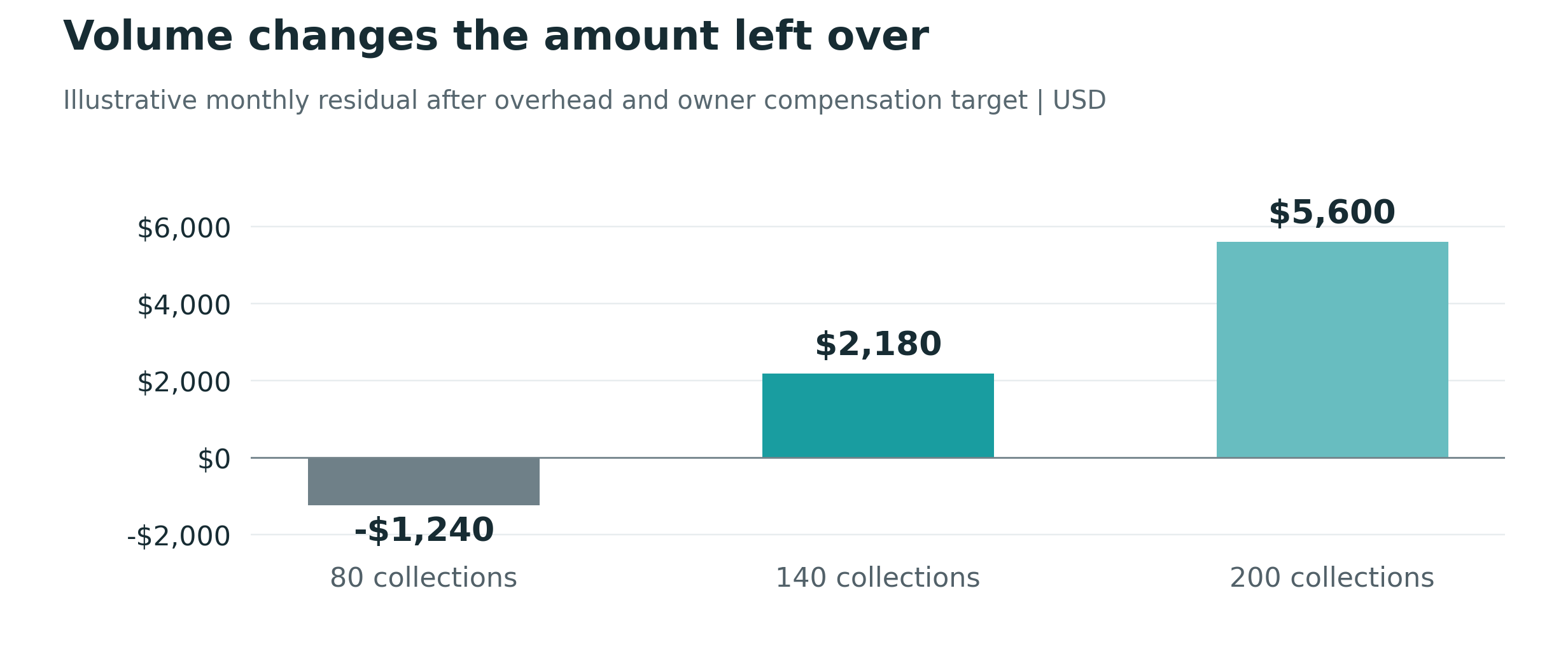
Figure 3. Illustrative monthly residual after $1,800 overhead and a $4,000 owner compensation target, USD. At 80, 140, and 200 collections, residuals are −$1,240, $2,180, and $5,600. Assumptions: $95 revenue and $38 variable costs per collection. Capacity and costs may change at higher volumes.
Source: Author’s financial example in this guide; scenario calculations, not observed earnings.
If you are evaluating how to start a mobile drug testing business part time, model available hours too. Travel, paperwork, sales, and problem collections constrain volume. A hypothetical 140 collections across 20 working days averages seven daily, but clustered workplace visits and scattered single visits have very different capacity requirements.
Cash flow can fail despite accounting profit. Negotiate billing terms, monitor receivables weekly, and set a minimum visit charge. Build the collection schedule and payment delays into your drug testing business plan before committing to fixed overhead.
Brand your mobile drug testing services professionally
Choose a name that is easy to say, spell, and remember. Check state business-name records, relevant trademark conflicts, domain availability, and social handles. Avoid names that imply government approval, guaranteed outcomes, or a laboratory you do not operate.
Brand mobile drug testing services around reliability, discretion, and employer convenience. A readable wordmark, restrained colors, consistent typography, and clear contact details will usually work harder than a complicated medical symbol.
Professional logo design should include usable files for invoices, uniforms, vehicle graphics, and a small website header. Keep sensitive donor information off visible paperwork and promotional photos.
An understated vehicle mark can help employer identification, but consider client privacy before advertising the purpose of every visit. Your positioning should explain who you serve and how scheduling works without implying that your staff makes employment or medical decisions.
Create useful company profiles and marketing materials
An employer buying on-site drug testing may need a short capability statement for procurement. Include scope, territory, collector qualifications, insurance availability, dispatch contacts, and the reporting process. Present only verified credentials and actual partner arrangements.
A two-page company profile can help when approaching safety managers or clinics. Company profile design support is useful once the underlying service and evidence are clear. A solo launch rarely needs an expensive brochure collection.
Prepare a proposal template, plain-language fee schedule, service agreement, site-readiness checklist, and appointment instructions. Business cards remain useful during industrial-park visits. Keep claims consistent across print, email, and the website.
Use anonymized operational examples only when permitted. Never invent client logos, testimonials, or performance statistics. As contracts accumulate, document measurable service improvements with customer permission rather than promising outcomes you cannot control.
Build a website that helps employers book correctly
Explain the service and keep sensitive information separate
A buyer should quickly find your territory, hours, service scope, booking method, and phone number. Create useful pages for employer collections, DOT drug testing collections where qualified, permitted non-DOT options, and group appointments. Explain collection timing separately from laboratory and MRO processing.
Publish fee inclusions or clear quotation criteria. Show legitimate credentials and testimonials with permission. For urgent work, display a staffed dispatch number and actual availability. A form notification sitting unread overnight is not emergency coverage.
Ask for employer contact details, location, estimated group size, and requested service. Do not request donor diagnoses, medications, identification documents, or test results through a general enquiry form. Route sensitive workflows through an appropriately configured partner system.
Compare platforms and ownership costs
Platform | Good initial use | Main decision |
|---|---|---|
WordPress | Custom service pages and local SEO | Arrange hosting updates backups and security |
Wix | Managed site with simple enquiries | Check plan features scheduling and renewal costs |
Squarespace | Compact service site and presentation | Confirm scheduling integrations and ongoing fees |
These are practical fit judgments based on WordPress features, Wix plans, and Squarespace plans. Public-site software is not automatically suitable for sensitive test records. Shopify is generally unnecessary unless selling products is a substantial part of your model.
Buy a domain through a reputable registrar using your business-controlled account and email. Enable multifactor authentication and renewal reminders. ICANN cautions that renewal prices can exceed introductory offers. Compare the full renewal term, email, backups, support, SSL, migration, and restoration charges rather than one promotional monthly figure.
For hosting, assess support availability, restore testing, performance near your users, and room to grow. A founder seeking how to start a mobile drug testing business needs a dependable enquiry channel before an elaborate custom application. Test on phones, with keyboard navigation and readable contrast; keep pages fast and forms clearly labeled.
Choose a delivery team and maintain the site
A local agency may provide convenient coordination, a freelancer may suit a small scope, and a remote team may offer competitive delivery. Compare relevant work, written specifications, ownership, accessibility, quality checks, handover, communication, and support terms. Obtain comparable quotations; low price alone proves little.
ZH Consultancy is based in Pakistan and provides website development services remotely. Agree deliverables and access responsibilities in writing. Budget website maintenance for updates, backups, monitoring, and recovery. Track qualified enquiries with analytics while excluding sensitive donor data from tracking tools.
Win employer contracts through focused customer acquisition
When deciding how to start a mobile drug testing business, plan how each initial buyer will find and assess you. Build a prospect list of fleet managers, HR managers, staffing firms, and occupational health providers in your actual territory.
Lead outreach with a specific operational issue: missed early shifts, long clinic trips, or difficulty scheduling groups. Offer a paid pilot with clear responsibilities. Follow up with a proposal that specifies site readiness, pricing, notice, volume assumptions, and support. Recurring agreements should distinguish reserved availability from guaranteed purchases.
For local search, create accurate service-area pages and an eligible Business Profile. Google’s guidelines say service-area businesses should hide an address where customers are not served; do not manufacture virtual locations. Google Business Profile support can help organize accurate local information.
On-site drug testing searches can attract job applicants and employers with different needs. Separate employer landing pages from individual appointment enquiries. Use search advertising only where your service, qualification, and response coverage match the promise.
A hypothetical $600 monthly campaign producing 12 qualified employer leads and two new contracts has a $50 qualified-lead cost and $300 customer acquisition cost. Those are assumptions, not expected results. Compare acquisition cost with contribution from retained accounts, not first-month revenue alone.
Google Ads management can help control irrelevant traffic, while a broader digital marketing strategy can coordinate outreach, SEO, referrals, and permitted email follow-up. Avoid donor-targeted remarketing or testimonials that reveal private test information.
Solve the operating problems that erode margins
Long journeys with small invoices
An overly wide territory produces unpaid driving and delayed appointments. Track contribution per visit and per working hour. Cluster scheduled clients, set dispatch zones, and charge for waiting and distance where agreed. Better route economics can outperform a higher headline test price.
Recollections and incomplete documentation
A wrong account number or missed seal detail can create rework and customer frustration. Use approved order verification, documented collector training, and internal quality review. Record root causes and follow the required correction process. The benefit is fewer preventable failures, not a guarantee that every specimen will yield a result.
Late payments and concentration risk
One large employer can fill the calendar while draining cash if invoices remain unpaid. Set credit terms, reconcile completed orders, and diversify deliberately. Update your drug testing business plan using actual payment days and customer concentration rather than assuming every issued invoice becomes immediate cash.
Service promises that exceed staffing
Promising continuous availability with one collector creates fatigue and missed calls. Publish sustainable hours, contract with qualified backup, and monitor response performance. Building mobile drug testing services around coverage you can maintain protects both client confidence and the founder’s schedule.
Avoid expensive startup mistakes
Drug testing startup costs become harder to recover when founders purchase a converted clinic before securing customers. Validate whether client facilities can support your lawful service model first. A larger vehicle is a capacity decision with maintenance and financing consequences.
Another mistake is accepting every requested service. Court-related testing, healthcare monitoring, hair collection, and alcohol testing can introduce different standards. Expand only after confirming competence, legal requirements, partner acceptance, insurance, and pricing.
Avoid copying another provider’s fee without examining inclusions. Do not label an unconfirmed screen as a final positive, interpret results for the donor, or advise employers to bypass their legal obligations.
Keep spare supplies, backup contacts, and a documented data-recovery process. Review contracts before offering unlimited travel, unlimited waiting, or guaranteed laboratory turnaround. Your early objective is a repeatable, dependable operation with evidence of demand, rather than the longest possible service menu.
Watch technology regulation and growth opportunities
DOT 40.210 authorizes urine and oral-fluid specimen types within its laboratory-based framework and excludes instant or point-of-collection drug tests and hair testing. Authorization does not mean every new testing method is operationally available.
At the November 2026 research check, DOT’s oral-fluid laboratory page still stated that there were no HHS-certified oral-fluid laboratories and that two are needed before employers can begin that option. The page displayed a December 2024 update date. Recheck the live list and partner readiness before offering DOT oral-fluid collections; separate oral-fluid collector qualifications also apply.
Electronic custody systems and scheduling integrations may reduce duplicate entry, but require approved workflows, access controls, and staff practice. AI can assist with appointment planning or general marketing drafts; do not feed identifiable donor records into unapproved tools or delegate medical interpretation to them.
Growth can come from denser routes, clinic subcontracting, additional qualified collectors, and carefully priced availability agreements. Understanding how to start a mobile drug testing business also means revisiting costs as labor, insurance, laws, and customer expectations change.
How to start a mobile drug testing business with a 90 day plan
Build your schedule around readiness gates, not a ceremonial opening date. How to start a mobile drug testing business in 90 days depends on training availability, authority responses, partner onboarding, and customer sales cycles. Delays in any of these can legitimately extend the timetable.
Period | Priority | Evidence before moving forward |
|---|---|---|
Days 1–15 | Validate segment and territory | Buyer interviews and plausible paid pilot prospects |
Days 16–30 | Plan register and check obligations | Scope legal review budget and insurance quotations |
Days 31–45 | Complete qualifications and partner setup | Documented proficiency and functioning accounts |
Days 46–60 | Prepare brand website and procedures | Tested enquiry flow site checklist and backup plan |
Days 61–75 | Run qualified paid pilot visits | Correct documentation and measured visit economics |
Days 76–90 | Review contracts cash and delivery | Repeat demand and evidence supporting next spending |
Recheck drug testing startup costs after obtaining actual quotes. Test the whole process, including an incomplete order and an unavailable facility. Only promise public availability once the operational handoffs work.
The Takeaway
The best answer to how to start a mobile drug testing business is a sequence of evidence-backed decisions: a viable employer segment, qualified collectors, suitable locations, reliable laboratory and review arrangements, and prices that cover the full visit.
Start with a service you can deliver consistently. Measure repeat demand, contribution, cash collection, and preventable errors before expanding equipment or geography.
Keep your drug testing business plan current as quotations become invoices and prospects become customers. If you need help turning the commercial decisions into a practical launch plan, ZH Consultancy can support planning, branding, and digital delivery from Pakistan for international clients.
Faq
Frequently Asked Questions
Before estimating drug testing startup costs, identify which training, locations, and partner responsibilities your model requires. The illustrative budgets in this guide are $16,000 for a focused launch and $33,700 for an expanded setup, both using an existing vehicle. They include working capital but exclude vehicle purchase, clinic conversion, and personal living expenses. Obtain local quotations; these are planning examples, not industry averages.
DOT urine collector rules do not require a nursing or medical degree; they require the specified knowledge, qualification training, and proficiency demonstration. Medical review is a separate physician role. State rules or additional services can create other requirements, so confirm your exact scope before accepting work.
Complete the applicable training and five consecutive error-free mock urine collections with a qualified evaluator under 40.33. Keep the required documentation and maintain qualifications. DOT does not certify collectors. Breath alcohol testing and oral-fluid collection have separate requirements; one course does not qualify you for every service.
Yes, a dedicated clinic van is not a blanket federal requirement. Suitable employer facilities can support mobile collections if all applicable privacy, security, equipment, and procedural requirements are met. Assess each site in advance. Use an appropriately insured vehicle for travel and secure transport.
Instant drug tests cannot satisfy DOT requirements. Some non-DOT programs may permit rapid preliminary screening subject to applicable law and policy. Arrange the appropriate confirmation and review process, and do not present an unconfirmed result as a final positive or proof of current impairment.
It can be, but profitability depends on collected revenue, partner costs, travel, staffing, overhead, and repeat clients. In this guide’s hypothetical 140-collection month, $13,300 revenue leaves $2,180 after modeled costs and a $4,000 working-owner compensation target, before tax and unlisted expenses. Earnings are not guaranteed.
Define your intended services and interview local buyers before buying equipment. Confirm a lawful customer need, realistic territory, partner arrangements, and the qualifications required. Pursue a properly prepared paid pilot once ready, then use actual costs and repeat demand to decide how quickly to expand.

Zain Hameed
Business strategy specialist helping a global client base of 800+ businesses build credible plans, financial models and investor-ready presentations.
In this article
Book a Free Consultation
Have a business idea, growth challenge or investor deadline? Book a free consultation and get clear next steps from our team.
Call our team
+923104049517
Email us
info@zhconsultancy.com

Business Topics
Business topics
Continue reading
Related insights
How to Start a Laundromat Business: A Complete U.S. Founder’s Guide
Learn how to start a laundromat business in the USA: market

How to Start a Construction Business in the USA
A homeowner wants to sign a $75,000 remodeling contract on Friday.

How to Start a Plumbing Business in the USA
At 7:15 on Monday morning, a homeowner calls about water coming

How to Start a Car Rental Business in the USA: A Founder’s Practical Guide
A family lands after midnight. They do not care whether your

How to Start a Landscaping Business: Costs, Licenses, Marketing and Profit
Picture two lawns on the same street. One homeowner wants a

How to Start a Cafe Business in the USA: Costs, Licenses, Marketing and Profit
You’re standing inside an empty storefront, and you can already picture