

BUSINESS STRATEGY / FOUNDER GUIDE

How to Start a Pest Control Business: From First Treatment to Recurring Revenue

Learn how to start a power washing business, estimate startup costs, check permits, price jobs for profit, choose equipment and attract customers.

ZH Research Team

Reviewed by Zain Hameed

Date Published

October 26, 2026

ZH Editorial Team

Business Strategy Desk

A homeowner finds termites near a doorframe and calls for help. You inspect, explain the findings and recommend a next step. They’re trusting you with their home.

If pests return or your quote ignores follow-up visits, a profitable-looking job can become expensive.

That’s the business problem behind how to start a pest control business. Technical skills matter, but so do safety, pricing and customer relationships.

Think of it as the Inspection-to-Income Framework:

Positioning: Which pests, properties and customers will you serve?

Skills and compliance: Can you identify problems and perform the work safely and legally?

Job economics: Will treatment fees cover labour, materials, travel and follow-ups?

Repeat business: How will customers find you and stay with you?

Build all four together and you have the foundation for a company—not just a calendar of treatments.

1. Decide What Type of Pest Control Business to Start

Before buying application equipment, choose the work you’re qualified to deliver. Treating ants in a home is different from managing rodents in a restaurant or performing structural fumigation.

Residential services may cover common insects and rodents. Commercial pest management can involve regular inspections, monitoring, reporting and prevention for restaurants, hotels, warehouses and offices. Termites, bed bugs, wildlife and fumigation can be additional specialties, but may require separate qualifications and approvals.

Start with a manageable service range.

Then decide who will pay for it. A homeowner facing an infestation may value fast communication and clear treatment expectations. A facilities manager may care more about documented inspections, scheduled visits and prevention.

Research local competitors’ coverage areas, reviews, service packages and response times. Look for problems customers repeatedly mention: unclear quotes, slow follow-up or treatments without practical prevention advice.

A useful point of differentiation is integrated pest management (IPM): inspection, accurate identification, monitoring, prevention and appropriate control—not automatic pesticide application. The U.S. Environmental Protection Agency’s IPM guidance explains this risk-conscious approach.

If your customer segment or service mix is uncertain, ZH Consultancy’s business consultancy services can help evaluate demand and feasibility before you invest.

Your goal isn’t to offer the longest list of treatments. It’s to serve a defined market reliably and profitably.

2. Global Pest Control Market Outlook and Growth Opportunities

Professional pest management is a substantial global services market, but a worldwide forecast isn’t a promise of bookings in your neighbourhood.

The Business Research Company’s September 2026 Building Pest Control Services Market Report estimates the market at USD 21.84 billion in 2025, USD 23.57 billion in 2026, and forecasts USD 31.62 billion by 2030—approximately 7.6% annual growth from 2026 to 2030.

Global Building Pest Control Services Market Forecast, 2025–2030
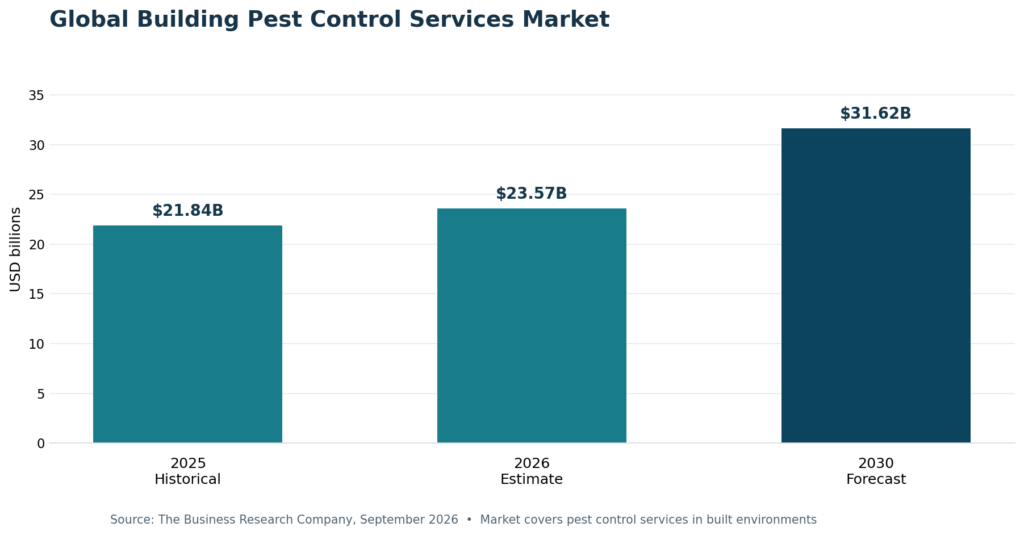
Source: The Business Research Company, September 2026. USD billions. 2025 is historical, 2026 is an estimate and 2030 is a forecast. The figures describe services in built environments—not standalone pesticide manufacturing or retail sales.

Demand is influenced by urban development, hygiene expectations, commercial facility maintenance and interest in preventive pest management. Digital monitoring and reporting are also reshaping how some companies deliver services.

North America led in 2025; Asia-Pacific is expected to grow fastest.

For a startup, recurring inspections and suitable maintenance contracts may offer more dependable income than emergency jobs alone. But your commercial potential still depends on local pest conditions, competition, licensing and customer budgets.

Research the market you can actually serve—not just the global market you can read about.

3. Understand Training, Licensing, Equipment and Startup Costs

Pest control is not a business where you should learn chemical handling through trial and error. A mistake can affect occupants, pets, property or the environment.

Check licensing and safety requirements

Rules vary by country, region, treatment type and pesticide classification. You may need business registration, applicator training, technician certification, permits and insurance. Specialized termite work or structural fumigation may require additional authorization.

For example, the U.S. EPA requires appropriate certification for people applying or supervising restricted-use pesticides; U.S. state requirements may be stricter. This is an American regulatory example, not a worldwide rule.

Learn pest identification, IPM, label instructions, protective equipment, emergency procedures and recordkeeping. Use products only for their authorized purposes, and follow their labels. The EPA also recommends secure pesticide storage, away from children, pets and food.

Budget for a professional setup

Buy equipment suited to authorized services: inspection tools, monitoring stations, approved applicators, PPE, secure storage and software.

Startup Expense Illustrative Budget (USD)
Training, certification and permits $700
Application equipment and protective gear $1,200
Inspection and monitoring tools $450
Initial supplies and secure storage $450
Registration and initial insurance $1,400
Website, software and launch marketing $600
Initial working capital $1,200
Total Illustrative Budget $6,000

Planning example only—not verified average startup costs. It excludes a vehicle, employees and specialized treatment equipment; actual costs can be much higher.

Get local quotations before spending. Choose a setup that supports safe, compliant work.

4. Create a Pest Control Business Plan and Set Profitable Prices

The most important question isn’t how many appointments you can book. It’s what remains after each appointment is completed.

If you’re researching how to start a pest control business, build a plan around your chosen services, target market, licenses, startup capital, monthly overhead, expected job volume and follow-up obligations. ZH Consultancy’s business plan services can help turn those assumptions into revenue and cash-flow projections.

Calculate job profitability

Suppose you charge $180 for a general residential treatment:

Item Illustrative Amount (USD)
Customer payment $180
Treatment materials −$18
Transport −$15
Technician labour −$45
Payment fee −$5
Allocated insurance and overhead −$27
Follow-up allowance −$20
Remaining before tax and other costs $50

Hypothetical figures, not a market price benchmark. Labour assumes 1.5 hours at $30/hour; real costs depend on the treatment and site.

That $50 isn’t net profit. Callbacks can reduce it. Document the scope, visits and warranties.

Some customers may benefit from scheduled inspection or prevention agreements. Twenty customers billed $150 per month generate $3,000 in monthly revenue, before service and operating costs. Make sure the contract specifies what that price includes.

Price the entire obligation, not just the initial application.

5. Build Safe and Efficient Pest Control Operations

Picture a restaurant calling because rodents have returned. If the original visit addressed only visible activity—not access points or food sources—the second visit may create an unhappy customer and an unprofitable callback.

Use a repeatable workflow:

Enquiry → Inspection → Pest identification → Treatment plan → Service → Documentation → Follow-up

Inspect first. Explain findings and feasible prevention steps. Choose appropriate methods in line with IPM, the product label, your training and local law. Set realistic expectations: some problems require monitoring and multiple visits.

Keep records of findings, approved products, treatments, instructions and recommended follow-ups. These records improve consistency and help meet applicable documentation obligations.

Group nearby jobs without rushing inspections. Monitor margins, callbacks and renewals.

Hire only when demand supports qualified technicians.

Better operations mean fewer preventable callbacks, clearer communication and more reliable margins.

6. Attract Customers and Grow Your Pest Control Business

When pests appear, customers want answers quickly. Your marketing should make it easy to find a qualified provider and understand what happens next.

A professional website should explain your services, service areas, qualifications, inspection process and quotation options. Avoid unsupported guarantees or claims that every pest problem can be solved in one visit.

For location-based searches such as “pest control near me,” an accurate Google Business Profile, where available and eligible, can help customers discover your business. Keep contact details updated and request genuine reviews.

Build referral relationships with property managers, restaurants, hospitality operators and commercial facility teams. These customers may value documented preventive visits and dependable scheduling, not just an emergency treatment.

As your business grows, ZH Consultancy’s digital marketing services can help connect local SEO, useful content, customer reviews and relevant advertising.

Measure booked inspections, customer revenue and retention—not clicks.

Your reputation should sell careful inspection, practical solutions and dependable follow-through.

7. Common Pest Control Business Startup Mistakes

Starting a pest control company involves risks that go beyond winning customers and completing treatments. A mistake in pest identification, licensing or chemical handling can affect occupants, property and your reputation. Even effective treatments can become unprofitable when travel time, materials and follow-up visits are underestimated. Expanding too quickly adds further pressure on training, recordkeeping and scheduling. Recognizing these common mistakes early helps you protect customers, manage costs and build a dependable business.

  • Offering services beyond your licence. General pest control, termite work and fumigation may require different permissions. Check before quoting.
  • Treating before identifying. An unnecessary or unsuitable pesticide application can create risk without solving the problem. Diagnose the cause and use IPM principles.
  • Underpricing follow-ups. Include materials, travel, labour and realistic return visits in every quote.
  • Neglecting records and chemical safety. Follow labels, protect people and pets, and document work according to applicable requirements.
  • Expanding before systems work. Extra technicians and vehicles increase costs. Build consistent scheduling and service quality first.

The Takeaway: Pest Control Is a Trust-Based Business

Learning how to start a pest control business involves more than buying treatment products. You’re developing a service that customers trust to address real problems while protecting their properties and wellbeing.

Return to the Inspection-to-Income Framework: Positioning → Skills and Compliance → Job Economics → Repeat Business.

Choose a focused market, work within your qualifications, understand every job’s costs and earn the right to be called again.

If you’re planning to launch or grow a pest control company, ZH Consultancy can help you evaluate startup spending, develop projections and plan sustainable growth.

Faq

Frequently Asked Questions About Starting a Pest Control Business

How much does it cost to start a pest control business?

It depends on licences, equipment, insurance, transport and service scope. The $6,000 example in this guide is illustrative, not an industry average.

Do you need a licence to start a pest control business?

Requirements vary widely. Commercial pesticide application and specialized treatments can require certifications or permits. Confirm rules with your local regulator.

Is a pest control business profitable?

It can be when prices cover labour, materials, travel, insurance and follow-ups. Efficient routing and suitable recurring contracts can help.

Can I start with no pest control experience?

You can train for the profession, but don’t perform regulated work without the required qualifications, supervision or permissions.

What equipment do I need?

Typically inspection and monitoring tools, suitable PPE and approved treatment equipment. Your precise list depends on the services you’re authorized to offer.

How do I find my first pest control customers?

Use clear local service pages, genuine reviews, referrals and outreach to property managers or commercial clients. Make qualifications and quotation steps easy to verify.

Portrait of Zain Hameed
Read & reviewed by

Zain Hameed

CEO · ZH Consultancy

Business strategy specialist helping a global client base of 800+ businesses build credible plans, financial models and investor-ready presentations.

4.9/5 Upwork rating
800+ Businesses worldwide
4.8/5 PeoplePerHour rating

Book a Free Consultation

Have a business idea, growth challenge or investor deadline? Book a free consultation and get clear next steps from our team.

Call our team

+923104049517

Untitled design (2)

Business topics

Continue reading

Related insights