

In this article
Three bounce house bookings for Saturday. At $325 each, that’s $975 in revenue before the weekend even begins.
Then the details arrive. One backyard has limited access. Another customer wants a longer rental. The forecast changes, and your crew still needs time to deliver, inspect, collect and clean every inflatable.
Owning an inflatable is one thing. Running a safe, profitable rental company is another.
If you’re researching how to start a bounce house business, think beyond the purchase price. Your real job is managing equipment, weather, customer expectations, insurance and the cost of every booking.
Use the Inflate-to-Income Framework to organize your launch: market positioning (who you’ll serve), safety and compliance (what you must operate responsibly), rental economics (what each booking really earns), and bookings and operations (how you’ll deliver reliably). Here’s how those pieces fit together.
1. Decide What Type of Bounce House Business to Start
A backyard birthday rental and a school festival require different equipment, staffing and scheduling. Choose your business model before building an inventory.
Popular rental options include standard bounce houses, combination units with manufacturer-approved slides, inflatable obstacle courses and dry or water slides designed for their intended use. Some operators offer event packages with tables, tents or other equipment through suitable partners.
Start with one or two commercial-grade units that match demand. A versatile inflatable booked regularly may outperform an expensive specialty attraction that sits in storage.
Know your customers. Parents often value clear prices and punctual delivery. Schools and event planners may need insurance documents, operating details and trained attendants. Compare competitors’ packages, delivery zones, reviews and cancellation policies, then look for an underserved niche.
Weather, school calendars and local event seasons all affect booking frequency. Check whether demand is concentrated on Saturdays or spread across school functions and weekday events: a single inflatable can serve only so many bookings in the same time window. If you need help assessing financial viability, ZH Consultancy’s business consultancy services can support your market and startup planning.
2. Global Party Rental Market Outlook and Bounce House Growth Opportunities
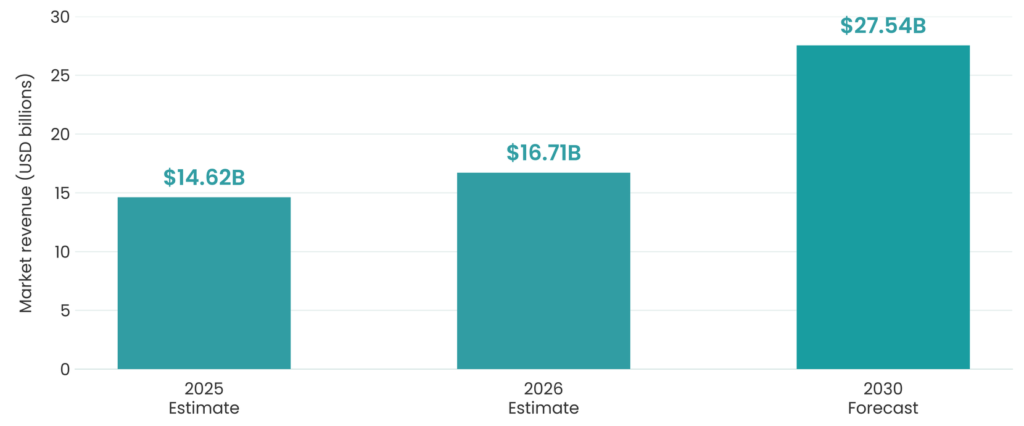
The worldwide party supply rental market offers useful context, but it is not a measure of bounce house rentals alone.
The Business Research Company’s September 2026 report estimates the global party supply rental market at $14.62 billion in 2025 and $16.71 billion in 2026, forecasting $27.54 billion by 2030. That implies approximately 13.3% compound annual growth from 2026 to 2030.
Global Party Supply Rental Market, 2025–2030
Source: The Business Research Company, Party Supply Rental Market Report (September 2026). USD billions; 2025 is a historical estimate, 2026 an estimate, and 2030 a forecast. The broader market includes tents, furniture, décor and entertainment rentals, including inflatable games. It excludes treating standalone inflatable manufacturing sales as bounce house rental revenue.
Birthday celebrations, school events, community festivals and corporate family days are potential booking sources. Convenient delivery and setup packages may also appeal to busy hosts. The report identifies North America as the largest regional party supply rental market in 2025.
For an individual operator, however, local booking demand beats global growth headlines. Survey event organizers, review competing rental calendars and estimate how many safe, feasible bookings your equipment can handle each month. Build three demand scenarios—slow, typical and peak season—and consider both the days when people want to book and the days when weather actually permits operation. This gives you a much more useful purchasing forecast than assuming every weekend will sell out
3. Licensing, Safety, Equipment and Startup Costs
Bounce houses are amusement equipment, not ordinary household items. Confirm your operating requirements before accepting a rental.
Rules vary by jurisdiction and may involve business registration, amusement-device licences, inspections, operator training and liability insurance. For example, Massachusetts requires licensing for small inflatable devices. That requirement is specific to Massachusetts, not a universal rule.
The commercial inflatable standard ASTM F2374-24 addresses design, installation, operation, inspection, training and maintenance; check which standards your jurisdiction applies.
Put safety ahead of bookings
Follow the manufacturer’s instructions on anchoring, approved surfaces, user capacity, blower operation and weather limits. Inspect equipment before each rental, keep documented maintenance records and ensure the trained supervision required for your specific setup is present.
The UK Health and Safety Executive advises outdoor operators to measure wind with an anemometer and not use inflatables above 24 mph (38 km/h)—or a lower manufacturer limit. These are UK guidance figures; applicable local rules may be stricter. Never continue operating in unsafe conditions to protect a booking.
Illustrative startup budget
| Startup expense | Example cost (USD) |
|---|---|
| Commercial inflatable and blower | $3,500 |
| Anchoring and safety equipment | $500 |
| Transport accessories and storage | $900 |
| Registration, permits and inspections | $500 |
| Initial insurance allowance | $1,400 |
| Website, booking tools and marketing | $600 |
| Cleaning and maintenance supplies | $300 |
| Working capital reserve | $2,200 |
| Total | $9,900 |
Hypothetical planning example, not a market average. Assumes access to a suitable vehicle and storage; excludes vehicle purchase, event attendants, major repairs and additional local compliance costs.
Choose commercial equipment with documentation and available replacement parts. Budget for bad-weather cancellations as well as the initial purchase. Ask an insurance professional about coverage for your specific rental models, delivery arrangements and any employees or event attendants. Insurers may impose operational conditions, and an inexpensive policy is of little value if it excludes the activities you actually provide.
4. Create a Bounce House Business Plan and Set Profitable Rental Prices
Learning how to start a bounce house business means knowing what remains after every delivery, not just what the customer pays.
Your business plan should set out target customers, equipment purchases, legal requirements, expected bookings, seasonal cash flow and a clear break-even target.
Consider a $325 backyard rental:
| Booking economics | USD |
|---|---|
| Customer payment | $325 |
| Labor: 3 hours × $22 | −$66 |
| Transportation and fuel | −$30 |
| Cleaning | −$25 |
| Wear and maintenance allowance | −$28 |
| Insurance, storage and marketing allocation | −$53 |
| Payment processing | −$10 |
| Remaining before tax and other costs | $113 |
Illustrative figures, not a standard rental rate. Includes an assumed operator labor cost; any required on-site attendant would add expense. Allocated overhead is not the same as an immediate cash payment.
The $113 remainder is about 34.8% of the fee, before other expenses and tax. Additional travel or staffing can quickly change the result.
State your rental duration, delivery radius, access requirements and additional charges clearly. Written agreements should cover setup conditions, supervision responsibilities, damage, deposits, cancellations and rescheduling. Weather policies must protect safety and comply with local consumer laws.
Track profitability by inflatable and by booking, and set aside money for repairs and replacement rather than treating all incoming cash as profit. Separate fixed expenses, such as storage and annual insurance, from costs that rise with each job. Your break-even booking target should reflect both, plus the slower months when recurring bills still arrive.
5. Build Safe and Efficient Bounce House Rental Operations
A busy Saturday only works if your schedule leaves time for safe setup and collection.
Use one repeatable workflow:
Enquiry → Site and event details → Booking agreement → Equipment inspection → Delivery and setup → Safety check and supervision → Collection → Cleaning and maintenance log.
Ask about access, ground conditions, space, electricity, users and the event timetable before confirming. Communicate who provides trained supervision and when the inflatable must be taken out of service.
Inspect anchoring, equipment condition and blower operation in line with the manufacturer’s instructions. Monitor weather during outdoor use, and stop operations when conditions exceed applicable limits.
After collection, clean and dry equipment appropriately, document damage and remove unsafe units from service until properly repaired and checked. A digital calendar and simple maintenance log can prevent double bookings and missed inspections. Leave sensible buffers between drop-offs and collections; unrealistic routes create pressure to rush safety checks. Have a clear contingency plan if a driver is unavailable or an inflatable fails inspection before an event.
Measure late deliveries, cancellation rates, equipment downtime and actual job hours. Scale only when you have enough trained people, working capital and suitable equipment to keep every event safe.
6. Find Customers and Grow Your Bounce House Business
Families need quick answers: What does it cost? Will it fit? Is it available? What happens if it rains?
A professional rental website should show real equipment photographs, dimensions, permitted users, pricing, delivery areas, safety information and an easy enquiry process. An accurate Google Business Profile, where eligible, can support local searches such as “bounce house rental near me.”
Share properly staged setup photos on social media, with permission, and ask satisfied customers for genuine reviews. Build relationships with schools, event planners, community groups and compatible party rental suppliers. Be ready to explain your insurance and supervision arrangements.
A focused digital marketing strategy can combine local SEO, seasonal content and targeted campaigns. Judge the results by confirmed profitable bookings, not likes or follower counts. With customer permission, reminders ahead of peak party seasons may encourage repeat business. Use genuine photographs and written specifications instead of stock images that could misrepresent the equipment being delivered. Clear expectations at the booking stage are part of excellent customer service.
7. Common Bounce House Business Startup Mistakes
Running an inflatable rental company brings risks that are easy to overlook when the first weekend bookings arrive. A low equipment price can hide high maintenance costs, while unclear rental terms may create disputes over access, delays or cancellations. More seriously, unsuitable inflatables, poor weather decisions and inadequate supervision can put guests at risk. New operators also sometimes expand their inventory before confirming dependable demand. Understanding these common mistakes early helps you protect customers, control expenses and build a rental business that earns lasting trust.
Buying household-grade equipment for commercial rentals. Choose inflatables designed and documented for your intended use.
Pricing without full costs. Delivery, labor, cleaning, repairs, insurance and storage all affect profitability.
Ignoring wind limits or supervision. Unsafe conditions mean stopping operations—not hoping the weather improves.
Using vague agreements. Document access requirements, cancellations, payments and each party’s responsibilities.
Expanding inventory before demand is proven. Watch bookings per unit and maintenance costs before buying more.
A reliable rental company protects both its customers and its cash flow.
The Takeaway
Understanding how to start a bounce house business is about much more than buying an inflatable. The Inflate-to-Income Framework brings together market positioning, safety and compliance, rental economics, and bookings and operations.
Start with suitable equipment, price each rental realistically and build systems that keep customers safe. As demand becomes predictable, expand carefully.
If you’d like support evaluating investment, forecasting bookings or building a launch plan, ZH Consultancy can help turn the numbers into a practical business strategy.
Faq
Frequently Asked Questions About Bounce House Business
Our illustrative one-inflatable budget is $9,900, assuming you already have transport and storage. Insurance, permits, equipment and staffing can make actual costs much higher.
Possibly. Business and amusement-device licensing, inspection and insurance requirements depend on your jurisdiction. Confirm them before operating.
It can be, if bookings cover labor, delivery, maintenance, insurance, overhead and equipment replacement. Weather and seasonal demand can affect earnings.
One or two appropriate commercial units can be enough to test demand. Expand when booking data and cash reserves justify it.
Appropriate commercial liability coverage is strongly recommended and may be mandatory. Make sure your actual inflatables and operating activities are covered.
Create a clear rental website, improve local search visibility, request genuine reviews and develop relationships with event planners, schools and community organizations.
Zain Hameed
Business strategy specialist helping a global client base of 800+ businesses build credible plans, financial models and investor-ready presentations.
In this article
Book a Free Consultation
Have a business idea, growth challenge or investor deadline? Book a free consultation and get clear next steps from our team.
Call our team
+923104049517
Email us
Business Topics
Business topics
Continue reading
Related insights

How to Start a Dumpster Rental Business: From First Container to Profitable Fleet
Learn how to start a dumpster rental business, estimate startup costs,
How to Start a Bounce House Business: From Weekend Rentals to a Profitable Company
Learn how to start a bounce house business, estimate startup costs,

How to Start an Interior Design Business: From Creative Talent to Profitable Studio
Learn how to start an interior design business, understand qualifications, estimate
How to Start an Electrical Business: From Skilled Electrician to Profitable Contractor
Learn how to start an electrical business, understand licensing, estimate startup
How to Start a Window Cleaning Business: From First Job to Profitable Company
Learn how to start a window cleaning business, estimate startup costs,

How to Start a Security Business: From First Contract to Profitable Company
Learn how to start a security business, understand licenses, calculate guard