

In this article
Picture a Saturday afternoon: the inflatable is clean, the customer has paid, and the neighborhood birthday party is ready to begin. From the driveway, it looks like a wonderfully simple business. Deliver a colorful bounce house, collect a few hundred dollars, and repeat next weekend.
Then reality calls. The lawn has a slope. The gate is narrower than the rolled-up unit. A thunderstorm is moving in. Your insurance broker wants the exact serial number, and the venue asks who will supervise the children. Suddenly, the important question is not how many parties you can book. It’s whether you can deliver each party safely, profitably, and without wrecking your weekend.
That’s the real story behind how to start a bounce house business in the United States. This guide covers the opportunity, its considerable downsides, realistic bounce house startup costs, state requirements, equipment, operating procedures, a bounce house business plan, professional branding, booking websites, local marketing, and the numbers that tell you whether expansion makes sense. The examples are in U.S. dollars and are explicitly labeled when illustrative rather than reported market averages.
Is a Bounce House Rental Business a Good Opportunity in the USA?
At its core, a bounce house rental business owns commercial inflatables and rents their use for birthdays, school events, church gatherings, family celebrations, and community functions. Many operators deliver and install each unit; others provide staffed event packages. Both are more complicated than dropping off equipment, because someone must establish site suitability, anchoring, inspection, supervision arrangements, and a safe pickup plan.
If you’re studying how to start a bounce house business, there’s a market—but be careful with impressive-looking industry numbers. The American Rental Association’s latest 2026 forecast projects about $6.2 billion in U.S. event-rental revenue in 2026, up approximately 9.5%. That includes tents, tables, chairs, audiovisual equipment, and other event rentals. It is not a stand-alone estimate of bounce-house rental revenue. The much larger global bounce-house product market reported by some research firms includes residential and commercial inflatables, not just American rental services.
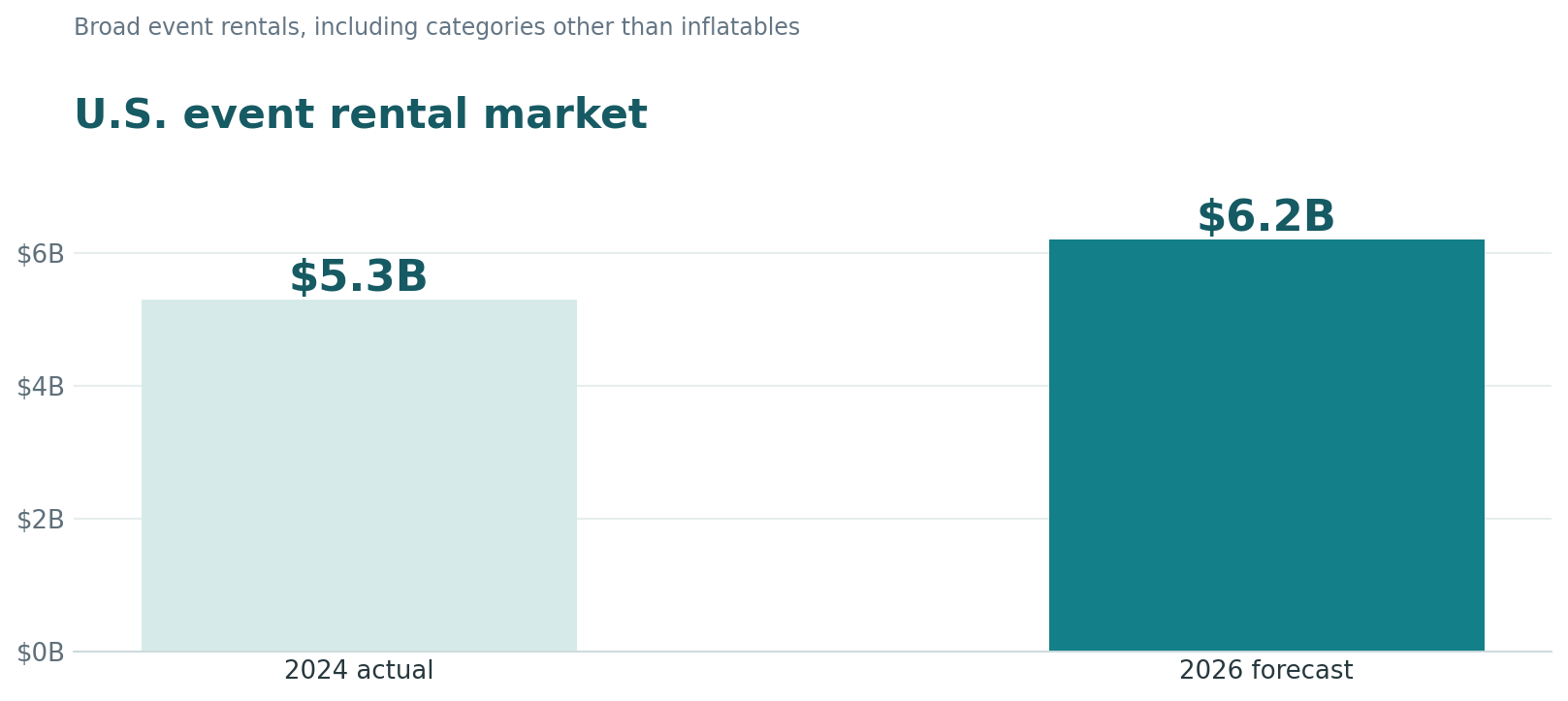
Figure 1. U.S. event rental revenue: 2024 observed $5.3B versus August 2026 projected $6.2B. Broad event rentals; not bounce-house-specific. USD billions.
Source: American Rental Association forecasts, cited by Lift and Access (August 2026)
A better demand indicator is your local customer base. The U.S. Census Bureau’s Vintage 2025 estimates show approximately 72.0 million people under age 18 nationally, including about 28.0 million ages five to eleven. These are population counts, not a prediction of event spending. They suggest a large potential audience whose actual purchasing decisions still depend on local incomes, weather, venue availability, and competition.
How should a founder use those figures? Forget the idea that 72 million children equals 72 million customers. A family that owns a backyard, can afford a celebration, and lives inside your delivery radius is a different prospect from a school that needs an insured, staffed vendor for 300 attendees. Research those groups separately.
The market isn't equally attractive everywhere
A suburban market with family neighborhoods, parks, and school events might support frequent backyard rentals. A dense urban location may offer strong demand but expensive parking, narrow access, permits, and inconvenient storage. Snowy northern markets can have a short outdoor season; warmer regions may book more months but face intense summer heat and thunderstorms.
Before learning how to start a bounce house business in your own county, count actual competitors and their inventory, minimum orders, delivery charges, review complaints, and calendar availability. Check municipal event calendars and school districts. Then calculate how many serviceable customers live within a delivery radius you can profitably cover. ZH Consultancy’s market research support can help formalize that work if you’re considering a significant equipment purchase.
Pros and Cons of Owning a Bounce House Business
The appeal is real. But so are the trade-offs. Here’s what to weigh before spending your savings.
Advantages | Disadvantages |
|---|---|
Possible to test demand with a small fleet | Commercial inflatables, transport and coverage require capital |
Weekend and event demand can fit a part-time launch | Your busiest hours are often weekends and holidays |
Additional units and party add-ons can increase order value | A larger inventory also increases cleaning, storage and inspection work |
School and community partnerships may create repeat customers | Venues may require permits, attendants and higher insurance limits |
Happy families can generate referrals and photographs | Weather cancellations, injuries and complaints can disrupt plans |
A strong local reputation can differentiate the company | Price competition and seasonal cash flow can be difficult |
What makes ownership attractive?
A bounce house rental business can start as a tightly managed local service instead of a storefront operation. A founder with safe storage and appropriate transportation may test one or two models before building an entire fleet. Customers also share photographs from parties, creating organic word of mouth when the service is dependable and permission to use images is obtained.
There are sensible add-on opportunities: inflatable slides, concession equipment, tables, chairs, and staffed school packages. However, every new product has its own space, transportation, cleaning, liability, and permit implications. “More products” does not automatically mean “more profit.”
The disadvantages founders discover too late
A cancellation can erase a weekend of expected revenue while insurance, storage, and financing bills continue. A soaked inflatable takes time to dry correctly. A unit stuck in a difficult backyard can derail the next delivery. Injuries are a serious concern, and a waiver is not a substitute for safe operation or legally required insurance. Staff may need physical training to move heavy equipment without injury.
For some people, these trade-offs are acceptable. For others—especially anyone who needs predictable weekday hours or has no reliable vehicle—they’re a strong reason not to launch yet. A genuine guide to how to start a bounce house business should make that decision easier, not sell everybody the dream.
Validate Customers and Competitors Before Buying Equipment
The first practical step in how to start a bounce house business is a map and a spreadsheet, not a shopping cart. Choose a realistic radius, perhaps 15–25 miles initially, and list family-heavy neighborhoods, schools, churches, apartment clubhouses, parks, and event venues. Identify which venues allow inflatables and what documentation they demand. Ask organizers whether they purchase directly or work through approved vendor lists.
Research ten local providers. Record their minimum rental periods, prices, packages, distance fees, event-staffing policies, cancellation terms, and product photos. Look for recurring frustrations in public reviews: poor communication, unexpected delivery fees, late setup, unclear pickup times, and equipment arriving dirty. Those patterns are opportunities to compete through execution rather than merely discounting.
Define the three customer groups separately
Backyard families prioritize safety, price transparency, easy booking, and punctuality. Schools and churches prioritize certificates of insurance, staffing, purchase-order procedures, supervision, and weather plans. Corporate and community events may require multiple units, event plans, liability limits, backup equipment, and formal invoices.
The economics also differ. A $275 backyard booking with a short drive may generate more contribution per hour than a $650 distant event requiring attendants and a generator. Your bounce house business plan should compare segments on profit and operational complexity, not just average ticket price.
Bounce House Startup Costs: A Realistic U.S. Budget
If you are wondering how to start a bounce house business without exhausting your savings, begin by asking how much cash you can safely commit. There isn’t one defensible national price. Equipment sizes, insurance underwriting, state requirements, and existing vehicles vary. The following is a planning scenario, not a vendor quotation or industry average, assuming two commercial units and access to an existing suitable vehicle.
Startup item | Illustrative budget (USD) |
|---|---|
Two commercial-grade inflatables | $6,500 |
Blowers, ground protection, stakes, carts and accessories | $1,050 |
Trailer/storage preparation | $2,200 |
Initial insurance provision | $1,800 |
Registration, inspection and permits allowance | $600 |
Website, branding and booking setup | $1,150 |
Cleaning supplies, training and launch marketing | $850 |
Cash reserve for weather, repairs and surprises | $2,500 |
Total illustrative opening budget | $16,650 |
This scenario does not purchase a towing vehicle, employee payroll reserve, or an expensive slide. A larger fleet, climate-controlled storage, or higher insurance minimums could push the budget considerably higher. A leaner operator with existing equipment might spend less. Compare at least three actual supplier and insurance quotes before making a commitment.
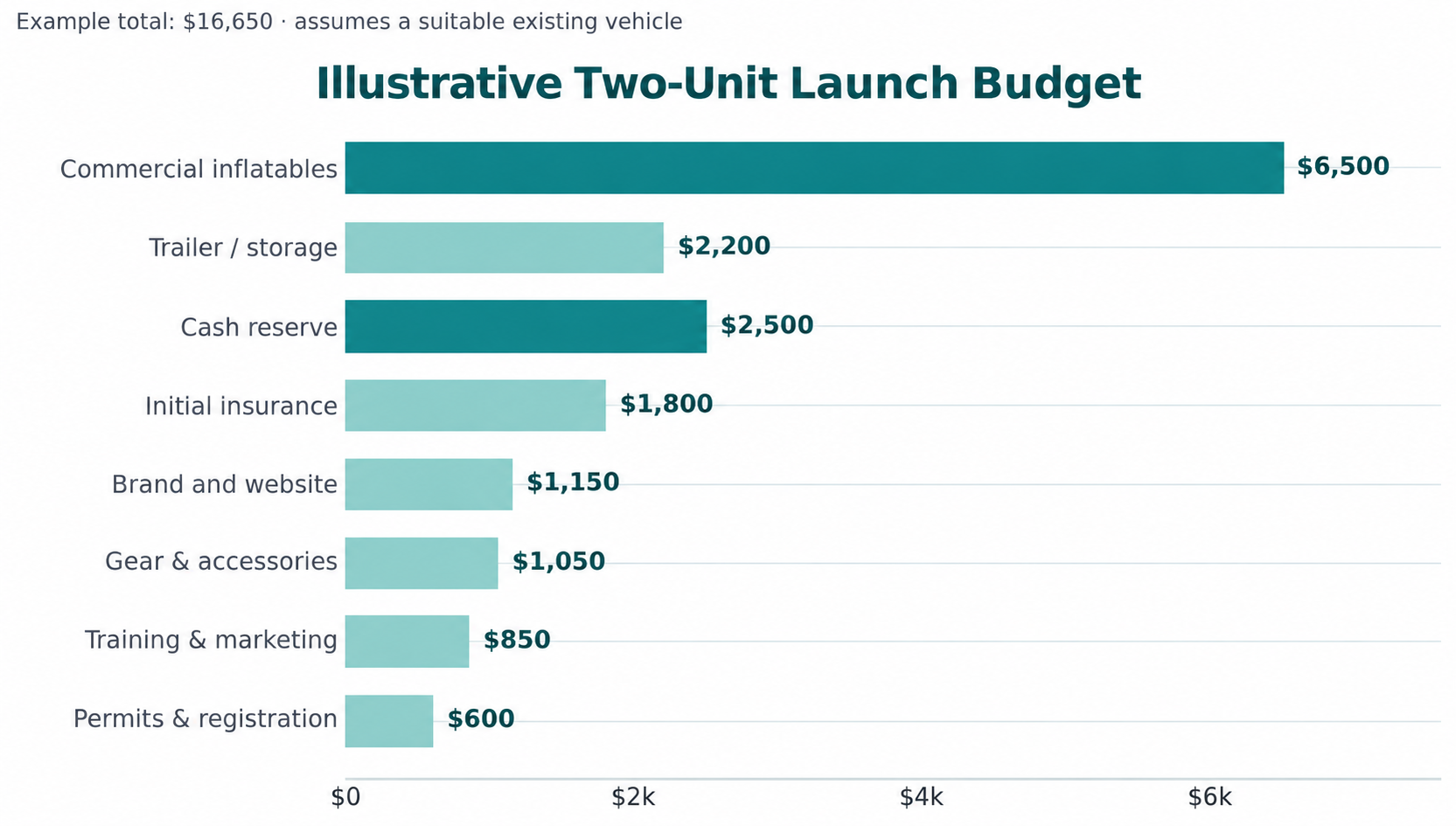
Figure 2. Illustrative two-commercial-unit startup budget of $16,650, assuming an existing suitable vehicle. USD; not average U.S. startup spending.
Source: ZH Consultancy financial-modeling context; chart values are original illustrative assumptions
When estimating bounce house startup costs, divide expenses into three buckets: one-time capital purchases, recurring overhead, and costs directly caused by each booking. That separation is essential for pricing and cash-flow planning. If a lender or partner wants a complete forecast, use financial modeling services to test slow-weather months and different fleet sizes.
Don't exhaust your cash on the inflatable
A disciplined estimate of bounce house startup costs prevents impulse purchases. The tempting purchase is the colorful castle. The unglamorous essentials are what keep the business alive: bounce house insurance deposits, compliant anchoring equipment, serviceable transport, backup blower capacity, and money to refund a customer when the weather turns dangerous. Reserve enough cash to survive weeks with no rentals; a business that needs every Saturday to be sunny is not adequately capitalized.
Choose Commercial Inflatables and Check the Supplier Properly
Buying correctly is a central part of how to start a bounce house business: choose equipment intended for commercial rental use, with documentation appropriate to the relevant regulatory regime. Ask for the manufacturer’s operator manual, serial number, rated capacity, permitted age/size information, anchoring and electrical requirements, repair instructions, material information, and records of relevant testing. Verify what your insurer and local regulator will accept before buying—especially for used units.
A standard castle often suits family parties; a combination jumper-and-slide may command a higher fee but requires more transport and setup work. Large obstacle courses can work for school events yet demand more crew, space and supervision. Water slides add drainage, drying, sanitation, and seasonal challenges. Choose inventory for your buyers, not just what looks spectacular on a supplier’s website.
Equipment checklist for every booking
Beyond the inflatable itself, plan for compatible blowers, protected electrical connections, properly rated ground anchors or ballast systems as approved, ground covers, cable protection, a dolly, cleaning products, inspection forms, replacement parts, a way to measure wind, and suitable transport restraints. Backup power and generators may be required for some events, but introduce separate noise, emissions, electrical, and fuel hazards.
Never improvise anchoring, repairs, or setup from a video tutorial. Follow the manufacturer, applicable law, insurer’s conditions, and trained installation procedures. The current ASTM F2374-24 standard addresses the design, installation, operation, maintenance, inspection, and training of commercial inflatable amusement devices, but whether and how it applies legally depends on the jurisdiction.
Licenses, Permits, Taxes and Bounce House Insurance
The legal side of how to start a bounce house business begins with an important distinction: there is no single federal rental license that makes a company compliant nationwide. Rules may come from state amusement-ride authorities, city business licensing, parks departments, fire officials, health rules for concession add-ons, and venue contracts. State treatment of inflatables differs substantially. Confirm the classification of each unit and your intended operating locations before taking deposits.
For example, Texas Department of Insurance describes insurance, annual inspection certification, a ride-specific compliance sticker, a $40 filing fee per ride, and operational reporting duties for covered amusement devices. It also identifies a $1 million per-occurrence insurance requirement for certain continuous-airflow inflatables. By contrast, New Jersey’s amusement-ride program requires applicable rides to be registered and issued annual permits following inspection and insurance review. Those examples are not a substitute for your own state’s rules.
The legal checklist to complete before launch
Choose a business structure with appropriate tax and liability advice; register your name; obtain an EIN when needed; check state and local business licenses; confirm whether sales or rental taxes apply; determine amusement-device permits and inspections; set up separate banking and bookkeeping; understand worker classification rules; and check permission for operation at parks and public events.
Bounce house insurance is more specialized than generic small-business cover. Ask brokers whether policies explicitly cover participant injuries from your specific inflatables, setup and takedown, weather incidents, off-site equipment, delivery vehicles, attendants, and the types of events you plan to serve. Request the insurer’s exclusions and actual quote in writing. Schools may demand additional-insured certificates and specific limits.
Compare general liability, commercial auto, equipment-in-transit/inland marine, workers’ compensation where applicable, and umbrella coverage. The cheapest premium is not a bargain if the incident you fear most is excluded. Your bounce house insurance budget must reflect actual quotes for your state and operation, not a single website’s nationwide average.
Safe Setup, Supervision and Emergency Procedures
Safety is the nonnegotiable chapter in how to start a bounce house business. The U.S. Consumer Product Safety Commission estimated more than 18,000 U.S. emergency-department-treated injuries associated with bounce houses in 2018. This is a historical injury estimate, not a current annual count. A peer-reviewed study of 2000–2019 data estimated 159,569 pediatric injuries over that period. These numbers make safety more than a small-print paragraph on a contract.
Site approval begins before dispatch. Confirm usable measurements, ceiling clearance for indoor jobs, access width, grade, surface type, overhead lines, electrical supply, drainage, and where vehicles can unload. On arrival, inspect the surface and unit, verify the prescribed anchoring and protective setup, and photograph the completed installation for your records. Refuse unsuitable sites.
Make weather a hard stop, not a negotiation
Monitor forecast and current conditions, including sudden gusts and approaching storms. The manufacturer’s wind limits and the most restrictive applicable regulatory or insurer instructions control. Do not operate in unsafe wind, lightning, or other hazardous weather. A waiver cannot make a dangerous setup safe. Stop use and evacuate promptly when conditions worsen; a safe shutdown is more important than preserving the booking.
Establish occupancy, rider-size separation, supervision assignments, no-flipping rules, no shoes or sharp items, entry/exit control, and emergency contact procedures. Staff should know how to isolate power, manage a deflation, respond to injuries, report incidents, and preserve records. Train new operators before they work independently.
A sound bounce house rental business has a daily inspection log, cleaning and disinfection record, damage/repair history, and a no-use tag for defective units. Inspect for fabric damage, seam failures, blower problems, wetness and anchoring defects between events. Stop-and-repair rules prevent a small flaw from becoming an expensive incident.
Write a Bounce House Business Plan With Real Numbers
A rigorous approach to how to start a bounce house business demands a bounce house business plan that explains the customers, geographic radius, equipment mix, competition, permits, safety policies, booking capacity, pricing, marketing, staff, capital needs, and financial downside scenarios. It’s a decision document—not a thirty-page sales brochure.
To control bounce house startup costs and avoid optimistic forecasts, a practical structure includes an executive summary; local demand and competitor research; customer segments; products and packages; licensing and risk controls; marketing; delivery operations; three-year forecast; startup investment; cash reserve; and milestones. If you’re seeking financing, include the exact use of funds and how debt would be repaid. ZH Consultancy’s business planning service can help shape that case around verifiable assumptions.
Forecast bookings by season, not by wishful thinking
Suppose two units each can complete one booking on an ordinary Saturday and Sunday. Even in a perfect four-week month that’s sixteen weekend opportunities before downtime, travel conflicts, or weather. You may add weekdays or multiple turns per day if the schedule truly permits, but don’t begin your forecast by assuming the fleet works at 100% utilization.
Make conservative, base, and optimistic forecasts for monthly bookings. Stress-test rainouts, fuel prices, labor, and an unexpected equipment replacement. An experienced founder may spend more time refining this forecast than choosing their logo. That’s sensible: a convincing bounce house business plan shows whether the company can survive the bad month, not just whether it looks attractive in July.
Bounce House Rental Pricing, Profit and Break-Even
Learning how to start a bounce house business also means understanding money: bounce house rental pricing should follow your actual costs and local willingness to pay. A competitor’s $250 listing may exclude delivery, taxes, attendants, or cleaning, so compare like with like. Establish a base service area, duration, transparent travel fee, minimum order size, and separate charges for staffing or extended periods when appropriate.
Here is an entirely illustrative $325 backyard booking, assuming insurance, inspection, and operating requirements are already met:
Single booking economics | USD |
|---|---|
Customer pays | $325 |
Delivery, fuel and vehicle allocation | −$38 |
Setup/pickup labor | −$70 |
Cleaning and drying allowance | −$24 |
Wear and replacement reserve | −$30 |
Processing and allocated overhead | −$48 |
Illustrative contribution before other costs and tax | $115 |
That $115 is not net profit: owner salary beyond recorded labor, annual tax, financing costs and unforeseen expenses may reduce it further. A $16,650 launch investment divided by $115 suggests about 145 similar bookings simply to recover that outlay from contribution. This calculation ignores the timing of cash flow and changes in expenses; it is a planning illustration, not a guaranteed payback period.
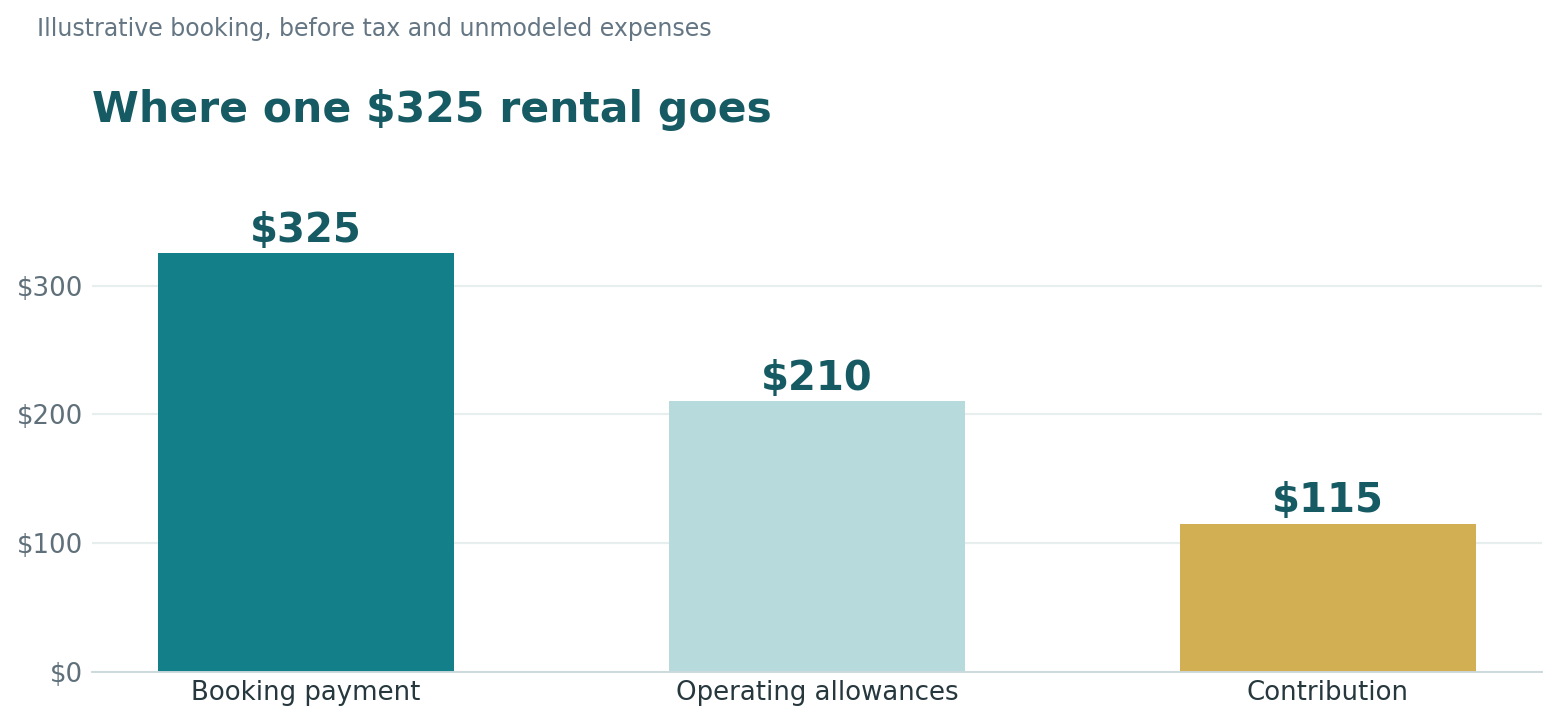
Figure 3. Illustrative $325 single-booking allocation: $210 operating allowances and $115 contribution before unmodeled costs and tax. USD.
Source: ZH Consultancy financial-modeling context; original worked example
Improve bounce house rental pricing by recording contribution per booking, per unit, per delivery mile, and per crew hour. A smaller rental closer to home can outperform a larger order two counties away. Consider small packages that simplify choices, but never promise unstaffed events if your policies or regulations require attendants.
Protect cash flow during slow months
Keep deposits and refund conditions unambiguous and compliant with local consumer laws. Track future booking obligations separately from money already earned; refundable customer deposits may create liabilities. Set aside reserves for insurance renewal, repairs and equipment replacement. If a winter month has nearly no bookings, the plan should still cover storage and necessary overhead.
Build a Brand: Name, Logo, Business Cards and Company Profile
Founders who ask how to start a bounce house business sometimes overlook branding. Parents often discover companies through local search and social posts, then decide whether a provider seems trustworthy. A memorable name is useful, but evidence of safe, professional service matters more. Choose a business name you can legally use, confirm domain and social availability, and check for obvious trademark conflicts before commissioning design.
A good bounce house logo must stay recognizable on a trailer, invoice, polo shirt, inflatable sign, mobile site, and tiny social-media avatar. Use readable type and limited colors. Avoid imitation of cartoon characters or licensed themes you don’t own. If you need a consistent mark and versions, see ZH Consultancy’s logo design services.
Are visiting cards and printed materials worth it?
Yes, but be selective. A well-designed business card can help when you meet a school administrator, party planner or venue manager. Put your business name, phone, website, service area, and a scannable booking QR code on it—not a wall of text. A small set of flyers, vehicle magnets, event banners, and staff shirts can support the same brand system; ZH’s graphic design services cover coordinated collateral.
For B2B buyers, a one- or two-page company profile can be more useful than a glossy catalog. Include your actual service area, equipment photos, insurance documentation available on request, operating approach, references, and contact process. Don’t claim to be “fully certified” without identifying the applicable certification. ZH Consultancy also offers company profile design services for these introductions.
Create a Booking Website That Converts Searchers Into Customers
The online component of how to start a bounce house business deserves real attention. A proper website is your 24-hour salesperson. It should answer the questions a parent asks before giving you a credit card: Is this unit available on Saturday? Will it fit? What is the full delivered price? Are you insured? What if it rains? How do I book?
The essential pages are Home, Rentals/Inventory, Individual Unit Pages, Pricing and Delivery Areas, Safety and FAQs, About, and Contact/Booking. Each unit page needs your own photographs, exact dimensions, setup space requirements, permitted surface types, capacities, transparent pricing, and clear date availability. Don’t hide crucial restrictions until checkout.
Wix, Squarespace, WordPress or Shopify?
Platform | Good fit | Main consideration |
|---|---|---|
Wix | Simple launch and straightforward editing | Check whether booking/rental extensions support the actual inventory workflow |
Squarespace | Attractive small catalog and brochure-style site | Rental scheduling may require third-party booking tools |
WordPress + booking plugin | Flexible local SEO, custom forms and inventory handling | You need updates, security, backups and a capable administrator |
Shopify | Selling merchandise or packaged event products | Daily equipment availability and delivery logistics may need specialist apps |
No platform is universally “best.” Compare total yearly cost, booking compatibility, inventory conflicts, mobile performance, staff access, deposits, taxes, and cancellation workflows. Dedicated rental platforms can be a sensible alternative if they handle rental windows, route dispatch, and equipment availability reliably; trial the exact workflow before committing.
Buy your domain in the company’s name, retain administrator access, enable multi-factor authentication, and ensure the booking system sends confirmations and backups. Use high-quality hosting with SSL, backups and support. For a custom booking journey or help choosing software, ZH Consultancy’s web development service and custom website development are relevant next steps. Once live, use website maintenance services when professional upkeep is needed.
A solid site also tracks form submissions and successful deposits without unnecessarily collecting sensitive customer information. Test the experience on a real phone using slow cellular data. Plenty of party enquiries happen while parents are juggling other plans.
Digital Marketing: Win Local Searches and Repeat Bookings
If you are planning how to start a bounce house business with limited funds, target customers already looking for local rentals instead of paying mainly for broad “brand awareness.” Start with Google searches for your actual services and locations: “bounce house rental in [city],” “inflatable slide rental [county],” or “insured school event inflatables.” Make service-area pages useful, with genuine delivery fees and coverage rules—not a hundred copy-pasted suburb pages.
If eligible, create a Google Business Profile with truthful service-area information. Customer-facing operations, address display, and eligibility must follow Google’s rules. Use real unit photographs, accurate hours, a booking link, and genuine reviews. ZH’s Google Business Profile optimization service can support that local setup.
A simple marketing funnel
A parent discovers you in search, views a unit page, checks dimensions and reviews, sees the delivered price, chooses a date, and pays a deposit. Every step can lose people. Measure impressions, visitors, quote requests, deposit conversions, average booking value, and repeat referrals. Not every Instagram view is a customer.
Create short real-world demonstration videos (with consent), show setup procedures, and highlight why clients value punctuality and clean equipment. Offer schools and planners a concise vendor information sheet, not spam. A seasonal paid-search campaign may help once unit economics are proven; use digital marketing services if you want structured campaign management. Keep ad spend separate from service fees.
Strong bounce house rental pricing is part of marketing: transparent bundles often beat confusing “call for price” listings. Follow up politely after successful events, request reviews without incentives that violate platform rules, and offer returning customers relevant seasonal promotions.
Run Every Rental With a Repeatable Operations System
An overlooked part of how to start a bounce house business is building one consistent workflow: inquiry, site-screening questionnaire, quotation, written contract, deposit, weather confirmation, dispatch, setup inspection, customer handoff, pickup, damage check, cleaning/drying, storage, and post-event follow-up. Put owner and venue instructions into the agreement, but make sure responsibility for legally required supervision remains clearly assigned and actually provided.
Use a shared booking calendar with equipment IDs, delivery addresses, job durations, crew assignments, and route buffers. For multi-event Saturdays, plan driving times under realistic traffic conditions and leave room for wet equipment, access surprises, and customer delays. A tight schedule on paper becomes a customer-service disaster in real life.
Staffing and cancellation policies
Train crew on safe lifting, traffic and parking, electrical precautions, equipment inspection, weather shutdowns, and incident reporting. Written checklists are useful only if people follow them. Clarify who can stop an event for safety, even if the customer objects. Keep an emergency contact and escalation plan.
Write a weather policy distinguishing customer preference changes from mandatory safety cancellations, and explain deposits, refunds or credits before booking. Local laws may limit certain terms. A sound bounce house insurance program and accurate contracts support risk management, but neither replaces safe judgment at the site.
Common Founder Mistakes, Solutions and Future Trends
Mistake: Buying a fleet before testing demand. Solution: pilot one or two commercial units, record real booking interest, and expand after checking margins. Mistake: Underpricing delivery. Solution: calculate actual drive time, loading, labor and fuel. Mistake: Copying a competitor’s safety policy. Solution: obtain requirements from regulators, manufacturers, insurers and qualified advisers.
Mistake: Failing to reserve replacement money. Solution: allocate part of each booking to equipment wear. Mistake: Accepting every venue. Solution: refuse jobs with inadequate clearance, surface, power or staffing. Mistake: Building an attractive website that cannot book inventory. Solution: test every unit/date scenario before launching ads. Mistake: Treating signed waivers as a magic shield. Solution: maintain actual operational controls and get appropriate legal advice.
Over the next few years, expect customers to place increasing value on frictionless online reservations, fast mobile information, transparent cancellation policies and visible safety practices. More rental platforms may automate routes, deposits and inventory availability. Those are sensible operational directions, not guaranteed market forecasts. There is no reason to buy expensive automation before your staff can consistently complete a paper checklist.
A Practical 90-Day Launch Schedule
Period | Priority | Deliverable |
|---|---|---|
Days 1–15 | Market, feasibility and permits | Competitor study, target radius, regulator and insurance checklist |
Days 16–30 | Capital, equipment and training | Quotes, supplier verification, written safety workflow, initial budget |
Days 31–45 | Branding and professional setup | Legal registration, logo, contracts, company profile and printed card |
Days 46–60 | Website and booking | Equipment pages, calendar, deposits, analytics, full booking tests |
Days 61–75 | Controlled launch | Initial compliant bookings, customer feedback and documented job costs |
Days 76–90 | Refinement | Contribution review, marketing improvements, rainy-day reserves and growth decision |
This is an illustration of launch sequence, not permission to operate before required approvals. Depending on jurisdiction, inspection schedules and insurance underwriting may take longer. The correct launch date is the first day you’re legally and operationally ready—not the first sunny Saturday on the calendar.
The Takeaway
If you’ve read this far, you’ve learned how to start a bounce house business beyond the colorful equipment and weekend income screenshots. The opportunity sits at the intersection of local demand, safety, equipment management, service quality and disciplined numbers. Its pros—repeat events, flexible initial scale and shareable customer experiences—are balanced by serious cons: weather, physical work, regulation, liability and seasonal cash flow.
Build around the next safe, profitable booking. Research your area, choose commercial equipment, verify permissions, insure the actual risks, track contribution after each event, and create a website that makes booking simple. Then use the data to decide whether another inflatable, a second crew, or a larger marketing budget is justified. If you need a structured feasibility study or cash-flow forecast, ZH Consultancy can help develop the planning materials without pretending a plan alone guarantees success.
Faq
Frequently Asked Questions
A founder’s total depends on commercial inflatable inventory, transportation, storage, insurance, inspections, permits and working capital. The two-unit example in this article totals $16,650, assuming access to a suitable vehicle. It is illustrative, not a national average or supplier quote. Get local insurance and regulatory quotes first: those may change your budget dramatically. Financing should also leave cash for rainy weekends and repairs.
It can be, but gross booking revenue is not profit. Calculate your actual setup and collection labor, travel, cleaning, wear, overhead, insurance and replacement reserves. In our illustrative $325 booking, $115 remains before additional costs and taxes. Strong bounce house rental pricing, consistent bookings and safe operations matter more than simply owning many inflatables.
Requirements vary by state, locality, venue and unit classification. Some states regulate commercial inflatables as amusement rides and require inspections, permits, and specific liability coverage. Check every place you intend to operate. Appropriate bounce house insurance should explicitly cover the devices and events you provide; an ordinary policy may contain relevant exclusions.
One or two suitable commercial units can be enough to validate demand while keeping storage, transport, cleaning, and scheduling manageable. Choose products after analyzing actual local customers. Add inventory only when profitability, permit compliance, crew capacity and cash reserves support expansion. Include the purchase decision in your bounce house business plan rather than buying extra units to look established.
A simple Wix or Squarespace site may work for a small catalog, while WordPress with a suitable rental-booking extension can give more control. Shopify is a stronger fit for ecommerce than for complex event-rental scheduling unless the right apps are added. The key requirement is accurate date-based availability, safe checkout, delivery rules and a mobile-friendly experience—not a particular brand name.
The major advantages are opportunities for repeat events, a manageable small-fleet launch and referral-driven local sales. The disadvantages are weather dependence, weekend working hours, heavy equipment, storage needs, possible injury liability, and state-specific rules. Check whether these trade-offs fit your finances and lifestyle before committing to bounce house startup costs you cannot comfortably recover.
Begin with a focused service area, clear pricing, real photos, a reliable booking website and an eligible Google Business Profile. Build relationships with schools, churches, venues and party planners; ask happy clients for honest reviews and referrals. Test small local advertising campaigns only after confirming unit economics. A professional brand, practical company profile and dependable communication help customers choose you over less organized competitors.

Zain Hameed
Business strategy specialist helping a global client base of 800+ businesses build credible plans, financial models and investor-ready presentations.
In this article
Book a Free Consultation
Have a business idea, growth challenge or investor deadline? Book a free consultation and get clear next steps from our team.
Call our team
+923104049517
Email us
info@zhconsultancy.com

Business Topics
Business topics
Continue reading
Related insights

How to Start a Laundromat Business: A Complete U.S. Founder’s Guide
Learn how to start a laundromat business in the USA: market

How to Start a Construction Business in the USA
A homeowner wants to sign a $75,000 remodeling contract on Friday.

How to Start a Plumbing Business in the USA
At 7:15 on Monday morning, a homeowner calls about water coming

How to Start a Car Rental Business in the USA: A Founder’s Practical Guide
A family lands after midnight. They do not care whether your

How to Start a Landscaping Business: Costs, Licenses, Marketing and Profit
Picture two lawns on the same street. One homeowner wants a

How to Start a Cafe Business in the USA: Costs, Licenses, Marketing and Profit
You’re standing inside an empty storefront, and you can already picture