

BUSINESS STRATEGY / FOUNDER GUIDE

How to Start a Window Cleaning Business: From First Job to Profitable Company

Learn how to start a window cleaning business, estimate startup costs, understand safety rules, price jobs, find customers and grow recurring revenue.

ZH Research Team

Reviewed by Zain Hameed

Date Published

October 27, 2026

ZH Editorial Team

Business Strategy Desk

Imagine finishing a window cleaning job, seeing spotless glass and collecting $240. It’s an appealing first invoice.

Now factor in travel, awkward windows and equipment replacement. Suddenly, the invoice looks less profitable.

That’s what many new operators underestimate. Cleaning windows and running a profitable window cleaning company are different skills.

If you’re researching how to start a window cleaning business, the challenge is to choose work you can perform safely, quote it accurately and find customers who will book again.

Think of the Pane-to-Profit Framework as four connected decisions:

Positioning: Which properties and customers will you serve?

Safety and compliance: Can you complete those jobs with suitable equipment, training and insurance?

Job economics: Will each quote cover labour, travel, supplies and overhead?

Customer acquisition: How will you win repeat bookings without spending more on marketing than those customers are worth?

Together, those decisions can turn occasional appointments into dependable work.

1. Decide What Type of Window Cleaning Business to Start

Residential, storefront and high-rise cleaning require different customers, equipment and pricing.

Choose a focused service

Common options include residential interior and exterior windows, regular ground-level storefront cleaning, low-rise commercial premises and specialist access work.

High-rise and rope-access jobs require additional competence, equipment and safety arrangements. Don’t treat them as a natural next step just because you’ve mastered residential cleaning. Start with properties you can service safely and consistently.

Identify customers who suit your business

A homeowner may book around a renovation or season change. A retailer wants its storefront looking presentable every week. A property manager may need scheduled cleaning across multiple buildings.

Study competitors’ reviews, coverage and quotes. Look for gaps such as missed appointments or unclear pricing.

Business consultancy support can help assess demand and positioning before you invest.

Your first goal isn’t to clean every kind of window. It’s to serve a clear customer group exceptionally well.

2. Global Window Cleaning Market Outlook and Growth Opportunities

There is an established worldwide market for outsourced window cleaning, although international growth alone cannot tell you whether a particular neighborhood needs another provider.

Grand View Research reports that the global window cleaning segment of contract cleaning services generated USD 93.16 billion in 2024 and is forecast to reach USD 128.73 billion in 2030, with a projected 5.6% compound annual growth rate for 2025–2030.

Global Window Cleaning Contract Services Market, 2024–2030
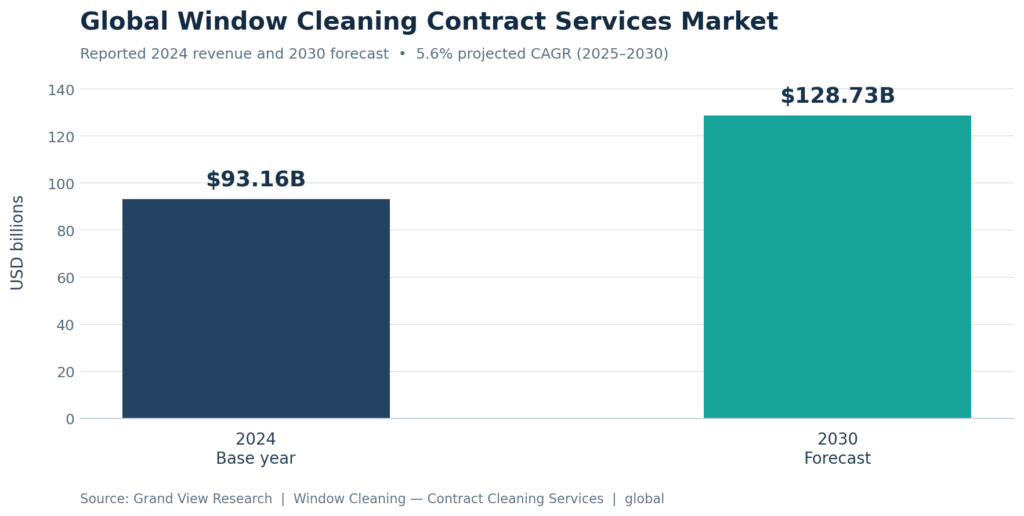
Source: Grand View Research, global window cleaning segment of contract cleaning services. The 2024 figure is the reported base year; 2030 is a forecast. These figures measure contracted services, not window-cleaning equipment sales or the revenue of small independent cleaners alone.

Where can a new business find demand?

Commercial maintenance and outsourced cleaning create opportunities. Suitable water-fed poles can make some jobs more practical.

The same research identifies North America as the largest regional market in 2024, while India has the highest forecast country-level growth rate through 2030.

Recurring storefronts can provide more predictable revenue. Still, investigate local properties, competition, prices and travel distances.

Market growth signals opportunity; a profitable service route is what turns it into a business.

3. Training, Licensing, Equipment and Startup Costs

A relatively small starting budget doesn’t make window cleaning risk-free. Slips, falls, broken glass and accidental property damage can cost far more than the equipment itself.

Check local requirements and work-at-height safety

Registration, insurance, permits and training requirements vary. Check local rules before offering specialist work.

The UK’s Health and Safety Executive advises avoiding work at height where reasonably practicable, including through suitable water-fed poles or safe indoor access. Where elevated work cannot be avoided, equipment selection, competence, supervision and rescue planning matter. This is UK-specific guidance, not a universal licensing rule.

Arrange appropriate insurance. Assess power lines, uneven ground, pedestrians and weather before starting.

Buy equipment for the jobs you actually offer

A basic setup may include squeegees, scrubbers, microfiber cloths, compatible cleaning products, extension poles, a purified-water system, protective equipment, secure storage and booking software.

Don’t buy specialist high-rise access equipment without the training and workload to justify it. Water-fed poles can reduce some work at height, but they still require competent use and site assessment.

Example window cleaning startup budget

Expense Illustrative USD budget
Squeegees, scrubbers and supplies $450
Water-fed pole and purified-water setup $900
Protective and safety supplies $250
Registration and initial insurance $900
Website, software and launch marketing $600
Working capital $1,200
Total $4,300

Planning assumptions, not supplier quotes or worldwide averages. The example excludes a vehicle, specialist access systems, extensive training and additional local requirements.

Get supplier quotations before investing; prioritize safe, sustainable work.

4. Create a Window Cleaning Business Plan and Set Profitable Prices

A $240 appointment may look lucrative—until you count the preparation, drive, cleaning time, supplies and insurance. Learning how to start a window cleaning business means understanding the economics of the whole job, not just the minutes spent on glass.

Build a practical business plan

Document customers, service area, equipment, prices and weekly capacity. A business plan should also test slow bookings and overrunning jobs.

Calculate the full cost of a booking

Consider this hypothetical residential job:

Job calculation Amount (USD)
Customer payment $240
Cleaning materials −$12
Transport and fuel −$18
Owner’s labour: 2.5 hours at $32 −$80
Payment processing −$6
Allocated insurance and equipment overhead −$34
Remaining before taxes and other costs $90

Illustrative figures, not prevailing market rates. The remaining $640 is roughly 11.4% of revenue; unbudgeted costs could reduce it further.

The $90 is not guaranteed net profit; unexpected delays and other expenses could reduce it.

Price the actual work

You can quote per pane, per window or per property, but adjust for access, condition, screens, interior cleaning, travel and safety requirements. Difficult access can increase costs substantially.

Eight storefronts each booking two $95 visits per month would produce $1,520 in monthly revenue, before expenses. Such work can be attractive when the locations are close together and the agreement clearly defines scope and frequency.

Don’t compete only on price. Know what each booking needs to earn.

5. Build Safe and Efficient Window Cleaning Operations

Even a strong quote can become unprofitable when jobs overrun, equipment fails or appointments are scattered across town.

Use the same workflow for every job

Enquiry → Property Assessment → Quote → Scheduling → Safety Check → Cleaning → Final Inspection → Payment → Follow-up

Confirm scope, access, weather and nearby pedestrians. Choose a safe method and inspect the finished work.

Make routes and service standards repeatable

Group nearby appointments and allow enough time for setup, travel and unexpected difficulties. Inspect and maintain squeegees, poles, hoses and access equipment; replace worn or damaged items promptly.

Track quotes, job margins, travel time and callbacks.

Hiring a second cleaner or purchasing more equipment should follow proven demand, appropriate training and sufficient cash flow—not just a crowded calendar.

Professional window cleaning combines consistent results with a process that protects customers, workers and margins.

6. Find Customers and Grow Your Window Cleaning Business

Visibility matters, but only when it brings enquiries from suitable local properties.

Make it easy to request a quote

A professional website should show your services, locations, genuine reviews, contact details and a simple quote request. Include before-and-after photographs where customers have given permission.

For local visibility, maintain an accurate Google Business Profile where available and eligible. Keep information current and request genuine reviews.

Pursue repeat work and referrals

Retailers, restaurants, estate agents and property managers can be useful contacts for regular storefront or building cleaning. Describe your cleaning frequency, access limitations, cancellation policy and service standards in each agreement.

Remind residential clients about seasonal cleaning and make rebooking easy.

A focused digital marketing strategy can bring together local search, customer reviews, referrals and carefully targeted advertising. Track completed bookings and acquisition costs not just website traffic or social media likes.

The goal is a dependable pipeline of profitable work, not the largest possible number of enquiries.

7. Common Window Cleaning Business Startup Mistakes

Starting a window cleaning business can seem straightforward once you have the equipment and your first customers, but common mistakes can quickly reduce your earnings. Underestimating travel time, accepting work beyond your safety capabilities or failing to protect a customer’s property can turn a routine booking into an expensive problem. Depending entirely on one-off appointments can also make income unpredictable. Identifying these risks early helps you quote accurately, work responsibly and build a service customers trust enough to book again.

Underpricing to win work. Quotes that ignore travel, labour and overhead may fill your calendar while draining your earnings.

Accepting unsafe high-access jobs. Specialist work requires the right competence, equipment and procedures. Don’t improvise a solution to secure a booking.

Ignoring route planning. Several nearby customers may be more profitable than more jobs spread across a large area.

Overlooking property protection and insurance. Inspect conditions, use appropriate methods and arrange suitable cover before taking on customers.

Relying only on one-time bookings. Seasonal residential work can be worthwhile, but repeat storefront and property-management contracts may reduce revenue volatility.

Build a reliable service whose costs you understand.

The Takeaway: Spotless Windows Aren't the Whole Business

Learning how to start a window cleaning business involves more than buying squeegees and finding someone willing to pay for a clean view.

Return to the Pane-to-Profit Framework: Positioning → Safety and Compliance → Job Economics → Customer Acquisition and Retention.

Choose the right customers, work safely, price your entire service and create reasons to book again. Those are the foundations of a business capable of sustainable growth.

If you’re planning to launch or expand a window cleaning company, ZH Consultancy can help you evaluate startup costs, prepare financial projections and develop a practical growth strategy.

Faq

Frequently Asked Questions About Starting a Window Cleaning Business

How much does it cost to start a window cleaning business?

Costs depend on equipment, transportation, insurance and service type. Our illustrative $4,300 budget covers a small operation but excludes a vehicle and specialist access equipment.

Do you need a licence to start a window cleaning business?

Requirements differ by location. Check business registration, insurance, local permissions and any work-at-height obligations before accepting jobs.

Is a window cleaning business profitable?

It can be if prices cover labour, materials, travel, insurance and overhead. Efficient routes and repeat clients can support stronger margins.

Can I start with no experience?

You can train in cleaning techniques, equipment handling and property protection. High-risk or specialist access work requires additional competence and safety arrangements.

Can I run a window cleaning business from home?

Often, where local rules allow it. You’ll still need suitable storage, transportation, insurance and any required approvals.

How do I get my first customers?

Use a clear website, local search visibility, genuine reviews and referrals. Contact nearby storefronts and property managers about appropriately priced repeat cleaning agreements.

Portrait of Zain Hameed
Read & reviewed by

Zain Hameed

CEO · ZH Consultancy

Business strategy specialist helping a global client base of 800+ businesses build credible plans, financial models and investor-ready presentations.

4.9/5 Upwork rating
800+ Businesses worldwide
4.8/5 PeoplePerHour rating

Book a Free Consultation

Have a business idea, growth challenge or investor deadline? Book a free consultation and get clear next steps from our team.

Call our team

+923104049517

Untitled design (2)

Business topics

Continue reading

Related insights