

In this article
A roofing contractor wants a container on Monday. A homeowner needs one collected before the weekend. Both sound like easy bookings until you discover the landfill closes early, the homeowner has filled the dumpster with concrete, and your truck needs a repair.
The container is the visible part of the business. The business itself is a sequence of promises about delivery, capacity, collection, and responsible disposal.
Learning how to start a dumpster rental business means making those promises profitable. This U.S. guide explains the market, fleet choices, startup investment, permits, operating systems, and customer acquisition. You will also see a worked financial model that separates revenue, owner labor, operating surplus, and cash requirements.
How to Start a Dumpster Rental Business With the Right Model
Customers rent a temporary waste container, load approved material, and pay you to deliver, collect, and arrange its disposal or recovery. The invoice may include a rental period, weight allowance, transportation, and disposal, with clearly disclosed charges for agreed extras.
A dump-trailer model leaves the entire trailer with the customer. A detachable-container trailer system lets a compatible towing vehicle and hoist trailer serve several separate bins. A truck-based roll-off dumpster business uses a purpose-built lifting system and compatible containers. These models have different investment, payload, and scheduling constraints.
Residential cleanouts, remodeling contractors, roofers, and commercial property managers also buy differently. Homeowners need help choosing size and understanding restrictions. Contractors may prioritize reliable exchanges and records. Permanent commercial collection is another service model, with different equipment and route commitments.
Choose a narrow starting offer and territory. A dumpster rental business plan should identify the customer, acceptable waste, equipment configuration, disposal destination, and jobs you will refuse. Starting a roll-off dumpster business does not mean you must serve every waste category or every neighboring town.
Research the Market at the Scale You Can Actually Serve
Fact.MR’s rental-market report, updated June 2026, estimates global dumpster and roll-off container rental revenue at $7.2 billion in 2025 and $7.44 billion in 2026. It forecasts $10.4 billion in 2036, equivalent to approximately 3.4% annual growth over 2026–2036.
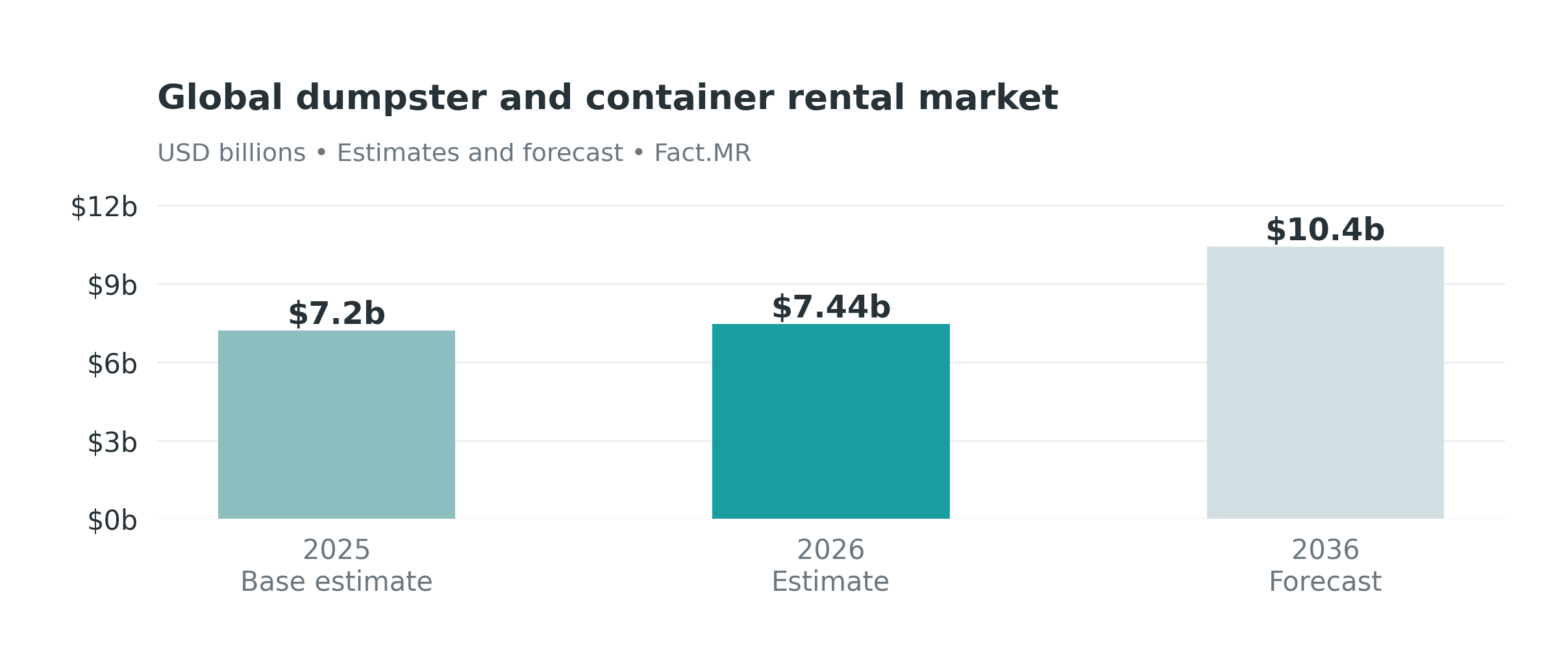
Chart 1. Global dumpster and roll-off container rental market, USD billions. The 2025 figure is a base-year estimate, 2026 an estimate, and 2036 a forecast. The category includes front-load, rear-load, and specialty containers, not just small residential roll-offs.
Source: Fact.MR market analysis.
For U.S. context, EPA estimates put construction and demolition debris generation at approximately 600 million U.S. tons in 2018. This older national baseline includes roads and bridges and excludes municipal solid waste. It is neither a current revenue estimate nor a count of material available to independent rental operators.
The useful question behind how to start a dumpster rental business is local: which buyers have recurring problems you can solve within a profitable driving radius?
Review building permits, renovation activity, competing quotations, container availability, and complaints about late pickups. Interview roofers and property managers about their existing providers. Check seasonal weather, construction slowdowns, disposal access, and travel times. A growing suburb can still be a poor territory if every load requires a long landfill journey.
ZH Consultancy’s market research services can help test demand and positioning. Validate actual customer interest before treating a national forecast as permission to buy equipment.
Compare the Advantages With the Commitments
There are real attractions: repeat commercial buyers, tangible assets, and a service customers need when projects generate bulky waste. You can also build a reputation around straightforward prices and dependable collections rather than endless discounts.
Potential advantage | Commitment that comes with it |
|---|---|
Containers can earn repeatedly | Each unit needs storage, inspections, repairs, and recovery |
Contractors can become repeat customers | Their schedules may change with little notice |
A compact territory can support efficient routes | Expansion can add driving faster than profitable demand |
A small owner-operated fleet is possible | One truck failure can interrupt the whole service |
Before deciding how to start a dumpster rental business, consider whether you can manage customers while driving and arranging disposal. Weekend rentals still create weekday obligations. A container sitting with a customer is an asset temporarily unavailable to the next buyer, even when nobody is loading it.
How to Start a Dumpster Rental Business With Enough Capital
The following dumpster rental startup costs are illustrative U.S. cash-planning scenarios in USD for November 2026, not dealer quotations or industry averages. The lean option assumes you already own a suitable commercial-use towing vehicle. The larger scenario buys a used truck with its lifting equipment included.
Launch funding item | Trailer system | Used roll-off truck |
|---|---|---|
Truck preparation or truck purchase | $4,000 | $90,000 |
Detachable-bin hoist trailer | $18,000 | Included in truck |
Compatible containers | $16,000 for 4 | $36,000 for 6 |
Initial insurance, registrations, and permits | $4,000 | $7,000 |
Yard deposit, tools, and securement equipment | $3,000 | $6,000 |
Branding, website, and software setup | $2,500 | $4,000 |
Initial marketing | $1,500 | $3,000 |
Working capital | $10,000 | $18,000 |
Emergency repair reserve | $5,000 | $10,000 |
Total launch funding | $64,000 | $174,000 |
The trailer scenario excludes purchasing the towing truck. The truck scenario assumes a cash purchase; finance deposits and monthly repayments create a different cash schedule. Both exclude personal living reserves, employees, buying property, major yard improvements, and any training you still require.
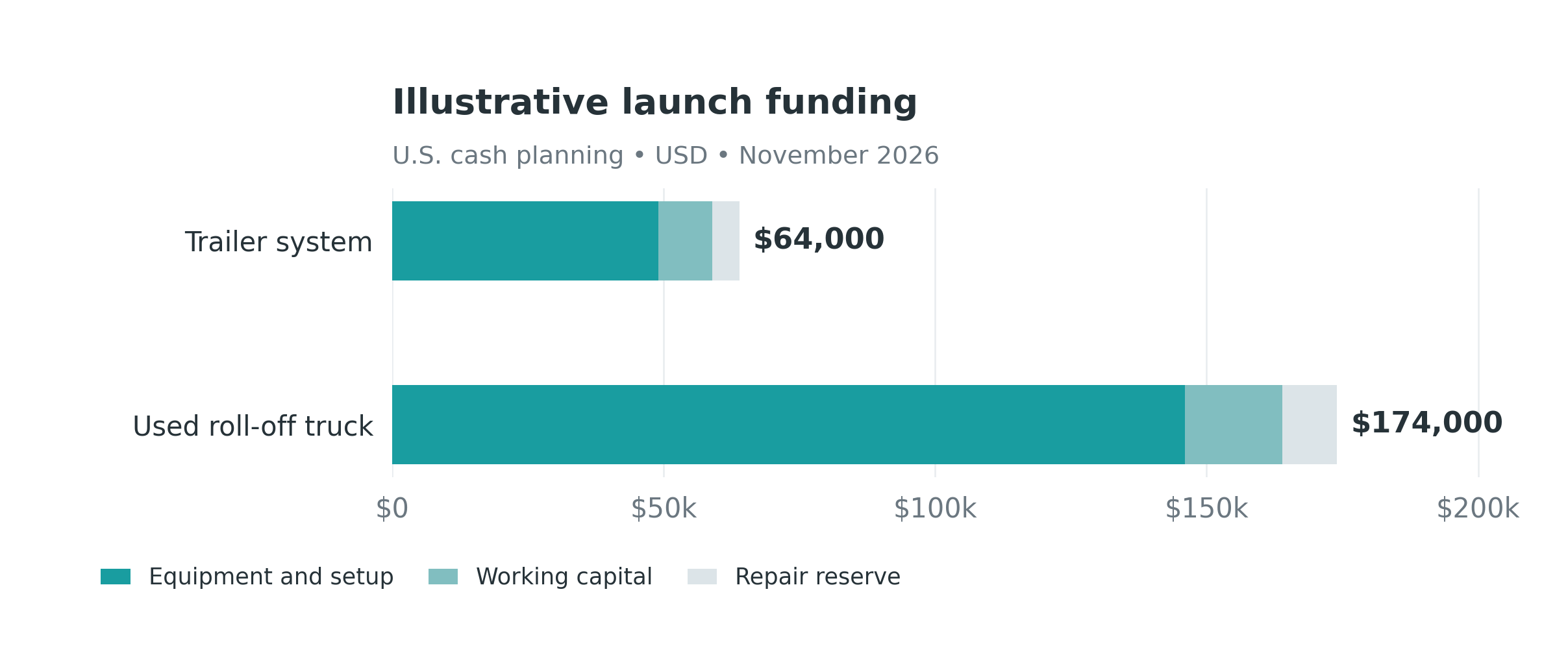
Chart 2. Illustrative launch funding, USD, November 2026: $64,000 for a detachable-bin trailer system and $174,000 for a used truck system. Working capital and repair reserves are cash balances, not immediate expenses. Assumptions and exclusions are stated above.
Source: ZH Consultancy scenario calculations; cost-planning approach informed by the SBA business planning guide.
Replace every allowance with supplier, yard, and dumpster rental insurance quotations. Inspect used equipment independently and confirm compatibility before paying deposits. A cheap truck requiring immediate hydraulic work can consume the money intended to fund disposal charges.
Separate one-time purchases from recurring fuel, tipping fees, maintenance, insurance, rent, software, marketing, and bookkeeping. Review dumpster rental startup costs against a 13-week cash forecast. Commercial customers who pay after service can leave you funding fuel and disposal long before the invoice reaches your bank.
Build a Dumpster Rental Business Plan Around Capacity and Cash
Your dumpster rental business plan should connect market evidence, fleet capacity, and financial assumptions. Begin with an executive summary explaining the territory, customer, equipment model, services, and specific reason buyers would choose you.
For example, a hypothetical roll-off dumpster business might focus on small remodelers and property cleanouts within a compact service area. Its promise could be clear weight allowances, accurate delivery windows, and documented pickups. That proposition needs buyer interviews and competitor analysis, not just an attractive business name.
Describe the customer profiles, sales channels, pricing approach, suppliers, disposal partners, yard arrangements, staffing, and operating workflow. Explain who answers requests, approves placements, drives, invoices, follows up, and covers absences. Record legal requirements and the point at which you would add another vehicle or employee.
Build monthly revenue projections from completed rentals and the average collected invoice. Estimate direct costs, fixed overhead, owner compensation, profit and loss, cash flow, and break-even. Include dumpster rental startup costs, funding sources, repayment commitments, and milestones. A forecast selling more rental days than your bins can provide is arithmetic fiction.
Prepare a slower-sales case, a higher-disposal-cost case, and a truck-downtime case. What happens if collections take two weeks longer or a container needs replacing? Identify the reserve and decision that keeps the company operating.
Set measurable milestones such as tested delivery procedures, approved disposal accounts, qualified inquiries, completed rentals, and invoice collection. Review actual performance weekly and update assumptions monthly.
ZH Consultancy’s business plan writing and financial modeling services can help develop the commercial case. Keep evidence for your territory and equipment choices attached to the plan; lenders and partners need to understand what supports the numbers.
How to Start a Dumpster Rental Business Legally
There is no single nationwide dumpster license. Requirements depend on where you collect waste, where you dispose of it, your vehicle configuration, and the materials accepted.
Register the business and confirm local permissions
Choose a structure with advice on liability and tax treatment. A sole proprietorship is simpler to establish in many situations; an LLC creates a separate entity but does not remove personal responsibility for your own negligent driving or conduct. The SBA launch guidance explains the broader registration process.
Register the entity and any required trade name, obtain an EIN when required through the IRS, and open a business bank account. The IRS issues EINs free. Ask an accountant about sales tax on rentals and services, employment taxes, depreciation, and estimated tax payments.
Check hauling licenses, franchise restrictions, container-placement permissions, yard zoning, outdoor storage, and whether storing loaded containers would trigger additional waste-facility approvals. Do not assume an industrial-looking property permits your intended activity.
For example, Austin requires private waste haulers operating for a fee within the city to obtain a license. Vehicle requirements and exemptions are part of that local system. A license in one city is not authority to collect everywhere.
Match driver and carrier obligations to the equipment
Under FMCSA classifications, a combination generally requires a Class A CDL when its combined rating or actual weight, whichever is greater, reaches 26,001 pounds and the towed unit’s rating or actual weight, whichever is greater, exceeds 10,000 pounds. Class B generally applies to qualifying single heavy vehicles. Confirm the exact configuration with your state licensing agency before buying.
A CDL and a USDOT number are different requirements. Federal interstate registration can apply at 10,001 pounds under the relevant rating or weight tests; states may impose intrastate registration too. Check applicable medical qualification, inspections, driver records, hours rules, and any required operating authority. Review the DOT drug and alcohol testing requirements, including the rules for owner-operators.
Arrange dumpster rental insurance and customer agreements
Dumpster rental insurance should reflect waste hauling and container placement. Discuss commercial auto, general liability, equipment protection, workers’ compensation obligations, and pollution-related exposures with a licensed broker. Describe the actual waste streams, drivers, and storage arrangements. Confirm exclusions and contract-required limits rather than assuming a general small-business policy covers everything.
A local attorney should review rental terms covering placement authority, accepted materials, access, loading limits, collection dates, extra charges, cancellations, damage, and payment authorization. These examples are planning guidance; verify current state and local requirements for your operation.
Choose Equipment That Fits Both the Load and the Location
Equipment compatibility matters as much as purchase price. Check the truck or trailer’s lifting system, container dimensions, empty weight, payload, axle limits, towing ratings, brakes, and securement arrangements. Obtain the manufacturer’s operating requirements and service history.
Common container volume | Typical inquiry to investigate | Limitation to explain |
|---|---|---|
10–15 cubic yards | Smaller cleanouts or limited space | Dense waste can exceed weight limits before filling it |
Around 20 cubic yards | Remodeling and larger household projects | Access and material mix still determine suitability |
30–40 cubic yards | Bulky construction debris or major clearances | Height, loading space, truck access, and payload need checking |
These are broad examples, not a sizing guarantee. Concrete, soil, shingles, and mixed household waste behave differently. A permitted fill line and a legal payload matter more than the number painted on the container.
Anyone learning how to start a dumpster rental business should inspect routes and placement sites before promising delivery. Confirm turning room, overhead clearance, driveway conditions, slopes, underground features, and room to operate the lifting system. Document surface condition and use suitable protection under your operating procedure without promising damage is impossible.
Arrange a legal yard with maneuvering space, security, maintenance access, and permission for the exact storage activity. Number every container, track condition, and schedule inspections of doors, welds, rollers, hydraulic equipment, tires, and securement components. Verify how dumpster rental insurance treats containers away from your premises.
Choose suppliers on compatible specifications, warranties, parts access, delivery, and repair support. Request a demonstration and verify rated capacity. A mixed fleet of bargain bins can become expensive if the truck cannot handle them consistently.
Establish Disposal and Daily Operating Procedures
Open accounts with suitable licensed disposal or recovery facilities before advertising. Obtain written acceptance rules, rates, minimum charges, surcharges, hours, queue expectations, payment terms, and account requirements. Identify a lawful backup destination for each accepted material category.
EPA’s C&D landfill guidance distinguishes construction debris from other waste and highlights additional regulation for materials such as asbestos. A facility accepting clean concrete may reject a load contaminated with household trash.
Publish a specific prohibited-material list based on facility rules and your authorizations. Explain restrictions for paints, chemicals, batteries, liquids, tires, appliances, and regulated materials as applicable. EPA household hazardous waste guidance explains why hazardous leftovers need appropriate handling. Do not accept unknown or suspect material because a customer calls it harmless.
Run each booking through inquiry, waste screening, quotation, permission checks, payment terms, dispatch, delivery photographs, pickup, weighing, disposal receipt, final invoice, and container inspection. Retain the scale ticket against the correct rental so weight adjustments are supportable.
Use trained drivers and equipment-specific procedures. FMCSA cargo securement guidance includes provisions for roll-on/roll-off and hook-lift containers; the applicable rules depend on the equipment. Plan tarping, load checks, clear work zones, and safe responses to overloaded bins. An extra charge does not make an unsafe load transportable.
Schedule weather disruptions, disposal closures, blocked pickups, and breakdowns realistically. Keep customers informed early. Build reciprocal backup arrangements with a suitable operator, subject to contract, insurance, and licensing checks, rather than improvising after the truck stops.
Set Dumpster Rental Pricing From the Full Rental Cycle
Good dumpster rental pricing starts with delivery, customer occupancy, collection, disposal, and turnaround. A low advertised rate can lose money when the customer is farther away or the waste is heavier than assumed.
Define the container, rental period, accepted material, included weight, delivery zone, taxes, and permitted extras. Explain extension days, excess weight, prohibited-item charges, cancellation rules, and unsuccessful collection attempts before payment. Do not hide ordinary operating costs inside surprise fees.
Work through one complete rental
Suppose a hypothetical rental sells for $525 before sales tax. It includes an assumed two U.S. tons of approved waste. At an illustrative $70 per ton, disposal costs $140. Add three total owner labor hours at $30 per hour for delivery, pickup, travel, and disposal; $45 fuel; $25 maintenance and wear; and $15 processing and other direct costs.
Direct cost is $315. Contribution toward fixed overhead and surplus is $210, or 40% of revenue. The disposal rate, travel time, and selling price are assumptions to replace with local evidence.
For monthly planning, assume $5,500 fixed economic costs: $1,000 owner administration, $1,000 equipment depreciation, and $3,500 insurance, yard, software, marketing, and other overhead. Job labor remains in direct costs.
Monthly economic result | 20 rentals | 27 rentals | 32 rentals |
|---|---|---|---|
Revenue at $525 each | $10,500 | $14,175 | $16,800 |
Direct costs at $315 each | $6,300 | $8,505 | $10,080 |
Contribution | $4,200 | $5,670 | $6,720 |
Fixed economic costs | $5,500 | $5,500 | $5,500 |
Operating surplus or loss | −$1,300 | $170 | $1,220 |
Break-even is $5,500 divided by $210, or 26.19 rentals: you need 27 complete rentals under these assumptions. At 32 rentals, owner job labor totals $2,880, with another $1,000 allowed for administration, before the $1,220 economic surplus. Legal accounting treatment depends on business structure.
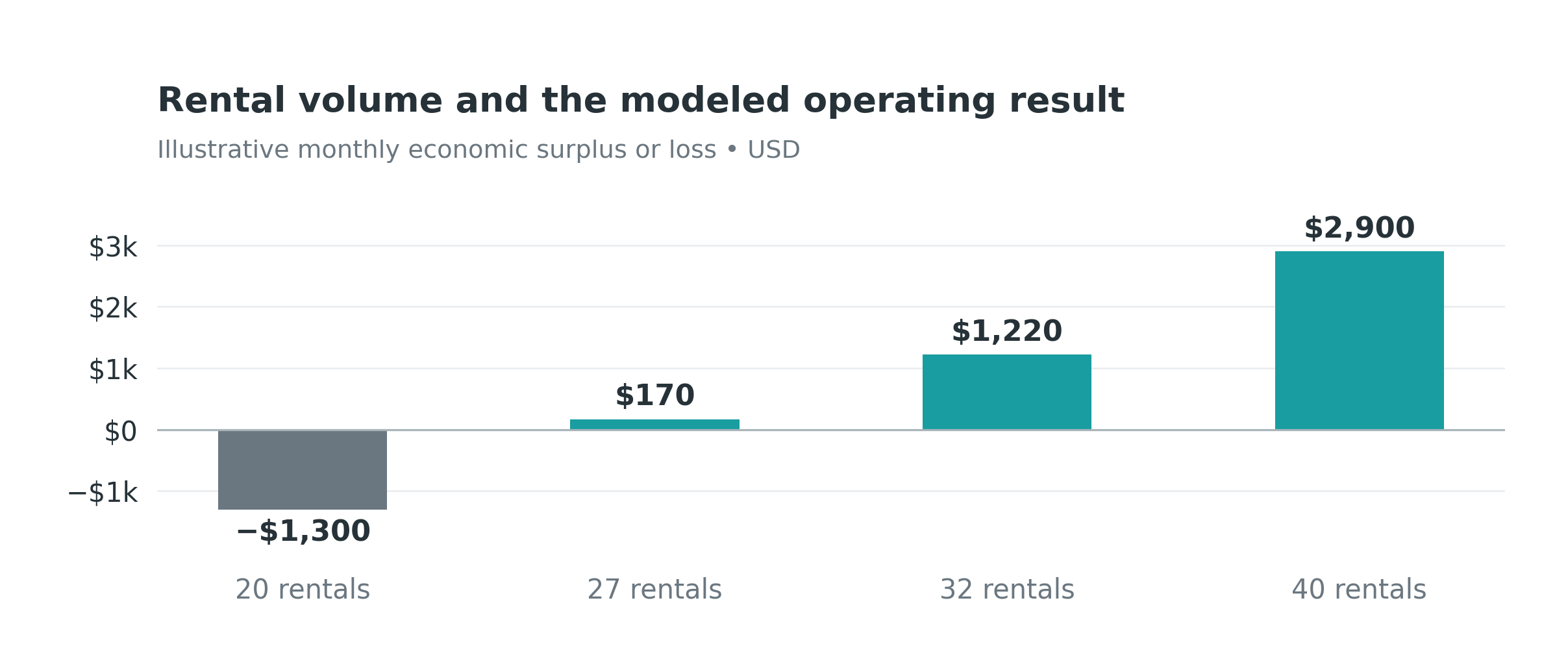
Chart 3. Illustrative monthly economic operating result in USD at 20, 27, 32, and 40 rentals: −$1,300, $170, $1,220, and $2,900. Assumptions: $525 revenue and $315 direct cost per rental, plus $5,500 monthly fixed economic costs including owner administration and depreciation.
Source: ZH Consultancy illustrative model above; break-even method described by the SBA.
The lesson behind how to start a dumpster rental business is that busy equipment can still produce a thin return. Depreciation is noncash, while loan principal consumes cash; financing, taxes, and replacement purchases require a separate cash forecast. Do not treat dumpster rental startup costs as reimbursed simply because the first bookings arrive.
Test weight, time, and container capacity
If actual waste averages three tons instead of two, another $70 of assumed disposal cost reduces contribution to $140 unless charges recover it. Transparent dumpster rental pricing might specify an excess-ton rate, but that rate also needs to cover added wear and administration.
With six bins and a 30-day month, you have 180 container-days. If each completed rental occupies a bin for four days including turnaround, 32 rentals use 128 days, or 71.1% utilization. The theoretical ceiling is 45 rentals before delays and buffers. Longer rentals require higher prices or a different fleet plan; revenue forecasts cannot ignore physical availability.
Give the Business a Clear and Credible Identity
Choose a name people can spell after hearing it once. Check business-name availability, trademarks, domains, and social handles. Avoid branding that suggests a municipal affiliation, service territory, or certification you do not have.
When considering how to start a dumpster rental business, connect the brand to a useful promise: clear loading rules, dependable communication, and an understandable invoice. Use consistent colors, type, uniforms, estimates, vehicle lettering, container identification, and business cards.
A logo should work on a dirty steel container and a small phone screen. Request scalable files and simple versions for signage. ZH Consultancy’s logo design services can support that system. Save large decorative spending until the operation delivers the experience the branding promises.
Prepare the Materials Commercial Buyers Actually Request
Roofing companies, remodelers, property managers, and facilities teams may need a company profile, service-area sheet, insurance certificate, sample rental agreement, rate structure, and references. A concise capability statement can explain fleet suitability, accepted materials, reporting, and contact arrangements.
Use real photographs and approved customer examples. A startup can describe its process honestly without inventing years of company history. Keep brochure claims aligned with the actual fleet and disposal relationships.
Company profile design becomes useful when you repeatedly approach commercial buyers. A homeowner-focused launch may need only a clear website, rental terms, and a practical one-page loading guide rather than a large sales presentation.
How to Start a Dumpster Rental Business With a Useful Website
Your website should help customers choose and book without guessing. Show container options, realistic project examples, accepted materials, weight allowances, rental periods, service areas, availability procedures, and contact information. Explain how quotations change with location or waste type.
Make the mobile route to a quotation short. Ask for the address or ZIP code, material, preferred dates, size, and placement details. Show any known charges before checkout. Distinguish a booking request from a confirmed delivery and prevent two customers from buying the same unavailable container-days.
Choose the platform around the booking workflow
Platform | Where it can fit | What to verify |
|---|---|---|
WordPress | Flexible service pages, content, and rental integrations | Updates, hosting, plugin support, and inventory synchronization |
Wix | A simpler service website and quotation journey | Rental integrations, date handling, and available customization |
Squarespace | A clear brochure site with strong project presentation | Booking integration and recurring application costs |
Shopify | A commerce-led business using rental extensions | Multi-day inventory, delivery logic, and total application costs |
Specialist rental platform | Asset availability, agreements, and rental workflows | Container-days, delivery zones, overages, reporting, and exports |
For example, Booqable’s dumpster rental software describes availability tracking, rental periods, contracts, and website integrations. Treat that as a vendor capability list to test with your actual workflow, not proof that every operational requirement is covered.
Buy your domain in an account controlled by the company; ICANN’s registrar list is a starting point. Keep renewal reminders, recovery details, and multifactor authentication current. Confirm ownership of the website, analytics, booking data, and payment accounts.
For self-hosted WordPress, compare hosting renewal costs, support, SSL, backups, restoration, performance, and upgrade options. As checked November 5, 2026, Hostinger Premium advertises $1.99 per month equivalent with $95.52 prepaid for 48 months, renewing at $10.99 per month for the same term. Taxes, domain renewals, and extras may apply; verify checkout. A low introductory rate is not your ongoing cost.
Test page speed, keyboard access, readable text, labeled forms, successful inquiries, and payment handling. Publish genuine reviews and project photographs with permission. Use a secure processor; never collect card details through ordinary email.
Compare a local agency, freelancer, and remote team on scope, quality checks, communication, handover, revisions, and maintenance. ZH Consultancy is a Pakistan-based provider of website development services for international clients; request a defined project scope rather than assuming an official fixed price. Agree responsibility for ongoing website maintenance so broken forms and outdated software do not interrupt bookings.
Find Customers and Measure the Bookings That Pay
Start with local intent. Create an eligible Google Business Profile using accurate business details and the actual service area. Google’s rules distinguish businesses customers can visit from service-area operations. Do not invent a storefront address for visibility.
Google Business Profile services can help organize the listing. Publish service and location pages that answer real questions, supported by genuine coverage. Explain loading rules, project suitability, and rental terms rather than producing dozens of interchangeable city pages.
Build relationships with roofers, remodelers, restoration contractors, real estate professionals, and property managers. Ask about current collection problems and propose a workable service arrangement. Request honest reviews after successful rentals and use permission-based reminders for repeat customers. Local Facebook groups and project photographs can also support awareness when community rules permit.
If you are working out how to start a dumpster rental business with paid advertising, begin with a small, defined territory and the sizes you can supply. Match advertisements to landing pages showing your dumpster rental pricing and availability process. Google Ads management should connect spend to qualified inquiries and completed rentals.
For example, a hypothetical $900 campaign producing 30 qualified inquiries and nine first-time paying customers costs $30 per inquiry and $100 per acquired customer. At the earlier $210 contribution per rental, that leaves $110 after advertising acquisition cost, before fixed costs. Include agency fees and other sales costs when calculating the full figure. Reconcile this with marketing already included in overhead to avoid counting the same spending twice.
Track response time, quote acceptance, collected invoices, repeat customers, utilization, and contribution by channel. Digital marketing support should reveal whether suitable bookings cover acquisition cost. More clicks cannot rescue a quotation process that leaves callers waiting all day.
Solve Operating Problems Before They Become Expensive Habits
Rentals look busy but contribute too little
The cause may be long routes, heavier loads, or excessive included days. The consequence is low earnings despite high occupancy. Review each completed rental and revise territory, weight allowance, or dumpster rental pricing. The benefit should be higher contribution per container-day, not merely a higher headline price.
Pickups are blocked or customers extend unexpectedly
Poor instructions and weak scheduling consume your next delivery slot. Confirm access and pickup dates, send reminders, and document approved extensions. Reserve turnaround capacity so one delay does not force several broken promises.
Damage and waste disputes consume management time
Missing photographs, unclear exclusions, and unsuitable dumpster rental insurance make claims harder to resolve. Record placement condition, permissions, loading instructions, and scale tickets. Escalate suspect waste through an approved procedure instead of arguing beside the truck. Better evidence supports fair decisions and fewer repeated disputes.
Knowing how to start a dumpster rental business includes assigning someone to each correction. Track callbacks, disputed charges, empty miles, and missed collections. If nobody checks the cause, the same problem usually returns wearing a different customer’s name.
Avoid the Startup Mistakes That Lock Up Cash
New operators researching how to start a dumpster rental business often buy equipment before confirming legal access to the market. Check local hauling permissions, approved storage, and disposal accounts first. A financed truck cannot create permission to collect waste.
Do not underestimate dumpster rental startup costs by omitting working capital, insurance installments, repairs, or household needs. Compare financing offers using total repayment, fees, security, and cash-flow effects; obtain professional advice before committing.
Avoid incompatible containers, undocumented used equipment, and promises to accept anything. Do not expand the service radius because one distant caller sounds enthusiastic. Calculate the full trip and the other bookings displaced.
Finally, do not depend on one contractor, one landfill, or one marketing channel. Keep payment terms realistic and customer records accessible. Adding containers is useful only when transport capacity, safe operations, and profitable demand can support them.
Prepare for Growth Through Better Information and Recovery
Future opportunity includes material separation, clearer recycling documentation, online booking, and better dispatch information. These directions matter because customers and disposal partners need to know what is in each container and where it went.
A roll-off dumpster business can investigate separate streams for clean concrete, metal, wood, or other approved materials when local facilities and economics support them. Do not label a load recycled without evidence of its actual destination and treatment.
Use GPS, asset tracking, reminders, and reporting to reduce missed pickups and improve availability. AI can help draft communications, but a person must check prices, restrictions, and commitments. Expand the fleet when repeated lost sales, utilization records, and contribution justify it, not because a competitor bought a larger truck.
Put the First 90 Days on a Practical Schedule
The sequence below assumes you can secure the required funding, driver qualifications, equipment, and approvals. Availability and licensing delays may move the launch date; never accept work before the operation is ready.
Period | Main action | Evidence needed |
|---|---|---|
Days 1–15 | Interview buyers and evaluate territory | Defined demand, competitors, and disposal routes |
Days 16–30 | Complete planning and permission checks | Funding model, legal pathway, and insurance quotations |
Days 31–45 | Inspect equipment and arrange facilities | Compatible fleet, lawful yard, and disposal accounts |
Days 46–60 | Build branding, website, and procedures | Tested quotation, booking, and delivery workflow |
Days 61–75 | Build partnerships and prepare demand | Qualified pipeline and confirmed launch readiness |
Days 76–90 | Deliver authorized rentals and review results | Actual weights, time, contribution, and collections |
Your dumpster rental business plan should identify who owns each milestone. The practical test of how to start a dumpster rental business is whether real evidence supports the next commitment. If delivery time or disposal cost differs from the model, correct the model before increasing marketing spend.
The Takeaway
Learning how to start a dumpster rental business means managing the complete rental cycle. Select a customer and territory, confirm permission to operate, match equipment to legal payload, and know the contribution earned by each container-day.
Protect working capital and collect reliable operating records from the first rental. A small fleet serving suitable customers consistently can provide better evidence for growth than a larger fleet built on optimistic assumptions. ZH Consultancy can help connect research, forecasts, branding, and the booking experience while you manage the local transport, waste, and regulatory responsibilities.
Faq
Frequently Asked Questions
Illustrative dumpster rental startup costs here are $64,000 for a detachable-bin trailer system when a suitable towing truck is already owned, or $174,000 for a used roll-off truck setup. These are scenarios, not averages or minimums. Replace allowances with quotations and add personal living reserves, staffing, property, training, and financing costs where needed.
It can be, but utilization alone does not establish profit. The illustrative 32-rental model produces $16,800 revenue and $1,220 economic operating surplus after direct costs, owner labor allowances, and fixed costs including depreciation. Dumpster rental pricing must cover the full cycle. Cash available after financing and tax can differ substantially.
Possibly. Requirements depend on vehicle and combination ratings or actual weights, configuration, and other applicable rules. A heavy truck and a truck-trailer combination can require different CDL classes. Check the exact equipment with your state licensing agency; remaining below a CDL threshold does not automatically remove other commercial vehicle obligations.
You may arrange transport through an appropriately authorized operator, subject to local rules and suitable contracts. Your dumpster rental business plan must account for transport prices, scheduling control, insurance, service failures, and responsibility for the waste. Outsourcing reduces some equipment ownership needs but does not automatically remove regulatory or customer obligations.
Dumpster rental insurance commonly involves commercial auto, liability, and equipment protection, with workers’ compensation and pollution-related coverage depending on activities and requirements. Explain your waste streams, drivers, yard, and container placement to a licensed broker. Confirm exclusions, required limits, and subcontracted hauling arrangements before accepting rentals.
Buy for validated demand, transport capacity, rental duration, and available cash. Six containers are used in this guide’s larger illustration, not offered as a universal recommendation. If bins remain with customers longer than planned, your booking capacity falls. For a roll-off dumpster business, this is also a transport-capacity decision. Add units when records show profitable demand and your collection system can handle it.
Use a credible local profile, helpful service pages, contractor relationships, and prompt quotation follow-up. Ask early customers for honest reviews and track which channels produce collected rentals. If you are learning how to start a dumpster rental business, test a modest advertising budget only after the booking and delivery process works reliably.

Zain Hameed
Business strategy specialist helping a global client base of 800+ businesses build credible plans, financial models and investor-ready presentations.
In this article
Book a Free Consultation
Have a business idea, growth challenge or investor deadline? Book a free consultation and get clear next steps from our team.
Call our team
+923104049517
Email us
info@zhconsultancy.com

Business Topics
Business topics
Continue reading
Related insights

How to Start a Laundromat Business: A Complete U.S. Founder’s Guide
Learn how to start a laundromat business in the USA: market

How to Start a Construction Business in the USA
A homeowner wants to sign a $75,000 remodeling contract on Friday.

How to Start a Plumbing Business in the USA
At 7:15 on Monday morning, a homeowner calls about water coming

How to Start a Car Rental Business in the USA: A Founder’s Practical Guide
A family lands after midnight. They do not care whether your

How to Start a Landscaping Business: Costs, Licenses, Marketing and Profit
Picture two lawns on the same street. One homeowner wants a

How to Start a Cafe Business in the USA: Costs, Licenses, Marketing and Profit
You’re standing inside an empty storefront, and you can already picture