

In this article
Choosing law firm website developers in New York starts with a practical question: can this team help the right prospective clients understand your practice and contact it confidently? An attractive homepage matters, but the full project includes attorney profiles, practice information, secure intake, search visibility, accessibility, and reliable ownership after launch.
New York City also presents distinct buying situations. A Manhattan commercial practice, a Queens immigration firm, and a Brooklyn family lawyer need different messages and contact paths. Copying one legal template across all three can hide the information visitors actually need.
This guide explains how to define the project, compare published prices, assess developers, and measure results. It uses New York City data, current New York professional rules, and clearly labeled financial examples. Research and advertised pricing were checked on November 5, 2026. The city is the geographic focus; professional obligations discussed here are New York State rules and require review by the firm’s counsel.
What Your Firm Should Expect From a Website Project
Experienced law firm website developers in New York should begin with your practice, audience, and intake process. Ask who you want to reach, which matters you accept, where your lawyers are admitted, and what happens after someone submits an inquiry. These answers shape navigation and page content before visual design begins.
Good law firm web design turns that strategy into clear choices. A prospective client should quickly identify the relevant practice area, see who handles it, and understand the next step. A corporate decision-maker may first examine partner experience; an individual facing an urgent problem may need a working phone number immediately.
The scope of legal website development should include content responsibilities, a page inventory, form routing, accessibility checks, performance work, launch support, and staff training. Clarify whether the provider writes original drafts, edits supplied text, or simply places your existing content into a new layout. Attorney review needs an owner and an approval deadline.
Define success through completed tasks: a visitor can find a relevant service, verify attorney credentials, and submit a minimal inquiry successfully. Require those tasks to work on an ordinary phone as well as a presentation screen. A clear scope makes bids comparable and gives the firm a practical basis for accepting the finished work.
Separate launch essentials from later additions. A small practice may first need accurate service pages, complete biographies, dependable contact options, and a manageable editing system. A resource library, additional translations, or a complex CRM integration can follow when there is a clear owner and business need. Phasing the work helps the firm avoid paying for features that nobody has time to operate.
The New York City Audience Behind the Search
When evaluating law firm website developers in New York, use local evidence to challenge assumptions about your audience. The following figures describe New York City, rather than the state or the wider metropolitan area.
City indicator | Published figure and period |
|---|---|
Population estimate | 8,584,629; July 1, 2025 |
Population change | −2.5%; April 2020 estimate base to July 2025 |
Median household income | $80,483; 2020–2024, in 2024 dollars |
Foreign-born residents | 36.6%; 2020–2024 |
Language other than English at home | 47.7%; residents aged 5+, 2020–2024 |
Households with a computer | 94.7%; 2020–2024 |
Households with broadband | 90.5%; 2020–2024 |
Source: U.S. Census Bureau, New York City QuickFacts. Periods differ by indicator; household connectivity is not website traffic or device share.
These figures support testing clear language, translation needs, and lightweight pages. They do not establish which language your particular clients prefer or what they can spend. New York law firm websites should combine public context with the firm’s own anonymized inquiry records and interviews with intake staff.
The NYC Department of Small Business Services reported more than 183,000 small businesses operating in the city in December 2025. That dated citywide count provides commercial context; it is neither a count of law firms nor a forecast of paying legal clients. A firm targeting business owners should validate its niche before commissioning dozens of service pages. ZH Consultancy’s market research services can support that audience assessment.
How Borough Context Can Change the Website Brief
The strongest proposals from law firm website developers in New York explain how location affects useful content without inventing local offices or neighborhood demand statistics. The examples below are planning scenarios, rather than claims about the typical residents or legal needs of each borough.
Illustrative practice context | Useful website response |
|---|---|
Manhattan commercial firm serving Midtown or the Financial District | Explain industries served, partner responsibilities, and how business inquiries are assigned. |
Downtown Brooklyn family or housing practice | Describe the consultation process, accepted matters, and actual meeting arrangements. |
Queens firm serving clients around Jamaica or Flushing | Assess language demand from real inquiries; provide reviewed translations where justified. |
Bronx litigation practice near Grand Concourse | Make contact options, office access, and the initial information request easy to understand. |
Staten Island estate or real estate practice serving St. George | Explain appointment options, preparation steps, and the firm's actual geographic coverage. |
An office page should help someone reach a real location. Include accurate contact details, meeting instructions, accessibility information, and photographs that represent the firm. A service-area statement should explain genuine coverage and jurisdiction.
Use discovery conversations to confirm how people actually meet the team. Some matters may start by phone, while others need a scheduled office appointment or secure video consultation. Explain the available options without implying that every lawyer is licensed everywhere or that every issue can be handled remotely. Contact instructions should reflect the firm’s working arrangements, including what happens outside staffed hours.
Do not turn every neighborhood name into an almost identical landing page. If one page answers the same questions for several nearby areas, a well-maintained regional page may serve readers better. Build additional pages when the practice has distinct services, evidence, or useful location information to offer.
Pages and Content That Help Visitors Decide
For law firm web design, prioritize the decisions a visitor needs to make. The homepage should establish the practice, the people responsible for it, the area served, and a clear contact route. Avoid opening with a large video that delays the useful information or a slogan that could describe any firm.
Practice Pages With a Clear Purpose
Each major practice page should explain the matters accepted, the intended client, the general process, and what an initial consultation involves. It should also identify limits where appropriate. Someone seeking a service the firm does not offer should discover that before completing a long form.
Keep educational material distinct from individualized legal advice. A lawyer should review statements about procedures, deadlines, fees, and possible outcomes. Assign a review date to content that may become stale; an old article can still attract visitors long after the original author has forgotten it.
Attorney Profiles and Credible Evidence
Attorney profiles should present accurate admissions, roles, education, experience, and contact information. Explain what a lawyer actually does within the practice. Awards, memberships, reviews, and case descriptions need verification, appropriate permissions, and counsel’s approval before publication.
When briefing law firm website developers in New York, provide a source for each material claim. Avoid turning a selected result into an implied promise. Stock photography should illustrate the page without representing actors as the firm’s lawyers or implying an office the firm does not occupy.
A Consistent Identity and Contact Path
Effective legal website development also makes future editing manageable. Use reusable layouts for biographies, services, and articles, with clear fields that staff can update. Consistency reduces the risk of a new profile losing its contact button or a new article appearing without its review information.
Visual consistency supports law firm web design when the logo, typography, photography, and downloadable materials belong to the same system. ZH Consultancy offers logo design and graphic design services for firms preparing those assets. New York law firm websites benefit most when branding reinforces clear information and accurate representation.
Mobile Performance and Accessibility
Ask law firm website developers in New York to demonstrate the actual inquiry journey on a phone: open a practice page, read a biography, tap the number, complete the form, and recover from an error. Check on a slower connection and with a smaller screen. Household internet statistics cannot tell you your own mobile traffic split.
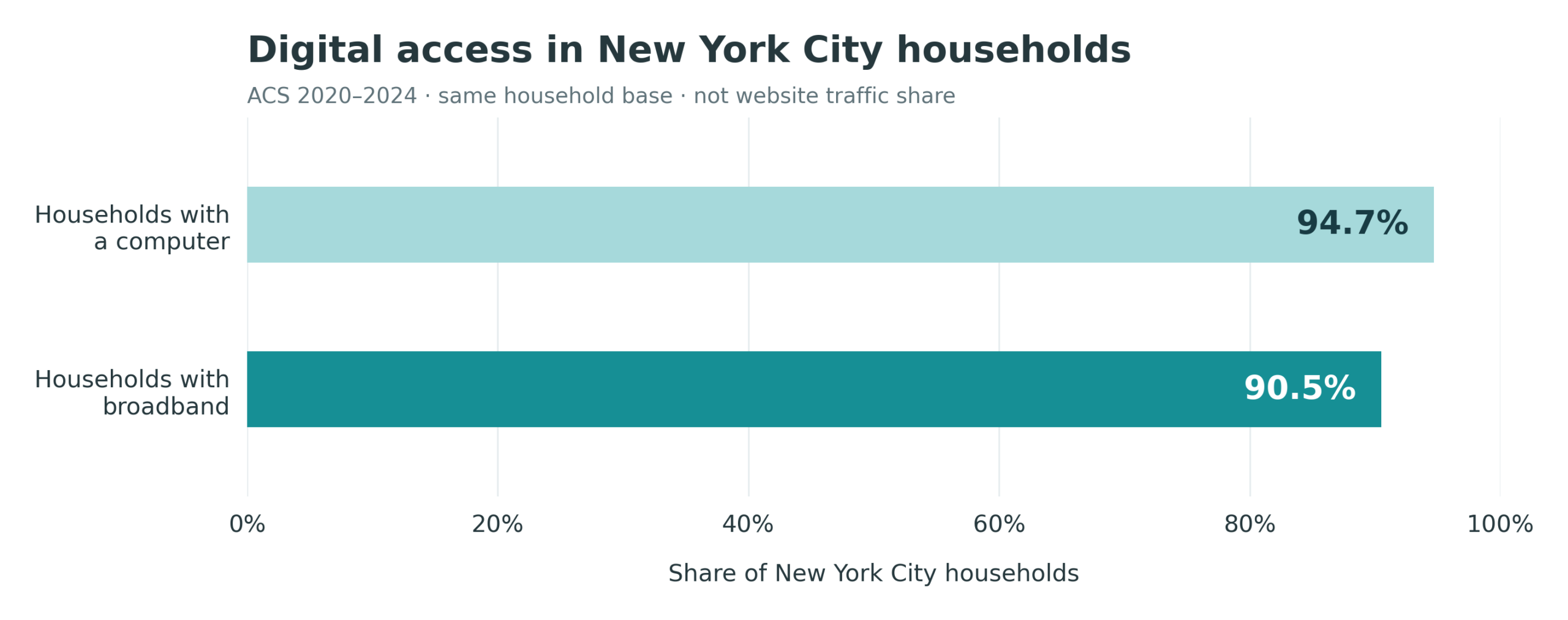
Figure 1. New York City household computer and broadband access, ACS 2020–2024. These household measures do not estimate mobile or desktop website traffic.
Source: U.S. Census Bureau, New York City QuickFacts
Set a performance budget early. Compress photographs, limit unnecessary scripts, and load large media only when useful. Google’s Core Web Vitals guidance gives recommended thresholds of LCP within 2.5 seconds, INP within 200 milliseconds, and CLS no higher than 0.1, assessed at the 75th percentile of field visits. A laboratory test helps diagnose issues, while real-user data shows what visitors experience.
Accessibility belongs in design, writing, development, and acceptance testing. Check keyboard navigation, visible focus, headings, contrast, text enlargement, descriptive links, form labels, error messages, and captions where needed. Include manual checks with assistive technology rather than relying entirely on an automated score.
The U.S. Department of Justice’s business accessibility guidance explains the ADA’s relevance to web access. Use WCAG 2.2 Level AA as a defined engineering target, with counsel assessing applicable obligations. It is not an automatic legal guarantee. The separate federal rules for state and local government websites should not be presented as a blanket private-law-firm deadline. An overlay installation alone does not demonstrate accessible forms or content.
For example, test whether a keyboard user can reach every required form field, understand an error, correct it, and submit without losing earlier entries. Check that the confirmation explains what happens next and offers a usable alternative contact method. Repeat the test after adding a booking widget or changing the form plugin. Record the device, browser, assistive technology, and result so a later developer can reproduce a failure. Keep this acceptance record with the handover materials, and assign responsibility for checking new content and third-party tools after launch.
New York Advertising Rules Changed in 2026
A current compliance brief matters when hiring law firm website developers in New York. The Appellate Divisions adopted amendments on May 27, 2026, effective June 1, 2026, including a replacement of Rule 7.1. Older website checklists may describe requirements from the former version.
Under the adopted Rule 7.1, communications about a lawyer or services must not be false or misleading. That includes material misstatements and omissions that create a materially misleading impression. Communications covered by the rule must identify at least one lawyer or firm responsible for their content and provide contact information. Claims of certified specialization have specific conditions, including identification of the certifying organization.
Use the official adoption order and replacement text when preparing the review brief. Do not mechanically carry forward, or delete, notices based on an old template. The current rule, the overall communication, and other professional duties need counsel’s attention. Separate solicitation rules also require review before targeted outreach campaigns.
For legal website development, the practical workflow is straightforward: the marketing team supplies the draft, the responsible lawyer checks claims and notices, and the developer publishes only approved content. Keep a dated approval record and a process for correcting errors discovered later.
The provider should implement the approved decisions, including where disclosures appear and how content updates are authorized. It should not promise that a template, disclaimer, automated scan, or generic compliance badge settles every professional obligation. Recheck the New York Courts amendments page when the project launches if the rules have changed during production.
Intake Forms, Privacy, and Security
Security questions should be part of your comparison of law firm website developers in New York from the first meeting. Begin with a minimal inquiry form: name, contact method, broad matter category, and information counsel considers appropriate for initial triage. Avoid inviting extensive confidential narratives or sensitive document uploads before the firm has established a suitable process.
New York law firm websites need intake notices approved for their circumstances. A checkbox or disclaimer is not a universal answer to professional duties. The current New York Rules of Professional Conduct, including Rules 1.6 and 1.18, should inform counsel’s decisions about client and prospective-client information.
Map where submissions go, who can access them, and how long they remain. Use encrypted connections, multifactor authentication for administrators, individual accounts, least-privilege access, tested backups, and a documented patching process. Test delivery failures and spam filtering with dummy information. A reassuring confirmation screen is inadequate if the inquiry never reaches the assigned staff member.
New York’s SHIELD Act guidance from the Attorney General describes reasonable administrative, technical, and physical safeguards for covered private information. Have counsel identify the data and obligations that apply to your setup.
Review chat, call tracking, analytics, session recordings, and CRM integrations before enabling them. Keep case narratives, documents, and identifying details out of advertising platforms and routine analytics. Establish a secure follow-up route for documents when needed. The website vendor and the firm’s intake staff must both understand that route.
Assign a primary and backup recipient for each inquiry category. Decide how staff acknowledge receipt, flag urgency for attorney review, and record unsuccessful contact attempts. Test the process with deliberately incomplete dummy submissions as well as perfect ones. The website can support a response standard, but it cannot compensate for an inbox that the team does not monitor.
Law Firm SEO Starts With Useful, Accurate Pages
Compare law firm website developers in New York on the quality of their search plan. Law firm SEO should connect relevant searches to useful pages and functioning intake. Rankings for broad terms are less useful if the resulting inquiries concern matters the firm does not accept.
Begin with a map of practice areas, intended audiences, and real locations. Give each important page a clear title, useful headings, a concise description, and internal links that help visitors continue. Avoid assigning several pages the same purpose. An attorney profile and a practice guide can support each other without repeating the same paragraphs.
Local visibility also depends on accurate business information. Google’s Business Profile guidelines govern eligibility and representation, including office arrangements. Do not invent a Manhattan address or list an unqualified virtual office to create a local impression. ZH Consultancy’s Google Business Profile services can support accurate setup and maintenance where the firm qualifies.
For law firm SEO, location pages should contain genuine value: actual offices, services, attorneys, access information, or locally relevant explanations. Google’s spam policies on doorway abuse are a reason to reject bulk pages that merely swap borough names.
Paid campaigns need separate landing-page planning and legal review. Google’s personalized advertising policy places restrictions around sensitive categories; assess the particular campaign and targeting method. Keep intake data out of audience uploads. ZH Consultancy’s Google Ads services and broader digital marketing services can be scoped around approved messaging and measured inquiries. No provider should guarantee a particular ranking, advertising approval, or retained-client total.
Platform Choice, Ownership, and Daily Editing
Ask law firm website developers in New York to show who controls the domain, hosting, administrator accounts, content, and integrations. Register business assets in accounts controlled by the firm. Give providers the access they need through separate accounts, and document how access is removed when the relationship ends.
For many small practices, WordPress offers a practical content-management option. Its published features include editing and extensibility, but quality still depends on implementation, hosting, and maintenance. A managed legal platform may reduce administrative work while imposing different design, export, or subscription limits. A custom application needs a specific business reason and a realistic support budget.
Sustainable law firm web design includes editing demonstrations using your own content. Ask a staff member to update a biography, publish an article, and change office hours in staging. For legal website development, document licensed assets, premium plugins, renewal charges, backup restoration, and export limitations before signing. Ownership should be understandable without an argument at the end of the contract.
Law Firm Website Cost: Compare Scope and Payment Terms
Proposals from law firm website developers in New York can differ because they sell different services. A template adaptation with supplied copy, a custom build with extensive attorney interviews, and a hosted subscription are distinct purchases. Compare the deliverables and ongoing obligations before comparing the headline number.
The advertised examples below were checked on November 5, 2026. They are national legal-website provider offerings, not a survey of NYC agencies, an endorsement, or ZH Consultancy quotations. Prices are in U.S. dollars and can change.
Published offering | Advertised price | Important basis |
|---|---|---|
PaperStreet Essentials | Around $3,000 starting first-year total | Includes platform, hosting, and support as described by the provider. |
PaperStreet Custom | Starts at $15,000; can exceed $25,000 | Custom-project pricing; confirm the full scope and recurring charges. |
LawLytics Starter | $99 per month | Month-to-month plan; confirm current limits and included services. |
LawLytics Growth | $249 per month, billed annually | $2,988 annual billing at the advertised rate; confirm current terms. |
Sources: PaperStreet design pricing and LawLytics pricing.
A useful law firm website cost comparison separates discovery, copywriting, photography, design, development, migration, attorney review, and staff training. Then identify hosting, licenses, maintenance, content updates, SEO, and advertising as included items or separate charges. Paid media spend should have its own budget.
Give every bidder the same page inventory, content assumptions, integrations, revision allowance, and acceptance requirements. Ask how pricing changes if attorney approval arrives late, additional services are added, or existing content requires substantial rewriting. A fixed fee needs a clear change-control process.
Look Beyond the Initial Invoice
To understand law firm website cost over time, calculate setup plus recurring charges for a defined period. These hypothetical options demonstrate the arithmetic only; they do not represent the providers above or imply equivalent scope.
Illustrative option | Setup | Monthly charge | 36-month total |
|---|---|---|---|
A: Lower setup | $3,000 | $250 | $12,000 |
B: Higher setup | $7,500 | $100 | $11,100 |
C: Subscription | $0 | $399 | $14,364 |
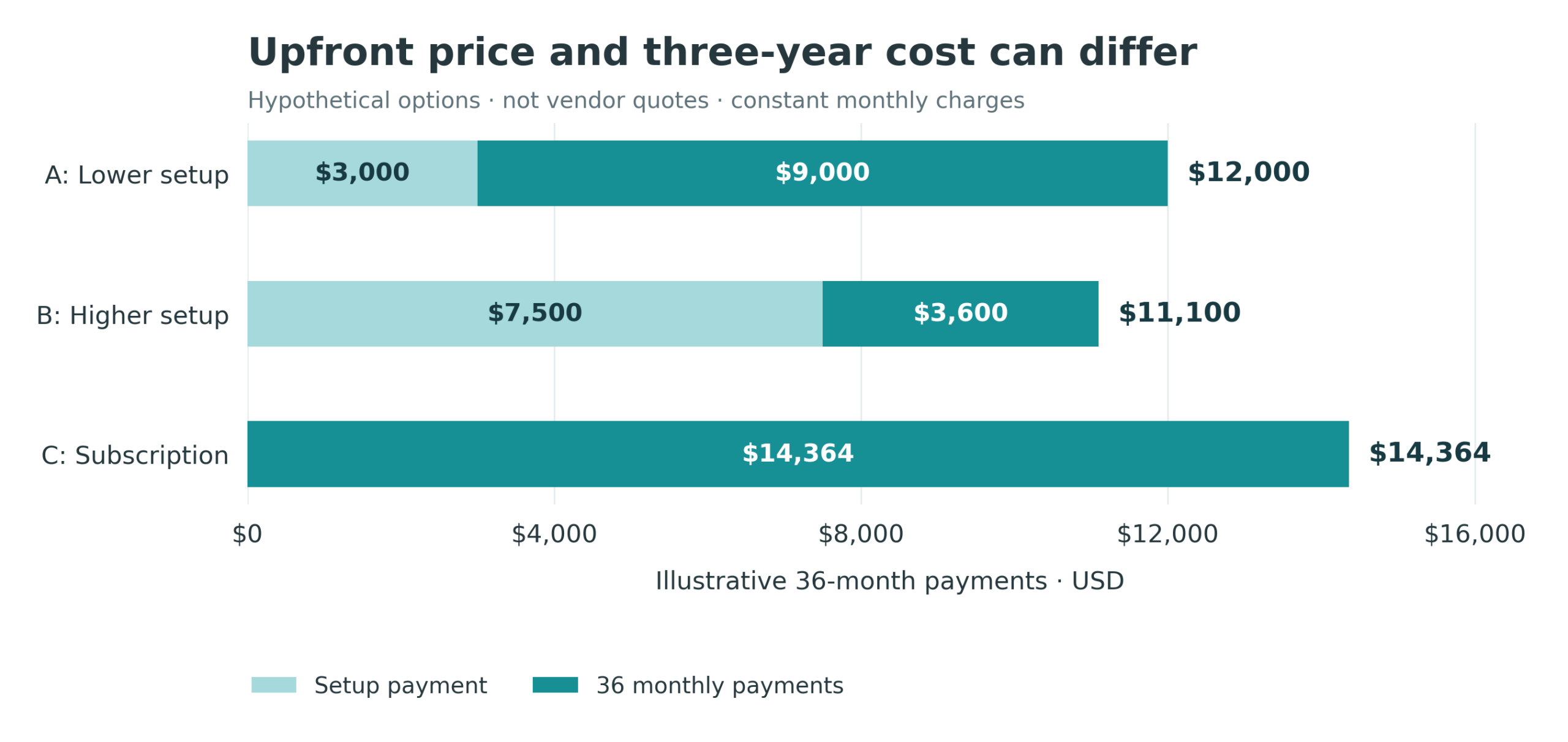
Figure 2. Author calculations for the three hypothetical options in the preceding table, November 2026, USD. Total equals setup plus 36 monthly payments. Scope may differ. Taxes, advertising, extra edits, financing, and exit fees are excluded. Values are not provider quotations.
Budgeting reference: SBA guidance on one-time and recurring expenses
For this law firm website cost model, total equals setup plus 36 monthly payments. Charges stay constant; taxes, advertising, financing, extra edits, and exit fees are excluded. The lowest three-year total is Option B, although its upfront payment is highest. Compare capability and contract terms alongside the arithmetic.
Request a written exit scenario: what happens to the domain, content, photographs, analytics, and forms if the firm leaves after a year? Clarify whether the site can be exported and hosted elsewhere, what remains licensed, and who pays migration costs. A low initial invoice can be expensive when essential assets are difficult to recover.
Comparing Local Agencies, Freelancers, and Remote Teams
Location alone does not establish quality. Evaluate law firm website developers in New York through relevant work, project controls, references, and the people assigned to your account. A local agency may suit a firm that needs in-person workshops or regular onsite production. Confirm that those services are actually included.
A freelancer may offer direct communication and a focused build. Ask about availability, specialist support, and continuity if the person is unavailable. A larger agency may provide several disciplines, but the proposed team and responsibilities still need to be clear.
For law firm web design delivered remotely, assess written communication, overlap with Eastern Time, review turnaround, and secure access practices. ZH Consultancy is based in Pakistan and works remotely with international clients. Discuss how the assigned team will coordinate with your lawyers and demonstrate its capabilities. Request a tailored proposal so you can assess the scope, experience, support arrangements, and value for your practice.
ZH Consultancy’s website development services can be discussed against a firm-specific brief. For legal website development, ask any provider to demonstrate the actual workflow, explain how attorney approvals are recorded, and identify support responsibilities. Geography can affect collaboration, while the written scope determines what is delivered.
A Delivery Plan That Protects Existing Traffic and Inquiries
Require law firm website developers in New York to distinguish a new build from a replacement. A redesign can lose useful search pages, backlinks, inquiry routing, and analytics history if the team treats the old site as disposable. Inventory existing URLs, content, accounts, forms, and tracking before approving a new structure.
The following schedule is illustrative for a modest site with prepared content and timely approvals. Larger practices, integrations, translation, or delayed legal review can extend it.
Illustrative stage | Main work | Approval evidence |
|---|---|---|
Weeks 1–2 | Discovery, content audit, page map, and intake plan | Approved scope and assigned content owners. |
Weeks 3–4 | Copy review, visual direction, and reusable page layouts | Attorney-approved text and design approval. |
Weeks 5–6 | Build, migration preparation, and integration testing | Working staging site with tested forms. |
Weeks 7–8 | Accessibility checks, launch, and staff handover | Signed acceptance checklist and support contacts. |
Preserving law firm SEO during migration requires deliberate work. Map old URLs to appropriate new destinations, retain useful addresses where practical, and implement redirects when URLs change. Review canonical tags, indexing settings, internal links, and the sitemap. Google’s site-move documentation provides the technical framework; a migration cannot promise unchanged rankings.
Before switching the domain, test forms, phone links, booking, email delivery, analytics, backups, and rollback arrangements. Confirm that staging restrictions have been removed from the production site where appropriate. Assign someone to monitor inquiries immediately after launch. ZH Consultancy’s website maintenance services can be scoped to cover updates, monitoring, and agreed support tasks.
Measure Qualified Inquiries and Retained Clients
The reporting brief for law firm website developers in New York should connect website activity with the firm’s intake process. Count successful submissions and calls, then identify qualified inquiries, booked consultations, and retained clients through a controlled internal workflow. Avoid putting personal case information into analytics events.
For New York law firm websites, a higher inquiry count can still be unhelpful if the additional contacts concern the wrong practice, jurisdiction, or budget. Define qualification with the responsible lawyer and intake team before interpreting a dashboard.
The following monthly model is hypothetical. Visits stay at 1,000, the inquiry rate rises from 3% to 5%, and the subsequent qualification, booking, and retention rates stay constant. It is not a NYC benchmark, client case study, or forecast.
Monthly funnel stage | Baseline model | Improved model |
|---|---|---|
Website visits | 1,000 | 1,000 |
Inquiries | 30 | 50 |
Qualified inquiries | 18 | 30 |
Booked consultations | 9 | 15 |
Retained clients | 3 | 5 |
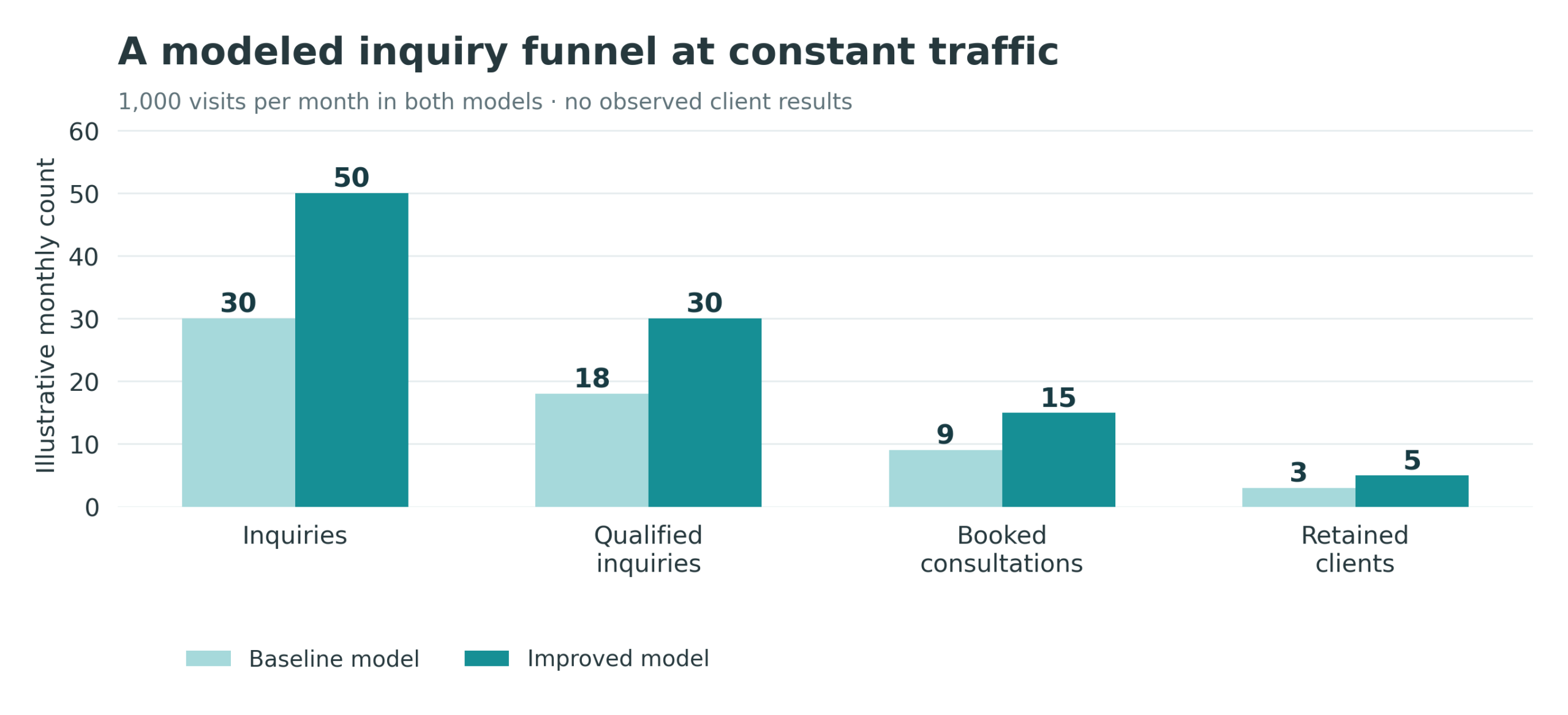
Figure 3. Author-created monthly funnel model, November 2026. Inquiry rates are 3% and 5%; later-stage rates remain constant. Values are illustrative, not observed performance or Google benchmarks. The table includes the equal traffic base, omitted from the chart to keep smaller stages readable.
Measurement reference: Google Analytics recommended lead-generation events
The downstream assumptions are 60% qualified, 50% of qualified inquiries booked, and one-third of bookings retained. Two additional retained clients at an assumed $1,200 contribution per client would produce $2,400 additional monthly contribution after legal-service delivery costs, before acquisition costs and overhead. This is not revenue, net profit, or a promised outcome.
Track payment timing and capacity as well. Extra matters only help financially when the firm can serve them appropriately and collect the expected fees. Compare several months, account for seasonality, and log changes to campaigns or intake staffing before attributing all movement to the redesign.
What to Ask Before Signing a Development Agreement
Send the same written brief to your shortlisted law firm website developers in New York. State the practice areas, target audience, real offices, proposed pages, languages, integrations, existing-site concerns, budget range, and preferred launch window. Identify who makes decisions and who approves professional claims.
Ask each bidder to walk through one relevant live site on mobile. Test its navigation and contact process using the firm’s permitted demonstration method; do not send invented legal inquiries to an unrelated practice. Request references or other evidence for the work claimed, and clarify which parts the proposed team actually produced.
Discuss law firm website cost through a complete proposal rather than an isolated hourly rate. The agreement should identify deliverables, milestones, revision rounds, acceptance criteria, payment timing, and the process for resolving defects. Distinguish a defect from a new request so both sides can administer changes fairly.
Ask who owns the source files and content, who holds credentials, and how quickly urgent failures receive attention. Request a sample handover checklist. Review confidentiality, subcontractor access, and handling of test data with counsel. Reject unsupported claims that any website can guarantee top rankings, universal legal compliance, or a fixed number of new matters.
Tie milestone payments to reviewable work such as an approved page map, functioning staging site, or completed handover. Name the person who accepts each stage and the time available for feedback. Document how unresolved defects are tracked after launch. This makes the commercial relationship easier to manage and reduces uncertainty when a partner requests changes late in production.
Future-Proofing Without Paying for Unnecessary Features
When comparing law firm website developers in New York, favor maintainable foundations: structured content, accessible components, a documented publishing process, and integrations the firm can support. New York law firm websites will need updates as attorneys, services, technology, and professional rules change. Budget for that continuing responsibility.
AI tools can help prepare drafts or organize approved public information, but a lawyer should review legal content before publication. Do not let an unreviewed chatbot give individualized advice or accept unrestricted confidential narratives. Define its limits, data handling, escalation route, and human owner before deployment.
For law firm SEO, keep information accurate and useful as search interfaces evolve. Avoid paying for an alleged shortcut that depends on fabricated authority, mass-produced location pages, or guarantees about AI citations. Build a publishing system that makes corrections and reviews easy. That work remains useful when individual marketing features change.
The Takeaway
Choose law firm website developers in New York by testing the quality of their brief, evidence, implementation, and handover. Prioritize accurate practice information, current professional review, accessible contact paths, secure intake, and clear ownership. Compare total costs across the same period and measure qualified inquiries after launch. A well-managed project gives the firm a dependable publishing and intake system that its team can understand and maintain.
Faq
Frequently Asked Questions
The proposal should define discovery, page structure, content responsibilities, design, development, intake routing, accessibility and performance testing, migration, training, and support. Identify exclusions and obtain attorney approval for professional claims. The exact scope depends on the practice and existing site.
There is no single verified NYC average in this guide. Published national offerings range from subscriptions to custom projects costing many thousands of dollars. Request comparable quotes and calculate setup, recurring fees, content work, maintenance, and exit costs over the same period.
No. A remote project can use written briefs, video reviews, staging demonstrations, and recorded training. An onsite workshop or photography session may still be useful. Choose the working arrangement that fits your team, and verify any claimed local office rather than assuming it exists.
It can be suitable when the implementation includes secure hosting, controlled access, tested updates, reliable backups, and accessible content. Compare it with managed platforms using editing needs, ownership, support, integrations, and total cost. The platform name alone does not establish quality or compliance.
That depends on the actual audience and the firm’s service capacity. Use intake evidence and audience research to choose languages. Have qualified reviewers check translations, including notices and forms, and establish how translated inquiries will be handled. Citywide language figures do not determine an individual firm’s needs.
Timing depends on competition, the existing site, content, technical condition, and the work undertaken. Establish a baseline and evaluate qualified inquiries alongside search visibility over time. A developer should explain milestones and measurement rather than guarantee a specific position or an exact results date.
A responsible lawyer should review the firm’s content, claims, notices, and intake process under current applicable rules. New York amended advertising-related rules effective June 1, 2026. Developers should implement approved decisions and provide an update process; a generic template or disclaimer is not sufficient review.

Zain Hameed
Business strategy specialist helping a global client base of 800+ businesses build credible plans, financial models and investor-ready presentations.
In this article
Book a Free Consultation
Have a business idea, growth challenge or investor deadline? Book a free consultation and get clear next steps from our team.
Call our team
+923104049517
Email us

Business Topics
Business topics
Continue reading
Related insights

How to Start an Electrical Business
Learn how to start an electrical business in the U.S., with

How to Start a Junk Removal Business
Learn how to start a junk removal business with U.S. startup

How to Start a Lash Business and Build a Loyal Client Base
Learn how to start a lash business in the U.S., compare

How to Start a Mobile Drug Testing Business
Learn how to start a mobile drug testing business in the

How to Start a Pest Control Business in the United States
Learn how to start a pest control business in the U.S.

How to Start a Pool Cleaning Business With Costs and a Launch Plan
Learn how to start a pool cleaning business, estimate startup costs,