

In this article
The sofa is advertised for free. Three days later, it is still blocking the hallway.
Picture the homeowner: a move is approaching, the donation center cannot collect until next month, and the sofa needs two people to carry it downstairs. A reliable crew that arrives on time and clears the space solves a problem worth paying for.
That is the opportunity behind learning how to start a junk removal business. The difficult part is delivering that convenience while paying for labor, transportation, disposal, insurance, and the occasional unpleasant surprise hiding behind the garage door.
This U.S. founder’s guide connects those decisions: choose work you can handle, validate local demand, establish lawful disposal routes, and build prices that support both the company and your own income. Start with the economics of one good job. The truck comes later.
What the Business Actually Does
A junk removal company collects unwanted items, loads them, transports them, and takes them to appropriate donation, recycling, or disposal facilities. Customers pay for the work, convenience, and handling of awkward materials.
Residential services include furniture pickups, garage clearances, estate cleanouts, and move-out jobs. Commercial customers include property managers, offices, retailers, and contractors. Rental turnovers can generate repeat bookings, although commercial payment terms may delay cash collection.
Choose between full-service loading and curbside collection. Curbside work can reduce labor and damage exposure; full-service jobs command payment for carrying, stairs, and careful handling. Heavy construction debris needs different weight limits, disposal arrangements, and potentially different authorizations.
When deciding how to start a junk removal business, distinguish hauling from dumpster rental, moving, demolition, and hazardous-waste cleanup. Those activities bring different obligations. A franchise adds branding and systems, but also fees, contract restrictions, and investment requirements. An independent operator controls the offer and must build its own operating discipline.
Begin with a narrow promise: for example, nonhazardous household furniture and garage clearances within a manageable driving area. Add services when your records show customers, capacity, and adequate margins.
Market Demand and the Local Opportunity
The EPA’s durable-goods data show 12.08 million U.S. tons of furniture and furnishings entering the municipal waste stream in 2018. About 9.68 million tons were landfilled. These are historical waste volumes, not current junk-hauling revenue or the volume available to private operators.
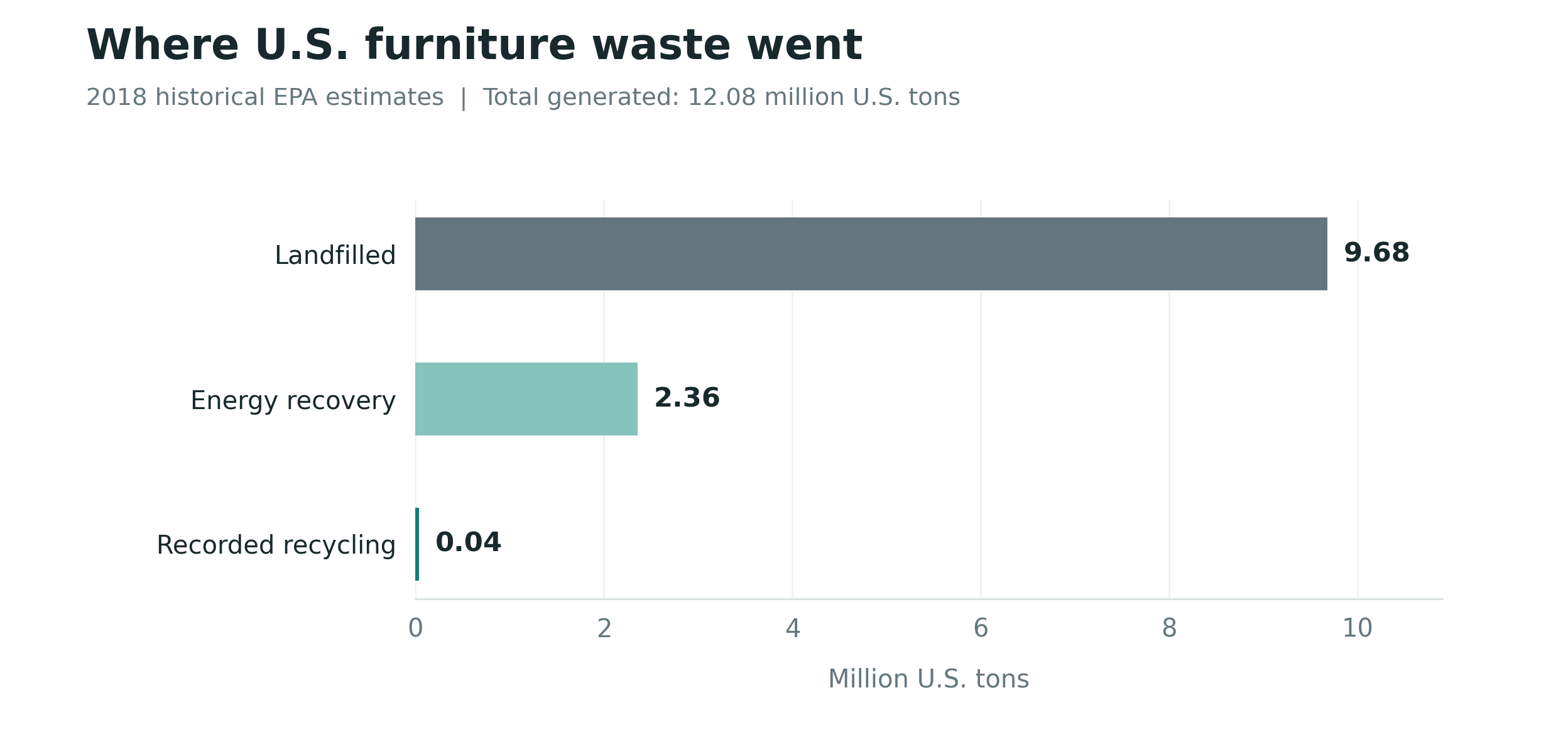
U.S. furniture and furnishings management in 2018, million U.S. tons. EPA estimates total 12.08 million tons. Recorded recycling does not capture every possible recovery activity; these figures do not measure the junk removal market.
Source: EPA furniture and furnishings data.
Globally, the World Bank’s What a Waste 3.0 reports 2.56 billion metric tonnes of municipal waste in 2022 and projects 3.86 billion by 2050 under its business-as-usual scenario. That broader trend puts disposal capacity and resource recovery into perspective. It cannot establish demand for your particular route.
The useful question in how to start a junk removal business is local: who has an urgent clearance problem, and what alternatives already exist? Compare private competitors, municipal bulky-item pickup, donation collections, and DIY rentals. Record junk removal pricing alongside response times, accepted materials, and customer complaints.
Interview ten property managers and ten households or referral partners. Ask about their last actual clearance, its cost, and what went wrong. Map disposal sites and travel times. Dense apartments may offer demand but difficult parking; suburban work may offer easier access but longer drives.
Use market research support when the investment warrants deeper validation. Spring cleaning, moving cycles, weather, and local housing activity should shape your forecast rather than a nationwide growth headline.
Build a bottom-up demand estimate. For a hypothetical target of 50 jobs monthly, a 25% inquiry-to-booking rate would require 200 qualified inquiries. Identify which partners and channels could realistically supply them. Count repeat work separately so one enthusiastic property manager does not become an entire imaginary customer base.
Pros and Cons of Owning the Business
Someone researching how to start a junk removal business should weigh control over the business against its physical demands and operational exposure. Recurring relationships can make bookings steadier, but even a small operation carries meaningful risks.
Potential advantage | Corresponding tradeoff |
|---|---|
Start with a focused service and suitable existing vehicle | Commercial suitability, repairs, and permits still cost money |
Collect payment promptly on residential jobs | Disposal and fuel must often be paid immediately |
Win repeat property-management work | Invoicing terms and client concentration can strain cash |
Expand through additional crews and routes | Recruitment, supervision, and vehicle downtime add complexity |
Offer tangible, visible customer value | Property damage, injuries, and complaints need prevention |
Part-time operation can test demand, provided your availability matches customer expectations and facility opening hours. A Saturday-only business should promise Saturday service rather than advertise around-the-clock collection.
The work also involves emotionally sensitive situations: bereavement, downsizing, and severe clutter. Patience, discretion, and clear boundaries matter. Selling reusable items may produce occasional income, but uncertain resale proceeds should never be necessary to make a removal job viable.
Junk Removal Startup Costs and Cash Reserves
Junk removal startup costs depend heavily on whether you already own a suitable truck, what your jurisdiction requires, and which materials you accept. The following are illustrative U.S. planning allowances in USD, not supplier quotations or national averages.
Startup cash requirement | Lean existing-truck model | Used dump-truck model |
|---|---|---|
Tow-ready trailer or used truck | $4,000 | $30,000 |
Tools and protective equipment | $1,500 | $2,200 |
Registration, permits, and advisers | $1,500 | $2,500 |
Initial insurance payments | $2,000 | $3,500 |
Parking or storage setup | $500 | $1,500 |
Logo, print, and vehicle graphics | $600 | $1,200 |
Website, domain, and hosting | $900 | $1,800 |
Phone and software setup | $300 | $500 |
Launch advertising | $1,200 | $2,300 |
Business working capital | $6,000 | $10,500 |
Emergency repair reserve | $2,000 | $4,000 |
Total illustrative cash | $20,500 | $60,000 |
The lean model assumes an already-owned, appropriately rated truck; its purchase value is excluded. Verify towing capacity and commercial use before relying on it. Add applicable purchase taxes and finance fees to actual quotes. Restrictive permitting markets can exceed these allowances substantially.
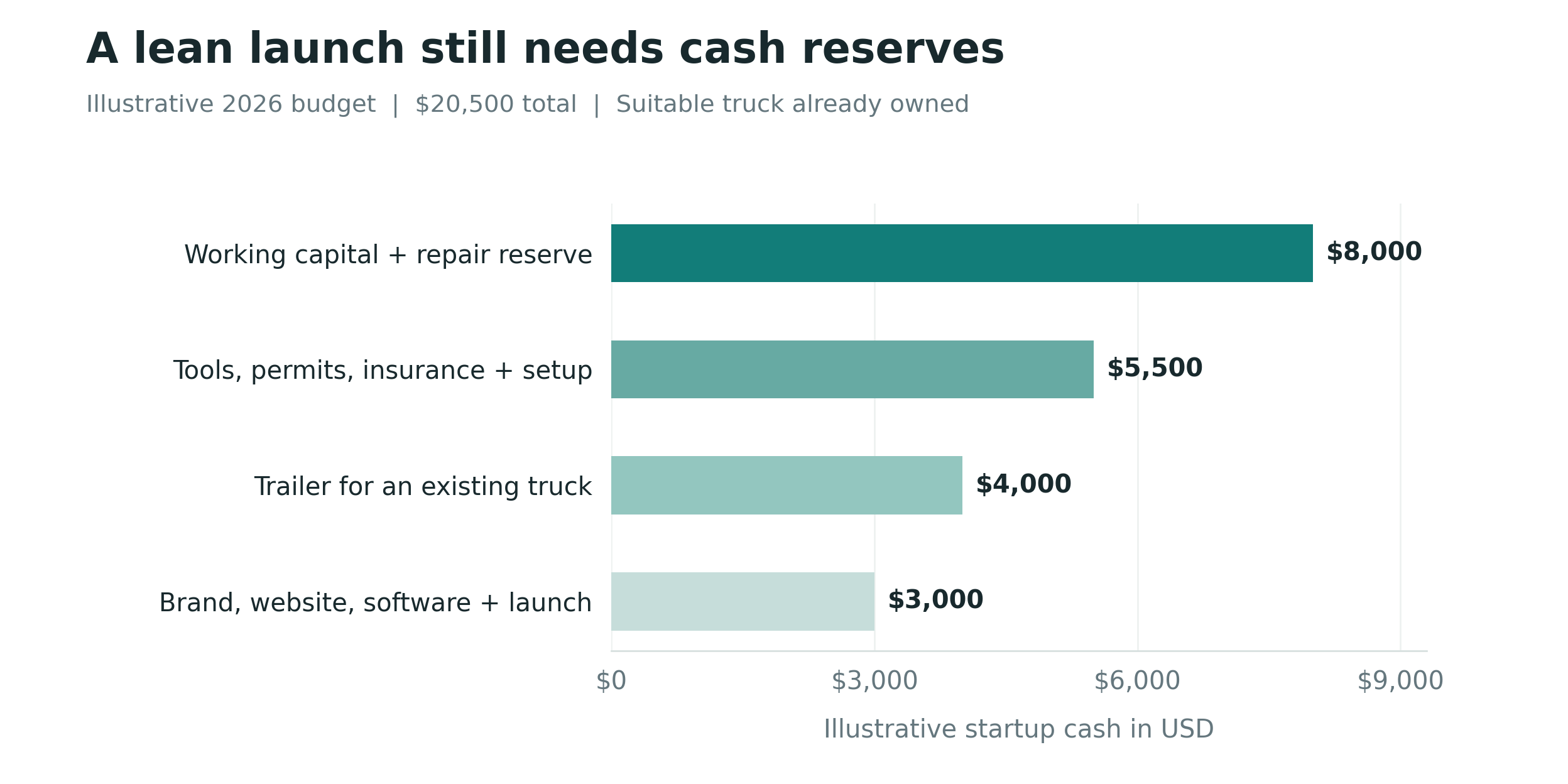
Illustrative 2026 lean startup allocation in USD, totaling $20,500. An existing suitable truck is assumed. These are the budget allowances above, not measured industry averages; personal living costs are excluded.
Planning reference: SBA startup-cost guidance. Amounts and grouping are original illustrative calculations.
Separate equipment purchases from recurring insurance, wages, fuel, disposal, subscriptions, and marketing. The SBA planning guide explains this distinction. Working capital should follow a monthly cash forecast; $6,000 is an allowance, not a guaranteed number of months of runway.
Learning how to start a junk removal business cheaply is useful only when the savings survive operations. Compare junk removal startup costs against repair risk, lost bookings, and your separate household cash reserve.
Use written quotes to refine junk removal startup costs before committing. A permit allowance should become an actual application fee; a vehicle allowance should become an inspected purchase with known immediate repairs. This turns a rough budget into a spending decision you can defend.
Build a Junk Removal Business Plan That Guides Decisions
A junk removal business plan should tell you what to do when a tempting job falls outside your service area, material policy, or price floor. A document that cannot help with those decisions needs more work.
Start the executive summary after you have resolved the operating model. Define the customer, service radius, accepted materials, and reason to choose you. Support the market section with interviews, competitor offers, municipal alternatives, and disposal-site research.
Your junk removal business plan should then connect pricing to crew time, load weight, unloading time, lead generation, and realistic daily capacity. Identify who answers inquiries, approves estimates, drives, supervises loading, handles complaints, and reconciles receipts.
Build monthly revenue, profit-and-loss, and cash-flow projections for at least the first year. Include seasonality, startup investment, owner withdrawals, equipment depreciation, taxes, and financing where applicable. Revenue follows completed jobs, while cash follows actual collections. A commercial invoice due next month cannot pay today’s transfer-station bill.
For example, a founder might target apartment turnovers in two adjacent ZIP codes, test three property-management relationships, and postpone heavy debris. Set measurable milestones: obtain disposal approvals, complete ten paid pilot jobs, measure contribution per job, then decide whether to expand.
This is how to start a junk removal business with evidence behind each purchase. Include a downside case with fewer bookings, higher disposal fees, and a repair interruption. Specify the cash balance that triggers spending cuts or additional funding.
For outside help, business plan writing can organize the strategy, while financial modeling services can test assumptions. Keep both tied to local evidence and operating capacity.
If you are deciding how to start a junk removal business with borrowed money, compare repayment schedules with conservative collections. Loan principal reduces cash without being a profit-and-loss expense; interest and depreciation follow different accounting treatments. Have an accountant connect the statements so a profitable-looking forecast does not conceal a funding gap.
Legal Requirements and Junk Removal Insurance
Legal setup is part of how to start a junk removal business before the first collection. Requirements depend on location, customer type, materials, vehicle configuration, and whether transport is interstate.
Business and Tax Setup
A sole proprietorship is straightforward but does not create the liability separation of an LLC. An LLC also does not replace insurance or eliminate personal responsibility for your own conduct. Compare structures using the SBA’s launch guidance and an appropriate adviser.
Register the entity and any required trade name, open a separate business account, and obtain required tax registrations. An EIN is free from the IRS; whether you need one depends on your circumstances. Check state treatment of removal services, disposal charges, and resale rather than assuming sales tax never applies.
Waste and Vehicle Permissions
Ask your city or county, state environmental agency, and disposal facilities about hauling permissions, local franchises, zoning, commercial parking, and recordkeeping. For example, New York City’s BIC regulates trade-waste categories. California generally requires registration for hauling ten or more used or waste tires, subject to exemptions. Neither is a universal national rule.
Under FMCSA’s USDOT criteria, interstate property operations can trigger registration at 10,001 pounds based on specified rated or actual vehicle or combination weights. Some states impose intrastate requirements too. CDL classifications use different thresholds and configurations, commonly including 26,001-pound criteria. Have the actual truck-and-trailer combination reviewed; being below a CDL threshold does not automatically remove other transport obligations.
Coverage and Customer Agreements
Arrange junk removal insurance around actual activities: general liability, commercial auto, workers’ compensation where required, and appropriate equipment protection. Ask specifically about loading damage, hired vehicles, subcontractors, pollution exclusions, and deductibles.
Get junk removal insurance quotations before purchasing equipment. Tell the broker about trailers, demolition exclusions, material types, and employees. Confirm payroll, worker classification, wage obligations, and safety duties before hiring; IRS employee guidance is a starting point.
Have a local lawyer review terms covering ownership and removal authorization, excluded materials, estimates, changes, cancellation, access, damage reporting, and payment. Obtain local tax and insurance advice for the specific operation.
Equipment Suppliers and Daily Operations
Equipment selection is another practical part of how to start a junk removal business. Match payload and towing ratings to the load, passengers, tools, and trailer rather than judging capacity by appearance. Concrete can reach a weight limit long before a trailer looks full.
Have a mechanic inspect used equipment. Compare brakes, tires, hydraulic systems, service records, parts availability, and downtime support. Confirm rental terms and junk removal insurance coverage before substituting a hired vehicle.
Carry suitable dollies, moving straps, load restraints, tarps or containment, floor protection, hand tools, gloves, eye protection, and first-aid supplies. Train the crew in controlled lifting, driving, securing loads, and stopping unsafe work. OSHA identifies lifting, falls, cuts, and vehicle hazards in collection work.
Establish donation, scrap, recycling, and disposal partners before booking. Record accepted materials, commercial access, minimum charges, surcharges, opening hours, queue times, and backup options. Never assume a household-only hazardous-waste program accepts loads from your business.
For refrigerators and air conditioners, use an approved receiving arrangement consistent with EPA refrigerant disposal requirements. Do not vent refrigerant, cut lines, or promise ordinary scrap disposal without confirming the process. Refer asbestos, unknown chemicals, sharps, and biohazards to appropriately qualified providers.
Use one documented workflow: request photos and access details, screen materials, estimate, confirm the final scope, obtain approval, protect the property, load safely, secure the vehicle, dispose lawfully, and retain receipts. Schedule around dump hours and weather. Keep customer information access-controlled, and establish a breakdown and cancellation procedure.
For estate or rental clearances, confirm that the person authorizing removal has the right to dispose of the items. Agree how to handle documents, valuables, and belongings discovered during loading. Stop for clarification when ownership is disputed. That brief pause can prevent an expensive complaint after an irreversible disposal.
Junk Removal Pricing and the Path to Profit
Good junk removal pricing combines customer clarity with job-level cost control. Common approaches include single-item prices, volume tiers, labor charges for difficult access, and material-specific allowances. Explain minimum charges and any stairs, weight, distance, or disposal surcharges before work begins.
1-800-GOT-JUNK’s published approach illustrates volume-based charging, including eighth-truck increments for multiple items. Its model is an example, not a national price list or proof that your vehicle holds the same volume.
Build your own junk removal pricing from measured costs. Suppose an illustrative ordinary job averages $350 before any sales tax. Variable expenses are $70 loaded helper labor, $65 disposal, $30 fuel and routine vehicle wear, and $10 payment fees and consumables: $175 total. Contribution is therefore $175 per job, or 50% of revenue.
Assume monthly fixed overhead of $2,750: $750 insurance, $250 parking, $200 phone/software, $1,000 ongoing marketing, $300 administration, and $250 permit or license allocations. Owner labor is excluded from helper wages and addressed separately below.
Jobs per month | Revenue | Variable costs | Before owner pay | After owner target |
|---|---|---|---|---|
35 | $12,250 | $6,125 | $3,375 | -$625 |
50 | $17,500 | $8,750 | $6,000 | $2,000 |
65 | $22,750 | $11,375 | $8,625 | $4,625 |
These results are after the $2,750 overhead but before depreciation, income taxes, financing costs, and unusual repairs. The $4,000 owner target is a planning allowance; its accounting and tax treatment depends on structure. The remaining money is not after-tax net profit.
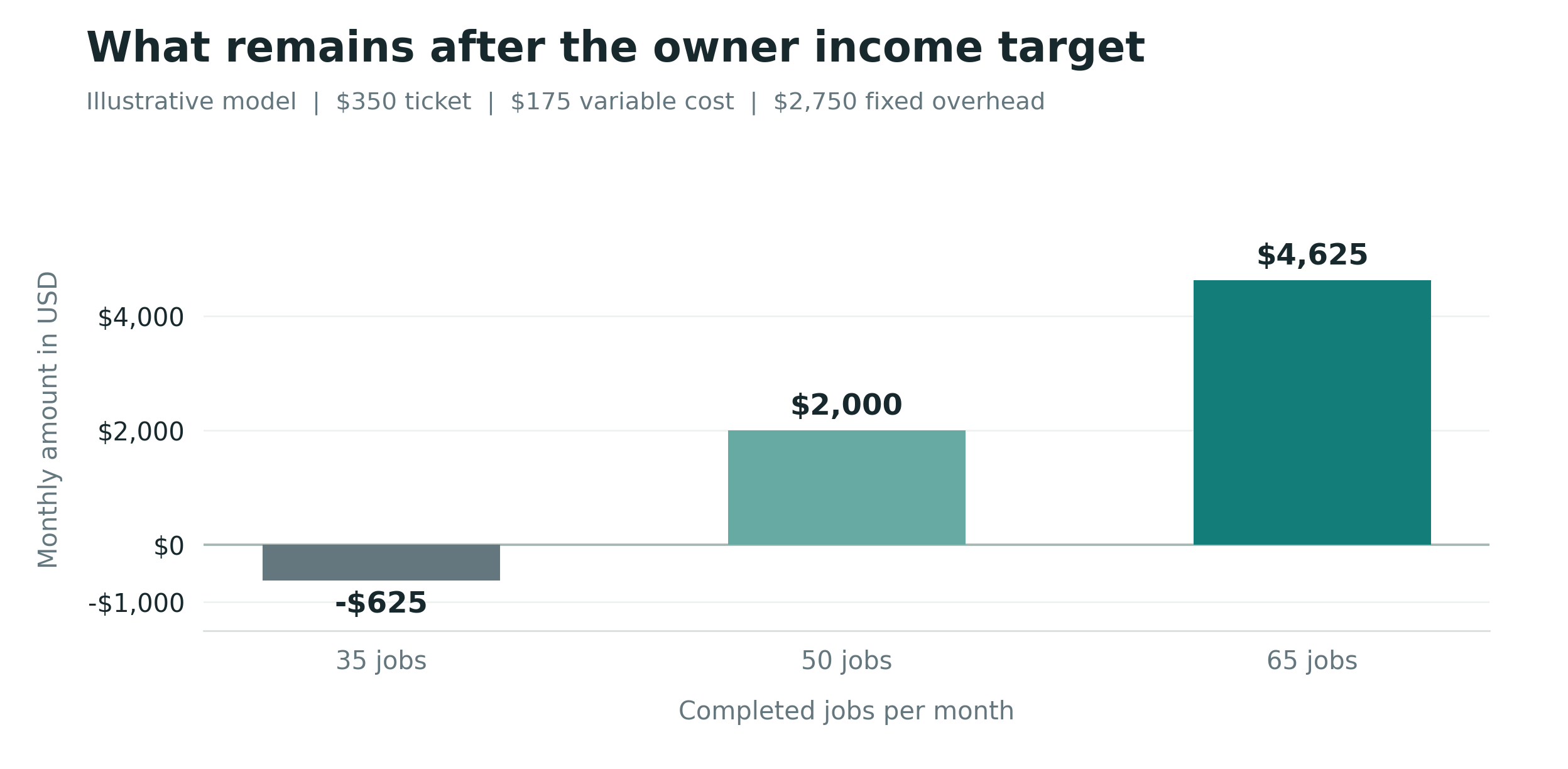
Illustrative monthly amounts after fixed overhead and a $4,000 owner compensation target, USD. Assumes a $350 average ticket and $175 variable cost per job. Depreciation, income taxes, financing, and unusual repairs are excluded; higher volume may require additional capacity.
Method reference: SBA break-even guidance. Scenario figures are calculated from the assumptions in this section, not earnings forecasts.
Operating break-even before owner pay is $2,750 ÷ $175, rounded up to 16 jobs. Including the owner target requires 39 jobs. At 50 jobs across 22 working days, capacity must support about 2.3 completed jobs daily, including travel and unloading.
Stress-test the junk removal business plan: if the ticket falls to $300 and disposal rises by $20, contribution falls to $105. Fifty jobs then leave $2,500 before owner pay and a $1,500 shortfall against that target.
Understanding how to start a junk removal business profitably means quoting awkward access and heavy loads accurately. Collect residential payment promptly, limit commercial credit, and treat resale income as upside.
Record the owner’s full workweek too: quoting, driving, bookkeeping, and customer follow-up consume time beyond loading. Compare the owner’s eventual compensation with those hours. A healthy contribution margin can still support an unattractive hourly income when administration and empty travel take over the week.
Build a Name and Brand People Recognize
Choose a name customers can pronounce, remember, and spell on the phone. Check state naming rules, relevant trademark conflicts, domain availability, and social handles before printing signs. A business registration alone does not settle trademark rights.
Give the brand a practical position: respectful estate clearances, dependable property turnovers, or straightforward household pickups. Avoid claiming to recycle everything unless you can substantiate it.
Use a simple logo that remains readable on a truck, shirt, invoice, and small phone screen. Consistent colors, typography, and photography help customers recognize the crew arriving at their property. Logo design services can turn that position into a usable identity.
For anyone learning how to start a junk removal business, branding also includes behavior: clean uniforms, advance arrival messages, courteous staff, and written prices. Those details influence trust at the doorstep.
Keep early junk removal marketing materials modest. A clear vehicle sign and business card can outperform an elaborate brochure that never reaches a buyer. Coordinate print and digital files through graphic design support when needed.
Marketing Materials That Help Win Commercial Work
A property manager may need more than a friendly text before adding you to a supplier list. Prepare a concise capability sheet describing service coverage, accepted materials, availability, business details, and how to request estimates.
Include genuine project photographs with permission, references where available, and evidence of relevant coverage when requested. Keep policy documents and sensitive information in an appropriate private exchange. Your proposal template should identify access assumptions, exclusions, disposal arrangements, approval authority, and payment terms.
A company profile design service becomes useful when approaching multi-property operators, offices, or facilities teams. A homeowner needing one mattress removed rarely needs a lengthy company presentation.
Create reusable estimate, invoice, and completion templates first. As projects accumulate, build short case studies showing scope, constraints, and verified outcomes. Never turn an imagined example into a claimed client result.
Build a Website That Turns Searches Into Bookings
A customer holding a phone beside a pile of furniture has immediate questions: do you collect this, do you cover this address, what might it cost, and when can you come?
Answer those before asking for a long form. Publish service and coverage pages, clear contact details, accepted and excluded materials, an explanation of estimates, real photographs, and genuine testimonials. Include a photo-upload option, access questions, and prominent call or quote buttons.
Choose the Right Platform
Platform | Good fit | Check before committing |
|---|---|---|
WordPress | Flexible service pages, local content, integrations | Hosting, updates, plugin quality, maintenance responsibility |
Wix | Owner-managed site with bundled hosting | Required business tools, ongoing plan cost, export limits |
Squarespace | Simple polished service presentation | Scheduling integrations and additional subscriptions |
Shopify | A business with a substantial product-sales operation | Whether commerce features justify the service-site complexity |
Industry scheduling platform | Quotes, dispatch, reminders, and payments | Website integration, data exports, fees, material screening |
WordPress, Wix, and Squarespace offer different ownership and management arrangements. For most small hauling firms, choose around the quote-to-job workflow. Automatic booking must still screen restricted materials and unrealistic time slots.
Domain Hosting and Long-Term Ownership
Register the domain in your own business-controlled account with two-factor authentication and reliable renewal contacts. Compare registration, renewal, transfer, privacy, and restoration charges.
For a current example, Namecheap’s November 1, 2026 notice lists regular .com registration at $15.98 and renewal at $19.98 annually, excluding the applicable ICANN fee; promotions can differ. Cloudflare Registrar uses at-cost registration and renewal, but confirm its management requirements suit you.
Hosting headlines need similar scrutiny. On November 4, 2026, Hostinger’s U.S. pricing page displayed Premium at $1.99 monthly equivalent, paid as $95.52 for 48 months, renewing at $10.99 monthly equivalent for the same term. Treat that as a dated offer, verify checkout taxes and terms, and compare backups, restore access, support, SSL, performance, and scalability.
Build for Real Customers
Use readable text, sufficient contrast, keyboard-friendly forms, labeled fields, compressed photographs, and a fast mobile layout. Test calls, forms, confirmation emails, and payments on real devices. Track qualified inquiries and completed bookings rather than visits alone.
Use hosted payment tools, limited administrator access, updates, off-site backups, and tested restoration. Assign responsibility for website maintenance instead of discovering the gap after a broken form loses bookings.
How to start a junk removal business includes choosing the right development partner. A local agency may offer on-site coordination; a freelancer can suit a limited scope; a remote team can provide broader skills. Compare actual quotes, deliverables, revision limits, support, account ownership, and handover arrangements. ZH Consultancy offers website development from Pakistan for international clients; request a scoped quote rather than assume a fixed saving.
Junk Removal Marketing and Customer Acquisition
Start junk removal marketing where intent is strongest: eligible local search presence, clear service pages, and referral relationships. Create an accurate Google Business Profile and follow Google’s representation guidelines. A service-area business that does not receive customers at its address should hide that address; invented offices create avoidable risk.
Build relationships with property managers, estate-sale organizers, cleaners, real estate agents, and storage operators. Offer a clear process for photos, estimates, scheduling, and authorized completion records. Reliability makes a referral easier to give.
Test tightly targeted Google Ads for services you actually accept. Exclude irrelevant searches, restrict geography to viable routes, and answer inquiries during advertised hours. Publish useful local content, permission-based before-and-after images, and occasional community or social posts. Email previous customers only with appropriate permission and a useful reason to return.
Measure junk removal marketing by booked work. Illustratively, $600 spent generating 20 qualified inquiries produces a $30 cost per lead. If eight book, acquisition cost is $75 per customer. Compare that with contribution before advertising; do not subtract advertising twice if it is already included in overhead.
Request honest reviews consistently. FTC rules prohibit fake reviews and incentives conditioned on sentiment; platform rules can be stricter. Google Business Profile support or broader digital marketing services should focus on qualified inquiries, conversion, and customer value.
Major Problems and Practical Solutions
Learning how to start a junk removal business also means building responses to predictable failures.
The Estimate Misses the Real Work
A photo hides stairs, parking restrictions, or dense debris. Labor and disposal costs rise after the crew arrives. Improve junk removal pricing with access questions, material screening, and written on-site approval before loading. Better scope control reduces disputes and protects contribution.
The Schedule Looks Full but the Day Produces Little
Scattered bookings and disposal queues consume paid hours. Group appointments geographically, allow unloading buffers, and compare revenue with total crew hours. A smaller service area can improve punctuality and productive capacity.
Cash Disappears Between Jobs
Commercial clients pay later while wages and disposal are immediate. Track receivables, require appropriate deposits on large projects, and review a rolling cash forecast weekly. Reserve money for taxes and repairs before discretionary purchases.
A Donation Facility Rejects the Load
Damaged furniture or changing acceptance rules invalidate the original plan. Confirm criteria before collection and maintain a lawful backup destination. Promise responsible handling you can document, rather than a guaranteed donation outcome.
Common Startup Mistakes
Buying the biggest truck first can lock the company into payments before demand is proven. Start with the smallest safe, compliant setup that supports validated jobs, and expand when utilization and contribution justify it.
Another mistake is comparing junk removal startup costs while ignoring operating cash. A vehicle bargain loses its appeal if it empties the account needed for wages and disposal. Keep household reserves separate from business working capital.
Do not assume a personal auto policy covers hauling for payment or that every activity falls within junk removal insurance. Obtain written answers on exclusions and material types. Avoid demolition, contaminated cleanups, or heavy-load jobs simply because a customer asks.
Finally, resist competing solely on price, relying on one lead platform, or adding a second crew before documenting the first crew’s process. Growth multiplies whatever system already exists, including its weaknesses.
Future Trends and Growth Opportunities
The World Bank’s waste projections suggest continuing pressure on collection and disposal systems. For operators, the practical response is to monitor facility access, fees, reuse opportunities, and customer documentation needs. A global forecast does not guarantee local sales growth.
Photo-based estimates, scheduling automation, digital payments, and routing tools can reduce administration. AI may help classify inquiries or draft estimates, but a person should verify material risks, access, and price before commitment. Protect customer photos and addresses when choosing tools.
Growth can come from recurring property turnovers, commercial clearances, or specialist partnerships rather than immediately buying another truck. Test the margin and operational requirements of each extension.
Future junk removal marketing may rely increasingly on prompt answers, demonstrable disposal practices, and clear online information. Track customer expectations through actual inquiries. When evaluating how to start a junk removal business for lasting growth, make each added route prove its economics first.
A Practical 90-Day Launch Plan
Use this sequence to investigate, prepare, and test the business. Permit approvals, finance, or equipment availability may extend the timetable; paid work starts only when the required permissions and coverage are in place.
Period | Main work | Evidence before moving forward |
|---|---|---|
Days 1–15 | Interview customers, map competitors and disposal routes | Documented demand, accepted materials, preliminary cost quotes |
Days 16–30 | Finish the junk removal business plan and legal groundwork | Cash forecast, applications, insurance proposals, spending limits |
Days 31–45 | Inspect equipment, confirm facilities, train the crew | Safe setup, backup disposal option, written operating workflow |
Days 46–60 | Complete branding, website, estimates, and payment setup | Tested forms, clear terms, domain and account ownership |
Days 61–75 | Test junk removal marketing and build referral relationships | Tracked inquiries, acquisition costs, pilot bookings when authorized |
Days 76–90 | Review completed jobs and adjust the offer | Actual job margins, customer feedback, realistic capacity decision |
Avoid measuring progress by how much equipment you have purchased. Ten documented, well-executed pilot jobs can teach you more about expansion than a month of optimistic spreadsheets.
Your launch checklist for how to start a junk removal business should therefore end with a decision: continue the tested offer, change the customer segment, or pause further spending. Set that review date before enthusiasm turns a small trial into an expensive commitment.
The Takeaway
The strongest answer to how to start a junk removal business begins with a small area, a specific customer problem, and a lawful disposal route. Price the whole job, protect the people doing it, and make it easy for customers to understand and book your service.
Validate demand before committing heavily to equipment. Use your first jobs to replace estimates with measured costs. Then grow the routes and relationships that leave enough money for the business, the owner, and the next unexpected repair.
Faq
Frequently Asked Questions
Junk removal startup costs vary with equipment ownership and local permissions. This guide’s illustrative budgets are $20,500 with a suitable existing truck and $60,000 with a used dump truck. Obtain local quotes and add your personal living reserve before deciding what you can afford.
There is no single nationwide permission covering every operation. Check business registration, local hauling or franchise requirements, material-specific rules, disposal access, and vehicle obligations. Commercial waste, tires, and interstate transport can trigger additional requirements.
Yes, when the combination is suitable, lawfully operated, properly insured, and adequate for the materials. Include passengers, tools, payload, towing limits, and securement in the assessment. Access to disposal facilities and customer properties matters as much as nominal capacity.
Discuss junk removal insurance with a broker familiar with hauling. Common needs include general liability, commercial auto, workers’ compensation where required, and equipment protection. Confirm loading damage, rented vehicles, subcontractors, and pollution or material exclusions in writing.
Build junk removal pricing from labor, disposal, vehicle costs, overhead, and a viable owner-income target. Use local alternatives as context. Explain minimums and surcharges, screen materials and access, and obtain approval for the final scope before loading.
A concise junk removal business plan helps connect customer demand, spending, capacity, and cash. Even without a lender, document the service area, accepted materials, price floor, disposal partners, monthly forecast, risks, and milestones for deciding whether to expand.
It is possible, but fewer jobs must still cover fixed costs and owner time. If you are researching how to start a junk removal business part-time, align appointments with disposal hours, advertise honest availability, and test actual contribution before making income assumptions.

Zain Hameed
Business strategy specialist helping a global client base of 800+ businesses build credible plans, financial models and investor-ready presentations.
In this article
Book a Free Consultation
Have a business idea, growth challenge or investor deadline? Book a free consultation and get clear next steps from our team.
Call our team
+923104049517
Email us

Business Topics
Business topics
Continue reading
Related insights

How to Start an Electrical Business
Learn how to start an electrical business in the U.S., with

How to Start a Junk Removal Business
Learn how to start a junk removal business with U.S. startup

How to Start a Lash Business and Build a Loyal Client Base
Learn how to start a lash business in the U.S., compare

How to Start a Mobile Drug Testing Business
Learn how to start a mobile drug testing business in the

How to Start a Pest Control Business in the United States
Learn how to start a pest control business in the U.S.

How to Start a Pool Cleaning Business With Costs and a Launch Plan
Learn how to start a pool cleaning business, estimate startup costs,