

In this article
A Leeds homewares shop sells its last green bowl to a customer at the till. Ten minutes later, someone in York buys that same bowl online. Both customers have paid. The shop has one bowl and an awkward email to write.
Picture the owner looking for a developer. One proposal offers a new theme and better photographs. Another offers to connect the online catalogue to the till, reserve stock when an order comes in and give staff a way to sort out exceptions. The difference matters on the first busy Saturday after launch.
Good ecommerce website development Yorkshire merchants can put to work starts with the route an order takes through the business. Can the customer find the right item? Will the stock count be right? Can someone pack, refund or exchange it without opening four different systems?
This guide follows that route, from the first product search to the return. It covers what to commission, how to compare Shopify and WooCommerce, what local providers publish about prices and which tests are worth doing before you pay the final invoice.
What Yorkshire trading conditions change about your store
The Office for National Statistics estimated 5.67 million residents in Yorkshire and The Humber at mid-2025. Around 1.12 million, or 19.7%, were aged 65 or over, based on the single-year age figures. Give people room to enlarge text, use clearly labelled controls and test shopping with customers of different ages. The ONS mid-2025 population tables use the statistical region, which includes North Lincolnshire and North East Lincolnshire.
The Department for Business and Trade estimated 430,900 private-sector businesses in that region at the start of 2026, up from 408,400 at the start of 2025. That includes an estimate of unregistered businesses and allocates firms by head office. The ONS separately counted about 194,000 VAT- or PAYE-registered businesses in the region in March 2026. The releases measure different populations, and one enterprise can operate several shops. See the DBT business population estimates and the ONS business activity and location release.
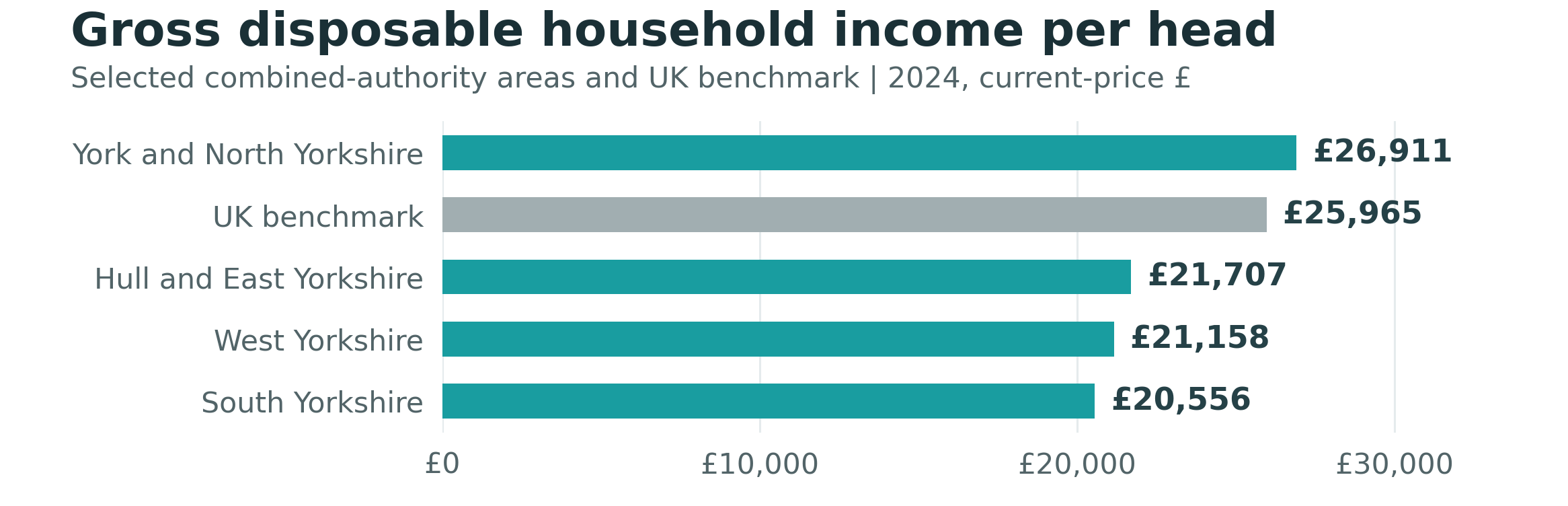
Figure 1. Gross disposable household income per head in current-price pounds, 2024. Selected combined-authority areas and the UK benchmark.
Source data from ONS regional household income, Table 2.
York and North Yorkshire had £26,911 in gross disposable household income per head in 2024, compared with £21,158 in West Yorkshire and £20,556 in South Yorkshire. These are area averages for resources households have to spend or save. Use order history, customer interviews and competitor prices to decide what customers will pay for your product and delivery. A merchant with limited order data can start with targeted market research.
Make the brief specific to how you trade
For a shop with a busy Leeds or Bradford counter, the ecommerce website development Yorkshire retailers commission can make a practical difference at collection. Show which location holds the item, reserve it for the buyer and send a ready-to-collect message after a member of staff has picked it. State how long you’ll hold it. Give the same instructions on the product page and in the confirmation.
York’s visitor economy creates a different opportunity. Make It York put the economic impact of tourism in 2025 at £2.08 billion, based on its STEAM estimates. A shop near the city centre could make its popular items easy to find by name or photo after a visit, then offer delivery within the destinations it actually serves. Test whether repeat orders come through a packaging insert with a short product link. See the Make It York visitor economy release.
In Sheffield, a maker of replacement components may have customers who already know the part number. Put exact-code search, clear pack sizes and reorder lists ahead of lifestyle imagery. For a Dales producer sending fragile or short-life goods, start with the postcodes and days the business can serve. If you also take trade orders in Hull or the East Riding, specify whether trade customers receive the same stock, prices and delivery terms as retail buyers.
Use channel data without borrowing someone else's sales target
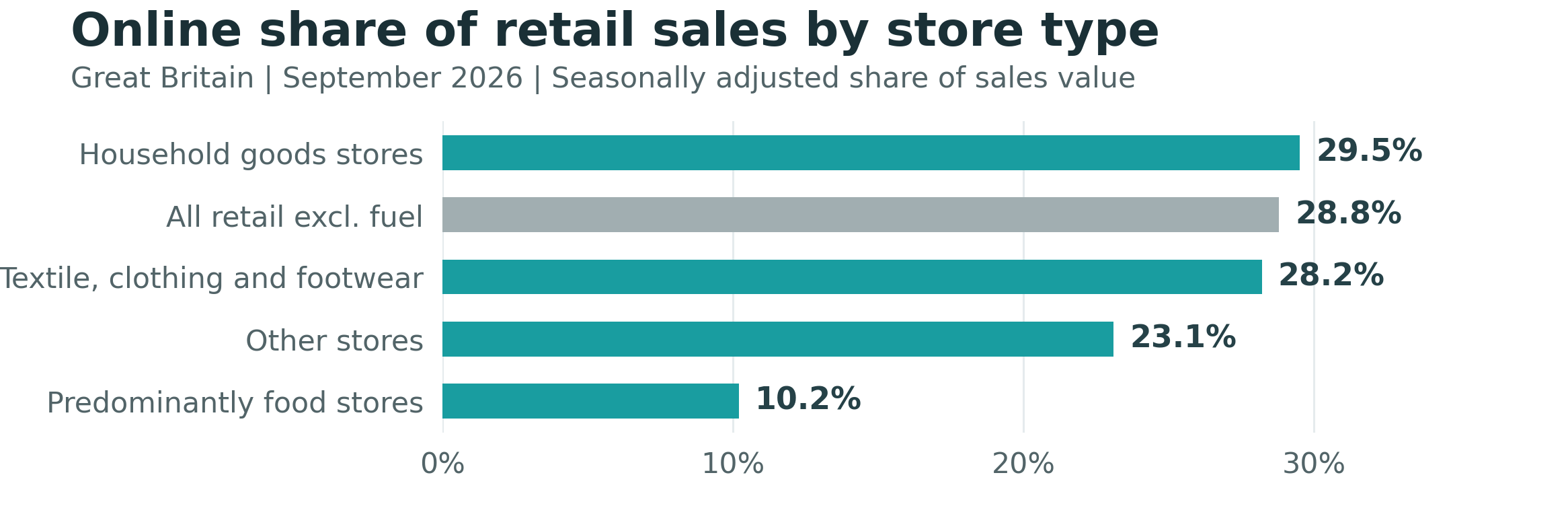
Figure 2. Internet share of retail sales value by selected store type, Great Britain, September 2026, seasonally adjusted. Groups are based on the retailer’s main activity. The all-retail benchmark excludes automotive fuel.
Source data from the ONS Retail Sales Index internet sales workbook, table ISCPSA3.
In September 2026, online sales accounted for 28.8% of retail sales value in Great Britain, excluding automotive fuel. That share was 29.5% for household goods stores, 28.2% for textile, clothing and footwear stores, and 10.2% for predominantly food stores. Those differences point to questions to test. Buyers of furniture may need dimensions and delivery information to decide remotely. A food shop with a limited delivery radius may benefit more from accurate collection slots and a reliable stock list. See the ONS September 2026 retail sales bulletin.
Ofcom reported that smartphones made up 77% of measured online time among UK adults who used the internet in May 2025. That measures time across services and devices at UK level. For your shop, watch the steps customers complete on each device. Someone browsing trainers on a phone may place an order later on a laptop, while a trade buyer might reorder directly from a phone between jobs. The Ofcom Online Nation report gives the national context.
Scope ecommerce website development Yorkshire shop teams can test
Start ecommerce web design with a product someone actually buys. For a Bradford clothing merchant, use a style sold in several sizes and colours. Decide what a buyer needs to see on a phone before selecting a size. Include measurements, photographs that change with the colour, availability for the chosen variant and the delivery options. Have someone who did not write the page try to pick their size and complete a test order.
Prepare a test catalogue before asking for a fixed price. Give suppliers one simple item, one variant family, one bundle and one item with an exception such as collection only. Ask who will enter the product information and which fields staff can edit. A useful catalogue includes consistent stock codes, weights, dimensions, prices and photos. The developer can plan imports and search around that material when scoping ecommerce website development services.
Trading model | Test purchase | What staff should see |
|---|---|---|
Shop and online | The last unit is sold at the till | It becomes unavailable online within the agreed time |
Regional delivery | A basket includes an item with a postcode restriction | The permitted options and dispatch date match the route |
Nationwide parcels | A shopper picks a size, pays and returns one item | Order, refund and stock records agree |
Trade accounts | Two buyers reorder the same part number | Each sees the price, pack size and terms for their account |
Give an item one stable stock code per sellable variant. If you use an electronic point of sale (EPOS), a warehouse system and the shop platform, nominate the system that controls stock. Specify when a paid order reserves it and when a cancellation releases it. Have the developer show what staff see if a stock update fails and how the connection recovers. A sync that works only when the internet behaves is a risky dependency.
Use ecommerce web design to help customers choose. A product photograph can show scale with a familiar object, while a finish sample can prevent a colour surprise. A simple back-in-stock notice can be useful for products you replenish. For made-to-order items, lead times belong near the buying decision. Plan these content needs alongside your product and brand design work.
Decide which products to launch with
A merchant with years of old product records can save time by checking which items still sell, which have reliable photos and which can be delivered at a workable margin. A furniture seller might keep bulky items available for showroom collection while starting parcel delivery with accessories. Use the ecommerce web design prototype to show which buying options each item has, then ask someone unfamiliar with the range to find an eligible item and explain when they could receive it.
Build filters from attributes customers actually use, such as width, finish or pack size. Agree which fields are required before a product can go live. If the supplier counts a T-shirt as one product and staff must enter 20 variants, price the work at variant level.
Choose a platform your team can maintain
The ecommerce website development Yorkshire merchants need depends partly on who will look after the shop on an ordinary working day. Have your staff add a product, change a delivery setting and process a refund in a demo. Count how many tools they open and whether they can tell what went wrong when a step fails.
Platform route | Where it fits | What to budget and test |
|---|---|---|
Shopify | A team that wants managed hosting and a standard checkout | Plan, theme, apps, payment fees and any till or warehouse link |
WooCommerce | A WordPress site with content and flexible store requirements | Hosting, extension licences, backups, updates and checkout compatibility |
Bespoke commerce | Trade or fulfilment rules that standard extensions cannot handle well | Integration work, security, automated tests and ongoing engineering |
Shopify for a simpler operating setup
Shopify development can be a sensible fit for a shop with standard products, parcel delivery and a team that wants fewer server tasks. It still takes work to structure collections, set up taxes and shipping and check how discounts interact with returns. When reviewed in November 2026, Shopify’s UK Basic plan displayed £19 per month with yearly billing and £25 with monthly billing. Those subscription figures are separate from your developer’s work, apps and payment charges. Check the official Shopify UK pricing page.
Ask for a Shopify development proposal that explains which features are standard, which use apps and where workarounds might be needed. A shop adding a physical till should test both directions of stock updates. Confirm the monthly app list, who receives notices about changes and which capabilities depend on the plan. Compare the provider’s scope with the Shopify website development service outline.
WooCommerce when WordPress is already working for you
WooCommerce development can suit a merchant whose buying journey starts with guides, recipes or specifications on a WordPress site. It gives the team control over how content and products connect. Include a host and an update plan that can support the store during campaigns. Ask how a new extension is tested alongside checkout, discounts and payment processing.
For WooCommerce development, check exactly what you can restore. Products, orders and settings depend on the database. Themes, extensions and photos also need copies. Ask the provider to restore a recent backup into staging, then show that staff can find a test order and that the appropriate product photos load. The WooCommerce backup documentation explains what to include.
Custom work for rules you can demonstrate
A Sheffield trade supplier might require account-level prices, purchase orders and approval by a second buyer. Before buying a bespoke storefront, ask providers to show the closest existing feature in Shopify or WooCommerce and the cost of extending it. Where bespoke work is justified, test a small integration before committing to the full build. Write down what happens if the accounting system is unavailable. Use a concrete workflow when discussing custom website development.
The ecommerce website development Yorkshire wholesalers need may include checking who is entitled to see trade prices or order on account. Give the supplier two anonymised account records and ask it to show how a new buyer is approved, which prices appear when they sign in and what staff see when their credit terms change. If most orders are still agreed by phone, a saved basket that requests a quote may be a practical first step. You can add online payment for approved orders after learning which terms customers use.
What an ecommerce website costs in Yorkshire
A provider may quote for a theme, a given number of product uploads and a basic courier option. Another may include photography, custom templates, data cleanup and an EPOS connection. Ask which ecommerce web design and development tasks are included before comparing the totals. These examples were published by Yorkshire providers and checked in November 2026.
Provider and scope | Advertised price | What to confirm |
|---|---|---|
£1,399 offer | Package lists 20 simple product uploads and flat-rate shipping | |
From £2,400 | Starter ecommerce includes adding up to 50 products | |
Andrew Backhouse Design, Ecommerce Plus | £3,600 guide | Package lists up to 100 products. Check variants and extra work |
These are advertised examples for different scopes. Request a quote in pounds that shows how VAT is treated and what can increase the bill. If the ecommerce website development Yorkshire providers quote for involves a migration, ask how many redirects, products and customer records they will handle. Set the cost of anything above that allowance before work starts. Check the UK VAT rates guidance with your adviser where relevant.
The easiest ecommerce website cost to miss is the work after launch. A theme can require a licence, a small extension can become a recurring charge and a catalogue feed can need regular repairs. Add platform or hosting bills, renewals, payment fees, ecommerce website maintenance and any staff time you expect to spend on data entry. Review the Shopify cost and features guide for further questions to put to a Shopify provider.
Suppose a quote shows £4,800 for the build, £1,200 for catalogue preparation and £900 for integrations. At £135 a month for hosting, apps and support, the running cost comes to £3,240 over 24 months. The total is £10,140 before VAT, transaction charges, ads and internal labour. This is an illustrative ecommerce website cost, with monthly charges held flat. Ask for equivalent figures from each supplier and a description of what triggers additional work.
Separate flat fees from charges that change with usage. A Shopify development quote may include configuring a reviews or delivery app while leaving the subscription to you. Ask for the charge at your current order volume and at twice that level. For ecommerce website maintenance, get a clear distinction between repairing an agreed feature and adding a new one. A pricing sheet that shows these assumptions makes the ecommerce website cost easier to review when the store grows.
Get the domain and key subscriptions in business-controlled accounts. Compare first-year and renewal charges, SSL coverage, staging and backups. For hosted commerce, establish which data can be exported and who can do it. For WooCommerce development, ask how the database and files could move to another host. If you register a .uk or .co.uk name, check the controls available to you as the domain holder in Nominet’s online services.
Make checkout match what you can deliver
The first test of ecommerce website development Yorkshire merchants invest in is whether a buyer can place an order the business can fulfil. Write the rules down before you choose shipping apps. Include the products you can pack together, weight limits, dispatch cut-offs, collection hours and the destinations you serve. Use examples with a mixed basket, an excluded postcode and a bank holiday.
Make the price clear early
A customer considering a £36 lamp needs to know what receiving it will cost. For UK consumer sales where a delivery fee is unavoidable, the Competition and Markets Authority says the total price should include the minimum mandatory delivery charge where calculable, from the first stage where the price is shown. The same guidance covers variable charges, a flat fee for a basket and genuine free collection. Agree how your product pages, promotions, basket and checkout will present your specific rates. See the CMA’s November 2026 letter to online retailers.
If you offer collection from a Leeds shop and courier delivery across Britain, test both paths. A collection order should reserve the item at the right branch, show the pickup address and produce a separate message when staff have checked and picked it. Keep your collection hours and store link aligned with any listing you use to reach nearby customers. This can be part of managing your Google Business Profile.
For ecommerce website development Yorkshire producers need to serve a limited delivery area, make postcode eligibility visible before someone spends time filling a basket. A North Yorkshire gift hamper seller might dispatch on set days and cap how many boxes can leave at once. If you sell outside Great Britain, test the actual routes and costs. When shipping to Northern Ireland, check the guidance for the goods and recipient involved. See GOV.UK guidance on GB–Northern Ireland parcels.
Test the orders that go wrong
Have someone attempt a declined card payment, refresh the confirmation page and try again. Check that one successful payment creates one order and that a declined payment is clearly shown to the buyer. Ask how the shop handles a payment confirmation that arrives late and who checks a paid order that never reached the fulfilment system. Test from a phone and through a keyboard, including focus indicators, field labels and errors people can recover from. Use WCAG 2.2 as a reference for accessibility checks.
Process a partial return and an exchange before signing off. Decide what goes back into saleable stock, how the refund appears to the customer and which team records the reason. Under UK distance-selling rules, customers who buy most goods online can usually notify the seller of cancellation within 14 days of receiving them and have another 14 days to return them. Exceptions include some personalised and perishable goods. Check the appropriate rules for your products, including rights for faulty goods, using GOV.UK’s guidance on returns and refunds.
Keep customer information out of test orders where possible. Ask what data the checkout, reviews, analytics and marketing tools collect and who can access it. Have your adviser confirm the necessary supplier terms and international transfer arrangements if a remote team will handle personal data. Test how tracking behaves when a visitor changes their choices. The ICO provides guidance on cookies and similar technologies.
Compare the people who will build and support it
Compare ecommerce website development Yorkshire agencies offer with the same brief you give a freelancer or remote team. A freelancer may suit a focused catalogue build if you have a clear plan and a named person can cover support. A local agency may be useful for an on-site till or warehouse workshop. Ask who will attend and who will take the lead on the integrations.
Remote teams can quote competitively for a defined brief. Ask about UK-hours overlap, named project contacts, where testing happens and who deals with a payment incident. ZH Consultancy is based in Pakistan and offers remote development. Compare its proposed scope, schedule and support against the same requirements you give local providers. Make sure the quote covers the work your business will actually need after launch.
Ask a Shopify development specialist to show you an existing shop with a similar catalogue or fulfilment model and explain what they built. Ask a WooCommerce development provider to demonstrate a refund and a catalogue edit in staging. View the storefront and its checkout on a phone. Ask the supplier to do the same task with the staff permissions your team will use. A live demo of routine work gives you more evidence than a gallery of homepage screenshots.
Put the owner, due date and acceptance test for each major task into the agreement. Clarify design revisions, data migration, training, which code and design files you receive and what happens to paid licences. Break payment into stages linked to work you can inspect. If the supplier is a UK limited company, check that the contract and invoice identify the company you find on the Companies House register.
Move an existing shop without losing orders
The ecommerce website development Yorkshire merchants commission for a move should include a catalogue audit. Export product and collection URLs, stock codes, prices, customer and order data you are permitted to move, and a list of pages that earn sales or search traffic. Agree where each field will land. Test a batch with an out-of-stock variant, a discount and a product with a different tax setting.
Preserve useful URLs where possible. Where they change, map each old product or collection to the closest replacement and test permanent redirects. Check canonical URLs, sitemaps and the pages you want indexed after launch. A retired item may warrant a clear discontinued page or a relevant replacement, depending on what a visitor needs. See Google Search Central’s site move guidance.
Set a time for the final copy of products, stock and orders. Decide where orders placed during the transition will be processed and who checks for differences. Once the new site is live, run a real low-value order, confirm that the payment and stock records agree, then refund it. If you plan to switch back in an emergency, explain how staff will recover the orders placed since the change.
Check product feeds as well as pages. Each offer’s price, availability and identifiers should agree between the product page, checkout and Merchant Center feed. If you use structured data, test it on a few variants first. Fix mismatches before a campaign sends buyers to the new store. See Google’s merchant listing documentation.
Use contribution per order to decide what to build next
For ecommerce website development Yorkshire merchants can justify financially, start with what an order contributes. Suppose a Bradford clothing brand sells a £54 basket before returns, excluding VAT. The table models the average across initially placed orders. The return allowance accounts for expected refunds and handling after stock recoveries. Figures are hypothetical and rounded.
Per initially placed order | Illustrative amount |
|---|---|
Merchandise sales before returns | £54.00 |
Landed product cost | −£21.00 |
Packing and labour | −£3.50 |
Payment fee | −£1.50 |
Shipping shortfall after customer charge | −£3.00 |
Expected return loss | −£4.00 |
Contribution before acquisition | £21.00 |
Paid acquisition cost | −£12.00 |
Contribution after acquisition | £9.00 |
Suppose a £1,800 improvement to fit information and variant photography cuts the average return loss by £1.50 per placed order. At 250 orders a month that is £375 saved. After £75 a month in extra tools and upkeep, the model shows £300 in monthly improvement and a six-month simple payback. At 150 orders a month the improvement drops to £150 and payback is 12 months. The calculation holds volume, prices and other costs constant and excludes taxes, financing and payment delays.
Track why customers return products and which pages they visit before buying. Test changes to a small product group before assuming a site-wide effect. Use paid campaigns when you can reconcile what they cost with profitable orders. For example, compare first-order contribution by channel and account for repeat buying separately. You can agree these measures when budgeting for ecommerce marketing campaigns.
This approach also helps you prioritise ecommerce web design. A merchant with healthy product margins but frequent sizing exchanges might invest in measurements and more useful photography. A merchant with expensive shipping on small baskets might test a multipack or minimum order that covers fulfilment. Add the operating changes to the ecommerce website cost before forecasting a return.
Plan the first 90 days of support
The ecommerce website development Yorkshire teams commission should come with a handover that someone can use on a Monday morning. Take ownership of the platform and domain accounts, train at least two staff and record how to run a refund, change stock and add a product. Use individual logins with appropriate access and switch off accounts that are no longer needed.
During the first week, check payments, stock and dispatch messages daily. During the first month, review abandoned baskets, reasons for refunds, queries about delivery and how quickly staff can fulfil orders. In the second and third months, choose one change based on what those records show and give it a measurable test. For example, check whether an early pickup message reduces calls about when an order will be ready.
Put a missed order on the ecommerce website maintenance checklist. Give the team a way to look up a payment reference, confirm whether an order exists and check if the warehouse received it. Rehearse this before a seasonal promotion when staff are busy. Include the same discipline in ecommerce web design changes. If you alter the collection selector, check that a buyer can still see the pickup address and that the address matches the order staff receive.
Agree what ecommerce website maintenance covers. A useful plan spells out support hours, the response to a checkout outage, who owns app and extension updates and when a restore was last tested. Shopify development still requires someone to watch app changes and test the ordering journey after edits. With WooCommerce development, budget for staging tests before deploying platform and extension updates. Set expectations with your website maintenance provider.
Over the next few years, expect more shop platforms to offer tools for automatic tagging, draft descriptions and customer-service replies. Start with reliable product records and a clear approval process. For example, a shop can draft descriptions from verified dimensions and materials, then have staff review claims and care instructions. Keep dispatch promises and stock figures tied to the systems that control them. Customers will still judge the shop by what arrives.
The Takeaway
The ecommerce website development Yorkshire merchants can build on starts with a real product, a real delivery promise and a staff member who can handle the order. Put those things into your brief. Compare providers on how well they can demonstrate the journey and how much it will cost you to run it.
If you are scoping a new store or fixing an existing one, send ZH Consultancy a sample product, your delivery rules and the systems you use. Its Pakistan-based team can discuss how to handle the work remotely. Discuss your ecommerce brief with ZH Consultancy.
Faq
Frequently Asked Questions
Published examples of ecommerce website development Yorkshire providers offer include a £1,399 package with 20 simple product uploads and a starter offer from £2,400 with up to 50 products. Your ecommerce website cost depends on variants, content, integrations and support. Ask for the total build price and a separate running-cost schedule.
Shopify development can suit a team that wants managed hosting and a familiar checkout. WooCommerce development may suit an existing WordPress site that needs flexible content or store rules. Test your hardest product, payment and fulfilment requirements on each option before choosing.
For planning, allow several weeks for a straightforward store with ready photos, clean product data and standard shipping. An EPOS connection, migration or trade catalogue can add time for tests and approvals. Ask for dates for the catalogue import, trial order, staff training and launch.
Yes, if your EPOS and online store can exchange stock information reliably. Decide which system controls quantities and test the last unit, a refund and a failed sync. The ecommerce website development Yorkshire retailers need for this setup should include an alert and a way for staff to reconcile stock.
Ask for a list of products, URLs and records to move, a trial import, redirect testing and a plan for orders placed during the switch. Include responsibility for checking payment, stock and feeds after launch. Set aside time for your own staff to test the process.
Give both the same brief and ask for a demonstration of a difficult order. Compare the ecommerce website development Yorkshire agencies propose with the remote team’s scope, time overlap, support and account ownership. Ask who handles faults after launch and what they charge.
Arrange for someone to check payment failures, stock sync and product feeds, test updates, review account access and keep a working backup or export. Ask who responds to urgent issues and which changes are billable. Schedule regular reviews of returns and delivery questions as part of improving the shop.

Zain Hameed
Business strategy specialist helping a global client base of 800+ businesses build credible plans, financial models and investor-ready presentations.
In this article
Book a Free Consultation
Have a business idea, growth challenge or investor deadline? Book a free consultation and get clear next steps from our team.
Call our team
+923104049517
Email us

Business Topics
Business topics
Continue reading
Related insights

How to Start a Side Business in the UAE While Working Full-Time
Learn how to start a side business in the UAE. Compare

How to Start an Electrical Business
Learn how to start an electrical business in the U.S., with

How to Start a Junk Removal Business
Learn how to start a junk removal business with U.S. startup

How to Start a Lash Business and Build a Loyal Client Base
Learn how to start a lash business in the U.S., compare

How to Start a Mobile Drug Testing Business
Learn how to start a mobile drug testing business in the

How to Start a Pest Control Business in the United States
Learn how to start a pest control business in the U.S.