

In this article
Imagine owning a business where customers walk in, load their clothes into a machine, pay for a wash, and do most of the work themselves. No complicated inventory. No salespeople chasing customers around. And unlike restaurants, you’re not throwing away unsold products at the end of the day.
The washing machines aren’t what make a laundromat profitable. It’s what happens around them. The apartment buildings nearby. The number of customers who actually need your services. The rent you’re paying. The water bill that arrives every month. Even the number of times your machines turn over on an average Tuesday afternoon.
If you’re researching how to start a laundromat business, the real questions go much deeper than which washers to buy or how much to charge per load. How do you identify a location with enough paying customers? How much capital should you have before signing a lease? Is buying an existing laundromat safer than opening a new one? How do utility costs affect your profits? And how do you convince customers to choose your store when there’s another laundromat three blocks away?
Is Starting a Laundromat Business Worth It?
Here’s an interesting thing about laundromats. A customer who visits your store on Monday might return next Monday. And the Monday after that. And potentially dozens of times throughout the year. You don’t necessarily have to convince that person to buy something new every week. They already have a problem that keeps coming back. Dirty laundry.
That’s one of the biggest attractions of the laundromat business model. Unlike businesses selling occasional luxury purchases, laundry services address a recurring household need. But recurring demand and recurring profits aren’t the same thing. You could have customers walking through your doors every day and still struggle to make money if your rent, utilities, equipment repairs, and financing costs consume most of your revenue. For someone learning how to start a laundromat business, that recurring demand is encouraging only when each visit contributes enough to cover real operating costs.
Why Laundromats Can Be an Attractive Business
The traditional self-service laundromat has a relatively straightforward business model. Customers bring their clothes, pay to use commercial washers and dryers, and handle most of the washing themselves. You provide the equipment, utilities, premises, and a clean, safe environment. This creates several potential advantages.
The Disadvantages Most First-Time Owners Underestimate
Potential advantage | Corresponding challenge |
|---|---|
Recurring laundry demand | Customers may switch to newer or more convenient competitors |
Self-service operations | Equipment still requires cleaning, maintenance, and repairs |
Multiple revenue streams | Additional services can increase staffing and operating costs |
Potential for reduced owner involvement | Employees, security, and contractors still need supervision |
Opportunity to serve a neighborhood for years | A poor lease or expensive location can undermine profitability |
The Coin Laundry Association identifies location, equipment condition, lease terms, utility costs, pricing, and competition among the factors influencing store performance. And that brings us to something every prospective owner should understand.
A Laundromat Isn't Automatically Passive Income
You may have seen advertisements describing laundromats as businesses that make money while their owners relax on a beach. Technically, customers can use the machines without the owner standing beside them. But someone still needs to handle equipment failures, customer complaints, cleaning, security, maintenance, and financial records.
Who Should Consider Starting a Laundromat?
A laundromat may be a good fit for someone who enjoys operating a practical, service-based business, has access to sufficient capital, and is comfortable managing equipment, property expenses, and customer service. It’s especially worth investigating if you’ve identified a neighborhood with strong laundry demand and can obtain a suitable location on workable lease terms.
Global and U.S. Laundromat Market Size: Is the Industry Growing?
Imagine finding a storefront in a busy neighborhood. There are apartment buildings nearby, a grocery store across the road, and plenty of people walking past every day. Looks like the perfect laundromat location, right? Maybe.
How Big Is the Global Laundromat Market?
For a more relevant comparison, Grand View Research estimated the global coin-operated laundries market at $17.55 billion in 2022 and approximately $19.20 billion in 2023. Its forecast projected the market to reach $35.84 billion by 2030, representing an estimated compound annual growth rate of 9.3% between 2023 and 2030.
Source: Grand View Research — Global Coin-operated Laundries Market
A newer estimate from 360iResearch places the global coin-operated laundries market at $21.09 billion in 2025, with a projected increase to $22.60 billion in 2026 and $35.05 billion by 2032. That report estimates annual compound growth of 7.52% over its forecast period.
Source: 360iResearch — Coin-operated Laundries Market Forecast
U.S. Laundromat Market Size: What the Last Five Years Tell Us
The U.S. Census Bureau provides a useful historical picture through its Annual Integrated Economic Survey. According to figures published through the Federal Reserve Bank of St. Louis, revenue in the U.S. coin-operated laundries and drycleaners category increased from approximately $4.27 billion in 2020 to $6.19 billion in 2024. Here’s the five-year breakdown.
Year | U.S. industry revenue | Annual growth |
|---|---|---|
2020 | $4.27 billion | — |
2021 | $4.88 billion | 14.4% |
2022 | $5.50 billion | 12.6% |
2023 | $5.91 billion | 7.5% |
2024 | $6.19 billion | 4.8% |
Source: U.S. Census Bureau, Annual Integrated Economic Survey, NAICS 81231. Values rounded; annual growth rates calculated from the underlying revenue figures.
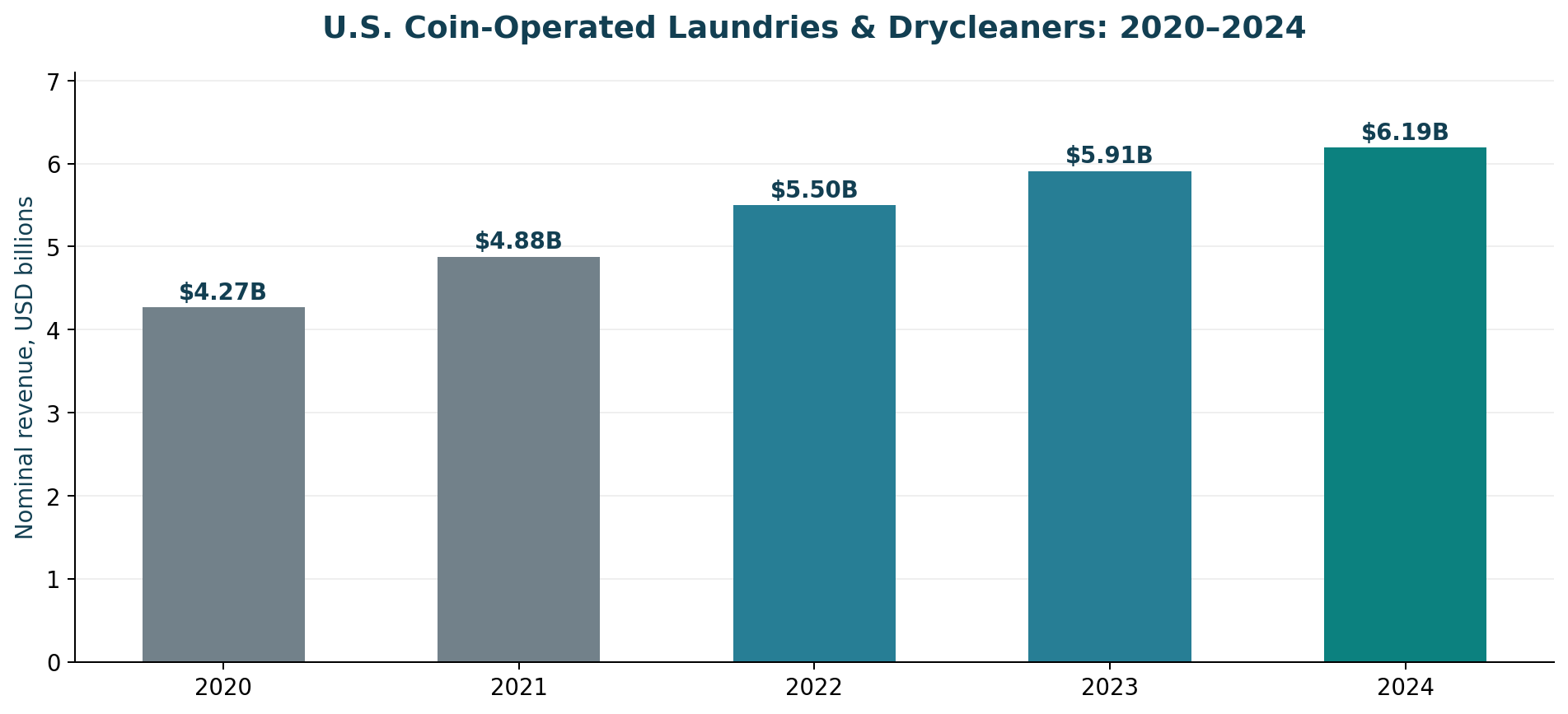
U.S. Census Annual Integrated Economic Survey, coin-operated laundries and drycleaners (NAICS 81231), 2020–2024, nominal revenue in USD billions; includes activities beyond walk-in self-service storefronts.
How Many Laundromat Businesses Are Operating in the United States?
Here’s where the numbers become interesting. The Coin Laundry Association estimates that approximately 29,500 coin laundries operate across the United States. Meanwhile, the U.S. Census Bureau reported 10,890 employer establishments in the coin-operated laundries and drycleaners industry in 2023.
Why such a big difference? Because the two sources aren’t measuring precisely the same thing. The Census employer-establishment count excludes businesses without paid employees. Its industry classification also includes certain commercial laundry equipment-service activities. The association’s figure is an estimate of coin-laundry locations. Neither should be described as an exact, real-time count of every laundromat operating in America.
Sources: Coin Laundry Association — Industry Overview and U.S. Census Bureau — NAICS 812310
So what should a future owner take from these numbers? First, laundromats are an established industry. You’re not trying to introduce a service nobody understands. Second, the existence of thousands of competitors means customers already have options. And third, national business counts tell you surprisingly little about the competitive conditions around a particular storefront. Understanding how to start a laundromat business in the United States means narrowing national figures to the households and competitors around one potential store.
Who Actually Uses Laundromats in America?
A common assumption is that laundromats primarily serve people who cannot afford washing machines. That describes part of the demand, but it misses several important customer groups. Consider renters living in apartments without in-unit laundry facilities.
The 2024 American Community Survey estimated approximately 46.1 million renter-occupied housing units in the United States. Source: U.S. Census Bureau — 2024 Housing Tenure
What Will Influence Laundromat Demand Between 2027 and 2030?
The industry has several potential opportunities over the next few years, but also some meaningful challenges.
First, housing patterns will continue to matter. Neighborhoods with substantial rental housing, limited in-unit laundry facilities, and convenient retail access may provide a stronger potential customer base. However, new apartment developments with private or shared laundry facilities can change demand, even while the local population grows.
What These Market Statistics Mean for a New Laundromat Owner
The global outlook is encouraging, and the United States has a sizable, established laundry market. But national industry statistics cannot tell you whether a particular storefront is worth renting.
Before investing, research the number of rental households within your actual service area, the availability of laundry facilities in nearby apartments, existing laundromat prices and machine capacity, customer accessibility, and the local utility and property costs. That research is what connects national market opportunity to a realistic business decision.
How to Choose a Profitable Laundromat Location
Imagine finding two empty storefronts. The first is on a beautiful street with expensive restaurants, modern apartments, and plenty of passing traffic. The second is in an older neighborhood surrounded by rental buildings. The storefront isn’t particularly impressive, but hundreds of households live within walking distance, and the nearest laundromat has a reputation for broken machines and long waiting times. Which location would you choose?
If you’re thinking about the second one, you’re asking the right questions. A successful laundromat doesn’t necessarily need the trendiest address. It needs to be where people have a genuine reason to pay for laundry services. And that’s why choosing a location is arguably one of the biggest decisions you’ll make when learning how to start a laundromat business. That local-first mindset is central to how to start a laundromat business without confusing a fashionable address with a commercially viable one.
Start With the People Who Will Actually Use Your Laundromat
Before looking at rental properties, identify the customers you’re trying to attract. For a traditional self-service laundromat, renters can be an important audience, especially where apartment buildings don’t provide convenient laundry facilities.
The Census Bureau’s data.census.gov can help you research neighborhood population and housing characteristics. But don’t stop at statistics. Walk through the neighborhood. Observe the surrounding buildings. Speak with local residents when appropriate. Find out whether apartment complexes have shared laundry rooms.
Study Your Competitors Before Assuming There's Room for Another Laundromat
Let’s say you’ve identified a neighborhood with 5,000 households and a substantial renter population. That’s encouraging. But now you discover four laundromats already operating nearby. Should you abandon the location? Not necessarily.
Of course, you’d still need to calculate whether the additional labor, electricity, security, and operating expenses justify staying open longer. A competitor’s weakness is only a business opportunity if enough customers care about it and you can solve it profitably.
Look Beyond Foot Traffic: Accessibility Matters More
A busy road can make a location appear attractive. But laundromat customers aren’t necessarily browsing storefronts the way they browse clothing shops. They’re often transporting bags or baskets of laundry. Some arrive with children. Others carry large comforters, blankets, or several loads of clothing.
Inspect the Utilities Before Falling in Love With the Property
The Coin Laundry Association specifically identifies utility capacity and possible water and sewer connection fees as important considerations during store planning. These costs can be significant.
Don’t assume that because a building previously operated as a retail store, it can automatically become a laundromat. And don’t assume the landlord’s assurance that “everything should be fine” is a substitute for technical inspections. When estimating laundromat startup costs, budget for utility upgrades based on inspected infrastructure rather than assumptions about the previous tenant.
Understand How Rent Can Destroy an Otherwise Profitable Business
Suppose you’ve found two suitable properties. Both appear capable of supporting the same number of washers and dryers. One costs $4,000 per month. The other costs $6,500. The second location has better visibility, but will that visibility generate enough additional business to justify the difference? Let’s look at the numbers.
Expense | Location A | Location B |
|---|---|---|
Monthly base rent | $4,000 | $6,500 |
Annual base rent | $48,000 | $78,000 |
Additional annual rent | — | $30,000 |
The more expensive location requires an additional $30,000 every year in base rent alone. And that’s before considering potential common-area maintenance charges, property-tax pass-throughs, insurance charges, and rent increases.
Use a Location Scorecard Instead of Trusting Your Instincts
When you visit several potential properties, it’s easy to remember the attractive storefront and forget the expensive sewer connection. A structured scorecard helps you compare locations more objectively. Here’s a practical example.
Evaluation factor | Maximum points |
|---|---|
Customer demand and nearby rental housing | 25 |
Competition and unmet customer needs | 20 |
Utility capacity and renovation requirements | 25 |
Rent, lease terms, and financial feasibility | 20 |
Access, visibility, and safety | 10 |
Total | 100 |
Validate the Numbers Before Signing Anything
Compare the resulting revenue scenarios with rent, utilities, staffing, repairs, financing payments, and other operating costs. You can conduct much of the initial research yourself. For a substantial investment, professional market research services can also help assess demand, competitors, pricing, and location risks. The practical answer to how to start a laundromat business in a particular neighborhood should come from this feasibility exercise, not a landlord’s sales pitch. Capture these findings in the laundromat business plan so the location assumptions can be challenged before a lease is signed.
Should You Buy an Existing Laundromat or Start From Scratch?
Imagine someone offers to sell you a laundromat for $300,000. The equipment is already installed. Customers are coming through the doors. The owner claims the business generates $18,000 a month and says they’re selling because they want to retire. Sounds like a pretty good opportunity.
When learning how to start a laundromat business, you generally have three routes: buy an existing store, build a new one, or purchase a franchise. Each comes with a different combination of investment, control, operating risk, and uncertainty. Let’s examine what you’re actually getting for your money.
Option 1: Buy an Existing Laundromat
Buying an established laundromat can save you considerable time. Instead of spending months installing washers and dryers, you take over a business with an existing location, equipment, and potentially an established customer base. You may also inherit valuable operating history. If you are researching how to start a laundromat business through an acquisition, established revenue is useful only when the records support it.
That matters because a store with several years of documented revenue is easier to evaluate than one that hasn’t opened yet. The Coin Laundry Association explains that existing laundromats are generally valued according to their operating performance, while newly built stores are valued more closely around construction and equipment costs.
How to Verify a Laundromat's Revenue Before Buying
This is probably the single most important part of acquiring an existing laundromat. Suppose the seller tells you: “We make around $18,000 every month, mostly in cash.” Wonderful. Now ask them to prove it.
Request business tax returns, profit-and-loss statements, bank deposits, coin collection records, card-payment reports, and other available operating records. Ideally, review at least three years of annual financial statements and 12–24 months of detailed operating data. Don’t simply accept a spreadsheet prepared by the seller.
Inspect the Machines and the Lease Together
Now suppose the lease expires in three years, with no guaranteed renewal. You may be facing major equipment purchases without knowing whether you’ll still control the property long enough to recover your investment. That’s a dangerous combination. A technical inspection of laundromat equipment should accompany the review of the remaining lease term.
Option 2: Build a New Laundromat From Scratch
Starting from scratch gives you greater control. You can choose the neighborhood, develop the store layout, install the machines you want, create your own brand, and design the customer experience around a specific market.
You may need architectural plans, plumbing upgrades, electrical improvements, gas connections, ventilation systems, building permits, commercial equipment installation, and inspections. Some costs may be difficult to predict before contractors investigate the premises.
Option 3: Buy a Laundromat Franchise
The FTC’s guide to buying a franchise explains what to examine, including costs, restrictions, financial claims, and the importance of speaking with existing franchisees.
Don’t assume that a recognizable brand guarantees customer demand or profitability. You still need to evaluate the location, financing, operating expenses, and contractual obligations.
Buying vs. Building vs. Franchising: Which Is Better?
Factor | Existing laundromat | New independent laundromat | Franchise laundromat |
|---|---|---|---|
Existing customers | Possibly | No | Not necessarily |
Historical store revenue | Usually available | Not available | Depends on the location |
Equipment condition | Requires inspection | New equipment possible | Depends on franchise model |
Branding control | Generally high | High | Often restricted |
Initial setup complexity | Moderate | Usually higher | Depends on support offered |
Ongoing franchise fees | Usually none | None | May apply |
Major risk | Hidden operating problems | Unproven demand and construction costs | Contractual costs and business performance |
No option is automatically superior. An existing laundromat with verified profits, healthy machines, and a favorable lease could be a stronger investment than an expensive new store. But a poorly maintained acquisition with unreliable financial records may be riskier than building a carefully researched location from scratch.
A Realistic Example: The $300,000 Laundromat That Costs More Than $300,000
Let’s return to our hypothetical seller asking $300,000. After performing your inspections, you discover that some machines need replacement and the business requires additional working capital. Your actual investment might look like this: For acquisitions, laundromat startup costs include closing expenses, deferred repairs and reserves as well as the asking price.
Investment requirement | Illustrative amount |
|---|---|
Business purchase price | $300,000 |
Equipment repairs and replacements | $30,000 |
Professional, legal, and closing costs | $10,000 |
Initial improvements and branding | $5,000 |
Working capital and cash reserves | $35,000 |
Total funding requirement | $380,000 |
If your proposed financing requires $3,200 a month, only $1,800 remains before income taxes and any owner compensation not already included in the operating budget. That’s a very different picture from hearing that the business makes $18,000 a month. That is why advice on how to start a laundromat business needs to show all-in acquisition funding rather than only the seller’s asking price. If you need laundromat financing for the acquisition, lenders may scrutinize those same cash-flow and equipment concerns.
If you need help evaluating these scenarios, professional financial modeling services can help connect purchase costs, debt payments, operating expenses, and future equipment spending.
My Recommendation for First-Time Laundromat Owners
If you’re buying your first laundromat, don’t assume the existing-store option is safer simply because customers are already there. And don’t assume a brand-new store is better because the equipment comes with warranties. Start with the evidence.
How Much Does It Cost to Start a Laundromat Business in the USA?
Imagine spending $180,000 on commercial washers and dryers, another $100,000 preparing your storefront, and thousands more on permits, insurance, and renovations. After months of planning, your laundromat finally opens. The machines are ready. Your sign is illuminated. Everything looks great.
How Much Money Do You Need to Open a Laundromat?
There’s no single startup price that applies to every U.S. laundromat. The investment depends on whether you’re purchasing an existing business, renovating a former laundry facility, converting a conventional retail property, or building an entirely new store. The biggest driver of laundromat startup costs is often the condition of the building and the level of equipment investment. As a practical starting point, consider these planning ranges.
Business type | Illustrative total funding range |
|---|---|
Small existing laundromat acquisition and improvements | $150,000–$350,000 |
Mid-sized leased laundromat with usable infrastructure | $300,000–$550,000 |
Major conversion, larger new store, or extensive construction | $650,000–$1.2 million+ |
These are broad planning scenarios, not guaranteed market averages or contractor quotations. Some acquisitions cost less, while large projects involving expensive real estate or extensive construction can exceed these amounts. When planning how to start a laundromat business, treat broad cost ranges as prompts to obtain local quotations, not as a lender-ready budget.
For comparison, BizBuySell reports that the median selling price of laundromats sold through its platform in 2025 was approximately $287,000. But remember the example from our previous section: a $300,000 acquisition could require $380,000 once repairs, closing expenses, and working capital are included. The purchase price alone is not your complete investment.
A Complete Laundromat Startup Budget: Let's Calculate the Real Numbers
Startup expense | Estimated cost |
|---|---|
Lease deposits and pre-opening rent | $18,000 |
Design, permits, legal and professional fees | $15,000 |
Plumbing, drainage, electrical and installation work | $95,000 |
Commercial washers and dryers | $170,000 |
Payment systems, security and monitoring | $12,000 |
Water-heating and ventilation improvements | $22,000 |
Furniture, signage and branding | $11,000 |
Website development and launch marketing | $10,000 |
Insurance, utility deposits and opening supplies | $7,000 |
Construction contingency | $35,000 |
Initial working-capital reserve | $60,000 |
Total estimated funding required | $455,000 |
Illustrative U.S. mid-sized laundromat startup budget, not a quotation or verified industry average. Assumes leased premises, no real-estate purchase, and some usable existing infrastructure. This budget distinguishes laundromat startup costs that create an operating store from working capital reserved for the months afterward.
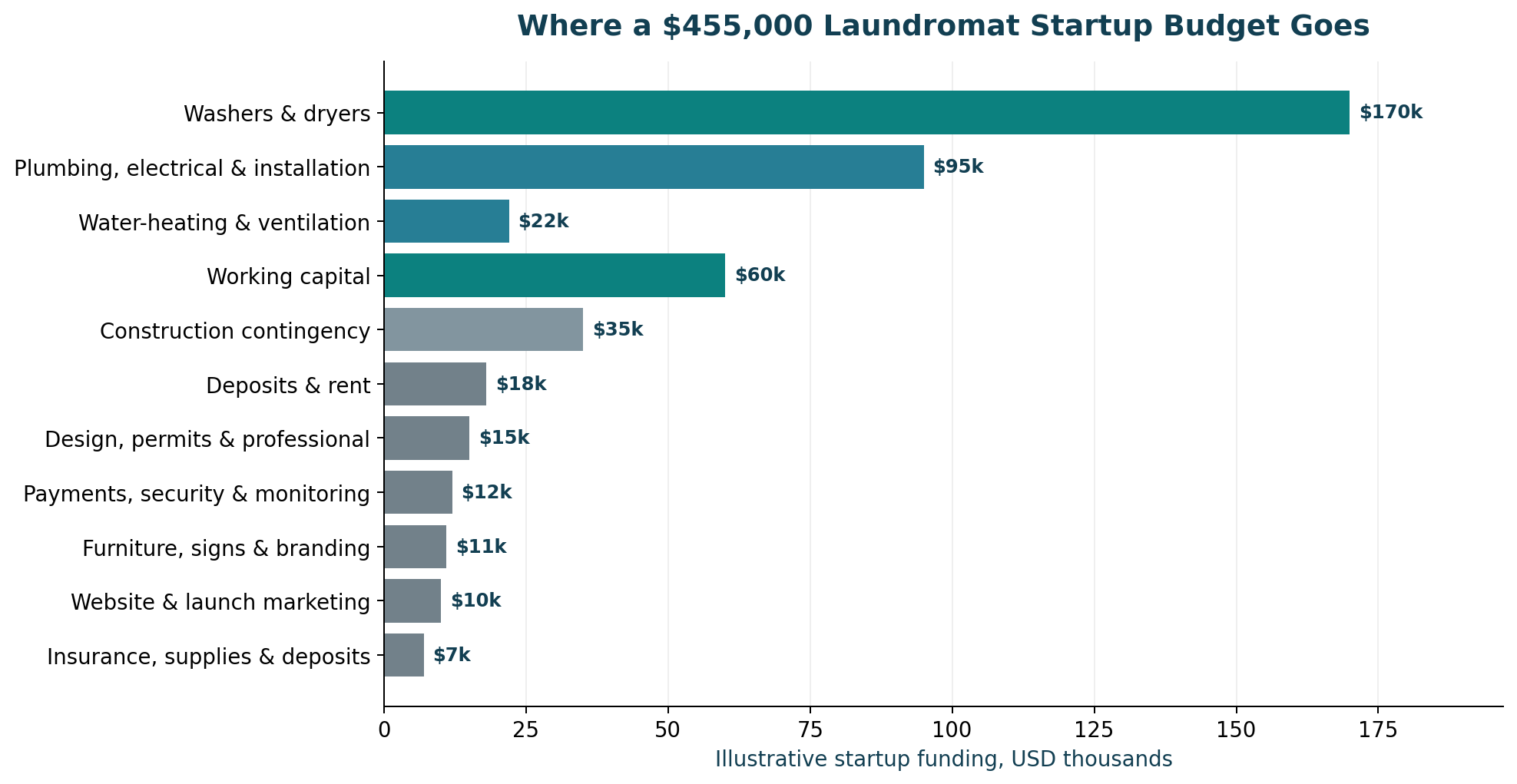
Illustrative $455,000 U.S. startup-funding example, USD thousands; these amounts are planning assumptions, not vendor quotes, nationally representative averages, or Statista data.
Source context: SBA — Estimate Your Startup Costs
Commercial Washers and Dryers: Your Biggest Equipment Investment
A store with plenty of washers but insufficient dryer availability can create frustrating customer bottlenecks. Before purchasing, compare quotations from established commercial laundry distributors, including equipment, freight, installation, warranties, and servicing arrangements. When comparing laundromat equipment, request installation and support terms alongside each machine quotation.
ENERGY STAR reports that certified commercial clothes washers are, on average, approximately 9% more energy-efficient and use about 45% less water than standard models covered by its comparison. Actual savings depend on the selected models, usage, and utility prices. Source: ENERGY STAR — Commercial Clothes Washers
Don't Underestimate Plumbing, Construction and Utility Costs
This is where seemingly attractive properties can become financial nightmares. Suppose a landlord offers you a spacious storefront at a reasonable monthly rent. You calculate the equipment costs and believe the numbers work. A proper estimate of laundromat startup costs should include written contractor scopes for drainage, connections, gas, electrical work and inspections.
The Coin Laundry Association specifically warns prospective owners to evaluate water, sewer, gas, electricity, and potential utility connection charges. Source: Coin Laundry Association — Getting Started for Investors
How Much Should You Budget for Branding, Website Development and Marketing?
Many first-time owners underestimate the importance of attracting customers before opening. They invest heavily in machines but leave almost nothing for branding, signs, local visibility, or a professional website.
Which business makes the stronger first impression? For the illustrative startup budget, we’ve allocated $10,000 to website development and launch marketing, with separate funding for signage and branding. That marketing allocation might support website setup, local advertising, professional photography, promotional materials, and opening campaigns.
Monthly Laundromat Operating Costs: What Happens After Opening?
Monthly expense | Illustrative amount |
|---|---|
Rent and property charges | $4,500 |
Water, sewer, gas and electricity | $4,000 |
Staff and payroll-related costs | $2,500 |
Equipment maintenance and repairs | $750 |
Insurance | $250 |
Software, internet and monitoring | $200 |
Ongoing marketing | $800 |
Cleaning and operating supplies | $400 |
Accounting and miscellaneous expenses | $700 |
Monthly operating expenses | $14,100 |
Illustrative monthly operating budget. Actual utility expenses depend heavily on machine use, local tariffs, and equipment efficiency. Staffing depends on wages and operating hours. Figures exclude income taxes, owner compensation, financing payments, and major equipment replacement.
This store needs approximately $14,100 per month to meet the listed operating expenses at the assumed activity level. That doesn’t automatically mean it breaks even at $14,100 in revenue.
How Much Working Capital Should You Keep?
If it temporarily generated no revenue, a $60,000 reserve would cover approximately 3.3 months of those cash commitments. In normal operation, customers would contribute revenue toward the bills, extending the reserve. But a slow opening, unexpected equipment repairs, or a permit delay could consume cash quickly. A realistic explanation of how to start a laundromat business must include the cash needed after the opening-day photographs are taken.
The U.S. Small Business Administration recommends calculating startup expenses alongside the cash needed to support early operating deficits. Source: SBA — How to Estimate Starting Costs
How Much Cash Do You Personally Need if You Finance the Laundromat?
Funding source | Illustrative amount |
|---|---|
Business or equipment financing | $315,000 |
Owner's invested cash | $140,000 |
Total project funding | $455,000 |
In this illustration, the owner supplies approximately 31% of the funding. That doesn’t mean a lender will automatically finance the other 69%. Approval depends on the borrower’s financial position, credit history, available collateral, project viability, cash flow, and the lender’s rules. Build any laundromat financing payment into the monthly forecast before deciding that the reserve is sufficient.
The Financial Mistake You Should Avoid
Only after understanding all three should you decide how much money you’re comfortable investing. Because the question isn’t simply whether you can afford to open a laundromat. It’s whether you can afford to keep it running long enough to become a sustainable business.
And that’s exactly why the next step is creating a detailed laundromat business plan—one that connects the market opportunity, startup investment, pricing strategy, and operating costs to a realistic financial forecast.
How to Write a Laundromat Business Plan
Picture yourself sitting across from a loan officer. You’ve found a promising location, obtained quotations for commercial washers and dryers, and estimated that opening the store will require $455,000. The loan officer looks through your proposal and asks a simple question: “How many customers do you expect to serve every day?”
Suddenly, the beautiful storefront and shiny new machines aren’t quite enough to make the investment sound convincing. This is why a laundromat business plan matters. It’s not simply a document you prepare because a lender asks for one. It’s the place where you test whether your assumptions about customers, equipment, pricing, and expenses actually fit together.
A good plan should answer three questions: Why will customers choose this laundromat? How will it make money? And what happens if the business performs worse than expected? The core of how to start a laundromat business is turning those three questions into assumptions you can test before borrowing money.
Start With the Business Concept and Your Customer
The first part of your plan should explain what you’re opening and who it’s meant to serve. Are you creating a budget-friendly self-service laundromat for nearby apartment residents? A modern cashless facility with oversized washers? Or a neighborhood laundry business offering self-service alongside wash-and-fold and pickup services? The laundromat business plan should clarify which services you can reliably deliver from opening day.
Research Your Market Before Forecasting Revenue
Talk to potential customers where practical. Review local demographic data and assess whether your proposed store solves a meaningful problem. For a major investment, properly structured market research services can help organize this evidence into demand estimates, competitor analysis, and location comparisons.
Calculate Revenue Using Machine Turns, Not Guesswork
Let’s make this practical. Assume your proposed laundromat has 20 washers, charges an average of $6.50 per wash across its machine sizes, and operates 30 days in a modeled month. A turn means one completed customer wash cycle on a machine. A lender-ready forecast links laundromat startup costs to projected machine use rather than assuming a large investment guarantees strong sales.
Monthly revenue source | Illustrative calculation | Revenue |
|---|---|---|
Self-service washing | 1,800 washes × $6.50 | $11,700 |
Self-service drying | 1,800 wash-equivalent loads × $3.50 average dryer spend | $6,300 |
Wash-and-fold | 40 orders × $75 | $3,000 |
Vending and other sales | Estimated monthly sales | $400 |
Total monthly revenue | $21,400 |
These are illustrative assumptions, not industry averages. Dryer purchases won’t always correspond one-for-one with washer cycles, and actual pricing and service mix will vary.
Test the Bad Months Before Planning for the Good Ones
A good financial forecast should therefore include conservative, base-case, and optimistic assumptions—not just one projected revenue figure. It should also distinguish accounting profit from cash available after debt repayments, and allow for taxes, equipment replacement, and additional staffing when services expand. Anyone working through how to start a laundromat business should recalculate these figures using local prices, utility tariffs and equipment specifications.
Build a Plan a Lender Can Actually Examine
For the financial portion, build monthly cash-flow forecasts for the first year and longer-range income, balance-sheet, and capital-expenditure projections. The SBA suggests a five-year financial outlook, with more detailed monthly or quarterly projections in the first year. Source: U.S. Small Business Administration — Write Your Business Plan
A professionally prepared laundromat business plan can help turn that research and operating strategy into a structured proposal for lenders or investors. Just remember that a polished document cannot compensate for unsupported assumptions.
Make the Plan Useful After Opening
A connected financial model makes it easier to test these changes without rebuilding your calculations every month. The goal isn’t to predict the future perfectly. It’s to understand which numbers drive the business, notice when they’re moving in the wrong direction, and make informed decisions before small problems become expensive ones.
A laundromat business plan is successful when it helps you reject a bad investment, improve a promising one, or operate a good one more intelligently. And once the numbers make sense, the next challenge is finding the capital to put the plan into action. That’s where laundromat financing comes in.
How to Finance a Laundromat Business in the USA
You’ve found a promising location. Your business plan looks reasonable. You’ve obtained equipment quotations, spoken with contractors, and calculated that you’ll need approximately $455,000 to open your laundromat properly. There’s just one problem. You don’t have $455,000 sitting in your bank account. Approach laundromat financing as a decision about future monthly obligations, not just a way to cover today’s equipment invoice.
The less exciting news? Getting approved for a loan doesn’t automatically mean the business can afford it. A lender might be willing to finance your equipment, but those monthly payments will continue whether your laundromat has a packed Saturday morning or a painfully quiet Tuesday afternoon. The financing side of how to start a laundromat business is less about qualifying for the largest loan and more about keeping enough cash after repayments.
SBA 7(a) Loans: A Flexible Option for Laundromat Financing
For many prospective owners, the U.S. Small Business Administration’s 7(a) loan program is worth investigating. The SBA doesn’t usually lend the money directly through this program. Instead, participating lenders provide financing, and the SBA guarantees an eligible portion of the loan. That guarantee helps lenders manage some of their risk. Lenders will also expect laundromat startup costs to reconcile with the proposed use of funds and the owner’s contribution.
The maximum loan amount under the standard 7(a) program is $5 million, although approval depends on eligibility, creditworthiness, repayment ability, and the lender’s assessment. Source: SBA — 7(a) Loan Program
SBA 504 Loans: Better Suited to Certain Property and Equipment Projects
But there’s an important limitation. SBA 504 financing generally cannot be used for working capital or inventory. That means you shouldn’t assume it will cover your ongoing marketing budget, ordinary payroll, and early operating expenses. Those cash requirements still need to be funded separately.
Source: SBA — 504 Loan Program
Equipment Financing: Can You Finance Washers and Dryers Separately?
A machine sitting idle for three weeks may not generate revenue, but the finance company will still expect its scheduled payments. Equipment financing can preserve cash at launch, but it doesn’t eliminate the cost of the equipment. It spreads that cost over time. Compare laundromat financing offers using total repayment costs and cash-flow impact, not the advertised rate alone. And remember that financing equipment separately can affect how other lenders assess your borrowing capacity and collateral.
How Much of Your Own Money Do You Need?
Funding source | Amount | Share |
|---|---|---|
Business loan | $315,000 | 69.2% |
Owner's investment | $140,000 | 30.8% |
Total funding | $455,000 | 100% |
Illustrative financing structure, not an actual lender offer or universal SBA down-payment requirement.
The original project budget already includes $60,000 in working capital. It must not be counted a second time. You’ll also need to confirm which budget items your particular lender can finance and which must be paid from your own funds.
Let's Calculate Your Monthly Laundromat Loan Payment
Using a standard amortizing loan calculation, your monthly payment would be approximately $3,990. That’s nearly $48,000 in debt payments every year. And the loan payment doesn’t replace your normal operating expenses. It comes on top of them. Let’s compare that obligation with the business plan from our previous section.
Monthly cash-flow item | Illustrative amount |
|---|---|
Total laundromat revenue | $21,400 |
Operating expenses | -$14,100 |
Cash before debt service | $7,300 |
Monthly loan payment | -$3,990 |
Cash remaining after debt service | $3,310 |
Illustrative loan terms and operating assumptions. The 9% rate is a calculation input, not a current lender quotation. Figures are before income taxes, owner compensation not already included, and major equipment replacement spending.
What Do Banks Look for Before Approving Laundromat Financing?
A lender wants confidence that you understand the business and can repay the loan. For a capital-intensive startup, you should be prepared to provide relevant documentation covering your proposed project.
According to the SBA, industry experience isn’t always required, but it can strengthen a lender’s confidence in the borrower. Source: SBA — Lender Match
A professional business plan can help organize the operating strategy and funding proposal, while financial modeling services can help connect revenue assumptions, loan repayments, and cash-flow scenarios.
Five Financing Mistakes That Can Put Your Laundromat at Risk
Mistake 2: Financing equipment without enough working capital.
Beautiful machines won’t pay your rent during a slow opening. Protect the reserves you’ve included in your startup budget. Knowing how to start a laundromat business responsibly also means recognizing where loan eligibility ends and your own financial risk begins.
Mistake 4: Assuming revenue will meet projections immediately.
Your store may take time to establish repeat customers. Test conservative cash-flow scenarios before deciding what you can afford.
How to Apply for Laundromat Financing
Then compare potential funding providers. The SBA’s Lender Match service can introduce eligible businesses to participating lenders. You can also speak directly with banks, credit unions, commercial equipment lenders, and CDCs for relevant financing options.
The best laundromat financing isn’t necessarily the loan with the smallest down payment. It’s the financing structure that lets you open the business, survive a slower-than-expected launch, maintain your equipment, and still generate enough cash to justify the investment.
U.S. Legal Requirements: How to Register and Legally Open a Laundromat
Imagine you’ve finally found the perfect property. The landlord agrees to your terms. You’ve secured financing, selected your equipment, and even started designing a logo for your new laundromat. Then you visit the local building department.
And if you’ve already signed a lease that requires rent payments before those issues are resolved, your business could start losing money before serving a single customer. This is why understanding the legal requirements is an essential part of learning how to start a laundromat business. One essential part of how to start a laundromat business in the United States is matching the premises to the required local approvals before construction starts.
Step 1: Choose the Right Business Structure
Business structure | Main advantage | Important consideration |
|---|---|---|
Sole proprietorship | Relatively simple to establish | No separate legal liability shield between owner and business |
LLC | Generally separates business liabilities from the owner's personal liabilities | State filing fees, ongoing requirements, and limits to liability protection |
Corporation | Can suit more complex ownership and investment arrangements | Additional governance and tax considerations |
An LLC is worth discussing with an attorney because a laundromat has physical premises, expensive equipment, customer traffic, and potential liability exposure. But don’t assume that forming an LLC protects you from every possible lawsuit or financial obligation.
The U.S. Small Business Administration provides a useful introduction to business structures and their differences. For a substantial laundromat investment, consult a qualified business attorney and tax professional before selecting your structure.
Step 2: Register Your Laundromat Business and Obtain an EIN
You can apply directly through the Internal Revenue Service. The IRS issues EINs free of charge. There’s no need to pay a third-party website simply to submit an EIN application.
One additional legal detail is worth noting: under FinCEN’s rule effective August 14, 2026, companies created in the United States are exempt from federal beneficial ownership information reporting. Certain foreign-formed entities registered to do business in the U.S. may still have reporting obligations. Check FinCEN’s current guidance rather than relying on outdated company-formation checklists.
Step 3: Check State and Local Laundromat Licenses
Here’s where business registration and permission to operate become two separate issues. Registering FreshSpin Laundry LLC establishes the company. It doesn’t necessarily mean the company can open a laundromat at 125 Main Street. Local approvals and fees are part of laundromat startup costs even when the business entity has already been registered.
Approval or requirement | What it may involve |
|---|---|
Business registration or local license | Permission or registration required by applicable state or local government |
Zoning and land use | Confirmation that commercial laundry operations are permitted at the property |
Building and trade permits | Approval for construction, plumbing, electrical, gas, or mechanical work |
Fire and occupancy approvals | Applicable fire-safety requirements and permission to occupy the completed premises |
Sewer and water approvals | Connection capacity, fees, discharge requirements, and possible permits |
Sign permits | Approval for exterior signage where required |
State tax registrations | Applicable business, sales, use, or employer tax accounts |
Step 4: Confirm Water, Sewer, Plumbing and Construction Requirements
For many laundromat founders, this is where the most expensive legal and technical surprises appear. A commercial laundry can require substantial water supply, wastewater drainage, electrical service, gas capacity, and dryer ventilation. The proposed laundromat equipment affects trade permits and accessibility planning, so suppliers and contractors need to work from the same layout.
The Environmental Protection Agency’s National Pretreatment Program explains how industrial and other nondomestic wastewater discharges may be regulated through state and local programs.
Step 5: Understand ADA Accessibility Requirements
Under the 2010 ADA Standards, covered facilities providing more than three washing machines generally must have at least two accessible machines. The same scoping rule applies separately to clothes dryers. Section 611 includes technical requirements addressing clear floor space, controls, and machine-opening heights.
Source: ADA.gov — 2010 ADA Standards, Sections 214 and 611
Accessibility involves more than machine counts. Entrances, accessible routes, parking where provided, restrooms where applicable, and other elements may also require attention.
Step 6: Obtain Appropriate Laundromat Business Insurance
Not every policy covers every incident. For example, ordinary wear and tear may not be covered under equipment breakdown insurance. You should also examine deductibles, exclusions, coverage limits, and whether the policy reflects your actual services.
A self-service-only store and a laundry business operating delivery vans may have different insurance needs. The SBA’s business insurance guidance is a useful starting point, but quotes and coverage decisions should be based on your individual operation.
Step 7: Prepare for Taxes, Employees and Workplace Safety
Don’t assume the entire laundromat industry is exempt from sales tax simply because customers operate the machines themselves. Ask a tax professional to review the services you intend to provide and the applicable rules.
Employees may encounter wet floors, hot equipment, heavy laundry loads, detergents, and cleaning chemicals. The Occupational Safety and Health Administration provides guidance on laundry-area fire hazards and workplace chemical safety.
The Legal Mistake That Can Cost You the Most
Here’s something worth remembering before you spend your first dollar on commercial equipment. A missing document is sometimes easy to correct. An unsuitable building is not.
So investigate the premises before making irreversible financial commitments. Have professionals review the proposed lease, utility and construction requirements, relevant local permits, and insurance needs.
The goal isn’t to complete as much paperwork as possible. It’s to make sure your business can legally open, operate safely, protect its investment, and avoid preventable financial surprises.
Choosing Laundromat Equipment and Setting Up Your Store
It’s Saturday morning, and your laundromat is finally busy. Almost every washing machine is running. Customers are coming through the doors, and you’re beginning to feel confident about your investment. Then something unexpected happens.
You invested heavily in equipment, attracted paying customers, and still managed to create a frustrating experience. What went wrong? You bought enough washing capacity without properly planning your drying capacity. Selecting laundromat equipment is a commercial decision about throughput, serviceability and lifetime costs, not simply a shopping list.
This is one of the reasons laundromat equipment selection involves much more than choosing a popular brand or finding the lowest price. Your machines, payment systems, floor layout, utility connections, and maintenance arrangements must work together. And when you’re spending six figures, getting those decisions right the first time matters. When owners ask how to start a laundromat business, the equipment question is really a capacity-planning question: which mix serves demand without unnecessary cost?
How Many Washers and Dryers Does a Laundromat Need?
Washer type | Number | Intended customer |
|---|---|---|
Small-capacity commercial washers | 8 | Everyday laundry and smaller loads |
Medium-capacity washers | 8 | Families and multiple laundry bags |
Large-capacity washers | 4 | Comforters, blankets, and bulky loads |
Total | 20 |
The Coin Laundry Association warns that dryers can become a bottleneck because drying often takes longer than washing. A smart layout considers how customers move from washers to dryers to folding tables.
That’s why an equipment distributor should help evaluate peak-hour capacity, drying cycle times, machine sizes, and customer flow before you finalize an order.
Which Commercial Laundromat Equipment Brands Should You Consider?
You don’t have to purchase the most expensive brand to operate a successful laundromat. But buying the cheapest available equipment simply to reduce startup costs can become an expensive mistake.
Commercial machines may run multiple cycles every day, often for years. They need to withstand frequent use, and when something breaks, you need access to qualified technicians and replacement parts.
Energy-Efficient Equipment Can Make a Real Financial Difference
Imagine two washers providing similar service to your customers. One consumes less water per cycle. The other uses more water but has a lower purchase price. Which one is cheaper?
Source: ENERGY STAR — Certified Commercial Clothes Washers
5 gallons × 4 cycles × 365 days = 7,300 gallons saved annually per machine. Across ten comparable washers, that’s 73,000 gallons annually. At an illustrative combined water-and-sewer rate of $0.015 per gallon, the calculated saving would be approximately $1,095 per year.
Coin, Card or Mobile App: Which Payment System Is Best?
Traditional laundromats earned their reputation as coin-operated businesses for a reason. Coins are familiar, straightforward, and can be convenient for customers who prefer cash. Before choosing a payment system, make sure the laundromat equipment supports the options your nearby customers actually use.
Modern commercial laundry equipment can support several payment methods, including coins, stored-value cards, payment kiosks, and app-based systems. Electrolux Professional describes payment configurations ranging from individual coin meters to centralized systems and digital payment options. Each has advantages and disadvantages.
Payment method | Advantage | Consideration |
|---|---|---|
Coins | Familiar and straightforward | Change availability, cash collection, theft risk |
Stored-value cards | Convenient for repeat customers | Card issuance and reloading arrangements |
Debit and credit cards | Convenient cashless payment | Transaction fees and connectivity |
Mobile payment apps | Digital convenience and possible remote features | Customer adoption and technical reliability |
Central payment kiosks | Can manage multiple machines | Upfront cost and system dependency |
Design Your Laundromat Around the Customer Experience
Now imagine walking into a laundromat where the washers are arranged randomly, folding tables block the aisles, and customers must squeeze past one another to reach the dryers. Even excellent machines won’t make that experience pleasant.
Source: U.S. Access Board — Accessible Washing Machines and Dryers
Your Maintenance Plan Matters as Much as Your Equipment Warranty
Dryer lint deserves particular attention. OSHA identifies accumulated lint in laundry areas and dryer traps as a fire hazard and recommends appropriate cleaning and maintenance procedures. Source: OSHA — Laundry Fire Hazards
And keep some money available for unexpected repairs. The $750 monthly maintenance allowance in our earlier operating budget is illustrative; an older store or a facility with extensive equipment use may require substantially more.
Don't Forget Security, Cleanliness and the Small Details
Laundromat owners sometimes spend months comparing washer brands and barely a day thinking about customer comfort. That’s backward. Customers notice more than the equipment.
A staffed store may need clear procedures for opening, closing, incident reporting, lost property, and handling customer complaints. An unattended store needs especially reliable monitoring and emergency response arrangements.
The Biggest Laundromat Equipment Mistake to Avoid
If there’s one lesson to remember, it’s this: Don’t purchase your equipment before understanding the customer demand, property infrastructure, and operating costs.
For our example, the $170,000 machinery allowance is a planning figure—not a confirmed quotation for 20 washers and 16 dryer pockets. Before signing purchase agreements, obtain model-specific quotes, confirm delivery and installation requirements, and reconcile the totals with your construction and financing budgets.
Laundromat Pricing, Monthly Expenses and Profitability: How Much Can You Actually Make?
Imagine it’s the end of your first successful month. Your payment system shows $21,400 in revenue. Not bad. Customers are coming in, washers are running, and your business is beginning to establish itself in the neighborhood. You might even start thinking about how quickly you’ll recover your investment.
That’s the difference between owning a laundromat that generates sales and owning one that generates money you can actually keep. When you’re researching how to start a laundromat business, understanding this distinction is essential.
How Much Should You Charge Per Wash and Dry?
Your competitor may own the building, operate paid-off equipment, and have lower utility costs. You’re paying commercial rent and financing new machines. Matching or undercutting their prices without understanding your costs could leave you working harder for less money. Any useful guide to how to start a laundromat business must separate the price customers pay from the contribution each sale makes toward operating costs.
How Much Revenue Can 20 Laundromat Washers Generate?
Let’s return to our planned store. We have 20 commercial washers, and we’re assuming each averages three paid self-service cycles per day. Industry operators call this measurement turns per day. Your laundromat business plan should state the price and daily-use assumptions behind every projected revenue stream.
The Coin Laundry Association identifies turns per day as an important measure of individual machine performance. Source: Coin Laundry Association — Industry Overview
Here’s the calculation for a 30-day month: 20 washers × 3 turns × 30 days = 1,800 paid wash cycles. At an average price of $6.50, washing generates $11,700. If those customers collectively spend an additional $3.50 per wash-equivalent load on drying, that creates $6,300. Now add our previous estimates for wash-and-fold and vending.
Revenue source | Monthly calculation | Revenue |
|---|---|---|
Self-service washers | 1,800 cycles × $6.50 | $11,700 |
Self-service dryers | 1,800 wash-equivalent loads × $3.50 | $6,300 |
Wash-and-fold | 40 orders × $75 | $3,000 |
Detergent vending and other sales | Illustrative sales | $400 |
Total monthly revenue | $21,400 |
What Are the Real Monthly Expenses of Running a Laundromat?
Monthly expense | Estimated amount |
|---|---|
Rent and property charges | $4,500 |
Water, sewer, gas and electricity | $4,000 |
Staffing and payroll-related costs | $2,500 |
Maintenance and repairs | $750 |
Insurance | $250 |
Software, internet and monitoring | $200 |
Laundromat marketing | $800 |
Cleaning and operating supplies | $400 |
Accounting and miscellaneous expenses | $700 |
Total operating expenses | $14,100 |
Illustrative U.S. laundromat operating budget at the modeled sales level. Financing payments, income taxes, owner compensation not already included, and major equipment replacement are excluded.
Its analysis found that the least profitable surveyed stores devoted substantially more of their revenue to rent than the most profitable stores. Source: Coin Laundry Association — Playing the Long Game
Our hypothetical $4,500 rent represents about 21% of monthly sales. That’s enough to justify a careful review of the lease and the store’s earning potential.
How Much Profit Would Our Laundromat Actually Make?
Let’s subtract the expenses from our revenue. Monthly revenue: $21,400. Monthly operating expenses: $14,100. That leaves $7,300 before financing payments.
Financial measure | Monthly amount |
|---|---|
Revenue | $21,400 |
Operating expenses | -$14,100 |
Cash before debt service | $7,300 |
Loan principal and interest payment | -$3,990 |
Cash remaining after debt service | $3,310 |
So the business has an illustrative $3,310 remaining per month, or $39,720 over twelve identical months. That isn’t the same as net accounting profit or guaranteed owner income.
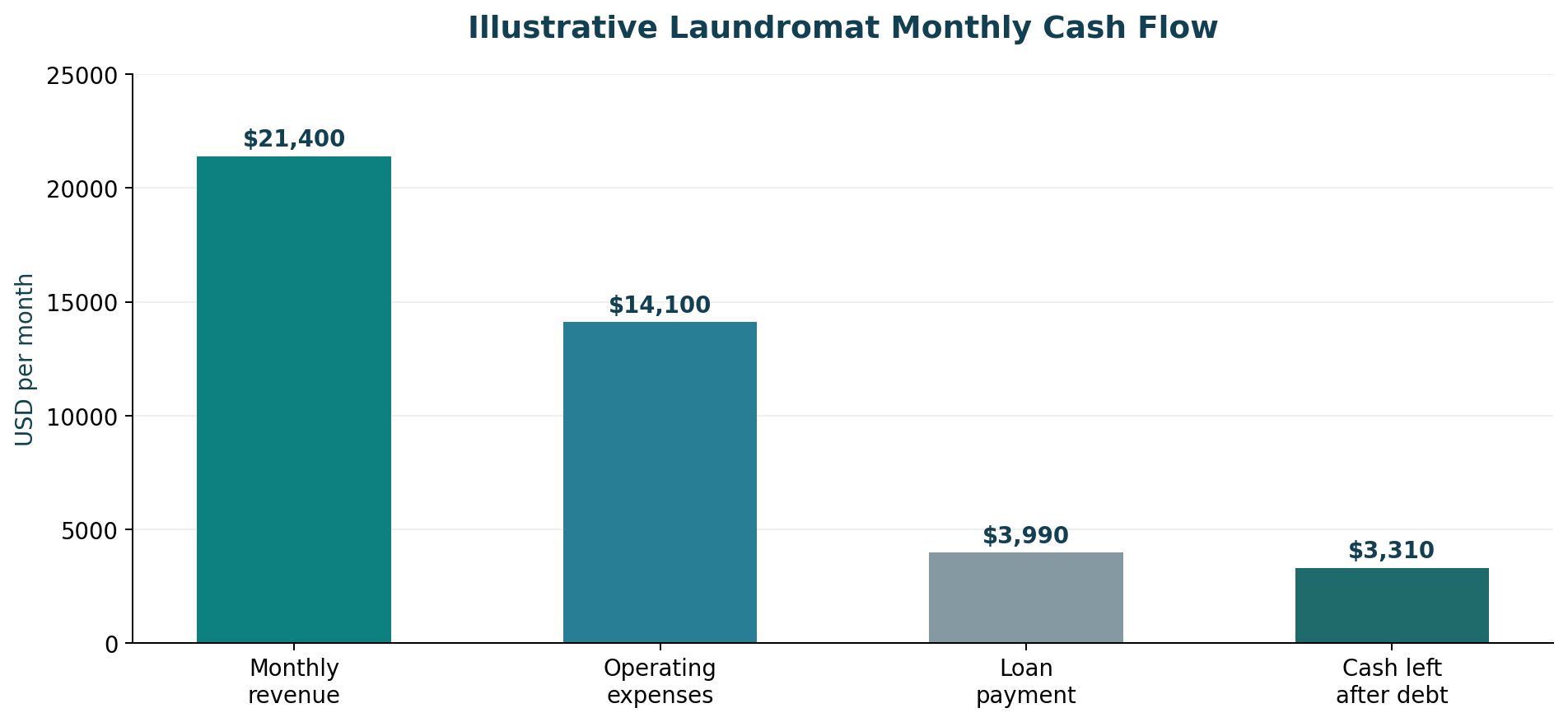
Illustrative monthly operating example in USD: $21,400 revenue, $14,100 operating expenses, $3,990 debt payments, $3,310 cash remaining before income taxes, owner pay not already included, and major replacement spending.
Financial-modeling reference: SBA — Break-Even Analysis
How Many Customers Does a Laundromat Need to Break Even?
Average turns per washer per day | Monthly revenue | Operating costs | Cash after $3,990 debt payment |
|---|---|---|---|
2.0 | $15,400 | $12,900 | -$1,490 |
2.5 | $18,400 | $13,500 | $910 |
3.0 | $21,400 | $14,100 | $3,310 |
4.0 | $27,400 | $15,300 | $8,110 |
Illustrative sensitivity analysis. Assumes stable prices, the same supplementary revenue, adequate machine capacity, and the modeled relationship between machine usage and variable costs. It excludes owner compensation, income taxes, and major capital expenditure.
And the associated increase in operating costs is modeled at $1,200. That creates $4,800 in additional monthly contribution. After accounting for our supplementary sales, fixed expenses, and loan payment, the business needs approximately 2.31 average washer turns per day to reach cash break-even.
This is a cash break-even calculation after scheduled loan payments—not accounting break-even, and not the point at which the owner necessarily earns an acceptable return. If wash-and-fold sales disappoint or utility costs increase, the required utilization will be higher.
The SBA’s break-even calculator explains the distinction between fixed costs, variable costs, and contribution margin.
How Can You Increase Laundromat Profit Without Simply Raising Prices?
The key is understanding the incremental costs. Wash-and-fold revenue requires labor, supplies, handling time, and sometimes delivery expenses. A $75 order isn’t $75 in profit.
The same applies to laundromat marketing. Spending $800 per month on marketing may be worthwhile if it creates additional repeat customers and profitable machine usage. But spending money on ads without measuring enquiries, visits, new customers, and repeat business makes it difficult to know what you’re buying.
The Profitability Numbers Every Owner Should Track
A laundromat’s financial health is easier to understand when you monitor a few useful measurements consistently. Start with turns per washer per day, total washer and dryer revenue, utility expense as a share of revenue, rent as a share of revenue, machine downtime, operating cash flow, and money available after debt service.
How to Run a Laundromat Successfully
It’s 8:30 on a Saturday morning. A customer walks into your laundromat carrying three overflowing laundry bags. She’s been coming here every weekend for two months because the machines work, the store is clean, and she can usually finish everything in about an hour.
Across the street, another laundromat has slightly higher prices. But the equipment works, the floors are clean, and somebody answers when there’s a problem. Guess where she’ll probably do her laundry next Saturday? Once you understand how to start a laundromat business on paper, the daily routines are what make the forecast achievable.
Build a Daily Operating Routine Before You Open
One of the easiest ways to lose control of a laundromat is to manage everything only when something goes wrong. A customer complains about a dirty restroom, so somebody cleans it. A washer stops accepting payments, so you call a technician. The change machine runs out of quarters, so you rush to the store.
Frequency | Operating tasks |
|---|---|
Opening | Check machines, floors, payment systems, lighting, entrances, and safety conditions |
Throughout the day | Clean surfaces, respond to customers, check machines, remove spills, and manage laundry carts |
Closing | Check equipment, reconcile payments where appropriate, secure the premises, and document issues |
Weekly | Review revenue, machine downtime, supply levels, maintenance records, and customer complaints |
Monthly | Analyze utility bills, operating profit, staffing, marketing results, and upcoming repairs |
Should Your Laundromat Be Attended or Unattended?
This is a bigger decision than it initially appears. An unattended laundromat may reduce payroll expenses. However, it also requires reliable payment technology, monitoring, cleaning arrangements, maintenance support, and a way for customers to report problems.
Consider our existing financial example. We’ve budgeted $2,500 per month for staffing and payroll-related costs. That might support a limited part-time staffing schedule, depending on local wages and employer expenses.
Create a Preventive Maintenance System
One broken machine might not destroy your business. But several unreliable machines can damage revenue and customer trust. Maintain an equipment register with machine numbers, installation dates, warranty details, maintenance records, and service contacts. Reliable laundromat equipment needs scheduled care even while individual machines remain under warranty.
Follow manufacturer-recommended maintenance schedules and establish procedures for taking unsafe equipment out of service. Dryer lint deserves special attention because accumulated lint can create fire hazards.
Handle Cash, Digital Payments and Refunds Properly
Imagine discovering that your machines collected $8,000 in cash last month, but the amount deposited into the business bank account was $7,400. Where did the other $600 go?
For customer refunds, establish clear rules. If a machine accepts payment but fails to start, customers should have a straightforward way to request assistance. A small refund handled professionally can protect a long-term customer relationship.
Manage Wash-and-Fold Services Without Creating New Problems
Remember the additional $3,000 in monthly wash-and-fold revenue included in our financial model? We assumed 40 orders at an average of $75 each. That additional revenue looks attractive, but wash-and-fold introduces responsibilities that don’t exist in the same way with self-service laundry.
For example, if a $75 order requires $25 in labor, $9 in utilities and supplies, and $3 in packaging and transaction costs, it contributes $38 before shared overhead and other expenses. Those are illustrative costs, but the principle matters.
Train Employees to Solve Problems, Not Just Watch the Store
A helpful attendant can make an enormous difference to the customer experience. Consider someone using a large commercial washer for the first time. They might not understand which machine to choose, how much detergent to use, or how the payment system works.
Can You Operate a Laundromat Without Being There Every Day?
Yes, some owners manage laundromats with limited daily involvement. But getting there requires dependable people and systems.
A remote owner needs a reliable way to review payment activity, identify equipment faults, monitor operating expenses, communicate with staff, and respond to emergencies.
Track the Numbers That Tell You When Something Is Wrong
Let’s return to our 20-washer example. Your original financial plan assumes three average washer turns per day, producing $21,400 in monthly revenue across all modeled services. Suppose your operating dashboard shows that average washer usage has dropped to 2.4 turns. That deserves investigation.
The Operating Principle That Helps Laundromats Grow
There’s a simple reason customers return to particular businesses. They know what to expect. When someone visits your laundromat, they should reasonably expect clean machines, working payment systems, clear prices, a safe environment, and a practical way to get assistance.
How to Create a Laundromat Brand, Logo and Company Profile
Picture two laundromats operating in the same neighborhood. Both have commercial washers, dryers, folding tables, and reasonable prices. The first has a faded sign reading “Coin Laundry.” Its website looks outdated, and its business cards were apparently designed sometime during the previous century.
That’s the real purpose of branding. It helps customers recognize your business, understand what you offer, and develop expectations about the experience they’ll receive. And you don’t need to build a luxury brand to accomplish that. You need a clear, consistent identity that fits your customers and your business model. Branding is part of how to start a laundromat business that people remember, but it only works when the store experience supports the promise.
Choose a Laundromat Business Name That People Can Remember
Your name can communicate cleanliness, convenience, speed, affordability, or the neighborhood you serve. But don’t get so creative that customers struggle to understand what the business actually does.
The United States Patent and Trademark Office provides an official trademark search system. Remember that state business-name approval, domain ownership, and trademark rights are different matters. A name appearing available in one database doesn’t guarantee you can use it without legal risk.
Design a Professional Laundromat Logo That Works Everywhere
But avoid relying entirely on the same generic washing-machine icon that dozens of competitors already use. Your logo should have its own identity.
You can explore ZH Consultancy’s professional logo design services if you need a consistent identity developed for your laundromat. The important thing isn’t having the fanciest logo in the neighborhood. It’s having one that customers recognize without needing to think about it.
Choose Brand Colors That Match the Customer Experience
Colors create expectations. Blue, teal, and white can communicate freshness and cleanliness. Darker colors can create contrast for signage, while warmer accents might help a neighborhood laundromat feel approachable.
Instead, choose colors that make your store recognizable, improve readability, and remain consistent across different materials. Imagine someone sees your laundromat’s teal sign while driving home. The next day, they search for laundry services on their phone and notice the same teal identity in your business listing.
Your Storefront Sign Is Part of Your Marketing Strategy
Think about how many potential customers pass your laundromat every week. Some may not need laundry services today. But they might need them next month when their washing machine breaks. Or when they move into an apartment without laundry facilities.
Do You Need Business Cards, Flyers and Printed Marketing Materials?
But printed materials can still help with specific marketing activities. For example, you might distribute professionally designed flyers to apartment communities where distribution is permitted. You could create a simple opening promotion for nearby residents or provide business cards to property managers and local business owners. Effective laundromat marketing begins with a customer promise you can demonstrate in the store, not simply a colorful logo.
ZH Consultancy’s graphic design services can support coordinated flyers, business cards, brochures, and other promotional materials.
Does a Laundromat Need a Professional Company Profile?
Only include capabilities your business can actually provide. Don’t claim medical-grade laundry processing, specialist sanitation, or regulatory certifications unless you genuinely meet the relevant requirements.
If you’re approaching commercial accounts, ZH Consultancy’s company profile design services can help organize your business information into a professional presentation. The purpose isn’t to impress people with the number of pages. It’s to make it easier for potential clients to understand your services and decide whether to contact you.
How Much Should You Budget for Laundromat Branding?
Branding and store presentation expense | Illustrative budget |
|---|---|
Exterior storefront sign and installation | $5,500 |
Interior signs and customer wayfinding | $1,800 |
Logo design and basic brand identity | $1,500 |
Business cards, flyers, and printed materials | $900 |
Branded staff clothing | $400 |
Additional furniture or presentation contingency | $900 |
Total | $11,000 |
Illustrative budget allocation, not published average prices or ZH Consultancy service quotations.
These expenses are already included in our original startup budget. They are not additional funding requirements. Remember that the separate $10,000 allocation for website development and launch marketing will cover different activities.
A Simple Branding Strategy for a New Laundromat
Before commissioning designs, write down three things. First, who is your main customer? Are you serving budget-conscious apartment residents, families with large laundry loads, college students, or professionals purchasing wash-and-fold services?
Second, why should those customers choose your store? Maybe it’s dependable equipment, clear pricing, larger washers, extended hours, easier parking, or convenient pickup services.
How to Build a Professional Laundromat Website That Attracts Customers
It’s Sunday evening, and a woman has just moved into an apartment. Her washing machine hasn’t arrived yet. She has two bags of dirty clothes, an early meeting on Monday, and absolutely no interest in driving around looking for a laundromat. So she picks up her phone and searches Google. “Laundromat near me.”
When you’re learning how to start a laundromat business, website development might seem less urgent than buying equipment or negotiating rent. And financially, it is. You can’t operate a laundromat with a website and no washing machines.
What Pages Should a Laundromat Website Have?
Here’s something worth understanding before paying a developer. You don’t need a 40-page website to operate one neighborhood laundromat. You need the right pages.
For FreshSpin Laundry, our hypothetical business, I’d recommend starting with a focused website that answers the questions customers are most likely to ask.
Website page | What customers should find |
|---|---|
Homepage | Main services, location, opening hours, and clear next steps |
Self-Service Laundry | Available washer and dryer sizes, pricing, payment methods, and facilities |
Wash-and-Fold | Pricing, turnaround times, garment policies, and order instructions |
Pickup and Delivery | Actual service areas, availability, minimum orders, and scheduling |
About Us | The business story, real store photos, and what makes the experience different |
Contact and Location | Address, directions, parking, phone number, and opening hours |
FAQ | Answers about payment, detergents, large loads, refunds, and service policies |
Buy a Domain Name That Customers Can Remember
Once you’ve chosen your business name, the next step is securing a domain. If your laundromat is called FreshSpin Laundry, you might investigate a domain resembling freshspinlaundry.com. That’s an example, not a claim that the domain is available.
Where Should You Host Your Laundromat Website?
Think of your domain as the address customers type into their browsers. Hosting is the service that makes the website available when they visit that address. If you build on WordPress, you’ll generally need a hosting provider.
Options include shared hosting, managed WordPress hosting, and more advanced server arrangements. Common providers worth comparing include SiteGround, Hostinger, Bluehost, and other reputable hosts.
WordPress, Wix or Squarespace: Which Platform Is Best?
This decision depends on what your laundromat needs to do. If you operate a single self-service store and primarily want to display services, hours, prices, and directions, you may not need a complicated website.
Platform | Best suited for | Main consideration |
|---|---|---|
WordPress | Flexible business websites, SEO content, and custom integrations | Requires hosting, updates, and ongoing maintenance |
Wix | Owners wanting a relatively simple managed website builder | Advanced workflow requirements may need additional apps or workarounds |
Squarespace | Design-focused informational websites with straightforward service presentation | Complex laundry-specific processes may need third-party integrations |
Specialized laundry software | Pickup, delivery, wash-and-fold, route management, and operational workflows | Subscription costs and website integration requirements vary |
Before choosing any platform, make a list of the functions your business actually needs. Then test whether the software supports them without expensive customization.
Should Customers Be Able to Book Laundry Services Online?
For a traditional self-service laundromat, online machine booking is not automatically necessary. Most customers expect to arrive and use an available machine. Unless your business specifically operates a reservation model, adding complicated machine-booking features could create more problems than benefits.
How Much Does a Professional Laundromat Website Cost?
Website and launch marketing expense | Illustrative budget |
|---|---|
Domain, hosting, and initial technical setup | $300 |
Website design and development | $3,500 |
Photography, content, and service information | $700 |
Booking or order integration setup | $500 |
Initial local advertising campaigns | $2,000 |
Remaining launch marketing and optimization reserve | $3,000 |
Total allocated | $10,000 |
Illustrative allocation within the previously established startup budget, not actual provider quotations. Costs depend on scope; payment-processing and ongoing software fees may be additional.
ZH Consultancy, based in Pakistan, provides professional website development services for businesses seeking remote design and development support. For more specialized booking and integration requirements, its custom website development services are another relevant option to evaluate.
How to Optimize Your Laundromat Website for Local SEO
For example, a self-service laundry page could explain your machine sizes, payment options, hours, parking, and the neighborhood you serve. Your wash-and-fold page could explain pickup instructions, actual pricing, turnaround times, and which orders you accept. A practical approach to how to start a laundromat business online is to answer the questions nearby customers ask before they visit. For laundromat marketing, the useful website metric is whether nearby visitors call, request directions or place real orders.
Google’s SEO Starter Guide emphasizes useful, original content and clear website organization. You can also add appropriate LocalBusiness structured data describing information such as your location and operating hours.
Make the Website Work Properly on Mobile Phones
Can customers select a service without confusion? Can they understand the price? Does the payment system work? Also test readability, color contrast, keyboard accessibility, and form labels.
A well-designed website should work for customers using different devices and assistive technologies. Speed matters, too. Use properly sized images, avoid unnecessary animations, and test performance using tools such as Google PageSpeed Insights.
Connect Your Website With Google Business Profile
Your website and Google Business Profile should support each other. When someone finds your business in Google Maps, they should be able to click through to a website that confirms the store’s location, services, and hours.
Don’t assume that every laundromat can add an ordering button simply because its website contains a form. We’ll cover Google Business Profile creation and optimization step by step in the next section, alongside Google Ads and Meta advertising.
Don't Forget Website Security, Maintenance and Customer Enquiries
Check contact forms and booking workflows, review security updates, verify backups, confirm pricing and opening hours, and examine traffic and enquiry reports.
If the business doesn’t have internal technical support, an ongoing website maintenance service may be useful, particularly when the site includes payments, booking integrations, or frequently updated services.
The Biggest Laundromat Website Mistake
Of course, building the website is only half the job. Now we need to get the right people to visit it. That brings us to laundromat marketing—especially Google Business Profile, Google Ads, Meta Ads, and the local campaigns that can turn nearby households into regular customers.
Laundromat Marketing: Google Ads, Meta Ads and Local SEO
Imagine spending $2,000 advertising your new laundromat on Facebook. Your advertisements receive thousands of views. People like your photos, leave comments, and congratulate you on opening a beautiful store. But at the end of the month, your washing machines are still sitting empty. What happened?
Same business. Very different marketing opportunity. The secret to effective laundromat marketing isn’t reaching the largest possible audience. It’s reaching people who have a reason to use your services and making it easy for them to choose you.
For most neighborhood laundromats, I’d start with Google Business Profile, local search visibility, and a carefully controlled advertising budget. Then I’d use Facebook, Instagram, and community partnerships to build familiarity and introduce additional services. For a local owner, how to start a laundromat business and how to attract the first repeat customers are closely connected decisions. Begin laundromat marketing with accurate store details and a specific reason for customers in the neighborhood to visit.
Google Business Profile: Your Most Important Local Marketing Foundation
You can’t pay Google to improve your organic local ranking directly. But you can provide complete, accurate information and build a business that earns a positive reputation. Source: Google — Tips to Improve Local Ranking
How to Create and Verify Your Laundromat's Google Business Profile
Let’s use FreshSpin Laundry, our hypothetical neighborhood laundromat. Start by visiting Google Business Profile and signing in with an account controlled by the business owner.
Next, complete verification using the method Google offers. Depending on the business, Google may provide video, phone, email, mail, or other verification methods. You cannot necessarily choose whichever method you prefer.
If the business also provides pickup and delivery, its profile may qualify for an appropriate service-area configuration. Source: Google — Verify Your Business
Optimize Your Google Business Profile to Attract Nearby Customers
Verification is the beginning, not the end. Once your profile is active, make it genuinely useful.
Keep service information accurate. If you offer wash-and-fold, pickup and delivery, or large-capacity washing, describe those services where the profile supports them. Review profile performance. Monitor available reports showing customer interactions such as calls, website clicks, and direction requests.
How to Get More Google Reviews Without Breaking the Rules
Reviews deserve special attention because they influence how potential customers evaluate local businesses. But here’s a mistake I would strongly avoid. Offering customers free drying in exchange for five-star Google reviews.
Arguing publicly with the customer usually doesn’t improve the situation. The aim is to earn trust, not manufacture a perfect-looking rating. Source: Google — Tips to Get More Reviews
For owners who need help maintaining accurate listings, improving local visibility, and coordinating reviews and website information, ZH Consultancy offers digital marketing services that include Google Business Profile optimization.
Google Ads vs. Facebook and Instagram Ads: Which Works Better for Laundromats?
Now that customers can find your business organically, should you invest in paid advertising? Possibly. But Google Ads and Meta Ads serve different customer situations.
Marketing factor | Google Ads | Facebook and Instagram Ads |
|---|---|---|
Typical customer situation | Actively searching for laundry services | Browsing social content |
Strong use case | Nearby laundry searches and wash-and-fold enquiries | Store openings, service promotions, and neighborhood awareness |
Targeting approach | Search terms, location, and campaign settings | Geographic audience and other available targeting options |
Useful creative | Clear service information and relevant landing pages | Real photographs, short videos, and specific offers |
Main challenge | Paying for clicks that don't become customers | Getting attention from people who may not need the service |
Recommended starting role | High-intent customer acquisition | Controlled local-awareness testing |
Neither advertising platform automatically guarantees a lower customer acquisition cost. Results depend on geography, competition, campaign setup, advertising creative, conversion tracking, and customer behavior.
How to Run Google Ads for a Laundromat
Those two searches should not necessarily lead to the same website page. Use geographic targeting appropriate to your actual service area and review available location-presence settings to reduce irrelevant clicks.
Source: Google Ads — Location Assets
For a more structured campaign, ZH Consultancy’s Google Ads management services are a relevant option to evaluate.
When Facebook and Instagram Ads Make More Sense
Meta advertising can be useful when you want to introduce your store or promote a service customers may not have considered. Imagine launching a wash-and-fold service for busy local professionals.
If you need help with campaign creative, audience planning, and performance analysis, ZH Consultancy also provides Meta Ads management services.
How to Spend an $800 Monthly Laundromat Marketing Budget
Let’s return to our financial model. Our operating expenses already include $800 per month for marketing. We don’t need to add another $800 to the business budget. Instead, let’s decide how that existing allocation might be spent.
Marketing activity | Monthly allocation |
|---|---|
Google Search Ads | $500 |
Facebook and Instagram advertising tests | $150 |
Local outreach, printed promotions, and campaign materials | $150 |
Total monthly marketing budget | $800 |
Illustrative allocation of the existing $800 monthly expense. Assumes the owner manages basic profile updates and campaigns; separate professional management fees or additional production work would need their own budget.
Calculate Whether Your Advertising Is Actually Profitable
Here’s the calculation I want every new owner to understand. Suppose you spend $500 on Google Ads and can reliably attribute 20 first-time paying customers to the campaign.
If a customer spends $10 on washing and drying during one visit, a $25 acquisition cost looks expensive. But what if the customer returns several times?
That’s $32 before accounting for the $25 advertising cost and other expenses. If they return eight times, the modeled contribution rises to $64.
Don't Ignore Apartment Managers and Local Partnerships
Here’s a marketing opportunity that doesn’t necessarily require an advertising platform. Suppose a nearby apartment building has 80 units and no convenient laundry facilities. Would it be worthwhile to speak with the property manager? Potentially.
Instead of sending an apartment manager an elaborate presentation, explain what problem your laundromat solves for residents and how they can access the service.
How to Turn First-Time Laundromat Customers Into Regulars
Advertising may encourage someone to try your store. But it won’t automatically convince them to return. That depends on their experience.
Once your service is dependable, consider practical loyalty strategies such as stored-value rewards, lawful customer promotions, or reminders sent to customers who have expressly agreed to receive marketing communications.
The Laundromat Marketing Mistake That Wastes the Most Money
If I had to highlight one mistake, it would be this: Spending money to attract new customers before making sure your business can convert and retain them.
A professional digital marketing strategy can help connect local visibility, Google Ads, Meta campaigns, and customer tracking to actual business objectives. But no agency can replace the basic requirement to run a laundromat people want to use.
Why Laundromat Businesses Fail and How to Avoid Costly Mistakes
Imagine buying a laundromat that appears to generate $20,000 in monthly revenue. The previous owner tells you the machines practically run themselves. The location looks busy, the equipment seems adequate, and the business has operated for years. You invest your savings, take out a loan, and become the new owner.
What we can examine are the financial and operational risks that make individual stores vulnerable. And, more importantly, how to address them before they put your investment at risk. The safer way to approach how to start a laundromat business is to test these risks before contracts make them expensive to correct.
Mistake 1: Choosing a Location Because It Looks Busy
The solution is to research laundry access, not simply population. Examine rental housing, apartment facilities, nearby competitors, transportation, parking, and local prices.
Visit competing laundromats at different times. Determine where customers are underserved. For an investment this substantial, professional market research services can help organize the evidence before you commit to a property.
Mistake 2: Believing a Seller's Revenue Without Verifying It
Suppose someone offers you an established laundromat for $300,000. They claim the business collects $18,000 per month and produces excellent profits. You ask to see the financial records.
Source: Coin Laundry Association — Best Practices for Due Diligence in Laundromat Acquisitions
Mistake 3: Signing an Expensive Lease That Leaves No Room for Profit
Here’s a finding worth paying attention to. According to the Coin Laundry Association’s 2026 industry analysis, the least profitable stores in its survey spent approximately 32% of gross revenue on rent, compared with roughly 18% among the most profitable stores.
Source: Coin Laundry Association — Playing the Long Game
If nothing else changes, our $3,310 monthly cash remaining after debt payments falls to $2,310. That’s a 30% reduction in available cash because of one expense increase.
Mistake 4: Spending Too Much on Equipment Before Proving Demand
The solution is to plan equipment around realistic demand, peak-hour capacity, machine sizes, and customer behavior. Start with an appropriate equipment mix and understand whether the business can support future expansion.
For our existing model, the $170,000 equipment allowance is a planning estimate—not permission to buy whatever fits the budget. Obtain model-specific quotations, compare service arrangements, and estimate expected utilization before purchasing. Owners who ignore equipment replacement can underestimate laundromat startup costs and the cash needed during the first year.
Mistake 5: Underestimating Utilities and Maintenance
Let’s say your monthly water, sewer, gas, and electricity budget is $4,000. Then actual bills arrive 25% higher than expected. That’s another $1,000 per month.
If revenue and other costs remain unchanged, the $3,310 remaining in our financial model falls to $2,310. Combine that with a $1,000 rent increase, and suddenly only $1,310 remains.
Source: American Coin-Op — 2026 State of the Industry Survey
Mistake 6: Borrowing So Much That One Slow Month Creates a Crisis
But here’s where things become uncomfortable. At two average washer turns per day instead of three, our previous financial model shows a monthly cash shortfall of approximately $1,490 after debt service. And that’s before any owner compensation not already included.
Use financial modeling services when a more detailed cash-flow forecast or lender-ready sensitivity analysis would help assess your investment. The objective is to understand what happens to your cash before there’s an emergency.
Mistake 7: Treating a Laundromat Like Completely Passive Income
This mistake often starts with an appealing idea. Buy some washing machines. Let customers operate them. Collect money. Simple.
Except customers need a clean store, working equipment, safe facilities, reliable payment systems, and somebody who can resolve problems. A laundromat can become a business with reduced daily owner involvement. But it won’t operate well simply because you stop paying attention.
Mistake 8: Spending on Advertising Before Fixing the Customer Experience
Imagine your Google Ads campaign works beautifully. People search for local laundry services, find your business, and visit. But several dryers are broken. The store feels dirty. Nobody knows how to process refunds.
Mistake 9: Adding Services Without Calculating Their Real Costs
Wash-and-fold and pickup-and-delivery services can create valuable additional revenue. But they also introduce additional work. Employees must handle orders, sort laundry, manage customer information, package clothing, and potentially coordinate transportation.
Suppose a new service generates $3,000 per month. That sounds promising. But if it requires $2,600 in additional labor, supplies, delivery, and other costs, the contribution before shared overhead is only $400.
A Laundromat Failure-Prevention Checklist
Before signing a lease, purchasing a store, or expanding, use this simple decision framework.
Warning sign | What you should do |
|---|---|
Demand estimates rely mostly on neighborhood population | Research actual access to laundry facilities and local competition |
Seller cannot substantiate reported revenue | Request independent financial due diligence |
Rent consumes too much projected revenue | Reevaluate lease terms and conservative cash flow |
Equipment budget has no technical specifications | Obtain comparable written quotes and capacity analysis |
Utility estimates are based on guesses | Investigate local tariffs, machine efficiency, and property infrastructure |
Financing works only in optimistic scenarios | Test lower revenue, higher costs, and debt-service coverage |
No reliable maintenance or staffing plan | Establish operating procedures before opening |
Advertising is measured only by clicks | Track paying customers and repeat business |
New services have no separate cost model | Calculate labor, supplies, capacity, and contribution margins |
A few warning signs don’t automatically mean you should abandon the opportunity. They mean you need better evidence or a different plan before committing more money.
The Difference Between a Laundromat That Survives and One That Succeeds
Think about two business owners. The first spends most of their energy trying to increase revenue. More advertising. More machines. More services. More customers.
The second also wants growth, but regularly asks different questions. Which machines are earning their space? Why did utility costs rise? Are customers returning? Can we afford another employee? How much cash will be left after debt payments and future equipment replacements?
The Future of the U.S. Laundromat Industry: Trends and Growth Opportunities for 2027–2031
Imagine walking into a laundromat in 2030. You tap your phone to start a washer. The machine sends a notification when your clothes are ready. A digital display shows which dryers are available, and the owner receives a maintenance alert before a minor equipment fault becomes an expensive breakdown.
At the same time, you shouldn’t waste money installing expensive systems simply because they’re fashionable. The next generation of successful laundromats will likely combine modern convenience with something much less exciting: careful financial management. Looking ahead, how to start a laundromat business will still come down to sound economics, even as payment technology changes.
Cashless Payments Are Becoming a Competitive Advantage
During the same period, reported credit and debit card acceptance increased from 15% to 42%. Source: Coin Laundry Association — The Mom-and-Pop Era
The survey was voluntary and unscientific, so those percentages shouldn’t be interpreted as exact national adoption rates. Source: American Coin-Op — Cashless Payment Trends
Offering convenient alternatives may reduce friction, but the financial decision still matters. Consider installation costs, processing fees, software subscriptions, equipment compatibility, and technical support.
Energy-Efficient Machines Could Become Even More Important
Now let’s talk about an expense customers rarely think about when choosing a laundromat. Water. In our earlier financial model, we allocated $4,000 per month to water, sewer, gas, and electricity. That’s $48,000 annually.
Source: ENERGY STAR — Commercial Clothes Washers
For example, suppose improved equipment and operating procedures could reduce our store’s combined utility bill by 10%. That would save approximately $400 per month, or $4,800 annually.
Wash-and-Fold and Pickup Services May Create New Revenue Opportunities
Traditional self-service laundromats depend on customers visiting the store and operating the machines. But what about customers who don’t want to spend two hours doing laundry?
Source: American Coin-Op — 2026 State of the Industry
Suppose an additional order generates $75 in revenue and incurs $45 in direct labor, transportation, supplies, and processing costs. That leaves $30 in contribution before shared overhead and other expenses.
Smart Equipment and Automation Could Reduce Operational Surprises
Imagine receiving an alert when a dryer develops a fault rather than discovering the problem after customers complain. Or being able to monitor machine revenue, operating cycles, and payment activity without visiting the store every evening.
Connected equipment and centralized management systems can make those processes possible. Some commercial laundry vendors already offer remote monitoring, payment reporting, machine-status information, and customer notifications.
Customers Will Still Care About Cleanliness More Than Fancy Technology
Here’s something that might surprise founders who are fascinated by automation. Modern technology isn’t necessarily what customers value most.
Source: American Coin-Op — Changing Customer Expectations
Technology can make the experience easier. But cleanliness, convenience, safety, and dependable equipment remain fundamental. If you have $5,000 available for improvements, think carefully before spending it all on a sophisticated feature while ignoring broken machines or maintenance problems.
Will Larger Laundromat Operators Create More Competition?
Another development worth watching is the growth of multi-location laundromat businesses. According to Coin Laundry Association survey reporting, the share of participating laundry organizations operating three or more stores increased from 10% in 2021 to 22% in 2025, although that figure was lower than the 27% recorded in 2024.
Which Laundromat Trends Are Actually Worth Your Investment?
Before committing money to a new feature, compare its customer benefit, financial impact, and operational complexity.
Potential investment | Possible benefit | What to verify first |
|---|---|---|
Card and mobile payments | Easier customer payments | Fees, setup costs, reliability, customer preferences |
Efficient washers and dryers | Potential utility savings | Equipment costs, local tariffs, estimated payback |
Remote machine monitoring | Faster identification of problems | Integration, subscription fees, repair workflows |
Wash-and-fold expansion | Additional service revenue | Demand, labor capacity, margins |
Pickup and delivery | Access to customers beyond walk-in traffic | Route economics, staffing, insurance, order volume |
Digital loyalty program | Potential repeat visits | Customer adoption, program cost, measurable retention |
Multiple locations | Potential scale advantages | Management capacity, capital requirements, location-level profitability |
Expand into more complex services when the numbers support them. Don’t assume an app, subscription program, or delivery van will solve weak location demand.
Preparing Your Laundromat for 2027–2031
Nobody can tell you exactly which payment technology or laundry service model will dominate by 2031. And individual technology trends shouldn’t be presented as guaranteed market forecasts. But you can prepare your business to adapt.
If that business committed to expensive technology without carefully calculating the return, it could quickly weaken its financial position. But if it used technology selectively to reduce downtime, improve convenience, or lower costs, those improvements might strengthen the operation over time.
Your First 90 Days: A Practical Laundromat Startup Action Plan
Imagine waking up tomorrow morning and deciding you’re finally going to open your own laundromat. You’ve read about the industry. You’ve looked at equipment prices. You know roughly how much funding you’ll need. You’re excited.
A laundromat is a capital-intensive operation, and the order in which you make decisions matters. For example, ordering commercial washers before confirming utility capacity could leave you with equipment that cannot be installed without major construction. A practical checklist for how to start a laundromat business should put demand validation and approvals ahead of equipment orders and advertising.
Days 1–15: Research the Market Before Choosing a Location
For founders who need a more structured demand assessment, professional market research services can help evaluate customers, competitors, and location opportunities.
Your Day 15 milestone: Identify your strongest potential markets, estimate local demand, and decide whether further investment is justified. If the evidence is weak, research another location rather than trying to make an unsuitable property work. Use the laundromat business plan to document why each neighborhood passes or fails the initial demand test.
Days 16–30: Evaluate Properties and Build the Financial Plan
Now test whether a comparable budget makes sense for the properties you’re evaluating. Don’t simply copy those figures into a lender application. Replace them with actual quotations and researched assumptions. Before applying for funding, replace generic laundromat startup costs with documented bids and property-specific estimates.
A professionally prepared laundromat business plan can help organize this research into a document suitable for financing discussions.
Days 31–45: Start Financing, Registration and Legal Due Diligence
Speak with potential lenders, compare their requirements, and prepare your funding application. If you’re considering an SBA-backed loan, use the official SBA Lender Match service to connect with interested lenders.
Be prepared to provide financial projections, the proposed use of funds, personal financial information, and relevant property or equipment details. A laundromat financing application is stronger when its assumptions match actual supplier quotations and proposed lease terms.
The SBA’s business launch guidance explains why location, registration, licenses, insurance, and tax obligations must be considered together.
Days 46–60: Finalize Equipment Planning and Develop the Brand
By this stage, you should have a much clearer understanding of the proposed business. Now you can begin turning the concept into an actual store.
But remember that the equipment mix should reflect actual customer demand, available space, dryer capacity, and utility infrastructure. Get written quotations and check delivery schedules before committing to purchases.
Days 61–75: Build the Website and Prepare Local Marketing
Make sure the website functions properly on mobile devices. A professional website development service can help build the site, but the owner should retain control of the domain, hosting accounts, and essential business information.
Source: Google — Add a Business Opening Date
For professional assistance with setup and local search visibility, ZH Consultancy offers Google Business Profile optimization services.
Days 76–90: Test Everything and Prepare for Opening
Here’s where excitement can become dangerous. You’ve spent months preparing the business. You want to open. Friends and family are asking when they can visit. Your website is ready, and your new sign looks fantastic.
Check that equipment is installed and commissioned by qualified professionals. Make sure insurance coverage is effective, staff have been trained, and maintenance procedures are documented.
Your 90-Day Laundromat Startup Checklist
Timeline | Main priority | Expected deliverable |
|---|---|---|
Days 1–15 | Market research and customer demand | Location shortlist and competitor assessment |
Days 16–30 | Property due diligence and business planning | Initial technical review and financial projections |
Days 31–45 | Financing and legal groundwork | Lender applications, legal structure, and approval requirements |
Days 46–60 | Equipment and branding | Equipment plan, supplier quotes, and brand identity |
Days 61–75 | Website and marketing preparation | Website, Google Business Profile preparation, and launch campaigns |
Days 76–90 | Operational testing and launch readiness | Inspections, system tests, staff preparation, and opening decision |
Illustrative 90-day planning sequence. Several activities can overlap, and construction, financing, equipment delivery, and permitting may continue beyond Day 90.
What if Your Laundromat Takes Longer Than 90 Days to Open?
This is an important distinction. If you’re acquiring an established laundromat, some infrastructure, equipment, and customers may already be in place.
Instead, create a project schedule with realistic dependencies. Identify which tasks can happen simultaneously and which cannot begin until another task is complete.
What Should You Measure During Your First 30 Days of Operation?
Once your store opens, avoid judging success entirely by the number of people who visit on opening weekend. Promotions and curiosity may temporarily increase traffic.
What matters is whether customers return and whether the business begins performing close to its financial assumptions. Review washer turns per day, washer and dryer revenue, utility usage, staffing costs, machine downtime, customer complaints, and cash remaining after operating expenses and financing.
The Most Important Decision in Your First 90 Days
Here’s something I wish more first-time business owners understood. Progress isn’t measured by how much money you’ve spent.
The decisions that matter most are often less exciting. Verifying demand. Checking the lease. Questioning seller revenue. Comparing equipment quotations. Calculating debt repayments. Protecting working capital.
The Takeaway
Remember the laundromat we imagined at the beginning of this guide? Customers walk in, load their clothes, pay for a wash, and handle most of the work themselves.
You could spend $455,000 opening a beautiful laundromat and still struggle financially if the neighborhood doesn’t have enough customers, the rent is excessive, or your equipment spends too much time sitting idle.
After $14,100 in operating expenses and approximately $3,990 in monthly loan payments, it had $3,310 remaining before income taxes, owner compensation not already included, and major equipment replacement costs.
Before you sign a lease or buy your first commercial washer, make sure you can answer a few important questions. Do enough nearby households genuinely need laundry services? Can the building legally and technically support your equipment? Have you verified the seller’s revenue if you’re purchasing an existing store? If a friend asks you how to start a laundromat business, begin with these questions rather than telling them which machines to buy.
If you need professional help with the planning and presentation side, ZH Consultancy can support relevant parts of the process through its business planning services, market research, and website development services.
Before investing in a laundromat, most prospective owners have a few questions that keep coming back, no matter how much research they’ve already done. Here are seven of the most important, with practical answers based on the financial and operational considerations we’ve covered.
1. How Much Money Do You Need to Start a Laundromat Business?
You may need anywhere from a substantial five-figure investment in a small, financed acquisition to several hundred thousand dollars or more for a larger laundromat. The total depends on whether you’re buying an existing operation or building a new store, as well as equipment, plumbing, renovations, rent, insurance, and working capital.
2. How Profitable Is a Laundromat in the United States?
A laundromat can be profitable, but earnings vary significantly with location, machine utilization, rent, utility prices, equipment condition, and debt. In our financial example, a laundromat generating $21,400 in monthly revenue has $7,300 remaining after modeled operating expenses.
After an illustrative $3,990 loan payment, approximately $3,310 remains before income taxes, owner compensation not already included, and major equipment replacements. That isn’t guaranteed net profit.
3. Can You Start a Laundromat With $100,000?
Potentially, yes—but $100,000 may need to serve as your equity contribution toward a larger financed project rather than covering the entire investment. You might investigate a smaller existing laundromat, a partnership, or a purchase involving eligible business financing.
For comparison, our $455,000 project uses $140,000 in owner funding and $315,000 in borrowing. Reducing the owner contribution to $100,000 would create a $40,000 funding gap unless the project budget or financing structure changed.
4. Do You Need a License to Open a Laundromat in the USA?
You’ll need to comply with applicable business registration, licensing, zoning, building, and operational requirements, but there is no single universal laundromat license covering every U.S. location. Requirements vary by state, county, city, and the services offered.
Before leasing a property, contact the local licensing, zoning, building, and water utility authorities. Registering a company doesn’t automatically mean a particular property can legally operate as a laundromat.
5. Is Buying an Existing Laundromat Better Than Starting From Scratch?
Buying an existing laundromat can be attractive because the machines, premises, and customers may already be in place. You may also have historical revenue records to evaluate.
Neither approach is automatically safer. For an acquisition, verify the financial records, equipment condition, and lease. For a new store, investigate customer demand, infrastructure costs, and required approvals before investing.
6. Can You Own a Laundromat Without Working There Every Day?
Yes, a laundromat can be operated with limited day-to-day owner involvement, provided dependable systems and people are in place. You may use attendants, cleaning contractors, maintenance technicians, payment reporting, and remote equipment monitoring to handle routine operations.
However, an unattended store isn’t automatically a passive investment. Someone must still respond to broken machines, payment disputes, cleaning issues, safety concerns, and emergencies. If you hire a manager or additional employees, include those costs in your financial projections.
7. How Long Does It Take to Open a Laundromat Business?
The timeline depends largely on whether you’re purchasing an existing operation or developing a new location. Buying an established laundromat may require less construction, but financing, financial due diligence, purchase negotiations, and lease transfers still take time.
Opening a new laundromat can involve property selection, design, permits, plumbing and electrical work, equipment delivery, inspections, and installation. Those activities may take several months and can extend longer when major renovations or utility upgrades are needed.

Zain Hameed
Business strategy specialist helping a global client base of 800+ businesses build credible plans, financial models and investor-ready presentations.
In this article
Book a Free Consultation
Have a business idea, growth challenge or investor deadline? Book a free consultation and get clear next steps from our team.
Call our team
+923104049517
Email us

Business Topics
Business topics
Continue reading
Related insights

How to Start a Laundromat Business: A Complete U.S. Founder’s Guide
Learn how to start a laundromat business in the USA: market

How to Start a Construction Business in the USA
A homeowner wants to sign a $75,000 remodeling contract on Friday.

How to Start a Plumbing Business in the USA
At 7:15 on Monday morning, a homeowner calls about water coming

How to Start a Car Rental Business in the USA: A Founder’s Practical Guide
A family lands after midnight. They do not care whether your

How to Start a Landscaping Business: Costs, Licenses, Marketing and Profit
Picture two lawns on the same street. One homeowner wants a

How to Start a Cafe Business in the USA: Costs, Licenses, Marketing and Profit
You’re standing inside an empty storefront, and you can already picture