

In this article
A homeowner wants to sign a $75,000 remodeling contract on Friday. The cabinet supplier wants a deposit on Monday. Your electrician can hold a slot for a week, and the building department still needs to review part of the scope. How much cash will you have to put into the job before the first progress payment clears?
That question can change which contract you take. It can also tell you how much money you need before you buy a truck, hire a crew, or start paying for leads.
If you’re working out how to start a construction business, follow Michael, the owner of fictional Dallas-area remodeler Northstar Residential Renovations. He starts with bathrooms and smaller kitchens, a $110,000 funding plan, and a job budget he can check against supplier and subcontractor quotes. The figures are illustrative U.S. dollars. Use the same calculations with your prices, licensing rules, and payment terms.
The Global and U.S. Construction Markets
The global figures include projects a residential remodeler may never bid on. Read them for scale, then look at U.S. spending and the number of contractors serving your kind of customer.
Global Construction Market Size and Outlook
Statista projects $21.74 trillion in worldwide construction revenue and $6.56 trillion in value added in 2026. Revenue measures project sales in its model. Value added measures the economic contribution after intermediate inputs. The two figures answer different questions. Statista worldwide construction outlook.
Ken Research publishes a separate series covering building, industrial, and civil construction output. Its market model goes from about $10.02 trillion in 2021 to a $12.07 trillion 2025 base, then projects $16.11 trillion by 2030 and $17.07 trillion by 2031. The stated forecast growth rate is 5.95% compounded annually from the 2025 base. The earlier figures are modeled historical estimates. Ken Research global construction market series.
Year | USD trillions | Status |
|---|---|---|
2021 | $10.02 | Historical estimate |
2022 | $10.39 | Historical estimate |
2023 | $10.83 | Historical estimate |
2024 | $11.39 | Historical estimate |
2025 | $12.07 | Base estimate |
2026 | $12.79 | Forecast |
2027 | $13.55 | Forecast |
2028 | $14.35 | Forecast |
2029 | $15.21 | Forecast |
2030 | $16.11 | Forecast |
2031 | $17.07 | Forecast |
U.S. Construction Spending and Forecasts
The Census Bureau’s spending series measures the value of construction put in place. Averaging its monthly seasonally adjusted annual rates gives the following annual figures in current dollars. Spending went from roughly $1.654 trillion in 2021 to $2.245 trillion in 2025, with a much smaller increase between 2024 and 2025. Census Bureau spending data via FRED.
Year | Average annual rate in USD trillions |
|---|---|
2021 | $1.654 |
2022 | $1.900 |
2023 | $2.073 |
2024 | $2.238 |
2025 | $2.245 |
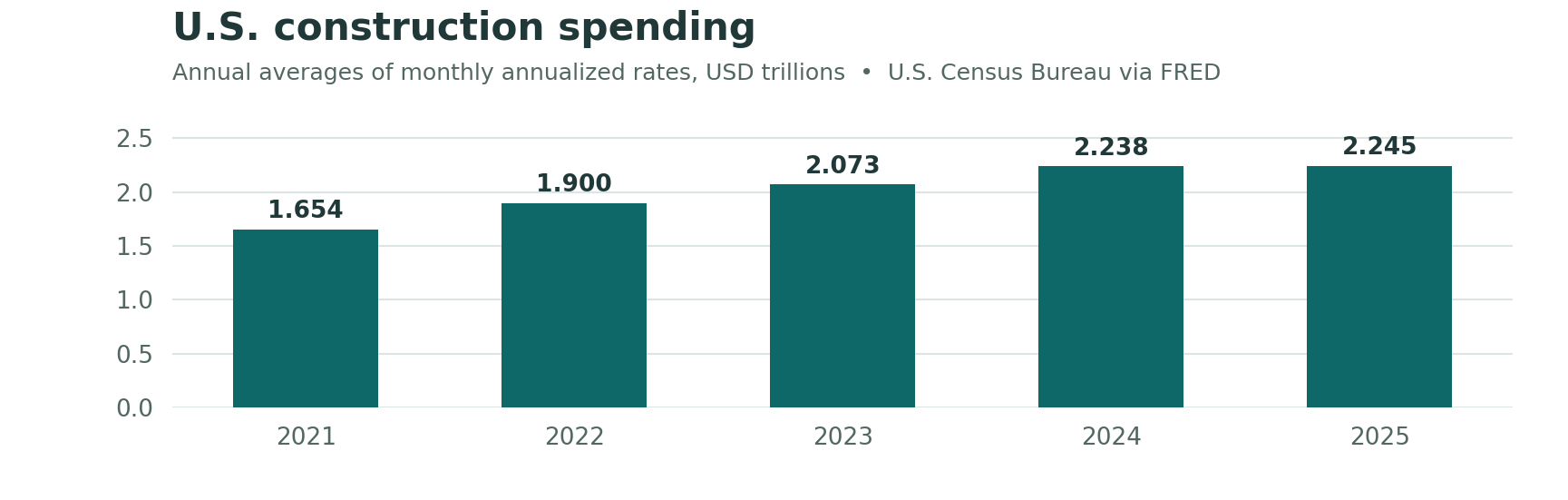
Figure 1. U.S. construction spending, 2021–2025, from the U.S. Census Bureau via FRED.
Statista’s U.S. overview puts spending at nearly $2.2 trillion in 2025 and forecasts nearly $2.7 trillion in 2030. That implies about 4.2% annual compound growth using its rounded endpoints. FMI’s October 2026 forecast puts 2026 spending at $2.167 trillion, down 3.4% on its reporting basis, with residential spending weaker. The two forecasts come from different releases. If you’re deciding how to start a construction business, use your local bid pipeline to test what a slower year could mean for your schedule. Statista U.S. construction outlook and FMI fourth-quarter 2026 outlook.
How Many U.S. Construction Businesses Already Operate
The Census Bureau counted 814,557 U.S. construction employer establishments in 2023. Of those, 135,337 were classified as residential remodelers under NAICS 236118, the closest category to Northstar. The 2024 Nonemployer Statistics series counted about 3.04 million construction businesses without paid employees across the broader sector. An employer establishment is a location, and a company may operate several. For your own estimate of competition, count the contractors that bid on the same work in the towns you can serve. Census profile for residential remodelers.
Choose a Niche and Test Local Demand
The work you sell determines how much equipment, supervision, and cash you’ll need. A flooring specialist can plan around short installs. A remodeler may coordinate several trades and inspections. A commercial contractor may need a longer bidding runway and the cash to carry invoices through extended payment terms.
Choose Jobs You Can Deliver With Your First Crew
Michael wants to know how to start a construction business with a schedule he can actually manage. Northstar picks bathrooms and smaller kitchens in a tight service area. That gives him a repeatable list of subcontractors, materials, permits to check, and questions to ask on a site visit. Write down what you’ll accept, what you’ll refer elsewhere, and the largest job you can fund while another one is underway.
Estimate the work each trade can complete per week and check for overlaps. The calendar may allow two small bathrooms at once if their rough-ins fall on different days. Two jobs with inspections and the same electrician scheduled on the same afternoon can tie up both crews. Ask who covers the gap if a key trade partner gets delayed.
Check What Nearby Buyers Actually Ask For
Pick two or three neighborhoods or municipalities. Review housing age and ownership, local permit records, and ten or so businesses that sell the same service. Read reviews for recurring issues such as unclear estimates, poor communication, or long delays on smaller jobs. Ask suppliers and property managers what customers request and which jobs companies turn down. Confirm the gap with buyers before financing equipment around it.
If Northstar gets 30 qualified inquiries and wins 20%, that’s six potential contracts in the illustrative model. List where those inquiries could come from and how many projects the crew can start and finish without running short on cash. A construction business plan should show that link between demand, conversion, and delivery. See ZH Consultancy’s market research services.
Register the Business and Check Contractor Licensing
Before you decide how to start a construction business in a given city, give the building department a specific address and work description. Ask what the company needs to bid, who can pull permits, and which licensed trades must do the regulated work.
Verify Contractor License Requirements for the Work You’ll Offer
Northstar plans to work in the Dallas area. The City of Dallas requires general contractors to register before undertaking work that needs a permit. A project in a nearby municipality may go through a different office. Call that office with the scope and confirm who applies, which inspections are required, and whether the city needs additional trade registrations. City of Dallas contractor registration guide.
Location | What to verify before taking a job |
|---|---|
Dallas, Texas | City contractor registration for permitted work, project permits, and credentials for regulated trades |
California | Applicable CSLB classification and license requirements, including for covered jobs needing permits or workers, or totaling $1,000 or more |
Florida | State-certified or locally limited registered contractor route and the right trade classification |
New York City | Home Improvement Contractor licensing for covered residential work, plus any building permits and trade credentials |
Keep a record of contractor license requirements for each jurisdiction you serve. Name the qualifying person, issuing agency, scope, expiration date, and responsibility for each permit. If the rules depend on a qualifying employee, check what happens if that person leaves. Put permit fees and inspection windows into your bid and schedule.
Register and Insure the Business
Check the business name and choose an entity with state and tax guidance. If you form an LLC, check your state filing office’s requirements for formation documents, a registered agent, and recurring reports. If you trade under a different name, check whether the state or county requires a separate assumed-name filing.
Once your entity is formed, apply directly to the IRS for a free EIN when needed, open a business bank account, and set up bookkeeping and payroll. Ask how your state handles sales or use tax on labor and materials. Verify worker classification and the records you need before you pay employees or subcontractors.
Price general liability, commercial auto, tools coverage, workers’ compensation where applicable, and any required bonds. Ask the broker how coverage applies to your actual scope and subcontracted work. Plan for OSHA or state-plan safety obligations, including training for the work crews perform. Paid work that disturbs paint in covered pre-1978 properties can trigger lead-safe renovation requirements. Have a local construction attorney review contracts, deposits, payment schedules, lien notices, and any rules governing project funds.
Calculate Startup Funding and Plan for the Cash Gap
A truck and a set of tools get you to the job. Working capital pays the crew and suppliers while you wait for the customer’s next payment. Separate those needs when you calculate construction company startup costs.
Price Setup and Protect the Opening Reserve
These three planning cases show how the funding mix can change with the work. For the residential remodeling case, the vehicle line covers a down payment and outfitting. The monthly vehicle budget covers its ongoing costs. Get local quotes before using any of the figures in a funding request.
Cost category | Lean specialty | Residential remodeler | Staffed general contractor |
|---|---|---|---|
Formation, licensing, and professional setup | $2,500 | $5,000 | $10,000 |
Initial insurance and bond costs | $3,500 | $9,000 | $20,000 |
Tools and equipment | $6,000 | $18,000 | $35,000 |
Vehicle and outfitting | $7,000 | $12,000 | $35,000 |
Branding, company profile, and website | $2,500 | $6,000 | $10,000 |
Office, software, and administration | $500 | $2,000 | $10,000 |
Launch marketing | $2,000 | $8,000 | $15,000 |
Working capital and contingency | $11,000 | $50,000 | $145,000 |
Total funding | $35,000 | $110,000 | $280,000 |
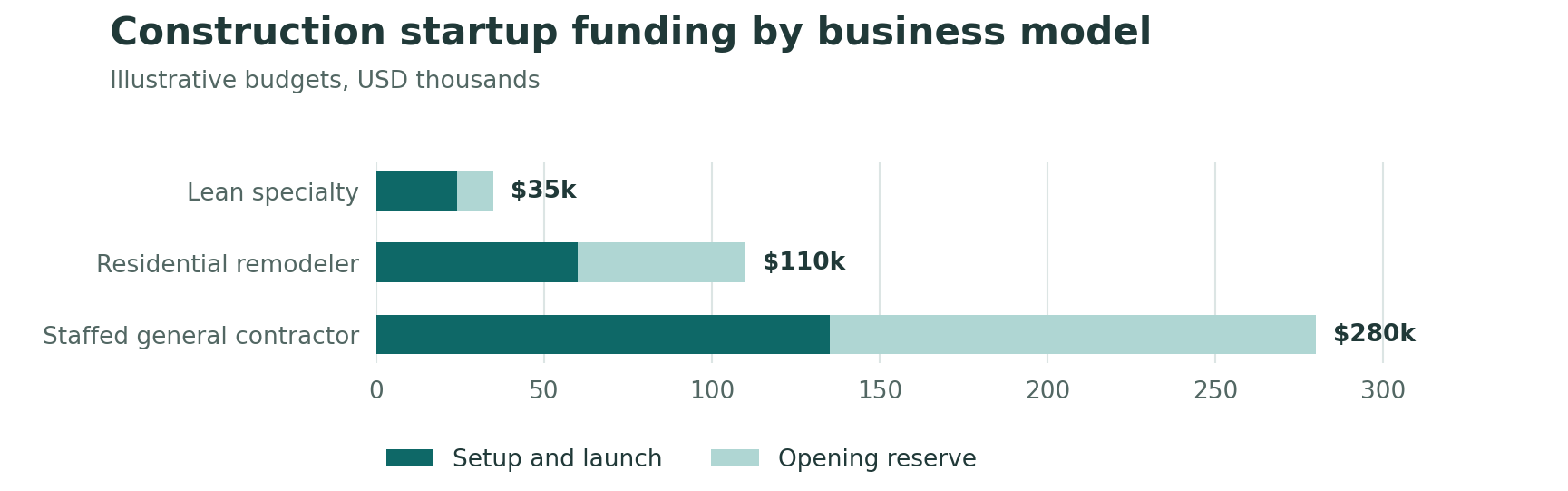
Figure 2. Illustrative setup and launch costs and opening cash reserves for three models.
For Northstar, $60,000 is available for setup and launch, leaving $50,000 to fund operations and projects. Michael contributes $65,000 and would need another $45,000. A hypothetical five-year loan at 10% annual interest costs about $956 a month before fees. Compare equipment finance, a bank loan, and eligible SBA-backed options using actual quotes. Put the first payment and the cash due at closing on the calendar. If you’re figuring out how to start a construction business with existing equipment, reprice the setup while keeping the project reserve visible.
Model the Week a Customer Pays Late
Check how far the construction company startup costs will carry you if the first jobs are slow to arrive. Northstar’s $50,000 reserve divided by $14,956 in monthly overhead and debt payments covers about 3.3 months before direct project outlays. To see what happens once work starts, put the job expenses and customer payments on the same calendar.
In a hypothetical 13-week trading period, Northstar starts with $50,000 in cash. It collects $100,000, spends $72,000 on jobs, pays $42,000 in overhead, and makes $2,868 in loan payments. That leaves $33,132. If one $25,000 receipt moves outside the period and costs are due as planned, the balance falls to $8,132. The low point within the quarter could be tighter, so forecast receipts and bills by week.
Put supplier deposits, crew payments, progress invoices, retainage where applicable, and expected collections into the same forecast. Tie invoicing to lawful contract milestones and follow up when an invoice comes due. Revisit construction company startup costs if a new project changes the reserve you need. See ZH Consultancy’s financial modeling services.
Build a Construction Business Plan Around Job Margins
Before Northstar sends a $25,000 estimate, Michael needs to know what it costs to deliver the scope. A construction business plan becomes useful when it connects job-level costs to the number of projects you can finish, bill, and collect.
Set the Price From the Gross Margin You Need
Northstar estimates $18,000 for materials, direct labor, trades, permits, and other job costs. The $25,000 price leaves $7,000 of gross contribution, a 28% gross margin. Divide cost by one minus the target margin to calculate that price. Adding 28% to $18,000 gives $23,040 and a 21.9% margin. The difference is $1,960 per job, or $64,680 across 33 jobs at the same cost.
Estimate materials from quantities and quotes. Include the hours you expect to pay for and the work each subcontractor has priced. Use recent similar jobs to check assumptions. If your costs rise mid-project, update the amount you expect to spend to finish before you commit the crew to the next start date.
Work Out the Monthly Operating and Marketing Budget
The overhead budget includes the owner-manager allowance for planning purposes. Separate job costs and loan payments so you can see which expenses change when the business takes another project.
Monthly overhead | Amount |
|---|---|
Owner-manager allowance | $4,000 |
Administration | $2,000 |
Insurance | $1,500 |
Marketing | $3,000 |
Software and accounting | $700 |
Vehicle costs | $1,300 |
Office and phone | $500 |
Miscellaneous allowance | $1,000 |
Total monthly overhead | $14,000 |
That’s $168,000 in annual overhead, including $36,000 for marketing. The construction company startup costs table includes a separate one-time launch allowance. Keep the opening and recurring figures on separate lines in the cash forecast.
Calculate Break-Even and a Downside Case
When you work out how to start a construction business that can pay its bills, divide fixed overhead by the gross contribution from one average job. At $14,000 divided by $7,000, Northstar needs two completed jobs a month for operating break-even. Including the $956 loan payment means three average jobs’ worth of contribution if payment and related expenses fall in the same month.
Jobs completed | Monthly sales | Gross contribution | Operating result |
|---|---|---|---|
1 | $25,000 | $7,000 | −$7,000 |
2 | $50,000 | $14,000 | $0 |
3 | $75,000 | $21,000 | $7,000 |
4 | $100,000 | $28,000 | $14,000 |
A year with 33 average jobs produces $825,000 in sales and $63,000 in operating profit before financing, depreciation, and tax. At 20 jobs, the same model loses $28,000. In your construction business plan, show how you would reduce spending, slow purchases, or change the job mix if demand comes in below target. See ZH Consultancy’s business plan writing services.
Set Up the Work and Build a Brand Customers Can Check
A customer wants to know who will show up, when the kitchen will be usable again, and who approves extra work. Your estimate, schedule, and website should give them consistent answers.
Walk the Job From Estimate to Handover
Start with the work sequence. For a bathroom, confirm who handles demolition, permitted rough-ins, inspections, waterproofing, finishes, and the final walkthrough. Check lead times before you promise a start date. Verify subcontractor credentials, insurance, references, capacity, and written scope. Have a backup for a trade that can hold up the rest of the job.
A practical part of how to start a construction business is deciding what happens when the site differs from the estimate. Suppose Northstar opens a wall and finds a repair the contract didn’t cover. Document it, check any permit implications, and get written approval on the cost and schedule before proceeding with the extra work. At the original $25,000 price, a job that costs $20,000 instead of $18,000 leaves $5,000 in contribution. Review that estimate to complete while there’s time to act.
Make the Logo and Company Profile Answer Real Questions
Northstar’s van, estimate, and website all need to say what it does and where it works. Choose a business name you can register, check relevant trademarks, and make sure the logo is legible from the street and at the top of a mobile estimate. Use photographs and project descriptions you have permission to share. Attribute work Michael completed at a previous employer to that experience. See ZH Consultancy’s logo design services.
A property manager may want an insurance certificate and a clear answer about who can approve a change on site. Put actual services, coverage, credentials, team experience, and an estimating contact in a short company profile. Northstar could divide its $6,000 identity and website allowance into $1,200 for the logo and basic visual materials, $1,000 for the company profile, and $3,800 for the website and estimate form. See ZH Consultancy’s company profile design services.
Build a Website That Qualifies Estimate Requests
A homeowner looking for a bathroom remodel should be able to see examples of that work, check the service area, and request an estimate from a phone. Build pages for the services you actually sell. Include relevant credentials, project photos with permission, and a short form asking for ZIP code, job type, approximate scope, and timing. Give the visitor an idea of when you’ll respond.
Test the form and phone number yourself. Record which service and source each inquiry came from, who responded, and whether it led to a site visit or signed job. That makes the website part of how to start a construction business with a pipeline you can measure. See ZH Consultancy’s website development services.
Get Found on Google Maps and Earn Reviews
Picture a homeowner comparing three remodelers on a phone after dinner. They’re looking for someone nearby with relevant projects, a working number, and hours that match when they can call.
Set Up a Google Business Profile for Contractors
Claim or create the eligible listing and complete the verification Google offers. Use the business name customers see on proposals and signage, the most accurate primary category, the hours you actually answer, and a working phone and website. Add services your company is qualified to offer. If you travel to projects and customers never visit your business address, use the service-area setup and hide that address from public view.
A Google Business Profile for contractors can show where you work, what you build, and what a finished job looks like. Post genuine project photos with permission and link to pages that explain your services. Google considers relevance, distance, and how well known a business is when showing local results. Keep coverage and hours current so people can tell whether you can serve them. For an owner learning how to start a construction business locally, that’s a useful first test of how customers find you.
After you update a Google Business Profile for contractors, open the published listing on a phone. Call the number, follow the website link, and check that the displayed hours match when you can answer estimate requests.
Ask for Honest Reviews and Follow Up on Inquiries
After a real handover, send the customer the review link and invite honest feedback. Keep gifts and discounts separate from the request, and ask customers consistently. If a review mentions a missed update, compare the communication log with what the client expected. Fix the handover or scheduling routine that led to it. A public reply can acknowledge the issue and offer a private way to follow up.
Review calls, website requests, and estimate appointments each week. A Google Business Profile for contractors earns its place in the construction marketing strategy when suitable inquiries become real site visits and paid work. See ZH Consultancy’s Google Business Profile optimization services.
Use Google Ads and Meta Ads Where They Fit
Someone searching for “bathroom remodeler near me” is already looking for a company. Someone saving before-and-after photos may still be choosing a layout. Build each campaign around what that person is ready to do.
Test Google Search for Active Demand
When planning how to start a construction business with a small paid budget, pick one service you can estimate and deliver. Group ads by service and limit coverage to the areas you can serve. Send bathroom searches to a bathroom page with real examples and a request form. Review search terms and exclude queries for jobs, materials, or services you don’t offer. Schedule call-focused ads when someone can respond. Test Local Services Ads only if your category and area are eligible and you can complete Google’s applicable screening.
Northstar’s $3,000 monthly construction marketing strategy could allocate $1,800 to Google Search, $400 to Meta, $500 to profile and local SEO work, and $300 to tracking and administration. The first two are $2,200 in ad spend. Use the budget you’ve included in overhead when you evaluate the whole business.
Compare Cost per Completed Project
Suppose $1,800 of Search spend brings 12 qualified inquiries, of which three eventually become completed and paid projects. That’s $600 in acquisition cost per project. At $7,000 gross contribution per project, each leaves $6,400 after its allocated ad spend and before other overhead. This is an example. Track the actual number of inquiries that become site visits, estimates, signed contracts, and collections. Review the period long enough for projects to finish. See ZH Consultancy’s Google Ads management services.
Meta can help introduce a planned renovation to nearby homeowners. Use a real before-and-after sequence, explain the size of project you take, and ask for location and timing before scheduling a visit. Give that campaign time to turn requests into estimates and collected jobs. The construction marketing strategy should compare the contribution left by completed work from each channel, including any time you spend on site visits that don’t convert. See ZH Consultancy’s Meta Ads management services.
If too many paid inquiries fall outside your scope, change one part of the construction marketing strategy at a time. A tighter service area or a more specific landing page lets you see whether the share of inquiries that qualify actually improves.
Run the First 90 Days and Catch Costly Mistakes
The first 90 days are a chance to learn how to start a construction business with a crew and a pipeline you can support. The dates below are planning windows. Let approvals, cash, and delivery capacity determine when you can accept regulated work.
Put the Launch Steps in Order
Use the early weeks to check the business before committing to work or taking on recurring costs. A lead from a property manager is useful once you can give them a realistic price, schedule, and scope.
Timing | Priority | What to check |
|---|---|---|
Days 1 to 15 | Define the service and test demand | Target customer, competitors, project size, and prices |
Days 16 to 30 | Work through legal and financial setup | Entity, banking, insurance, and contractor license requirements |
Days 31 to 45 | Prepare sales materials | Logo, company profile, estimate form, and website |
Days 46 to 60 | Test job readiness | Trade partner quotes, safety procedures, and permit steps |
Days 61 to 75 | Test eligible local marketing | Google profile, referrals, calls, and qualified inquiries |
Days 76 to 90 | Bid work you can carry | Written scope, margin, inspection windows, and weekly cash |
Ask where the last five suitable leads came from and why each one booked or passed. Then review job cost against the estimate and reconcile the cash forecast with actual collections. Update the construction business plan with what you learned about job size, crew availability, and the cost to win an appointment.
Fix the Decisions That Put Contractors Under Pressure
- Pricing to fill the calendar. At three jobs a month, a 5% price cut and 10% direct cost increase take Northstar from $7,000 in modeled operating profit to a $2,150 loss. Check the cost to finish and the margin before offering a discount.
- Taking deposits without a cash schedule. Map when materials and trades need paying against lawful payment milestones. Check the lowest cash week before taking another project that draws on the same reserve.
- Starting work while the scope or approvals are unclear. Recheck contractor license requirements, permits, inspection steps, and trade availability before setting a start date. Record the approved scope and price changes as they happen.
- Hiring on the strength of a busy month. Confirm the backlog is profitable, scheduled, and fundable. Model the added payroll, equipment, and supervision before counting on that hire to deliver more revenue.
Before adding another crew, measure how often the current projects finish close to their budget and expected payment date. If extra supervision raises monthly overhead by $5,000, three average jobs leave $2,000 before financing instead of $7,000. Use the additional costs and collections to decide how many jobs the second crew would need to complete.
The Takeaway
If you’re deciding how to start a construction business, go back to the $75,000 contract and ask what cash you’d need before the first progress payment. Northstar’s example sets aside $50,000 of its $110,000 in startup funding to carry jobs and pay bills. Before you take your first contract, check your authorization, price the scope, confirm the crew, and test the payment dates. Use local marketing to find more work once you know which jobs you can finish at the margin you need.
Your location, project size, and payment schedule shape the cost and timing of a construction launch. Apply these examples to the actual work you plan to sell.
Faq
Frequently Asked Questions
The illustrative construction company startup costs in this guide are $35,000 for a lean specialty operation, $110,000 for a residential remodeler, and $280,000 for a staffed general contractor. Get quotes for tools, vehicles, permits, insurance, and marketing. Calculate working capital from the bills you’ll owe before customer payments arrive.
Check contractor license requirements for the state, municipality, trade, and project. A business may need a state license, local registration, a qualifying person, or specialty credentials. Ask the authority who can bid the work, who can pull permits, and which inspections apply. Keep the entity registration and trade approvals in separate records.
Profit depends on pricing, direct costs, and overhead. In Northstar’s example a $25,000 job with $18,000 of direct costs contributes $7,000. Two average jobs cover $14,000 monthly overhead. Three produce $7,000 in modeled operating profit before debt, depreciation, and tax. Compare the schedule for collecting that profit with the dates bills are due.
The answer depends on your role and local rules. Some jurisdictions require verified experience or a qualified license holder. Confirm how supervision and qualifying relationships must work. If you’re learning how to start a construction business as an owner without trade experience, budget for qualified supervision, estimating, and safety oversight before you promise a project.
Eligible businesses can apply through lenders that participate in SBA programs. A lender will review the use of funds, owner contribution, credit, and ability to repay. Bring a construction business plan, equipment quotes, and a cash forecast that includes a delayed payment. Northstar’s $45,000 loan is a worked funding example.
Start with a defined service, genuine referrals, and a website showing the work you can deliver. Set up an eligible Google Business Profile for contractors and test paid Search for people actively looking for your service. Use your construction marketing strategy to track qualified inquiries through site visits, quotes, and paid jobs.
Confirm licensing, permits, insurance, and trade availability for the exact job. Get material and subcontractor quotes, agree on scope and change-order terms, and map payments against weekly cash needs. If you’re learning how to start a construction business, run those checks on a sample job before you take a deposit.

Zain Hameed
Business strategy specialist helping a global client base of 800+ businesses build credible plans, financial models and investor-ready presentations.
In this article
Book a Free Consultation
Have a business idea, growth challenge or investor deadline? Book a free consultation and get clear next steps from our team.
Call our team
+923104049517
Email us

Business Topics
Business topics
Continue reading
Related insights

How to Start a Laundromat Business: A Complete U.S. Founder’s Guide
Learn how to start a laundromat business in the USA: market

How to Start a Construction Business in the USA
A homeowner wants to sign a $75,000 remodeling contract on Friday.

How to Start a Plumbing Business in the USA
At 7:15 on Monday morning, a homeowner calls about water coming

How to Start a Car Rental Business in the USA: A Founder’s Practical Guide
A family lands after midnight. They do not care whether your

How to Start a Landscaping Business: Costs, Licenses, Marketing and Profit
Picture two lawns on the same street. One homeowner wants a

How to Start a Cafe Business in the USA: Costs, Licenses, Marketing and Profit
You’re standing inside an empty storefront, and you can already picture