

In this article
A family lands after midnight. They do not care whether your logo won an award. They care whether the vehicle they booked is waiting, whether the price matches the quote and whether someone answers the phone if anything goes wrong. Now imagine you own the company that handles those details better than the crowded counter next door. That is the business opportunity—not merely owning cars.
If you are exploring how to start a car rental business, begin with a less glamorous question than “Which cars should I buy?” Ask who will rent them, on which days, at what final price, and how many bookings you can serve without running out of cash. A parked car still collects financing, insurance and depreciation bills. A booked car can lose money too.
This guide takes you from researching U.S. demand to choosing a model, raising funding, registering legally, designing a brand and booking website, using local SEO and paid ads, and managing the fleet safely. The five-car example is deliberately transparent: you can challenge every assumption before committing your own savings.
Global Car Rental Market Size, Growth & Future Outlook
Statista Market Insights projects about $112.00 billion in worldwide consumer car-rental revenue for 2026 and $135.75 billion by 2030, a 4.93% forecast CAGR for 2026–2030. Its model covers consumer bookings through online and offline channels—not vehicle leasing, taxis or the entire transportation industry.
The publicly visible Statista overview does not provide a complete 2021–2025 yearly global revenue table. It would be misleading to invent one. It does project that online channels will account for roughly 75% of its defined car-rental revenue by 2030. For a founder, that makes easy mobile booking and accurate online inventory business necessities, not optional features.
Source: Statista Market Insights — Car Rentals Worldwide, 2026–2030 forecast
Higher travel demand, online booking, vehicle financing costs, insurance and fleet availability could all shape the market ahead. A forecast describes a sector; it cannot tell you whether three cars will rent reliably in your neighborhood. That decision needs local evidence.
The key to how to start a car rental business is distinguishing global growth from local demand. An off-airport fleet gains little from a traveler who cannot reach its pickup point.
U.S. Car Rental Market Size & Business Opportunities
For the United States, Census passenger-car-rental revenue (NAICS 532111) rose from $23.94 billion in 2020 to $31.80 billion in 2021, $38.77 billion in 2022, $41.61 billion in 2023 and $41.88 billion in 2024. These are historical current-dollar industry receipts, not Statista forecasts. The 2024 gain was small compared with the earlier recovery.
Source: U.S. Census Bureau AIES — Passenger Car Rental Revenue (FRED)
The 2022 Economic Census counted 2,190 employer firms and 9,326 establishments in U.S. passenger-car rental. One firm can own many counters, and peer-to-peer hosts are not necessarily represented the same way. Treat these figures as an industry footprint—not as a count of all direct competitors for your city.
Source: U.S. Census Bureau — 2022 Economic Census NAICS 532111
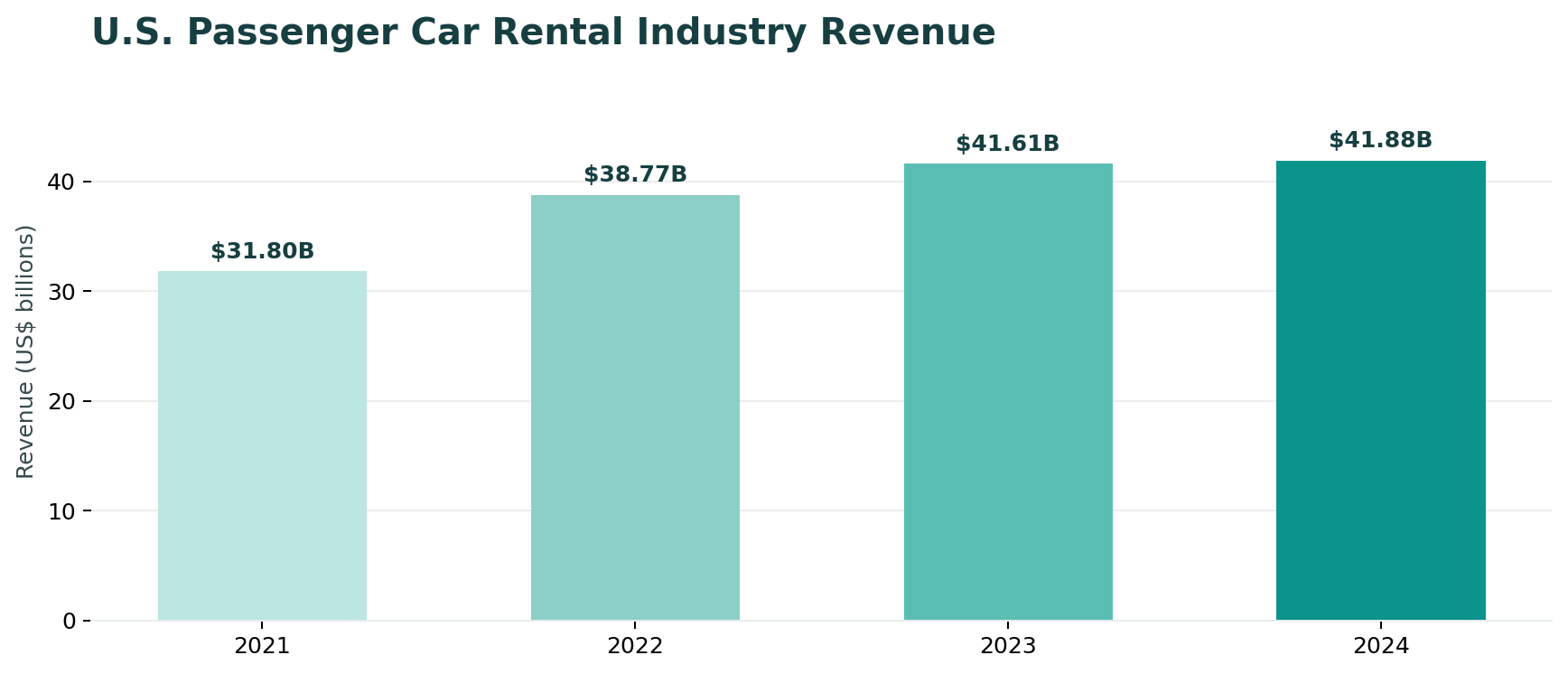
U.S. passenger car rental industry revenue, 2021–2024 (US$ billions). Historical Census AIES measurements; not forecasts.
Source: U.S. Census Bureau via FRED
The opportunity for a new operator is usually a narrow customer problem: collision-repair replacement cars, weekly economy rentals, reliable business-travel vehicles or family SUVs near lodging. A national revenue figure is useful context. Your real market begins within a practical pickup or delivery radius.
Statista also forecasts $34.19 billion in U.S. consumer car-rental revenue for 2026. Its scope differs from Census historic receipts. If you study how to start a car rental business, test local repeat bookings, not just national totals.
Choosing the Right Car Rental Business Model
A traditional agency rents a company-owned or commercially financed fleet. A franchise adds brand systems and fees. A peer-to-peer host uses a marketplace such as Turo and accepts its rules and earnings structure. Airport operations bring different access and concession requirements from a neighborhood counter. Your car rental business plan must name the model because it determines insurance, contracts, technology and financing.
Think in customers, not just vehicle classes. A repair-shop partnership may produce predictable replacement demand; resort visitors can produce bigger peaks and quiet weeks. Weekly rentals reduce handovers but can lower the effective daily rate. Luxury cars may photograph beautifully while exposing you to costly repairs, higher deposits and longer idle periods.
A platform can help supply bookings but also controls part of the customer experience. An independent operator owns more of the relationship and carries more marketing responsibility. Compare the full economics and insurance terms before deciding.
For founders weighing how to start a car rental business, list the first 20 likely renters and how you will find them. If every answer is a marketplace, customer acquisition is not yet under your control.
Pros and Cons of Owning a Car Rental Business
A rental company can create repeat income from a reusable asset, but unlike many service businesses it carries expensive fixed commitments even when demand disappears. Understanding the trade-offs now will keep the launch plan honest.
The upside: vehicles can earn across multiple bookings; local repair-shop and corporate relationships can create repeat demand; good service builds referrals; and a proven small fleet can expand gradually. Customers are paying for convenience, not only for the metal you own.
The downside: commercial insurance can be costly or difficult to obtain; vehicles depreciate even when parked; accidents and disputes interrupt cash flow; and demand can be seasonal. Airport access, age and insurance rules, chargebacks, theft risk and maintenance downtime add complexity. A five-car business is still exposed when two vehicles are off the road.
Learning how to start a car rental business includes planning for late-night returns, weekend pickups and accident calls. Promising 24-hour support without a realistic response arrangement can exhaust a founder.
Market Research Before You Invest
Test the area before you buy. Quote the same pickup dates and vehicle category from 10–15 nearby providers. Record the final checkout price, deposit, insurance terms, mileage, pickup location, review complaints and availability. Speak with body shops, hotels, employers and insurance-related referral partners. Ask what travelers keep complaining about; that answer may become your positioning.
Then model actual vehicle-days. Suppose a three-car operation in a hypothetical Tampa market sells 54 vehicle-days in a 30-day month: that is 60% utilization. At a realized $79 per day, it collects $4,266 before costs. Change the booked days and daily rate until you can see whether a slower month survives. This is an example, not a reported Tampa business result.
When studying how to start a car rental business, interview repair shops and hotels. One needs dependable replacements; another needs frictionless late pickups. Their needs shape your contract and fleet.
Good market research turns vague optimism into evidence. ZH Consultancy’s market research services can help structure competitor comparisons and local demand assumptions before you commit to a fleet.
Build Your Car Rental Business Plan Before Borrowing
What does a lender or partner need to see? A real car rental business plan starts with a customer segment and a specific service area, not a generic claim that travel is growing. It should explain the booking model, fleet mix, operating permissions, insurance, pricing, unit economics and the maximum cash loss the owner can tolerate.
Write the executive summary last. Start with a competitor grid and customer evidence; then build a 12-month forecast with booked vehicle-days, realized daily price, variable cost, fleet financing, insurance, payroll, parking, marketing and repairs. Add a three-year view for larger funding decisions, but let the first 90 days decide whether the assumptions survive contact with reality. A car rental business plan should also identify the person responsible for each operating milestone.
Create conservative, base and upside cases. Ask how much cash remains if utilization stays at 45%, an SUV needs a $3,000 repair, or a marketing channel generates calls but no paid rentals. State exactly how much funding is needed, where it goes and when it is repaid. A lender-ready forecast should reconcile monthly cash flow with the depreciation and debt schedules. Founders who need a more defensible lender forecast can get financial modeling support.
Your car rental business plan should identify financing sources, personal guarantees and cash runway in the slow case. An editable model is more valuable to a lender than a glossy market-size presentation.
How to Start a Car Rental Business Legally in the USA
There is no single nationwide car-rental license that covers every state, city and airport. Begin with the state where the vehicles will be registered and customers will collect them, then confirm city zoning, local business authorization, tax registration, vehicle title rules, and the insurer’s operating conditions. Do not pay a nonrefundable lease deposit before checking those requirements. Search for the actual car rental business license rules where vehicles will be picked up.
Entity, EIN and local permission
Choose an appropriate structure, register the company under state rules, appoint an agent when required, and open a separate business bank account. An LLC may provide liability separation, but it does not erase personal guarantees or replace insurance. Apply for an EIN directly through the IRS when needed; the IRS does not charge for it. If a jurisdiction requires a car rental business license or tax permit, register before taking bookings.
State rental taxes are not interchangeable. In Texas, qualifying car-rental operators collect 10% gross rental receipts tax on contracts of 1–30 days and 6.25% on contracts over 30 but no more than 180 days. Florida generally imposes a $2-a-day rental-car surcharge for the first 30 days on qualifying vehicles, alongside applicable taxes. Verify the precise rules where you operate.
A car rental business license checklist should track state filing, tax permits, city zoning, vehicle registration, rental insurance, disclosures and special pickup permissions—with the issuing agency and renewal date.
Source: Texas Comptroller — Motor Vehicle Rental Tax Guide
Source: Florida Department of Revenue — Rental Car Surcharge
Insurance, rental contracts and customer safeguards
Have an attorney review rental agreements, additional-driver rules, deposits, permitted uses, damage terms, privacy and consumer notices. Obtain insurer-approved commercial rental coverage before accepting a booking; ordinary personal auto policies are not designed for this operation. Driver screening and payment information need lawful, secure handling. A legal entity and a signed waiver cannot make an unsafe car safe.
When explaining how to start a car rental business, obtain insurer-approved quotes for the exact fleet. A car rental business license or LLC never substitutes for appropriate coverage.
Building Your Fleet and Setting Up Car Rental Operations
Buying the cheapest used car is not always economical. Compare reliability, mileage, insurance acceptability, repair availability, resale value and fit for local customers. Three efficient sedans and two compact SUVs could be a reasonable pilot in one market; in another, the same mix could be wrong. Buy only after your own evidence points to demand.
Five vehicles have 150 theoretical vehicle-days in a 30-day month, before cleaning, maintenance, damaged cars and gaps between reservations. Approved commercial rental financing can preserve launch cash, but consumer auto financing or leases may prohibit third-party rentals. Confirm permitted use in writing before signing.
How to start a car rental business is also a scheduling challenge: two cars unavailable for four days cut monthly capacity from 150 to 142 vehicle-days. Your website must block those dates.
Use fleet software to prevent double bookings, block maintenance dates, log signed agreements and capture return photographs. Inspect lights, tires, warning messages, fuel or charge, mileage and prior damage at every handoff. Check open recalls by VIN. Telematics and GPS require clear customer notice, lawful handling and strict controls.
Source: NHTSA — Vehicle Recalls
How Much Does It Cost to Start a Car Rental Business in the USA?
The down payment is only the beginning. Add vehicle taxes and title, rental-use insurance, approved premises, booking tools, legal agreements, signage, a website, branding, advertising and cash reserves. The numbers below are an illustrative U.S. scenario, not a financing offer: $22,000 used vehicles, 30% down, 10% APR over 60 months and lender permission to rent them. Make separate lines for car rental startup costs and recurring monthly commitments.
Financed-fleet startup cash | 3 cars | 5 cars | 10 cars |
|---|---|---|---|
Vehicle down payments | $19,800 | $33,000 | $66,000 |
Other pre-opening costs | $17,650 | $28,400 | $52,400 |
Four-month operating reserve | $21,498 | $44,244 | $91,028 |
Separate repair contingency | $7,500 | $12,500 | $25,000 |
Total cash target | $66,448 | $118,144 | $234,428 |
In the five-car model, $110,000 of vehicles require $33,000 in down payments and roughly $77,000 in financed principal. Modeled debt service is about $1,636 monthly. Paying cash instead avoids that payment but demands far more capital upfront. In either case, reserve for insurance deductibles, repairs and slow booking months. A borrower needs to know which car rental startup costs can be financed and which require cash.
The cash budget deliberately includes four months of operating expenses and a separate repair allowance. It does not include the founder’s living expenses, income taxes or rare catastrophic losses. Real fleet insurance quotes can be dramatically different from the illustration, so the final car rental startup costs must come from your actual state, drivers, vehicles and insurer.
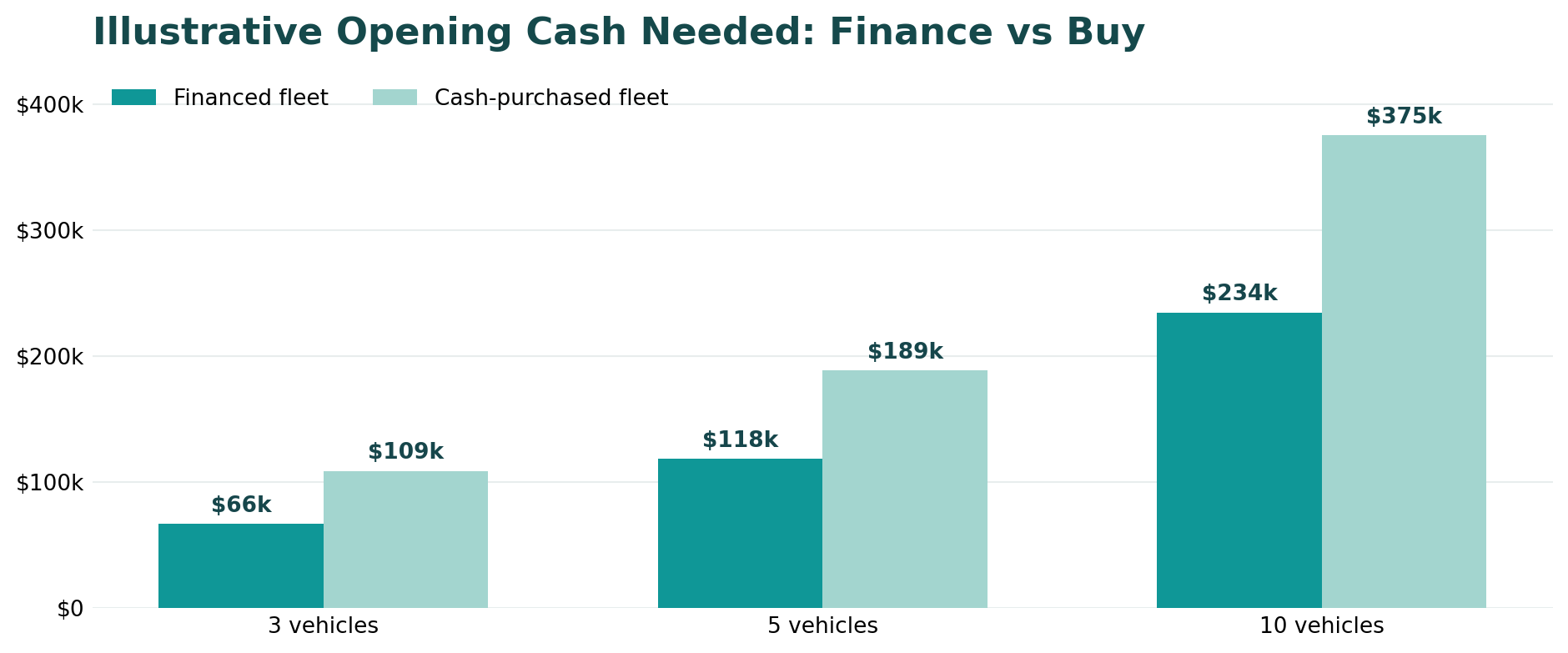
Illustrative opening funding needs (USD) for 3-, 5- and 10-vehicle fleets. Cash-purchase figures are from the source model; scenarios are not market averages.
Source: Original illustrative car-rental calculations. Methodology reference: SBA startup cost guidance
Car rental startup costs are more than purchases. Keep cash for slow months, claim deductibles and repairs. Additional cars can consume reserves before creating reliable bookings.
Monthly commitments | 3 cars | 5 cars | 10 cars |
|---|---|---|---|
Vehicle financing | $982 | $1,636 | $3,272 |
Rental fleet insurance | $1,350 | $2,250 | $4,500 |
Premises, maintenance, software, administration | $1,195 | $1,845 | $3,575 |
Google Ads spend | $900 | $1,800 | $3,500 |
GBP professional management | $300 | $450 | $750 |
Staff allowance | $0 | $2,000 | $5,000 |
Total monthly fixed cash | $4,727 | $9,981 | $20,597 |
The monthly model assumes $450 in fleet insurance per vehicle only for planning. Google Business Profile is free to create for eligible businesses; optional professional profile management appears as a separate expense. The $1,800 Google Ads figure is advertising media spend, not a claim about typical industry budgets. Replace every estimate with a supplier quote before borrowing.
How to Price Your Car Rentals and Calculate Profitability
Your advertised $99 daily rate is not necessarily the amount your business keeps. Discounts, weekly pricing, refunds, taxes, mandatory charges, cleaning, card fees and unsold days all matter. Price for realized rental income and contribution after variable costs, and make the full customer price understandable before checkout. Check car rental startup costs separately from the expenses incurred on each completed booking.
At five cars and 30 days, you have 150 possible vehicle-days. With a $99 realized rate and $12 per booked-day cash cost, each rented day contributes $87 toward $9,981 in fixed monthly cash commitments. Break-even requires 9,981 ÷ 87 = 114.7, rounded up to 115 booked days—or 76.7% utilization. That is a demanding target before owner compensation and tax.
Before changing prices, recompute break-even booked days. This is how to start a car rental business without confusing busy calendars with healthy contribution margins.
30-day scenario | Booked days | Daily rate | Rental revenue | Cash surplus / deficit |
|---|---|---|---|---|
Conservative | 90 | $79 | $7,110 | −$3,951 |
Base | 115 | $99 | $11,385 | +$24 |
Optimistic | 125 | $119 | $14,875 | +$3,394 |
At 115 days, the model records $11,385 in revenue, $1,380 variable spending and $9,981 fixed cash commitments, leaving just $24 in cash surplus. That is not economic profit. Principal repayment, interest and vehicle depreciation affect accounting differently; an actual model must separately track debt balances, tax treatment, asset values and owner pay.
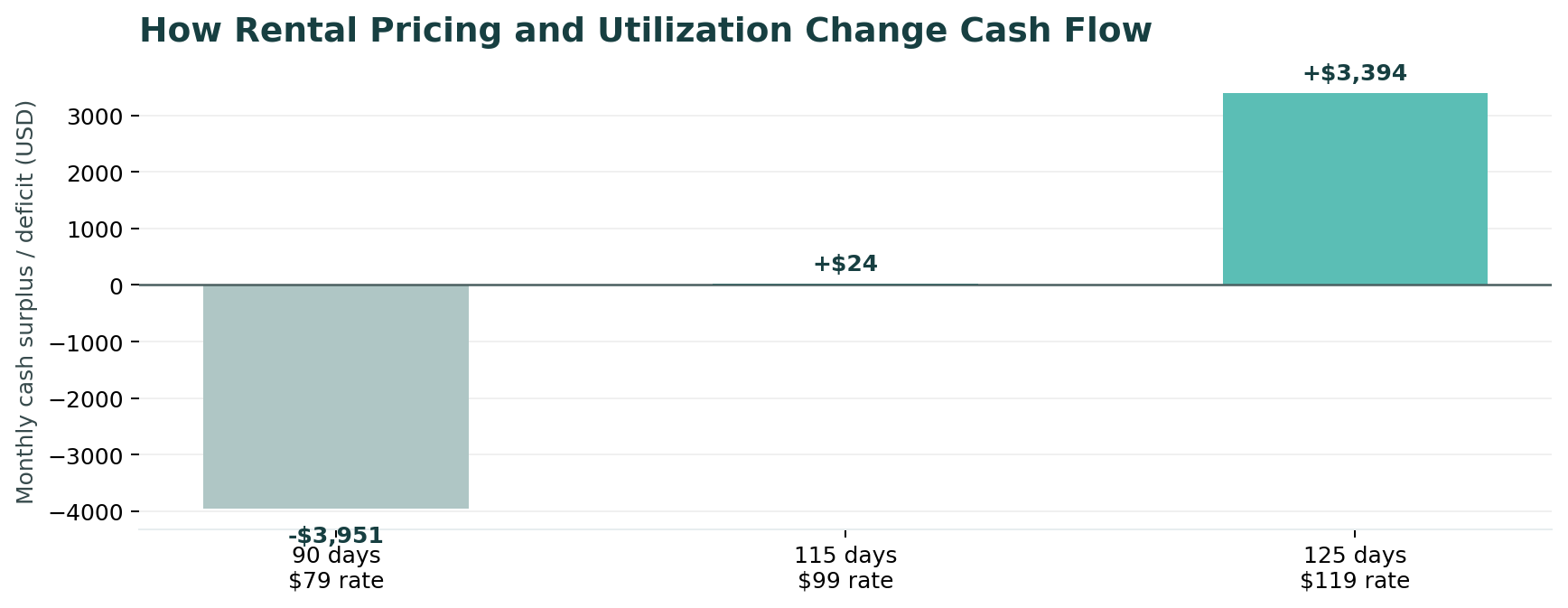
Five-car rental business: illustrative monthly cash result at different rates and utilization (USD, 30-day month). Assumes $12 variable cost per rented day and $9,981 fixed monthly cash commitments.
Source: Original scenario analysis using the SBA break-even method
Watch utilization, realized daily rate, revenue per available vehicle, repair downtime, acquisition cost and vehicle-level contribution. A long booking that fills the calendar at a weak rate can earn less than a partly utilized fleet with stronger margins.
Building a Professional Car Rental Brand That Customers Trust
Customers often see your company for the first time on a phone while comparing several available cars. Choose a distinctive name, check its legal and domain availability, and create a logo readable on a key tag, booking confirmation, vehicle sign and business card. Matching colors, honest vehicle photography and consistent pickup messages build recognition. Branding cannot substitute for punctual service, but it can make a trustworthy operation easier to recognize.
A short company profile or capability statement helps with hotel desks, repair shops, insurers and corporate accounts. Include your legal name, service area, fleet classes, hours, pickup procedures, insurance information you are permitted to share, account arrangements and a reliable contact person. Print a few professional visiting cards for partner meetings; a giant glossy brochure is unnecessary for a three-car pilot. Clear business card design and consistent graphic design help partners remember how to reach you.
A booking website needs current inventory, a working mobile experience, clear total pricing, fees and deposit terms, driver conditions, pickup instructions, a secure payment provider, cancellation policies and a real support contact. If reservations are approved manually, say so. Never promise instant confirmation when your calendar and payment system do not synchronize. A professional booking website should make the process testable before advertising begins.
When planning how to start a car rental business online, test a booking on an ordinary phone. Customers should find total charges, mileage, deposits and cancellation terms quickly.
For a small operation, WordPress with specialized booking software may give flexible control but needs ongoing updates; Wix or Squarespace can simplify an inquiry-focused site; a specialized rental platform may fit inventory and contract handling better. Shopify is primarily designed for commerce and normally needs additional rental tools. Test the entire reservation path before running paid ads.
The most expensive website mistake is buying a beautiful homepage before deciding how reservations will work. Choose the domain in a business-owned account with a reputable registrar; compare renewal cost, DNS access and account recovery rather than only a first-year coupon. Keep hosting, booking software and payment permissions documented so your company can change vendors later.
Domains, Hosting and the Rental Booking System
For a WordPress site, compare managed hosting, backups, updates, staging and technical support. A hosted builder such as Wix or Squarespace can suit an inquiry-first pilot, while dedicated rental software may make more sense once you need live vehicle inventory, contracts and deposits. Map the customer path—search, quote, document requirements, payment hold, confirmation, pickup and return—before commissioning development. Plan for website maintenance after launch, not only the initial build.
Google Business Profile Optimization for Car Rental Businesses
A Business Profile is available only to eligible businesses that make in-person customer contact. A real staffed rental desk may qualify; a mailbox, fake airport location or online-only lead operation does not. Enter the genuine business name, appropriate category, actual phone, website and hours, and follow Google’s verification process. Google Business Profile optimization begins with eligibility, not search ranking tricks.
Delivery-only and age-restricted business eligibility can involve additional rules, so do not assume every fleet host can create a service-area listing. Google may require evidence of signage or operations. Never claim an airport branch or use a borrowed address to appear closer to travelers.
Show actual vehicles, pickup instructions, availability information, holiday hours and accurate service coverage. Ask real customers for reviews without incentives or selective screening, then respond professionally. Regular accuracy and service matter more than cramming keywords into the listing name.
Google Business Profile optimization continues after verification: update real hours, vehicles, photos and review responses. Google Business Profile optimization should match the actual pickup experience.
Measure calls, website clicks and directions but compare them with completed rentals; a map impression is not profit. ZH Consultancy offers Google Business Profile services to help eligible operators keep listings accurate and useful. Consistent Google Business Profile optimization can reduce confusing inquiries and improve trust.
Google Ads for Car Rentals: Turn Searches into Paid Bookings
Run Search campaigns around real rental needs in the places you serve: economy, SUV, weekly, monthly and replacement vehicles. Give each meaningful offer its own landing page. Avoid broad countrywide targeting and disable irrelevant terms after reviewing search-term reports.
Google Ads for car rentals works best with narrow searches and accurate inventory. Track completed rentals, not clicks. Google Ads for car rentals becomes wasteful when pickup locations are misrepresented.
Airport searches can be valuable, but never advertise a counter you do not operate or pickup rights you do not have. Publish honest pickup instructions and actual availability. Bids and click counts matter less than paid, completed rentals after customer refunds and cancellations.
The five-car example allows $1,800 monthly advertising. If that produces 15 completed four-day rentals at $99 per day, attributed revenue is $5,940 and cost per booking is $120. After $720 of modeled variable costs and the $1,800 ads spend, those reservations contribute $3,420 toward other business costs—not net profit. Do not subtract advertising twice in the complete cash model.
Link ads to reliable booking conversion events, and reconcile website and offline sales. Review cancellations, no-shows and fleet availability before scaling a winning keyword. ZH Consultancy’s Google Ads management services can help design search campaigns and track actual customer outcomes. Judge Google Ads for car rentals against completed, profitable transactions.
Source: Google Ads — Search Terms Report
Google Ads vs. Meta Ads: Which Is Better for Car Rental Businesses?
Google Search often fits urgent car-rental intent because customers are already asking for available vehicles. Meta Ads can be useful for wedding cars, road-trip packages, remarketing permitted audiences and local brand awareness. Neither is automatically superior. Start where you can reliably measure completed bookings, not simply cheap leads.
For anyone evaluating how to start a car rental business, match campaigns to demand. Google Ads for car rentals often suits urgent bookings; Meta may suit specialty promotions.
Keep the same test budget. For example, compare $1,800 of Search media with a later $1,500 Search plus $300 Meta split; do not treat the second scenario as additional spending. Judge channels by gross margin after acquisition, not by the number of forms submitted. Budget Google Ads for car rentals according to the contribution from actual completed rentals.
Build quieter channels as well: partners at repair shops and hotels, legitimate reviews, repeat customers and relevant local SEO content. Social posts can show the actual fleet, but they cannot fix unavailable cars or a confusing checkout experience. Use coordinated digital marketing services only when the business can trace spending to completed rentals.
Running a Successful Car Rental Business Day to Day
A reservation is only the beginning. Confirm the approved driver, license and insurance conditions, dates, pickup location, deposit authorization and contract terms before releasing keys. State rules and insurer underwriting differ, so “minimum age 25 everywhere” is not a valid national rule. Protect sensitive driver and payment data.
Use time-stamped pickup and return photos: each side of the car, existing damage, tires, fuel or charge, mileage and dashboard lights. Tell customers which amounts are actual charges and which are temporary payment holds. A surprised customer is more likely to dispute fees even when your calculation is correct.
Document extension requests, accidents, roadside support, vehicle non-return and damage reports. Never disable a moving vehicle or treat every late return as theft. Put personal safety and emergency response ahead of claim paperwork.
Review recalls and maintenance, remove unsafe cars from inventory, train staff and track vehicle downtime. Check pickups and returns daily; cash, booking quality and paid traffic weekly; and depreciation, contribution, customer retention and cash runway monthly.
Source: FTC — Renting a Car: Fees, Holds and Customer Rights
Why Car Rental Businesses Fail—and How to Avoid It
The first failure is financing a fleet before validating demand. A car can look affordable on a monthly loan payment while its insurance, parking and lost booking days make it expensive. The second is chasing flashy models instead of the vehicles repair shops and travelers actually request. Build forecasts around realistic booked days, not personal preferences.
Owners can fail by tracking bookings instead of vehicle-level profit. How to start a car rental business sensibly means scaling contribution margin, not simply the number of cars.
The third is weak control of handovers, insurance, driver eligibility and payment disputes. The fourth is relying on one booking marketplace or one ad campaign. The fifth is growing from five vehicles to ten before cash flow and operations can support the leap. Create written procedures, compare channel economics and add vehicles only when demand keeps repeating.
Here is a stress test: 90 booked days at $79 produce $7,110 in revenue and a modeled $3,951 monthly cash deficit. Even at $99 for those same days, the company remains $2,151 short. At 115 days and $99 it just crosses simplified cash break-even by $24. If your conservative case drains the reserve, reduce committed costs or rethink the launch—not simply your advertising headline.
How to Start a Car Rental Business: A 90-Day Launch Plan
Days 1–30: interview renters and partners, compare local rental quotes, check insurer eligibility and zoning, and prepare utilization scenarios. Obtain actual financing and commercial rental-policy quotes before paying for cars or premises. Decide whether the location and target customer deserve a pilot.
The first month should test how to start a car rental business with real evidence: do insurable vehicles, permitted premises and plausible bookings produce a route to break-even?
Days 31–60: register and insure, secure required approvals, finalize contracts, prepare the first vehicles and build a booking website that displays truthful availability. Create brand materials, test reservations and establish an eligible Google Business Profile only after the underlying operation exists.
Days 61–90: start with measured Search campaigns and direct local partnerships. Track booked days, realized rates, cancellations, repair downtime and acquisition costs each week. Improve your process and customer reviews before expanding the fleet.
These dates are decision stages, not a promise that registration, insurance or airport approval can be completed on schedule. Do not take a customer’s payment before the required legal and insurance groundwork is finished. At day 90, review what the numbers—not your enthusiasm—say about adding another vehicle.
The Takeaway
The clearest answer to how to start a car rental business is to validate the customer before buying the asset. Prove demand, verify licensing and rental-use insurance, preserve working capital and make pickup and returns exceptionally reliable. A small fleet with healthy contribution can outperform a larger one that stays parked.
Then give customers an easy path from search to keys: accurate local information, honest prices, a functioning booking website and responsive support. When you need help structuring the business model and financial assumptions, ZH Consultancy offers business plan writing, market research, financial modeling, design and digital marketing services that can support those decisions.
These are the questions founders most often need answered before committing capital. The answers below highlight practical trade-offs; actual state requirements and supplier quotes still need checking.
Faq
Frequently Asked Questions
Our financed-fleet illustration requires about $66,448 for three cars, $118,144 for five, or $234,428 for ten—including four months of modeled operating reserves and a separate repair contingency. These are not national startup averages. Your figures depend on rental-use insurance, location, vehicle prices and financing terms. The small-fleet model does not include owner living costs or personal income tax. Treat these car rental startup costs as a worksheet to replace with local quotes.
A three-car pilot can be viable, but one unavailable vehicle immediately removes a third of capacity. An LLC may help separate liabilities, subject to legal limits; it is not universally mandatory and does not replace commercial rental insurance. Verify your state formation and tax rules.
Requirements depend on the state, city, airport and type of operation. Check business registration, premises, rental taxes, vehicle title and registration, permitted pickup locations, insurance, customer notices and agreements. Texas has a motor vehicle rental tax framework; Florida has a different daily rental surcharge. Never rely on personal auto coverage. Put every car rental business license, tax and insurance requirement in a tracked checklist.
Choose vehicles with local demand, reliable parts supply, manageable depreciation and insurable operating profiles. Some businesses may qualify for lender-approved SBA-backed financing, but eligibility and permitted use depend on the program and lender. A consumer auto loan may prohibit rental use.
In the five-car illustration, fixed monthly cash commitments are $9,981. At $99 per booked day less $12 variable cost, approximately 115 vehicle-days are required for simplified cash break-even—76.7% utilization in a 30-day month. That excludes owner pay and full economic depreciation. At 90 days sold for $79, the monthly modeled deficit is $3,951.
A marketplace such as Turo can distribute bookings, but it imposes platform rules and earnings terms. An independent operation controls its brand and customer journey while assuming marketing and technology responsibilities. Airport operations may require concessions or other access permissions. Compare legal obligations and full unit economics.
Build an eligible, accurate Google Business Profile and an effective booking website first. Search ads can then reach high-intent local renters. Judge both channels by completed bookings and contribution, not clicks. Meta can support selected specialty offers once tracking works. Effective Google Business Profile optimization starts with accurate customer information.

Zain Hameed
Business strategy specialist helping a global client base of 800+ businesses build credible plans, financial models and investor-ready presentations.
In this article
Book a Free Consultation
Have a business idea, growth challenge or investor deadline? Book a free consultation and get clear next steps from our team.
Call our team
+923104049517
Email us

Business Topics
Business topics
Continue reading
Related insights

How to Start a Laundromat Business: A Complete U.S. Founder’s Guide
Learn how to start a laundromat business in the USA: market

How to Start a Construction Business in the USA
A homeowner wants to sign a $75,000 remodeling contract on Friday.

How to Start a Plumbing Business in the USA
At 7:15 on Monday morning, a homeowner calls about water coming

How to Start a Car Rental Business in the USA: A Founder’s Practical Guide
A family lands after midnight. They do not care whether your

How to Start a Landscaping Business: Costs, Licenses, Marketing and Profit
Picture two lawns on the same street. One homeowner wants a

How to Start a Cafe Business in the USA: Costs, Licenses, Marketing and Profit
You’re standing inside an empty storefront, and you can already picture