

In this article
Picture two lawns on the same street. One homeowner wants a dependable person who shows up every Tuesday. The other has stopped answering calls from the company that left grass clippings across the driveway. Same neighborhood. Same basic service. Two completely different reasons to hire someone.
That gap between simply mowing a lawn and running a dependable service is where the business opportunity begins. If you are researching how to start a landscaping business, you probably already know you need equipment and customers.
The examples below use an illustrative Charlotte, North Carolina, operation. Costs are planning scenarios, not quotes or nationwide averages; laws must be checked in the relevant state and city.
The Landscaping Industry: Is Starting a Landscaping Business Worth It?
The national opportunity matters only if your local market can keep a crew profitably booked.
Global landscaping market size and growth
Landscaping includes recurring lawn and garden maintenance, enhancement, design and installation—not just mowing. Grand View Research estimates a $330.6 billion global landscaping-services market in 2024, a $372.2 billion estimate for 2026, and a $484.8 billion forecast for 2030. The report gives a roughly 6.6% forecast compound annual growth rate for 2025–2030. Those values use one research firm’s scope and methodology; they do not measure lawnmower or gardening-equipment retail sales. A large market helps explain the opportunity, but how to start a landscaping business locally is still a question of routes, skills and customer demand.
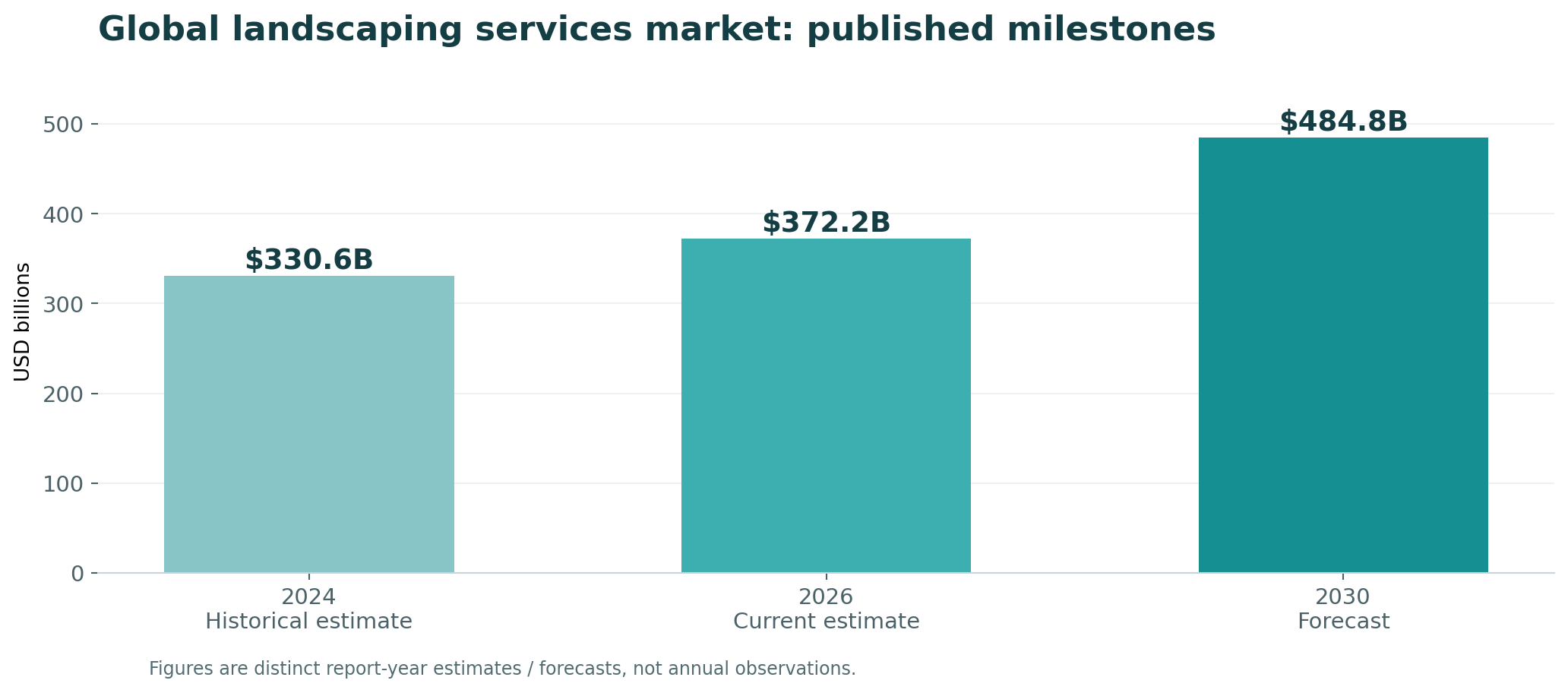
Figure 1. Global landscaping-services market size, 2024 historical estimate, 2026 estimate and 2030 forecast (USD billions).
Source: Grand View Research
U.S. market size: distinguish three different measures
Statista’s public U.S. landscaping overview reports approximately $178.4 billion for 2024. The National Association of Landscape Professionals (NALP), citing IBISWorld, reports $188.8 billion in 2025. They are commercial market estimates and should not be treated as the same series as federal establishment revenue.
For a comparable historical measure, the U.S. Census Bureau’s Annual Integrated Economic Survey series, distributed by FRED, records U.S. landscaping-services establishment revenue of $91.23 billion in 2020, $101.80 billion in 2021, $115.41 billion in 2022, $115.60 billion in 2023, and $123.63 billion in 2024. In this series, revenue grew approximately 35.5% from 2020 through 2024 in nominal dollars; 2023’s nearly flat result is a reminder that growth does not occur smoothly every year.
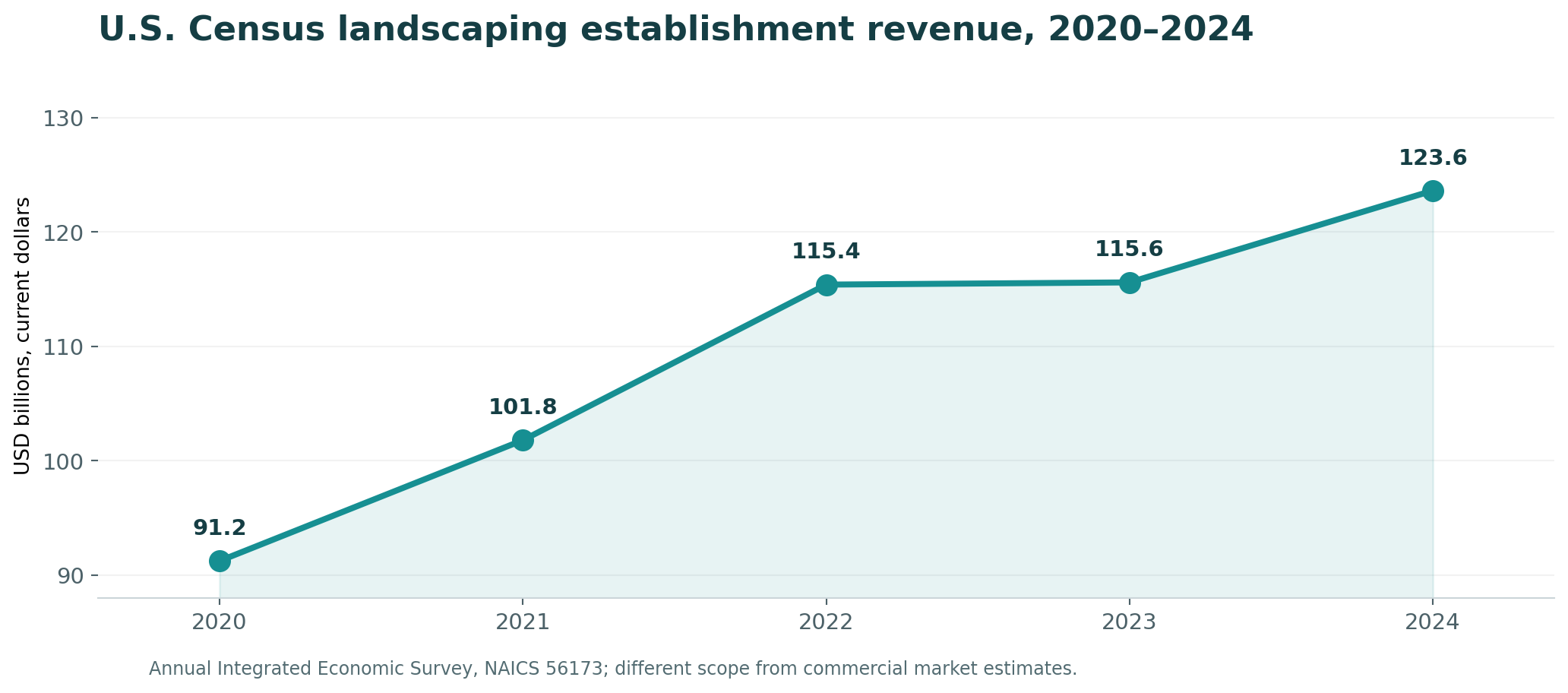
Figure 2. U.S. landscaping-services establishment revenue, 2020–2024 (USD billions, nominal). Different scope from Statista/IBISWorld market estimates.
Source: U.S. Census Bureau via FRED
How crowded is the market? The National Association of Landscape Professionals, citing IBISWorld, reports around 692,777 landscaping businesses and more than 1.4 million workers in its broader industry definition. The U.S. Census Bureau separately reports 117,969 employer establishments for landscaping services in 2023. These figures are not interchangeable: establishments with payroll are not the same as the full population of owner-operators and nonemployers. National business counts say little about the actual competitors within a fifteen-minute drive of your first customer. These figures inform how to start a landscaping business, not who will hire you.
Future demand and the opportunity for a startup
A separate Grand View Research U.S. outlook projects the U.S. market at $203.8 billion in 2030, from its $116.1 billion 2022 baseline, with a 7.3% forecast CAGR for 2023–2030. This is not a 2027–2031 annual projection, and its baseline should not be spliced into the Census series. Forecasts remain uncertain; no verified 2031 figure is assumed here. That distinction matters when deciding how to start a landscaping business rather than simply buying into a growth forecast.
Choose the Right Landscaping Business Model Before Investing
The business model determines who pays you, how often, and what equipment you need.
Residential maintenance, commercial contracts and installations
For a new owner, residential maintenance is a practical start. Mow, edge and clean up reliably. At $95 for 32 visits, one customer brings $3,040 in potential annual sales before costs. Recurring work makes routes and staffing easier to plan. That is one answer to how to start a landscaping business: establish repeatable service before chasing every job.
Commercial grounds care can bring larger contracts and steadier scheduling. It also comes with sharper expectations: documented insurance, coverage when a crew member is sick, clear work standards and often slower payments. Imagine an apartment manager who needs spotless common areas before a weekend leasing event.
Planting, sod and landscape renovations may have larger project values, but also more material, schedule and warranty risk. Irrigation, pesticide applications, hardscaping and tree work may need extra licensing or insurance. The cautious way to start is to offer only work you can legally and safely deliver. That is how to start a landscaping business without unnecessary risk.
Decide on a profitable service mix
Choose services by four tests: demand, margin, safe delivery and licensing. Start narrow. Add seasonal cleanups or planting after customers trust you. Track each service’s costs—a $450 cleanup is not a bargain if it takes two crew-days. This is the first practical decision in how to start a landscaping business with manageable risk.
Pros and Cons of Owning a Landscaping Business
The attractive part is obvious: repeat maintenance work, a low-complexity service you can start with limited equipment, visible results customers appreciate and the possibility of adding profitable seasonal services. A well-run route also creates referrals: one satisfied homeowner can introduce you to three nearby neighbors.
Now the less photogenic side. Work is physical, weather interrupts schedules, trucks and machines fail, staffing can be difficult and injuries or property damage carry real consequences. Competition is often strongest for basic mowing.
Research Your Local Landscaping Market and Find Profitable Customers
First test demand on streets you can serve efficiently; national growth cannot guarantee local bookings.
Select the territory before buying equipment
Choose a compact neighborhood before buying a truck. Compare home lots, travel distance, competitor offers and customer complaints. Even a wealthy region can be unprofitable if every job requires a long drive. A focused local market research assessment can help identify customer groups and viable routes.
Investigate 10–15 actual competitors: services, photos, service areas, review complaints and public prices when available. A short landscaping business plan can turn that research into a defensible target customer and route design. Use Google Keyword Planner and Trends to observe interest, but remember that searches alone do not prove people will hire you.
Here is why route density matters. Eight jobs at $95 produce $760. If each takes 50 minutes plus ten minutes to drive and unload, the route uses eight crew-hours: $95 in gross sales per crew-hour.
Validate demand with real inquiries
Talk to homeowners, real estate investors and property managers before buying a second mower. Ask who they use now, how frequently they need service, what frustrates them, and how they choose vendors. Offer a narrowly defined service and record real requests for estimates.
Write a Business Plan Before Buying the Big Equipment
A landscaping business plan should test real assumptions, not decorate fifty pages. Who needs the service? How many nearby properties can one crew visit? What if rain delays three working days? How long can you meet truck payments when bookings slow? This is how to start a landscaping business with testable assumptions.
Build it around a service territory, real competitor and customer interviews, pricing, a staffing plan, documented legal requirements, equipment quotes, a marketing strategy and monthly cash-flow forecasts.
Register a Landscaping Business Legally in the United States
Your license, insurance and tax obligations depend on where you operate and exactly what you do.
Entity formation, business names and taxes
There is no universal landscaping license for every U.S. service. Mowing, irrigation, pesticide application and hardscaping can trigger different rules. An LLC can help separate some personal risks but does not replace insurance. Verify federal, state and local requirements before selling the service. The SBA business launch guide offers a useful starting checklist. A landscaping business license may be required for some activities even when basic mowing is allowed. A landscaping business plan should include the cost of compliance and insurance.
Check your name in the state registry and USPTO trademark search; register the entity or DBA as required. Obtain an EIN if applicable—IRS applications are free—and open a dedicated bank account. Verify state and local business, sales-tax and employer registrations.
Concrete state examples—and what they do not mean
Licensing follows the actual work. In California, some landscape construction can require contractor licensing. In Texas, certain irrigation services are regulated. Pesticide application adds its own state requirements. Those are examples, not a national checklist. Your landscaping business license obligations must match the tasks and locations you advertise; consult official regulators before quoting specialist work.
Licenses, permits, insurance and safety
The EPA requires certification for restricted-use pesticides; states may impose broader requirements. Arrange utility marking before excavation, and obtain appropriate liability, commercial auto, equipment and workers’ compensation policies. Follow OSHA landscaping safety guidance for machinery, chemicals and heat. Use written agreements and accurate payroll records. Any guide on how to start a landscaping business must match the exact services with applicable laws. The landscaping business license question becomes more complex when you add chemicals, tree services or construction. Compliance is central to how to start a landscaping business responsibly.
Calculate Landscaping Startup Costs and Funding Needs
Understanding landscaping startup costs starts with budgeting beyond opening day. You also need cash to survive slow bookings and unexpected repairs.
Three launch models, one consistent set of assumptions
Begin with three possible sizes rather than one dream budget. The lean model assumes an owner with a suitable vehicle and a limited maintenance offer. The standard model adds a used truck, trailer, commercial mower and an employee. The growth model approximates two crews. These landscaping startup costs are illustrative models, not a supplier survey. A thoughtful landscaping business plan should show opening purchases, monthly cash demands and reserves separately so that a promising launch does not run out of money before the busy season.
Funding item | Lean solo | Standard | Growth-focused |
|---|---|---|---|
Initial setup investment | $7,000 | $42,350 | $104,800 |
Monthly cash needs | $4,250 | $12,150 | $32,500 |
3-month reserve | $12,750 | $36,450 | $97,500 |
Total launch funding (3-month) | $19,750 | $78,800 | $202,300 |
Total launch funding (6-month) | $32,500 | $115,250 | $299,800 |
Reserves change the picture. The lean model requires $7,000 in purchases, or $19,750 with three months of cash. Standard is $42,350 to launch, or $78,800 with reserves. Growth-focused is $104,800 before reserves, or $202,300 with them. Six-month reserves bring these scenarios to $32,500, $115,250 and $299,800. These landscaping startup costs are illustrative, not quotes or legal minimums. Funding how to start a landscaping business requires plans for slow bookings and breakdowns. Verify local prices.
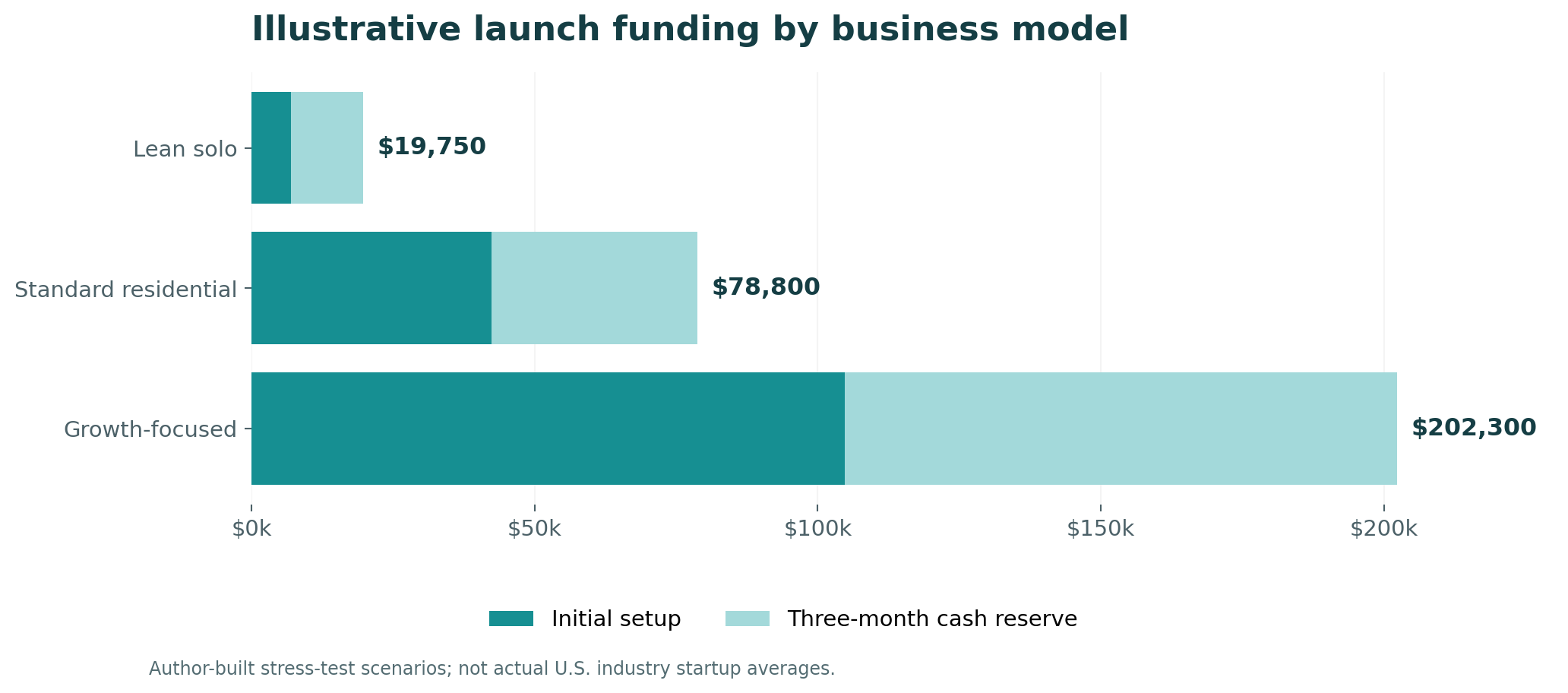
Figure 3. Illustrative startup setup investment and three-month cash reserve across three business sizes (USD). Not published industry averages.
Source: Author calculations from the itemized startup scenarios
Standard company monthly cash plan | USD |
|---|---|
Employee wages / employer costs | $3,850 |
Owner living cash allocation | $2,500 |
Insurance | $650 |
Fuel / transportation | $800 |
Equipment maintenance | $450 |
Storage / facility | $450 |
Phone / software | $200 |
Google Ads media | $1,800 |
Google Ads management | $450 |
GBP / local content work | $150 |
Bookkeeping / administration | $350 |
Other cash buffer | $500 |
TOTAL | $12,150 |
The illustrative $42,350 standard setup includes a used truck ($17,000), trailer ($2,800), mower ($6,700), tools and PPE ($1,700), registration ($750), initial insurance ($1,800), branding ($1,200), website ($2,500), launch advertising ($2,000), software ($500), storage setup ($700), training ($600), supplies ($600) and contingency ($3,500). The figures add to $42,350; actual quotes will differ. If purchases are financed, include loan repayments in the monthly budget.
What goes into the monthly cash plan?
The standard scenario has $12,150 in monthly cash needs, including payroll, owner draws, insurance, transport, equipment, storage, software, marketing and administration. Avoid counting prepaid launch costs twice. Google Business Profile is free to create; management is optional and paid. Use a thirteen-week cash forecast and twelve-month scenarios; financial modeling can help test what happens when work starts late or customers cancel.
Landscaping Pricing, Profit and Break-Even Calculations
Profitable pricing must cover more than mower time: travel, labor, overhead and slow periods.
Price the whole job, not just the mower time
Copying a competitor’s price can wreck your margin. At $95 per visit, assume $44 labor and $12 fuel and equipment usage, leaving $39 before overhead, marketing and profit. Longer drives and difficult properties need different rates. If fully allocated cost is $74 and you want a 20% margin, divide $74 by 0.80: the price is $92.50, not $74 plus 20%.
Do not confuse job margin with cash break-even. The $39 per visit already deducts labor, while the $12,150 monthly budget also includes payroll. Subtracting labor again would double-count it. Move $1,250 of fuel and equipment usage out of the fixed cash budget and treat it as $12 variable cost per visit. Fixed cash needs become $10,900; each $95 visit contributes $83 toward that amount. This illustrative model needs about 132 visits monthly, or 33 weekly customers, to cover cash spending—not to earn accounting profit.
The annual season changes the answer
A 32-week season changes the cash equation. Twelve months at a $10,900 monthly base requires $130,800; at $83 per visit after usage expenses, that is about 1,576 visits, or 50 weekly customers during the active season. This assumes full bookings immediately, which rarely happens. Price seasonal services separately and plan for weather.
Build a Landscaping Brand Customers Recognize and Trust
Branding should make your service recognizable and trustworthy without draining the cash needed for launch.
Name, logo and identity before expensive vehicle graphics
A logo cannot rescue unreliable work, but a clear identity helps neighbors remember and recommend you. Choose a name that works on a phone call, check business and trademark availability, then use consistent colors on estimates, uniforms and vehicles. Make your logo design legible on small screens and printed signs. Order modest quantities of visiting cards before spending heavily on wraps. Branding supports how to start a landscaping business, but it cannot replace service quality.
Company profile and website as sales tools
Residential customers rarely ask for a glossy brochure. Property managers, HOAs and commercial facility teams sometimes do. For those buyers, a two- to four-page company profile or capability statement can explain your service area, crew capacity, insurance, compliance status, equipment, references and how you handle emergencies. Do not claim contracts, credentials or experience you have not earned. A concise, accurate company profile design can make a new contractor look organized without pretending to be a national company.
A visitor should know what you do, where you work and how to request an estimate within seconds. Use mobile-friendly pages for mowing, cleanup and commercial maintenance; include real photos, a click-to-call number and a short form. WordPress, Wix or Squarespace can work for an early service business. Use professional website development when you need a tailored booking or tracking system; test form delivery and ownership before launch.
Choose a Domain, Website Platform and Practical Sales Materials
Buy a short, memorable domain in a business-controlled account and check renewal fees, not just a discounted first year. For a simple quote-and-gallery website, WordPress offers flexibility, while Wix and Squarespace can suit owners who prefer managed editing. Compare mobile speed, form delivery, accessibility, backups, support and who owns the website—not just the monthly subscription price. A little website maintenance is often cheaper than losing enquiries to a broken form.
Keep printed material equally practical. A basic card should show the real business name, phone, web address and service area. A commercial capability sheet can add insurance status, equipment capacity and actual references. Consistent graphic design makes those pieces recognizable; it does not need to consume the money you need for payroll and safe equipment. Set a cap on landscaping startup costs devoted to branding before the first customer.
Google Business Profile for Landscapers: Build Local Visibility
Your local listing should show accurate services, territory and contact information so homeowners can enquire confidently.
Set up an eligible service-area profile correctly
An eligible, properly maintained Google listing can put a landscaping company in front of people already searching nearby. But a Google Business Profile for landscapers is not an instant customer machine. You still need real service details, photos, accurate hours, reviews, a working contact route and dependable field operations.
Claim an existing profile rather than creating a duplicate. A contractor visiting customers without a staffed public office should generally set up a service-area business and hide the home address. Google forbids fictitious storefronts and keyword-stuffed business names. Google Business Profile for landscapers should show actual operating territory, not an imaginary office.
Choose the most accurate primary category for what you really do, such as “Lawn care service” or “Landscaper,” and add relevant services rather than every keyword you can think of. Show real equipment and real projects. Set only the service areas you can actually reach. Google may request verification that demonstrates a legitimate operation. If this is new territory, Google Business Profile optimization can help organize the setup, service information and review process without promising rankings.
A verified profile is a starting point, not a ranking shortcut
Follow the verification method Google offers; it may request a continuous video showing legitimate business equipment and operation. Do not create fake offices. Service-area listings do not make a company rank in every listed ZIP code.
Improve relevance, distance and prominence
Google explains local results using relevance, distance and prominence. Those words are more useful than “post every day” folklore. Accurate categories and services help search engines understand what you offer. Distance is influenced by where the business actually operates, not the number of ZIP codes typed into a field. Reviews and other credible references can strengthen prominence, but nobody can buy a higher organic Maps position from Google. Read the official local listing guidance before making changes.
After completed work, invite genuine customers to leave honest reviews. Never pay for, filter or manipulate ratings. Reply professionally, protect customer privacy, and review profile details, new inquiries and service updates weekly. Posting frequency is not a guaranteed ranking signal.
Measure booked customers, not profile views
Five hundred profile views do not repay the truck. Track qualified calls, estimates, accepted jobs and collections. If 30 enquiries bring six paid customers, enquiry-to-customer conversion is 20%; whether that is attractive depends on acquisition cost and job value. These measurements clarify how to start a landscaping business without mistaking views for customers.
Google Ads for Landscapers: Win High-Intent Search Leads
Google Ads for landscapers can generate enquiries quickly, but paid clicks are not profitable jobs. Treat each campaign as a measurable acquisition experiment.
Start with customer intent rather than the largest keyword
Paid search can be useful because the customer is already asking for a service. Someone typing “weekly lawn service near me” is closer to hiring than someone casually watching a lawn makeover video. Keep Google Ads for landscapers tightly focused on the services and neighborhoods you can actually serve.
Target only profitable service territories. Compare Google’s “Presence” and broader location settings; the narrower setting can miss absentee landlords. Run call assets when staff can answer, and forms when someone can follow up. Advertise only services you can legally deliver.
Write the ad, landing page and follow-up as one experience
Imagine a Charlotte customer clicks an ad for weekly lawn service. They should land on a page that says what the service includes, whether their ZIP code is covered and how to request a quote. Not a generic homepage that forces them to search again. Connect calls and forms to a lead log, respond promptly during safe working hours, and test every conversion before paying for traffic. A Google Ads management service is only valuable if it helps you understand booked jobs, not just click-through rates.
How much to spend and what a lead really costs
LocaliQ’s 2025 U.S. Search benchmark reports a $117.92 landscaping cost per lead, $8.76 cost per click and 6.42% lead conversion rate. They are separate cross-account medians from Google and Microsoft campaigns, not a guaranteed local price. At $1,800 of media spend, that benchmark suggests approximately 15 leads—not fifteen paying customers. Source: 2025 Home Services Search Benchmark For Google Ads for landscapers, track your own booked-job cost.
Monthly paid-search funnel | Illustrative result |
|---|---|
Media / management spending | $1,800 / $450 |
Inquiries | 15 |
Qualified prospects | 9 |
Estimates delivered | 7 |
Paying customers | 3 |
Media + management CAC | $750/customer |
Suppose 15 leads yield nine qualified prospects, seven quotes and three customers. Spending $1,800 on media plus $450 management means $750 to acquire each customer. A $95 visit less $44 labor and $12 usage leaves $39 before overhead; over 32 visits that is $1,248. Subtract acquisition and only $498 remains before other overhead. Judge Google Ads for landscapers on retained customer contribution, not clicks.
Track the complete funnel without double-counting
Record ad impression → click → completed form or meaningful call → qualified prospect → site inspection → accepted quote → paid invoice as separate steps. In Google Ads, a conversion may be set to a completed inquiry or a supported phone-call event; neither proves the job was sold.
Google Search versus Meta and local organic discovery
Google Search often fits customers actively requesting mowing estimates. Meta can work for visual makeovers, seasonal offers or retargeting. Neither channel deserves a blank check. Compare the cost of winning a paying, repeat customer, not impressions or cheap forms. A combined digital marketing strategy should include tracking, a fast landing page and timely follow-up.
Convert Landscaping Leads into Paying, Repeat Customers
Fast responses, accurate estimates and reliable service turn enquiries into repeat contracts.
Answer and qualify before the prospect disappears
A lead is not a customer. That sounds obvious until a company celebrates fifty form submissions and only sends twelve estimates. Assign someone to own each enquiry from first contact to follow-up, whether the crew is mowing or driving.
Use honest estimates and written change orders
Write down the scope before anyone starts work. Is edging included? Are grass clippings hauled away? Who pays for disposal? What happens after heavy rain? A vague “landscaping services” agreement leaves room for expensive disagreements. For a renovation, separate major materials and labor.
Retain customers and use referrals ethically
A client paying $95 across 32 visits buys $3,040 of annual service. At the illustrative $39 contribution per visit, that is $1,248 before overhead and acquisition. If winning the client cost $750, just $498 remains before other expenses. Retention, referrals and route density can improve the economics; a new booking alone proves little.
Run and Grow a Profitable Landscaping Operation
Growth adds routes, crew hours and risk; establish reliable systems before taking on more work.
Route discipline, maintenance and safety
An efficient landscaping route looks unremarkable from the outside. The truck arrives on time, the crew has the correct tools, and the next job is close by. Behind the scenes, the owner is tracking completed visits per crew-hour, missed appointments, equipment hours, callbacks and payment status.
Quality control means fewer expensive replacements
Close every job with a safety and quality check. Were gates closed, clippings cleared, plants protected and sprinkler heads avoided? Document damage promptly. During heat waves, use appropriate rest, water and acclimatization measures and maintain an emergency plan. The long-term answer to how to start a landscaping business is consistent, safe performance.
Control the seasonal cash cycle before expanding
A second crew adds payroll and equipment obligations. The example adds $10,000 monthly, or $120,000 yearly. At $83 per maintenance visit after usage costs, that requires roughly 1,446 more visits in a 32-week season: about 46 extra weekly customers. At 55 minutes per visit, the work takes about 42 crew-hours weekly before travel. Validate both demand and capacity before hiring.
Trends That Could Change the Business by 2030
Route software, digital estimates, automated reminders and better equipment diagnostics can reduce administrative work. Water restrictions, heat exposure, changing weather patterns and demand for lower-maintenance landscapes can change what customers buy.
Why Landscaping Businesses Fail—and How to Avoid the Mistakes
Most failures start with compounding mistakes in pricing, cash management and customer service.
Underpricing and equipment debt
The classic failure is a full calendar and an empty bank account. Pricing a visit at $75 instead of $95 reduces the illustrative margin after labor and usage from $39 to $19. Across 1,280 visits, that $20 gap represents $25,600 in lost sales. A landscaping business plan needs job costing, not just sales targets.
Weak marketing and customer experience
A polished logo cannot compensate for missed calls, and paid ads cannot compensate for a confusing quote. If customers regularly wait three days for an estimate, fix that process before increasing media spend.
Cash, people and premature growth
Cash shortages often appear after successful months. Maintain a 13-week forecast, update your annual plan when seasons change, and separate owner withdrawals from operating costs. Classify workers lawfully; do not hire for unsigned contracts. To understand how to start a landscaping business sustainably, look hardest at the slow months.
Your First 90 Days: A Practical Landscaping Launch Plan
Sequence the first 90 days around validating demand, protecting cash and building a reliable operation.
Days 1–15: validation before purchasing
In the first two weeks, choose a compact territory, a clear customer type and two or three services. Interview prospects, review local competitors, and get actual equipment and insurance quotes. Build a simple landscaping business plan with realistic owner compensation, operating months and a downside scenario.
Days 16–30: registration and operations readiness
Register the entity, obtain an EIN where needed, confirm permits, buy suitable insurance, open business banking and establish safe work procedures. Purchase only essential tools. Prepare logo, estimates, agreements and bookkeeping; never take work requiring pending authorization.
Days 31–45: website, local presence and lead systems
Launch a mobile-friendly estimate website and an eligible, accurate Google Business Profile for landscapers. Use genuine job photos, working contact methods and truthful service areas. Make sure the owner controls domain, hosting and analytics accounts. Plan regular website maintenance so a broken quote form does not cost bookings.
Days 46–60: controlled Search campaign and first estimates
Launch a tightly targeted Search campaign; review search queries, valid calls, estimates and paying customers. A hypothetical $1,800 budget at a $117.92 benchmark CPL implies 15 leads—not a promise. Track acquisition costs before scaling.
Timing | Launch objective | Evidence to collect |
|---|---|---|
Days 1–15 | Demand validation and funding | Territory, services, quotes, cash forecast |
Days 16–30 | Legal and equipment readiness | Approvals, insurance, essential tools |
Days 31–45 | Digital lead systems | Working mobile site, GBP, tested forms |
Days 46–60 | Controlled Search acquisition | Qualified inquiries, bids, first jobs |
Days 61–90 | Improve customer economics | Contribution, retention, cash runway |
Days 61–90: improve the economics
Group customers by route and compare contribution with cash needs. Ten weekly $95 accounts, each serviced four times, generate $3,800 in monthly revenue—far below this model’s $10,900 base plus usage costs. Improve the offer or expense structure before expanding. Recheck Google Business Profile for landscapers when your actual service territory changes.
The Takeaway
The practical answer to how to start a landscaping business is not a magic mower, an expensive truck or a clever advertising trick. A landscaping business license check and insurance review should precede any regulated services.
Start small enough to learn, but professionally enough to be trusted. An honest website, accurate Google listing and prompt estimates matter more than a complicated funnel. If you need a lender-ready explanation of your assumptions, ZH Consultancy offers business plan writing and financial modeling support. Your own market checks and safe operations still determine whether the plan works.
These answers cover common decisions about startup capital, safety, marketing and seasonal profitability.
Faq
Frequently Asked Questions
Funding depends on equipment, vehicles, employees, and seasonality. Our illustrative lean startup needs $7,000 to open or $19,750 with a three-month cash reserve; the standard model needs $42,350 or $78,800 respectively. These are examples—not national averages. Request local insurance and equipment quotes before committing.
Yes, for basic work you can safely and competently deliver. Learn equipment operation, estimating, customer communication, and job costing before taking paid work. Regulated pesticide, irrigation, tree, or construction services may need credentials, permits, and experienced personnel.
There is no nationwide landscaping business license covering all services. Business registration and local requirements may apply to mowing; pesticide application, irrigation, or construction can trigger separate state licensing. Verify the exact activity with official state and municipal agencies before advertising it.
It can be, but busy crews are not proof of profit. At a $95 maintenance price, our example allows $39 after $44 in field labor and $12 in fuel/equipment usage; that $39 still supports overhead and acquisition. Review each job and the full 12-month cash forecast.
Focus on one service area and a clear offer. Create an eligible Google Business Profile, launch a mobile-friendly estimate page, test focused Search Ads if affordable, and contact legitimate local prospects. Answer quickly, qualify inquiries, send written estimates, and ask satisfied customers for honest reviews and referrals.
There is no guaranteed spend. Our illustrative monthly media budgets range from $850 (lean) to $1,800 (standard) and $3,800 (growth-focused). LocaliQ reported a $117.92 landscaping search-ad lead benchmark for 2025, not a guaranteed 2026 rate. Scale only when booked jobs justify acquisition costs.
Possibly, depending on climate, customer contracts, and permitted seasonal services. Northern mowing seasons can be short; southern maintenance may extend longer. Forecast cash monthly, retain a reserve, and test profitable seasonal cleanups or other appropriately licensed services rather than assuming year-round mowing.

Zain Hameed
Business strategy specialist helping a global client base of 800+ businesses build credible plans, financial models and investor-ready presentations.
In this article
Book a Free Consultation
Have a business idea, growth challenge or investor deadline? Book a free consultation and get clear next steps from our team.
Call our team
+923104049517
Email us
info@zhconsultancy.com

Business Topics
Business topics
Continue reading
Related insights

How to Start a Laundromat Business: A Complete U.S. Founder’s Guide
Learn how to start a laundromat business in the USA: market

How to Start a Construction Business in the USA
A homeowner wants to sign a $75,000 remodeling contract on Friday.

How to Start a Plumbing Business in the USA
At 7:15 on Monday morning, a homeowner calls about water coming

How to Start a Car Rental Business in the USA: A Founder’s Practical Guide
A family lands after midnight. They do not care whether your

How to Start a Landscaping Business: Costs, Licenses, Marketing and Profit
Picture two lawns on the same street. One homeowner wants a

How to Start a Cafe Business in the USA: Costs, Licenses, Marketing and Profit
You’re standing inside an empty storefront, and you can already picture