

In this article
A patient opens your website during a short break at work. They want to know whether you accept their insurance, how close your office is to the subway, and whether they can request an appointment without making a phone call.
Instead, they find a rotating banner, a photograph of an unfamiliar dentist, and a contact form that disappears below a large promotional graphic. They return to the search results.
That is a useful starting point when comparing dental website developers in New York. The assignment is to help suitable patients understand your practice and take the next step with confidence.
This guide focuses on New York City’s five boroughs. It connects local market evidence with dental website development, realistic project budgeting, patient booking, privacy, accessibility, and provider selection. The goal is a website your team can manage and your patients can actually use.
What Dental Website Design Needs to Achieve
A dental website has several audiences: prospective patients, existing patients, parents arranging visits, referring clinicians, and people comparing elective treatment options. Each arrives with a different question.
Good dental website design makes those questions easy to resolve. A new patient needs services, credentials, insurance information, location, and contact options. An existing patient may need a portal link or updated hours. A referring clinician needs a clear professional contact route.
Ask dental website developers in New York to describe these journeys before discussing colors. If their proposal begins and ends with visual effects, the operational work may be missing.
Define the business objective precisely. More website traffic is useful only if it produces appropriate inquiries, attended appointments, or fewer avoidable administrative calls. A fully booked practice may need better patient information rather than a larger advertising campaign.
Set three initial priorities with your practice manager. For example: improve new-patient inquiries, make insurance information clearer, and reduce failed appointment requests. Those priorities should determine the page structure, integrations, testing, and reporting.
Dental Website Developers in New York Need Local Context
The Census Bureau’s city-level QuickFacts estimates New York City’s population at 8,584,629 on July 1, 2025. The same vintage shows a 2.5% decline from its April 2020 estimates base. A large market should not be mistaken for automatic growth.
For 2020–2024, citywide figures include 47.7% of residents age five and older speaking a language other than English at home, 90.5% of households subscribing to broadband, and median household income of $80,483 in 2024 dollars. Residents under eighteen account for 20.2%, while those sixty-five and older account for 16.6%.
These measures describe residents and households, not your website’s visitors. Broadband subscription is not a mobile-versus-desktop traffic share. Use your own appropriately configured measurement to understand device behavior.
The city’s Department of Small Business Services reported more than 183,000 operating small businesses in December 2025. That is broad economic context, not a count of dental offices or newly registered legal entities.
The practical implications are straightforward. Explain eligibility and costs clearly, offer usable mobile pages, and choose languages based on the patients you actually serve. Review your appointment inquiries and front-desk questions before assuming every practice needs the same content.
Understand Borough Differences Without Stereotyping Patients
A citywide average conceals meaningful differences. County-level Census estimates place median household income at $48,676 in the Bronx, $80,263 in Brooklyn, $86,136 in Queens, $98,333 on Staten Island, and $103,931 in Manhattan for 2020–2024, expressed in 2024 dollars.
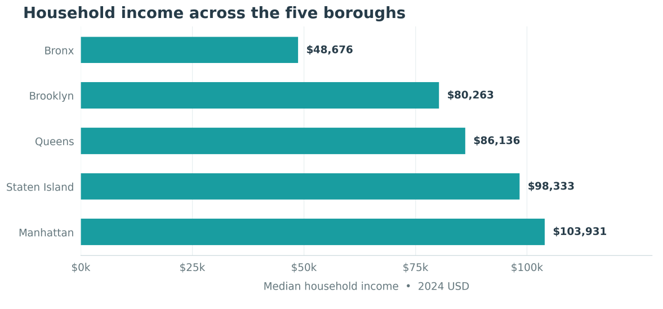
Figure 1. Median household income by New York City borough, 2020–2024 estimates in 2024 USD. Boroughs correspond to their counties. These household estimates do not measure an individual patient’s income, insurance benefits, or willingness to purchase treatment.
Sources: Census QuickFacts for Bronx County, Kings County, Queens County, Richmond County, and New York County.
Use the differences to ask better questions, not to assign a treatment preference to everyone in a borough. Insurance clarity and respectful financial explanations can matter at any income level.
Midtown and the Financial District
An office serving people near their workplace might prioritize lunchtime availability, precise building-entry instructions, and an obvious appointment-request route. Show the floor, suite, entrance photograph, and realistic walking directions from the transit stops your staff actually recommends.
This is a service-planning example, not a claim that every Manhattan patient works nearby. Interview your own patients about how they travel and when they can attend.
Flushing and Jackson Heights
For a practice serving multilingual patients, translate the essential journey: services, insurance explanation, contact options, directions, and scheduling instructions. Match the website’s language promises to staff availability. A translated page should not leave a patient expecting a language your team cannot support.
Queens County’s Census profile reports that 55.4% of residents age five and older spoke a language other than English at home in 2020–2024. That supports investigating language needs; it does not identify a particular neighborhood’s preferred language.
Have translated pages reviewed by someone who understands both the language and dental terminology. Include form instructions, validation messages, and appointment acknowledgments in that review. Test the handoff to staff as well: a useful translation should help a person complete the process, not merely reach another untranslated screen.
Park Slope and Bay Ridge
A practice seeking family appointments can explain age groups served, appointment coordination, and what parents should bring. Actual step-free access, stroller arrangements, and entrance information are more useful than an unsupported “family-friendly” slogan.
The Bronx and Staten Island
Choose travel and affordability information from real inquiries. One office may need better bus directions and plan-participation details; another may receive repeated parking questions. Verify the details instead of recycling another borough’s page.
Good dental website design turns those observations into useful content. When assessing dental website developers in New York, ask how they would research your catchment area before recommending neighborhood pages.
Assess Competition Using the Right Measures
New York’s Office of the Professions lists 6,136 registered dentists across mailing addresses in the five NYC counties as of July 1, 2026. Manhattan accounts for 2,550, Queens 1,573, Brooklyn 1,387, Staten Island 349, and the Bronx 277.
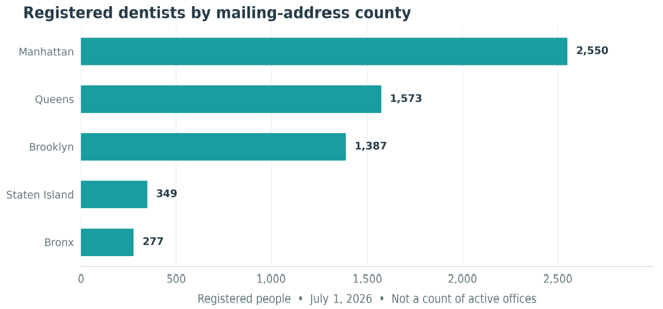
Figure 2. Registered dentist licensees by primary mailing-address county, July 1, 2026. These are people, not dental establishments. Mailing addresses may differ from practice locations, and registration does not establish active practice. Counts therefore should not be treated as a clinic census or provider-to-patient ratio.
Source: New York State Education Department dentistry license statistics.
For a useful competitive review, examine nearby practices serving comparable patients. Compare their actual service information, credentials, review handling, mobile experience, location clarity, and inquiry process. Avoid copying their wording or treating every listed dentist as a direct competitor.
Ask dental website developers in New York to document three specific gaps your website can address. “We will make it modern” is difficult to evaluate. “We will clarify plan participation and make the appointment request work on mobile” can be tested.
Build Pages Around Real Patient Questions
Your site does not need fifty thin pages to look substantial. Start with the services you actually provide, the locations patients can visit, and the questions your team answers repeatedly.
| Page or feature | Patient question | Useful content |
|---|---|---|
|
Home |
Is this practice relevant to me? |
Services, location, real team, and clear next steps |
|
Dentist profiles |
Who will provide my care? |
Verified credentials, roles, and accurate biographies |
|
Service pages |
What does this practice offer? |
Clinician-reviewed explanations and consultation process |
|
Insurance and payment |
How do I check costs and benefits? |
Current participation details and a verification route |
|
Location |
Can I get there easily? |
Entrance, suite, transport, parking, and access information |
|
New-patient page |
What happens before my visit? |
Request process, documents, and approved preparation details |
Explain the distinction between accepting an insurance plan and being in-network where applicable. Encourage benefit verification rather than promising that every procedure is covered. Identify who owns the accuracy of the insurance list and how often it is reviewed.
Service pages should be written for decisions, not merely search phrases. A cosmetic consultation page can explain the assessment process without guaranteeing results. An urgent-care page should state actual contact hours and response arrangements without promising availability the practice cannot deliver.
Useful dental website design also makes existing-patient links easy to find. Keep bill payment and patient-portal access distinct from general inquiries. Avoid directing someone seeking a receipt into a new-patient sales form.
ZH Consultancy’s website development services can support the public website’s structure and usability. Clinical statements, treatment descriptions, and professional claims should remain subject to the practice’s review and approval.
Create a small content register with a named reviewer and review date for each important page. Give insurance lists, team changes, and opening hours a faster update route than general educational material. When a clinician leaves or a service is paused, the website should change before patients discover the discrepancy at reception. This is an operational responsibility your project brief should assign explicitly.
Make Mobile Pages Fast and Accessible
A patient should be able to read your address, call the office, or start a request without closing several pop-ups. Test the actual small-screen journey, including third-party booking windows, cookie notices, maps, and error messages.
In dental website development, a fast homepage is not enough. Large before-and-after galleries or embedded scheduling tools can make important inner pages slow or difficult to use.
Google’s Core Web Vitals guidance identifies loading, interaction, and layout stability as useful measures. Its good-experience targets include LCP within 2.5 seconds, INP below 200 milliseconds, and CLS below 0.1. These are performance targets, not promises of rankings or revenue.
Compress images, reserve space for media, limit unnecessary scripts, and test representative devices. Ask for both laboratory testing and available real-user evidence; a single desktop score does not describe every patient’s experience.
Accessibility needs human testing too. Review keyboard navigation, focus indicators, heading order, contrast, image alternatives, readable text, form labels, and understandable errors. Include the external scheduler in testing.
The Justice Department’s accessibility guidance discusses businesses open to the public, including medical offices. Set a clear technical benchmark, such as WCAG 2.2 AA, with your advisers and developer; applicable legal obligations require their own assessment. An overlay or automated scan alone does not prove compliance.
Ask dental website developers in New York to demonstrate these checks on a real working page before accepting the project.
Make Patient Booking Work With Your Front Desk
A request form and a confirmed appointment are different services. If staff must approve the time, label the action “Request an appointment” and explain when and how the team responds.
Patient booking should match clinical capacity, provider schedules, appointment types, and new-patient eligibility. A beautiful calendar that offers unavailable appointments can create more work than it saves.
Before approving dental website development, test a complete request with fictional details. Check what the patient sees, where the information goes, who receives it, and what happens if the system fails.
Assign a primary and backup staff member to review requests during stated hours. Decide how duplicate submissions, unavailable times, language needs, and unanswered follow-ups are handled. A confirmation should distinguish receipt from acceptance and explain the next step. Test the process with the reception team rather than assuming a successful email notification means the appointment journey is complete.
Keep sensitive information in an appropriate workflow
For practices subject to HIPAA, identify what information the website and connected services create, receive, maintain, or transmit. Map forms, appointment tools, email notifications, chat, call recordings, analytics, and administrative access.
HHS guidance on business associates explains the contractual safeguards required when a vendor performs applicable services involving protected health information. A vendor’s marketing label is not a substitute for assessing the actual arrangement.
Collect only information needed for the initial task. Do not invite detailed symptoms, insurance documents, photographs, or medical histories into a generic form without an approved handling process. Limiting fields reduces exposure but does not automatically make appointment-related data non-sensitive.
Review tracking separately from design
The HHS tracking bulletin discusses disclosures through website technologies. Its notice also explains that a court vacated the portion treating an IP address linked to a visit to an unauthenticated health-related page as sufficient to trigger HIPAA obligations in the circumstances described.
That distinction matters. Avoid declaring all anonymous page views protected health information or assuming every public page is exempt. Assess the data and context, particularly scheduling, registration, portal, and form interactions, with appropriate privacy and legal support.
Keep advertising pixels and session-replay tools away from sensitive workflows unless their use has been specifically reviewed and approved. A cookie banner does not, by itself, establish a lawful disclosure arrangement.
When comparing dental website developers in New York, ask for a data-flow explanation in plain English. Your practice should know which organizations receive information and who is accountable for failures.
Connect Local Search With Useful Service Information
Dental SEO begins with accurate practice information and pages that answer real questions. Build clear service pages, descriptive titles, sensible internal links, crawlable navigation, and a consistent location identity.
Google’s local-ranking guidance describes relevance, distance, and prominence. A provider cannot sell control over all those factors or guarantee a particular map position.
Keep your Business Profile’s address, hours, contact details, categories, and destination pages accurate. Check the individual-practitioner rules before creating separate dentist profiles. Do not multiply listings or invent offices to occupy more search results.
For multi-location practices, give each real office its own useful page with staff, services, directions, and contact details. A page for an area you serve should not imply a staffed office there.
Effective dental SEO also requires migration discipline. Inventory existing URLs, valuable content, page titles, internal links, and important redirects before redesigning. Preserve useful URLs where possible, and monitor indexing and inquiry delivery after launch.
Ask dental website developers in New York which search assets will be preserved and which changes need approval. ZH Consultancy’s Google Business Profile services and digital marketing support may complement website work, but each activity needs a defined scope and realistic expectations.
Understand Dental Website Cost Before Comparing Quotes
Dental website cost depends on the work: locations, content, photography, design, integrations, migration, accessibility testing, privacy review, training, and ongoing support. A ten-page template project and a multi-office integration project are different purchases.
There is no single verified New York market rate that describes all of them. Ask dental website developers in New York to price the same written brief so you can compare the actual deliverables.
For published context, O360’s pricing page describes a quoted one-time design fee followed by $99 monthly, with marketing separate. The monthly figure alone is not the full project cost, a New York average, or proof that its scope matches another proposal. Verify current terms directly.
Here is a hypothetical USD allocation for a single-location project. It is a budgeting example, not a vendor quote or ZH Consultancy price list.
| One-time project work | Illustrative allocation |
|---|---|
| Discovery and requirements | $800 |
| User experience and visual design | $1,400 |
| Content adaptation and review coordination | $900 |
| CMS development | $1,800 |
| Integration and technical testing | $900 |
| Migration, training, and launch | $700 |
| Total illustrative build budget | $6,500 |
Assume another $175 monthly for hosting and maintenance, $75 monthly for scheduling, and $25 annually for a domain. Over three years, those assumed recurring charges total $9,075. Adding the build gives $15,575 before taxes, advertising, new photography, translation, and additional professional review.
Use this exercise to expose omissions. Do quoted maintenance charges include content changes, restoration, and integration troubleshooting? What happens when a paid plugin renews or the scheduling vendor changes its interface?
Compare dental website cost over the expected relationship, including exit and migration. A low initial fee can coexist with expensive renewal terms, while an expensive proposal can still omit essential work.
Compare Local Agencies Freelancers and Remote Teams
Different provider models can work. A New York agency may offer convenient in-person discovery and local coordination. A freelancer may suit a narrow project with a clearly defined brief. A healthcare specialist may bring established workflows, although claims still need verification.
A remote team may offer a different cost structure and access to several skills. Geography alone does not establish design quality, clinical understanding, response times, or security practices.
| Provider model | Potential advantage | Question to resolve |
|---|---|---|
| New York agency | Local meetings and coordination | Who performs the work and what support is included? |
| Independent freelancer | Direct access and a focused scope | Who covers absence, testing, and specialist integrations? |
| Healthcare website specialist | Familiarity with practice workflows | What is owned, portable, and verified independently? |
| Remote team | Flexible staffing and commercial options | How are communication, access, and accountability managed? |
When comparing dental website developers in New York with remote providers, use the same acceptance criteria. Request a named project owner, written milestones, a working demonstration, and a clear handover process.
ZH Consultancy is based in Pakistan and offers remote services to international clients. Its custom website development provides an option for practices comparing remote delivery with local agency proposals. Request a tailored quote and assess communication hours, quality checks, ongoing support, and total costs against the same brief.
Build public pages using fictional test data wherever possible. If any vendor would access protected health information, assess the applicable agreements, safeguards, subcontractors, and access arrangements first. HHS guidance on overseas processing emphasizes relevant contractual requirements and location-specific risk analysis. A foreign or domestic address alone does not settle the compliance question.
Choose a Platform and Keep Control of the Assets
The best platform is the one your team can maintain and your required integrations can support. In dental website development, the content-management system and the clinical scheduling system do not have to be the same product.
WordPress can support flexible content and integrations. Wix and Squarespace offer hosted approaches. A specialist platform may bundle industry features. None should be assumed suitable for sensitive workflows simply because it can display a form.
| Platform | Suitable use | Check before choosing |
|---|---|---|
| Self-hosted WordPress | Flexible services, locations, and content are priorities | Someone must manage hosting, updates, plugins, and backups |
| Wix or Squarespace | A simpler hosted public website meets the brief | Validate integration, accessibility, and export requirements |
| Dental website platform | Its included workflow fits the practice | Examine contracts, portability, and additional charges |
| Custom application | A clearly demonstrated need exceeds standard tools | Higher engineering, support, and governance demands |
Keep the domain, analytics administration, business listings, photography rights, and essential vendor accounts under practice control. Give developers appropriate delegated access rather than sharing a permanent owner login.
Check domain registration and renewal pricing, SSL, backups, recovery, support availability, and email separately. Squarespace’s hosting guidance and Wix’s SSL explanation illustrate why bundled features must be checked against specific needs.
Your dental website cost comparison should include ownership and exit terms. Record what can be exported, what requires rebuilding, and who pays for transition assistance. Arrange website maintenance before launch so responsibilities remain clear after the build ends.
Use Trust Signals That Can Be Verified
Patients should recognize the actual practice. Use current team photographs, accurate credentials, real office images, and clinician-approved service explanations. Show who reviewed important clinical content and when it was updated.
Ask dental website developers in New York how they manage approval of treatment claims, galleries, and testimonials. New York’s professional-conduct rules address misleading advertising, unsubstantiated claims, and guarantees. Have appropriate advisers assess promotions and professional wording before publication.
Obtain the necessary permission for patient images and stories. Keep consent records and establish how removal requests are handled. Do not turn a stock photograph into a supposed staff member or present a hypothetical result as a real case.
The FTC’s reviews rule guidance addresses fake reviews and incentives tied to particular sentiments. Request honest feedback without promising rewards for five-star ratings. Do not confirm treatment details in public responses to reviews.
Consistent dental website design also helps recognition. Align the logo, typography, colors, signage, and appointment communications. Relevant logo design support can help a practice clarify its identity, while a company profile is more useful for referral or corporate relationships than as a substitute for patient-facing information.
Measure Attended Appointments Rather Than Clicks Alone
Before investing, define the patient booking funnel: qualified inquiry, scheduled appointment, attended visit, and collected contribution. Avoid treating every phone tap or calendar opening as a new patient.
Here is an illustrative monthly scenario, not a New York benchmark. Both versions receive 1,200 visits. The baseline inquiry rate is 3%; the improved assumption is 4.5%. In each version, 60% of inquiries become appointments and 85% of appointments are attended.
| Monthly stage | Baseline assumption | Improved assumption |
|---|---|---|
| Website visits | 1,200 | 1,200 |
| Inquiries | 36 | 54 |
| Scheduled appointments | 21.60 | 32.40 |
| Attended appointments | 18.36 | 27.54 |
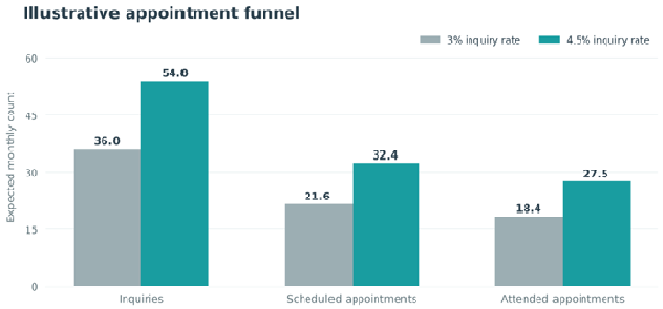
Figure 3. Illustrative monthly funnel at 1,200 visits, comparing 3% and 4.5% inquiry rates. Appointment and attendance rates remain 60% and 85%. Decimal values are expected averages across periods, not fractional patients. Stages describe the same prospects and must not be added together.
Source: Author calculations using the assumptions above. For the underlying planning approach, see the SBA financial-planning framework.
The expected difference is 9.18 attended visits monthly. If each incremental visit contributes $180 after relevant variable clinical costs and collection effects, the model produces $1,652.40 of incremental contribution. After the assumed $250 monthly website and scheduling cost, $1,402.40 remains.
Dividing a $6,500 build by that amount gives approximately 4.6 months of simple modeled payback. The calculation excludes the annual domain charge, tax, financing, ramp-up, and other changes. It is not a forecast or a guarantee; weaker conversion or limited clinical capacity can substantially change the result.
Test a less optimistic outcome too. At a 4% inquiry rate, the same traffic and downstream assumptions produce 24.48 attended visits, an increase of 6.12 over baseline. At $180 contribution each, less $250 recurring cost, the modeled monthly benefit becomes $851.60. Simple payback extends to approximately 7.6 months. If the practice cannot accommodate additional visits, even that scenario overstates the opportunity. Improving attendance or administrative efficiency may then be a better first objective than generating more inquiries.
Ask dental website developers in New York how they would measure improvement without transferring sensitive patient information into advertising systems. Keep operational reconciliation in approved systems, use aggregate reports where appropriate, and distinguish website performance from staff response speed or seasonal demand.
For paid campaigns, separate ad spending and management charges from build costs. ZH Consultancy’s Google Ads management can be scoped separately, with success tied to suitable inquiries and business outcomes rather than unsupported patient-volume promises.
Test the Provider Before Signing the Agreement
Ask shortlisted providers to walk through a realistic task: a new patient on a phone finds insurance information, checks directions, requests a visit, and receives a clear acknowledgment. Include a keyboard-only version and a failed-form test.
Professional dental website developers in New York should explain what happens after the click. Which system stores the request? Who receives it? How does staff know whether it was handled? What does the patient do if the tool is unavailable?
Request a written scope covering pages, revisions, clinical approvals, integrations, migration, accessibility testing, privacy responsibilities, training, ownership, support hours, and acceptance criteria. Identify third-party subscriptions and any limits on content updates.
Have the provider demonstrate relevant work without disclosing confidential client data. Ask what was actually built by its team and whether the examples still reflect its current process.
Agree how defects will be documented and resolved. Separate an unfinished requirement from a new feature request so the final invoice does not become a debate about scope. Tie payments to reviewable milestones, and identify the support contact, response expectations, and escalation path in the agreement. Keep approvals in writing so the practice and provider can resolve questions using the same record.
Evaluate dental SEO proposals separately from the design portfolio. Require a clear account of technical work, content responsibilities, local-profile activity, and reporting. Avoid contracts built around guaranteed rankings, unverified exclusivity, or a promise that compliance is permanently solved.
Plan a Launch Your Team Can Support
A useful delivery plan has review gates, not merely a promised launch date. The following is illustrative; content readiness and integration approvals may extend it.
| Phase | Main work | Approval needed |
|---|---|---|
| Week 1 | Discovery, inventory, patient journeys, and data mapping | Brief, scope, and responsibilities |
| Weeks 2–3 | Content structure and representative designs | Practice and clinical review |
| Weeks 4–5 | Build, integrations, and migration preparation | Working functions and access arrangements |
| Week 6 | Accessibility, device, form, and redirect testing | Documented acceptance and staff readiness |
| After launch | Monitoring, corrections, and measurement | Named maintenance and review owners |
During dental website development, keep a decision log and consolidate feedback through one practice contact. Use staging access, backups, and a rollback plan. Test DNS and email implications before changing hosting.
Ask dental website developers in New York to include staff training with real everyday tasks: changing hours, updating a biography, checking an inquiry, and escalating an outage. Confirm who can make urgent corrections when the project team is offline.
Fix Common Failures and Prepare for Change
A website can fail quietly. A broken notification may resemble a demand problem; an inaccurate insurance list may create unsuitable inquiries; a slow scheduler may appear to be poor marketing.
Investigate the cause before purchasing more traffic. Submit test requests regularly, reconcile them with approved operational records, and review the questions callers still struggle to answer online. Assign an owner to each correction and verify that the fix works.
Dental SEO needs continuing content and technical care, while patient booking needs coordination with staffing and availability. Neither stays effective simply because the site launched successfully.
AI can assist with drafting administrative copy or organizing content, but clinicians should verify treatment explanations and professional claims. Do not upload patient material to unapproved tools or fabricate testimonials, office photographs, or case results.
As search interfaces and patient expectations change, clear service descriptions, accurate location information, accessible pages, and dependable scheduling remain useful foundations. When evaluating dental website developers in New York for a long-term relationship, prioritize a process for reviewing and correcting the site over promises about the next marketing trend.
The Takeaway
Choosing dental website developers in New York is a decision about patient experience, operational reliability, ownership, and measurable value. Start with your actual patients and practice capacity, then ask providers to demonstrate how their proposal addresses the gaps.
Compare the whole relationship: build scope, ongoing costs, content accuracy, privacy responsibilities, support, and a workable exit. A website earns its place when patients understand what to do and your team can deliver the next step consistently.
Faq
Frequently Asked Questions
Dental website cost depends on scope and ongoing services. This guide models a $6,500 build and $15,575 over three years, including assumed recurring charges. These are planning figures, not local averages or ZH Consultancy rates. Obtain comparable written quotes for your requirements.
Not necessarily. Compare dental website developers in New York with remote teams using the same requirements for communication, ownership, testing, and support. Local access can help coordination; remote delivery can suit a well-managed brief. Verify any arrangements involving sensitive data before granting access.
Assess the actual information and services involved. For a HIPAA-covered practice, vendors handling protected health information may require appropriate agreements and safeguards. A public information page and a clinical intake workflow create different requirements. SSL alone does not establish HIPAA compliance.
Careful migration can reduce avoidable disruption, but no provider can guarantee unchanged rankings. Preserve useful URLs, map necessary redirects, retain valuable content, and check indexing after launch. Dental SEO should include migration planning rather than begin only when traffic has already fallen.
Choose according to content needs, integrations, ownership, and available support. WordPress, hosted builders, and specialist platforms can each fit particular briefs. Dental website development should validate the complete workflow, including third-party scheduling, instead of assuming the platform name settles the decision.
Offer the process your team can reliably manage. Direct confirmation needs accurate availability and appropriate system controls. If staff approval is required, present a request process with clear response expectations. Keep an accessible telephone alternative and test failure handling.
Use verified credentials, real team and office photographs, accurate insurance information, and clinician-reviewed content. Obtain appropriate permission for patient material. Consistent dental website design helps recognition, but genuine information and dependable follow-through do more than decorative badges or unsupported claims.

Zain Hameed
Business strategy specialist helping a global client base of 800+ businesses build credible plans, financial models and investor-ready presentations.
In this article
Book a Free Consultation
Have a business idea, growth challenge or investor deadline? Book a free consultation and get clear next steps from our team.
Call our team
+923104049517
Email us

Business Topics
Business topics
Continue reading
Related insights

How to Start an Electrical Business
Learn how to start an electrical business in the U.S., with

How to Start a Junk Removal Business
Learn how to start a junk removal business with U.S. startup

How to Start a Lash Business and Build a Loyal Client Base
Learn how to start a lash business in the U.S., compare

How to Start a Mobile Drug Testing Business
Learn how to start a mobile drug testing business in the

How to Start a Pest Control Business in the United States
Learn how to start a pest control business in the U.S.

How to Start a Pool Cleaning Business With Costs and a Launch Plan
Learn how to start a pool cleaning business, estimate startup costs,