

In this article
Your phone rings while you are finishing a service call. A property manager needs an electrician who actually returns messages, documents repairs, and turns up when promised. You know you could do the work. You also know your employer currently handles the quoting, insurance, scheduling, and uncomfortable conversations about unpaid invoices.
That is the gap you must close when learning how to start an electrical business. Technical ability earns trust on site; a workable commercial system keeps the company alive between jobs.
This U.S. guide connects licensing, startup investment, safe operations, pricing, and customer acquisition. The goal is a company that pays for your labor, meets its obligations, and has cash left to improve.
How to Start an Electrical Business With a Focused Service Model
An electrical contractor installs, maintains, tests, or repairs electrical systems within its authorized scope. Customers pay for skilled labor, materials, diagnosis, coordination, and a properly completed job. Selling equipment alone is a different business model.
Residential service work can offer relatively short jobs and faster payment. Remodels require coordination with homeowners and other trades. Commercial maintenance can produce repeat relationships, while construction subcontracting usually demands more estimating, documentation, and working capital. EV charging, solar connections, and industrial controls require suitable competence and any additional approvals.
Choose one principal customer and a manageable service radius. A contractor serving apartment managers might prioritize scheduled appointments, tenant access, and clear work orders. A homeowner specialist might prioritize diagnostic visits and smaller installations.
Your electrical business plan should explain what you will decline, too. A job outside your competence, capacity, or electrical contractor license scope is an expensive way to discover your limits. Start with a repeatable offer that your qualifications and resources can support.
If you are exploring how to start an electrical business while employed, check employment restrictions, conflicts, and insurance before taking outside work. Do not use your employer’s customer list, materials, or equipment without authorization. Offer appointment windows you can actually honor; a part-time launch still creates full responsibility for the jobs you accept.
Understand Demand Without Confusing It With Guaranteed Revenue
The U.S. Census Bureau’s 2022 Economic Census reports 78,975 firms and 81,249 establishments in NAICS 238210. This category includes electrical contractors and other wiring installers; establishments are operating locations, not individual electricians or a complete count of every solo operator.
The Bureau of Labor Statistics reports about 821,000 electrician jobs in 2025 and projects 9% employment growth during 2025–2035. Its estimate of 72,700 annual openings includes replacement hiring. These figures describe workers, not business revenue or new customer leads.
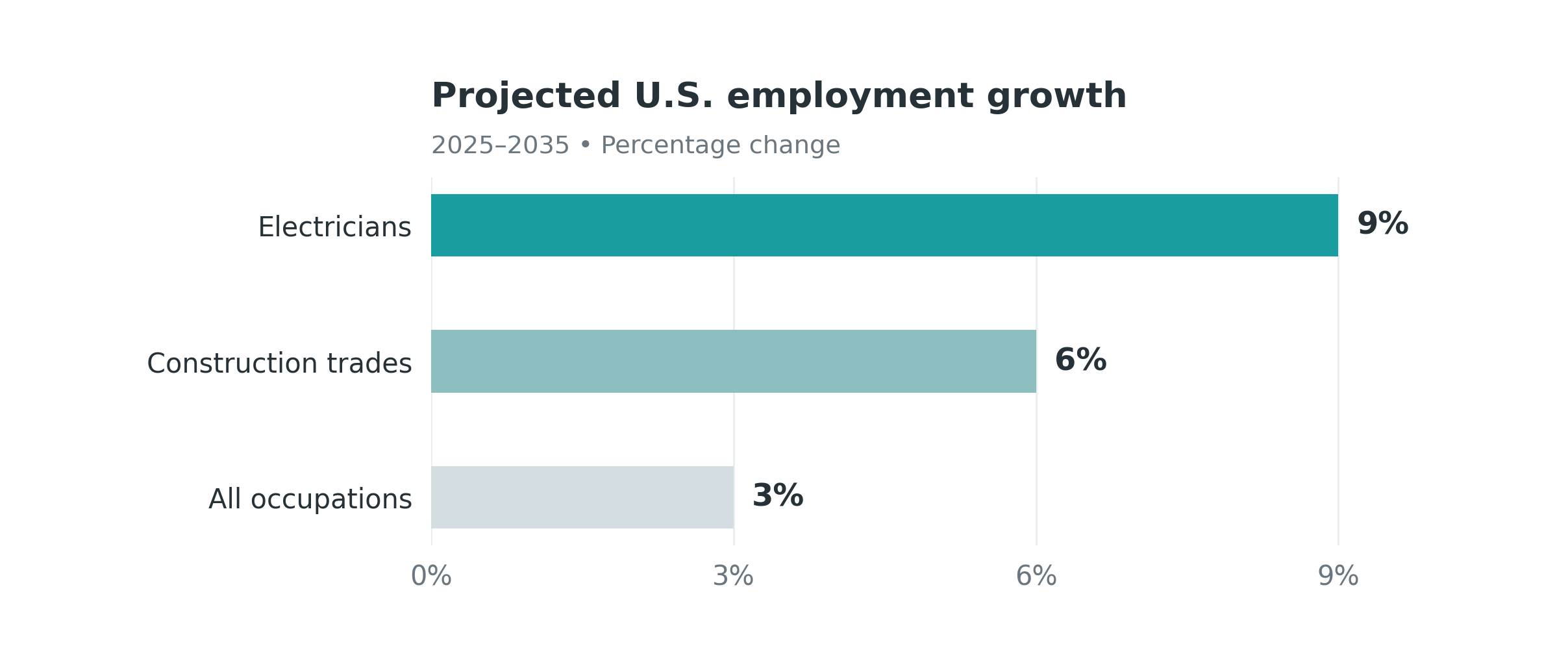
Chart 1. U.S. projected employment growth, 2025–2035: electricians 9%, construction trades 6%, all occupations 3%. Rounded national projections are not local sales forecasts.
Source: BLS Occupational Outlook Handbook.
For global context, The Business Research Company estimates electrical services revenue at $264.36 billion in 2025 and $280.50 billion in 2026, forecasting $358.71 billion for 2030. This broad commercial estimate spans residential, commercial, and industrial services; it is not the size of the U.S. residential repair market.
If you are researching how to start an electrical business, investigate your actual territory. Review building permits, competing service areas, housing conditions, and property-manager requirements. Interview potential buyers about delays and unmet needs. Market research support can help test whether an apparent gap represents paying demand rather than wishful thinking.
Weigh the Pros and Cons Before Committing
The attraction is understandable: useful skills, visible customer problems, and opportunities for repeat work. The difficulty is that demand arrives unevenly, while insurance, vehicles, and payroll still need paying.
Advantage | Corresponding business challenge |
|---|---|
Repairs and maintenance can create repeat relationships | Customers still compare providers and expect reliable response |
A focused operator can begin without a large office | Vehicles, testing equipment, authorization, and reserves still cost money |
Specialized services can strengthen positioning | Training, supervision, and liability increase with complexity |
Employees can expand delivery capacity | Payroll, management, and cash collection become harder |
Self-employment also changes your working week. Estimates, ordering, records, and callbacks consume time that once belonged to evenings or weekends. Price that time into the operation. A full diary that produces no owner compensation is a demanding hobby with a service van.
How to Start an Electrical Business on a Realistic Budget
There is no useful universal answer to how to start an electrical business on a particular budget. Your existing tools, vehicle, qualifications, customer type, and payment terms determine the funding requirement.
The following electrical business startup costs are illustrative U.S. planning allowances in USD as of November 2026, not market averages or supplier quotations. They assume an owner who already meets the trade qualification requirements. They exclude apprenticeship years, employee payroll, leased premises, and large construction-project material advances.
Use of launch cash | Lean owner operator | Equipped service van |
|---|---|---|
Formation, applications, exams, professional setup | $1,500 | $2,500 |
Tools, test equipment, PPE, ladders | $4,500 | $8,000 |
Vehicle purchase or initial preparation | $1,500 | $25,000 |
Initial insurance and bond premiums | $2,000 | $3,500 |
Opening materials and consumables | $1,500 | $3,000 |
Logo, vehicle lettering, cards, website build | $1,500 | $3,000 |
First year domain, hosting, software setup | $500 | $1,000 |
Initial customer acquisition | $1,000 | $2,000 |
Working capital | $8,000 | $12,000 |
Emergency reserve | $2,000 | $4,000 |
Total launch funding | $24,000 | $64,000 |
The lean scenario assumes you already own a suitable vehicle. Its $1,500 allowance is preparation, not a purchase budget. The equipped scenario assumes a $25,000 vehicle cash purchase; financing changes cash timing and creates recurring payments.
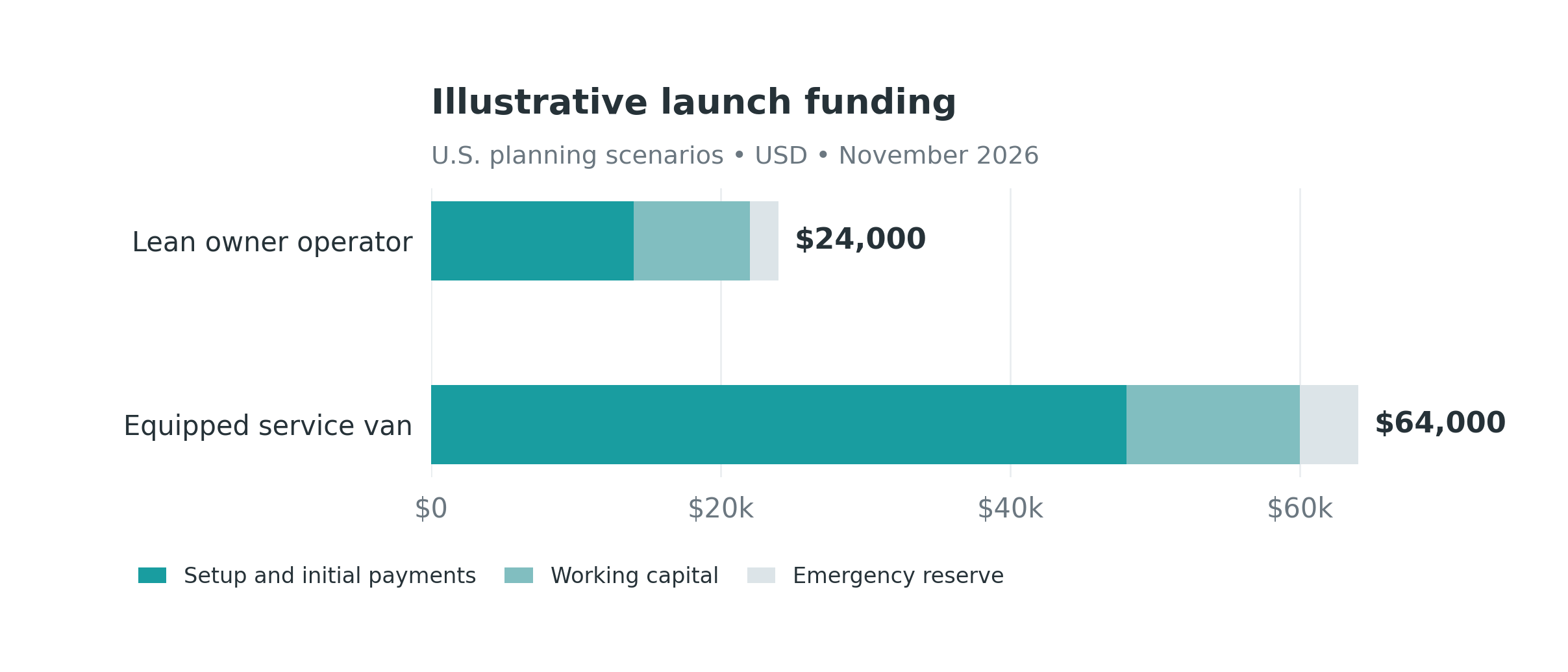
Chart 2. Illustrative U.S. launch funding in USD, November 2026: $24,000 versus $64,000. Working capital and reserves are cash balances, not immediate expenses. Figures exclude personal living reserves and the exclusions stated above.
Source: ZH Consultancy illustrative calculations using the table above; budgeting method informed by the SBA startup cost guide.
Separate one-time setup from recurring fuel, software, insurance, maintenance, storage, accounting, and marketing. Obtain electrical contractor insurance quotations before committing. Add household living reserves separately, and adjust electrical business startup costs after obtaining local prices. Your electrical business plan should show when each payment leaves the bank, including annual renewals.
Size working capital from the cash forecast rather than copying the table. If a hypothetical commercial job requires $6,000 of materials before work starts and payment arrives a month after completion, that cash stays committed throughout the purchasing and delivery period. Add the bills due while you wait, then account for lawful customer deposits and supplier credit. Several overlapping projects can exceed the illustrated reserve even when every job is profitable on paper.
Write an Electrical Business Plan That Guides Decisions
A useful electrical business plan connects the work you can sell with the capacity and cash needed to deliver it. It should answer why customers will choose you, how jobs will be completed, and what happens if sales arrive slowly.
Start with an executive summary and a specific concept: for example, residential service and small installations within a compact territory. Define customer profiles, competitors, service exclusions, your selling proposition, and realistic pricing assumptions. Interview buyers rather than assuming everyone wants the cheapest electrician.
Translate that positioning into an operating model. Identify who answers calls, prepares estimates, performs authorized work, orders materials, checks quality, and collects payment. Explain when you would hire, what supervision is required, and how you would cover illness or vehicle downtime.
Build monthly revenue projections from completed jobs and average invoice value. Then forecast direct costs, overhead, owner compensation, profit and loss, cash flow, and break-even. A capacity check should limit sales to the hours genuinely available after travel and administration.
For a hypothetical owner operator, a milestone might be 40 completed service jobs in month three, with accurate job records and a workable collection process. That is a planning target, not a prediction. Test a slower case with fewer bookings, delayed payments, and one major repair bill.
Keep a rolling 13-week cash forecast alongside the annual model. Review cash, outstanding invoices, quoted work, and capacity every week. Revise assumptions when evidence changes.
Define approval gates for expansion. Before hiring, compare the fully loaded employment cost with reliable additional contribution, not unsigned estimates. Before accepting a large contract, check who approves variations, when invoices become payable, and how a schedule change affects your other customers. Set a limit on dependence on any single buyer. That keeps a promising account from quietly controlling your entire cash flow.
An electrical business plan prepared for a lender also needs a funding request, repayment logic, and evidence supporting assumptions. ZH Consultancy’s business plan writing services and financial modeling services can help connect those documents. The founder still needs to validate the licensing path and local demand.
How to Start an Electrical Business Within the Law
Business registration does not authorize electrical contracting. Separate ownership, company authorization, the qualifying individual, and the credentials required for people performing the work.
Confirm the licensing route in your jurisdiction
Texas requires an applicant to employ a licensed master electrician, who may also own the business. Its contractor application guidance specifies liability minimums of $300,000 per occurrence, $600,000 aggregate, and $300,000 aggregate for products and completed operations. Those are Texas requirements, not nationwide coverage recommendations.
California uses the C-10 classification. Its electrical contractor license qualification process generally requires four years of qualifying experience, with permitted education credits and documentation rules explained by CSLB. A contractor bond of $25,000 is required for an active license. The bond amount is the coverage obligation, not necessarily the premium you pay. Other bonds or entity-specific conditions may apply.
Before applying for an electrical contractor license, obtain a written checklist from the relevant board and local building authority. Confirm worker credentials, experience verification, exams, qualifying supervision, renewals, permits, inspections, and the locally adopted code edition and amendments. Do not assume reciprocity allows immediate work across a state line.
Establish the company and tax records
Compare a sole proprietorship with an LLC or corporation using the SBA business structure guidance. An LLC does not erase responsibility for your own negligent work. Discuss liability, tax treatment, and payroll with qualified advisers.
Register the entity and any required trade name, obtain an EIN when required through the IRS, and open a separate bank account. IRS EIN applications are free. Have an accountant confirm estimated taxes, employment obligations, worker classification, and how your state treats materials and installation labor for sales tax.
Arrange electrical contractor insurance and contracts
Electrical contractor insurance should match your actual work. Discuss general liability and completed operations, commercial auto, tools coverage, workers’ compensation obligations, and any project-required umbrella or professional coverage with a licensed broker. Explain subcontracting, EV work, and exclusions before binding coverage.
Have a local attorney review scopes, payment terms, lawful deposits, cancellations, changes, warranties, and dispute procedures. Licensing, consumer contracts, tax, and insurance rules differ by state and activity. Recheck them before accepting a new work category.
Set Up Equipment and Operations Around Safe Delivery
Buy for your chosen work: appropriate test instruments, insulated tools, PPE, access equipment, organized vehicle storage, and standard consumables. Select equipment with suitable ratings and maintain inspection or calibration records where required. Rent occasional specialist equipment until utilization justifies ownership.
Compare suppliers on availability, returns, approved products, delivery, credit terms, and warranty support. A lower purchase price disappears quickly if an unsuitable component creates a second visit. Track frequently used stock and reorder levels without filling the van with slow-moving inventory.
Anyone learning how to start an electrical business needs an operating procedure before the first booking. Capture the customer’s problem, address, authorization, access arrangements, proposed scope, and permit responsibility. Follow the job through estimate approval, scheduling, materials, site assessment, completion records, inspection closeout, invoice, and follow-up.
Use OSHA’s electrical contractor standards to identify requirements applicable to construction or maintenance work. Establish competent supervision, hazard assessment, training, protective equipment, and hazardous-energy controls. Schedule safe isolation and verification rather than letting a customer deadline dictate the method. A generic checklist cannot replace task-specific procedures and qualified judgment.
Set rules for dispatch: leave travel and emergency capacity, group nearby calls, and confirm availability before promising appointments. A system such as Jobber’s electrical contractor software can connect requests, estimates, and invoices; test the workflow before subscribing.
Back up customer records and restrict staff access. Keep inspection results, photographs with permission, product details, and change approvals under a consistent job number. Confirm that your electrical contractor insurance covers the services and personnel being dispatched. A backup supplier, vehicle arrangement, and qualified coverage contact can prevent one disruption from canceling an entire week.
When recruiting, verify the worker’s authorization and practical competence for the assigned tasks. Define apprentice supervision, site responsibilities, and who signs completion records. Budget wages, employer taxes, benefits, training, and paid nonproductive time. Calling someone a subcontractor does not by itself establish that classification; obtain advice before choosing a payroll arrangement simply because it appears cheaper.
Price Jobs to Pay for Labor and Produce a Surplus
The financial question behind how to start an electrical business is simple: what must each job contribute after its direct costs?
Use a stated diagnostic or minimum service fee for small visits, time and materials when uncertainty makes that appropriate, or a fixed quotation when scope can be defined. Explain what the customer receives, what is excluded, and how additional work is approved. Do not guess a fixed price for an unknown fault without managing that uncertainty.
A worked service job example
Assume a hypothetical service job sells for $450 before sales tax. Direct costs are $100 of materials, two owner job hours including travel valued at $40 per hour, and $20 of vehicle running costs, processing, and consumables. Total direct cost is $200; contribution toward overhead and surplus is $250, or 55.6% of sales.
Now assume monthly overhead of $4,000. This includes $1,200 for owner administration and $2,800 for insurance, fixed vehicle costs, software, accounting, marketing, and other overhead. Direct owner labor remains in job costs. Do not count the same expense twice.
Monthly result | 12 jobs | 16 jobs | 40 jobs |
|---|---|---|---|
Revenue at $450 per job | $5,400 | $7,200 | $18,000 |
Direct costs at $200 per job | $2,400 | $3,200 | $8,000 |
Contribution | $3,000 | $4,000 | $10,000 |
Monthly overhead | $4,000 | $4,000 | $4,000 |
Modeled operating surplus or loss | −$1,000 | $0 | $6,000 |
Break-even is $4,000 divided by $250, or 16 jobs monthly. At 40 jobs, the model allocates $3,200 to owner job labor plus $1,200 to administration, before the $6,000 surplus. Owner compensation and business surplus are separate economic measures; legal accounting treatment depends on the entity.
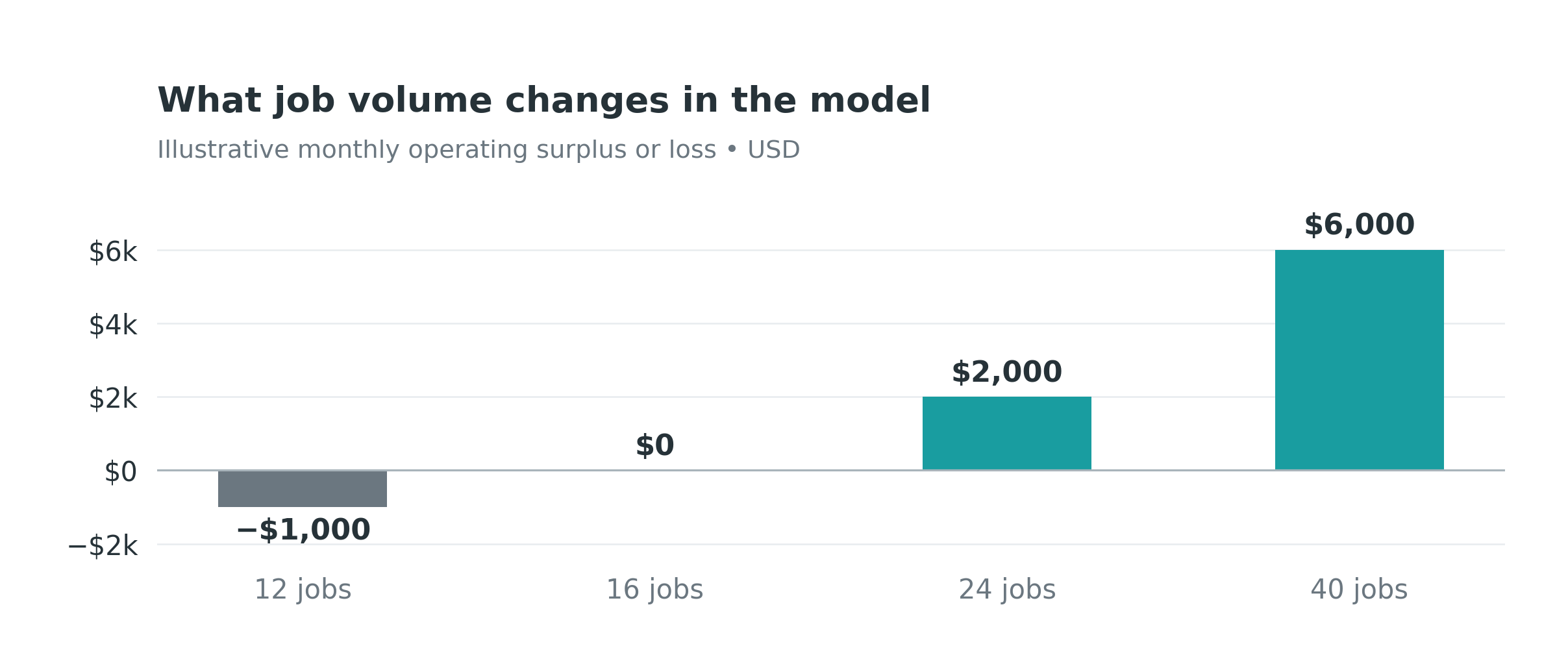
Chart 3. Illustrative monthly operating surplus or loss in USD at 12, 16, 24, and 40 jobs: −$1,000, $0, $2,000, and $6,000. Fixed assumptions are $450 revenue, $200 direct cost per job, and $4,000 monthly overhead.
Source: ZH Consultancy illustrative model above; break-even method described by the SBA.
These are planning calculations, not earnings forecasts. Tax, debt principal, additional equipment purchases, and payment timing affect cash available. An extra unbilled labor hour costs $40 under these assumptions. Startup funding is separate: do not treat electrical business startup costs as though customer revenue instantly reimburses them.
Check actual hours against estimates every week. A 25% markup on $200 of direct cost produces a $250 selling price and a 20% contribution margin before overhead. Long projects also require progress billing, material purchasing plans, and attention to retainage and collection risk. Agree lawful terms before financing the customer’s project yourself.
When deciding how to start an electrical business, test capacity as seriously as price. Forty jobs at two delivery hours require 80 hours before the separately allowed administration. If actual delivery averages three hours, the same calendar and labor allowance no longer work. Change the schedule, price, or service mix instead of assuming enthusiasm will create extra hours.
Choose a Name and Brand Customers Can Recognize
Select a name that is easy to say, spell, and read on a moving vehicle. Check state business records, local trade-name rules, trademark conflicts, domains, and social handles. Entity-name approval alone is not trademark clearance.
Define a specific promise, such as clear residential service appointments and documented repairs. Build consistent colors, typography, uniforms, estimates, and invoices around it. A logo must remain legible on a card and van door; complicated electrical illustrations usually add little.
If you need help, logo design services can create adaptable files and usage rules. Include required license information on advertising and documents according to your jurisdiction, and use only credentials you actually hold.
Prepare Marketing Materials for the Buyers You Want
A homeowner may need a clear estimate and trustworthy website. A property manager may also request a capability statement, insurance certificate, service coverage, references, and an onboarding form. Match the material to the decision.
For commercial outreach, prepare a concise company profile, proposal template, service brochure, and sample maintenance report. Use real project photographs with permission and factual case studies; never invent completed projects.
Well-targeted electrical business marketing can begin with a one-page PDF rather than a costly presentation. Company profile design becomes useful when a consistent, credible introduction supports repeated tender or facilities-management conversations.
How to Start an Electrical Business With a Website That Converts
A customer on a phone needs to know whether you cover their address, handle their problem, and can be contacted now. Put those answers before decorative animations.
Create distinct pages for genuine services and service areas, supported by accurate license details, team information, permitted project photographs, testimonials, and clear contact options. Explain diagnostic charges or the estimating process without implying every job can be priced online. Only advertise emergency availability you can reliably provide.
Use a short form asking for location, problem, contact details, and preferred timing. Allow a photo upload when useful, but do not encourage customers to open electrical equipment. Distinguish requesting an appointment from a confirmed dispatch. Use a secure payment provider for permitted deposits or invoices rather than collecting card information by email.
Choose a platform that fits the operation
Platform | Suitable use | Check before choosing |
|---|---|---|
WordPress | Flexible service pages, content, and integrations | Hosting, updates, security, and extension maintenance |
Wix | A relatively simple site with online requests or appointments | Required plan, booking features, and portability |
Squarespace | A small service site with polished templates | Scheduling subscription and integration costs |
Shopify | A business also selling equipment online | Whether commerce features justify the service-site overhead |
Field-service booking system | Requests linked to estimates and dispatch | Service radius, buffers, approvals, and customer data export |
Compare official Wix Bookings, Squarespace scheduling, and Shopify commerce features against your workflow. These are suitability judgments, not performance rankings.
Keep ownership and ongoing costs clear
Buy the domain through your own account, enable renewal reminders and multifactor authentication, and retain administrator access. A developer should not become the only person who can renew your business identity.
The following USD offers were checked on November 4, 2026; taxes, domain renewals, and extras may apply. Confirm the checkout terms.
Hosting example | Introductory commitment | Published renewal |
|---|---|---|
Hostinger Premium | $1.99/month equivalent; $95.52 prepaid for 48 months | $10.99/month for the same term |
SiteGround StartUp | $3.99/month; prepaid for 12 months | $17.99/month |
Sources: Hostinger and SiteGround. Compare backup frequency, restore access, SSL, support, storage, and upgrade options. Introductory rates are not the long-term budget.
Test speed and usability on real phones, keyboard navigation, readable contrast, labeled forms, successful inquiries, and analytics. Assign responsibility for updates, backups, security, and recovery. Website maintenance services should have a defined scope.
A local agency may offer easier in-person coordination; a freelancer may offer direct access; a remote team may provide a different cost structure. Compare delivery responsibilities, revisions, ownership, and ongoing support. ZH Consultancy provides Pakistan-based website development services for international clients, with scope and pricing agreed for each project.
Build Electrical Business Marketing Around Completed Jobs
Start electrical business marketing where buyer intent is strongest: people with a relevant problem in your actual service area. Create an eligible Google Business Profile with accurate services and hours. Google’s guidelines say service-area businesses should hide their address when they do not receive customers there. Do not use a borrowed office to manufacture a location.
Google Business Profile support can help organize the listing. Your website should explain real service coverage and answer customer questions. Publish useful project explanations and request honest reviews after completed work without conditioning the request on a positive rating.
Build referral relationships with property managers, remodelers, HVAC firms, and other complementary businesses. Offer clear response arrangements and documentation. Share useful completed-work examples on Facebook or Instagram; a relevant local audience matters more than follower count. Use permission-based email for maintenance reminders and follow-up.
For paid search, begin with a controlled geographic area and a service you can deliver profitably. Track qualified calls and form inquiries through to completed, collected jobs. Google Ads management is useful only when targeting and measurement match the operation.
An illustrative $600 campaign generating 20 qualified leads and eight new paying customers has a $30 cost per lead, 40% lead-to-customer conversion, and $75 advertising cost per acquired customer. That excludes agency fees and other sales costs. Do not count inquiries as customers or unpaid invoices as collected revenue.
Measure electrical business marketing by acquisition cost, contribution after acquisition, response time, repeat bookings, and customer retention. Compare results by channel. Digital marketing services should make those outcomes visible rather than report impressions alone.
Set a response standard during business hours and arrange coverage when you cannot answer. Record the requested service, source, estimate outcome, and reason for losing work. If inquiries are suitable but estimates rarely convert, investigate response delays, scope clarity, and trust before buying more traffic. More leads merely amplify a weak follow-up process.
Solve the Problems That Quietly Erode Profit
Quotes win but margins disappear
If estimates miss travel, access delays, testing, or return visits, the cause is incomplete job data. The consequence is unbilled labor. Compare estimated and actual time, revise standard allowances, and confirm uncertain conditions before agreeing scope. Better records improve the next quotation.
Work is completed but cash is missing
Slow invoicing and weak payment terms create a funding gap. Invoice promptly, obtain change approvals, review receivables weekly, and agree lawful staged payments for larger work. The expected benefit is less cash trapped in completed projects.
One incident threatens the whole operation
Poor documentation, unsuitable electrical contractor insurance, or a rushed safety decision can create costly disputes. Review coverage as services change, maintain records, and give qualified staff authority to stop unsafe work. Prevention is cheaper than relying on a policy to repair every mistake.
Knowing how to start an electrical business includes deciding who owns each correction. Assign a person, deadline, and measurable result, such as fewer callbacks or faster invoicing. Otherwise the same problem simply receives a different explanation next month.
Avoid the Startup Mistakes That Are Hard to Reverse
Founders investigating how to start an electrical business often spend too early on the visible pieces. Buying a larger van or specialist equipment before validating demand makes a quiet month more expensive. Rent, stage purchases, and review utilization first.
Do not assume a worker credential replaces an electrical contractor license. Verify the company authorization before advertising or contracting, including any local registration rules.
Underestimating electrical business startup costs usually means forgetting reserves, renewals, or slow collections. Maintain a cash forecast and separate household needs from company funds.
Avoid relying on one builder, one employee, or one advertising channel. Electrical business marketing needs continuity even during busy weeks. Keep customer relationships and operating records accessible to the company, and hire only when workload, supervision, and funding justify it.
Prepare for Electrification and More Demanding Customers
The IEA’s Electricity 2026 outlook forecasts average global electricity demand growth of 3.6% annually during 2026–2030. Electricity consumption is not contractor revenue, but electrification supports a reason to investigate upgrades, charging, controls, and maintenance in suitable local markets.
Growth still depends on training, supplier support, permits, utility capacity, and customer budgets. Check current incentive rules before mentioning subsidies; do not build a sales promise around an unverified credit.
Use automation for appointment reminders, document organization, and draft communications. Human review remains necessary for quotations and technical decisions. Avoid sending customer addresses or site photographs into unapproved AI tools.
Expand when a service is repeatable and cash collection works. Recurring commercial maintenance can be attractive, provided scope, inspection responsibilities, and response commitments are explicit.
Turn the First 90 Days Into Evidence
This schedule is for someone already qualified, or organizing a legally compliant qualifying arrangement. It cannot replace years of required experience or guarantee approval dates. If authorization takes longer, move customer delivery accordingly.
Period | Main work | Evidence before moving forward |
|---|---|---|
Days 1–15 | Interview buyers and compare competitors | Defined customer, territory, and service gap |
Days 16–30 | Verify licensing, plan funding, begin applications | Documented authorization path and cash forecast |
Days 31–45 | Arrange insurance, suppliers, tools, and procedures | Readiness review; no unauthorized trading |
Days 46–60 | Complete branding, website, forms, and estimates | Tested inquiry and job-record workflow |
Days 61–75 | Build partnerships and prepare launch campaigns | Qualified pipeline; approvals checked |
Days 76–90 | Deliver authorized work and review results | Actual time, margin, callbacks, and collections |
The practical test of how to start an electrical business is whether these milestones produce evidence. Delay a launch if authorization or safe delivery is unresolved. Update electrical business startup costs when supplier quotes and insurance terms become concrete.
The Takeaway
Learning how to start an electrical business means turning trade competence into dependable delivery and sound economics. Choose a focused customer, confirm authorization, protect working capital, and price the time you actually spend.
Keep your electrical business plan close to the booking calendar and bank balance. Early proof is a properly completed job that pays for labor, overhead, and the next day’s operation. If you need help connecting research, forecasts, branding, and the website, ZH Consultancy can support those commercial foundations while you retain responsibility for technical and regulatory decisions.
Faq
Frequently Asked Questions
Illustrative electrical business startup costs in this guide are $24,000 for a qualified owner with a suitable vehicle and $64,000 for an equipped service-van scenario. They are planning examples, not minimums or averages. Replace every allowance with quotations and add personal living reserves, training, staffing, premises, or project funding where needed.
Sometimes, subject to the jurisdiction’s ownership and qualifying-person rules. Texas, for example, requires the company to employ a licensed master electrician, who may also be the owner. Ownership does not authorize an unqualified person to perform regulated electrical work. Confirm the arrangement with the licensing authority.
Requirements differ. An electrical contractor license and an individual master or journey-level credential serve different purposes. Some jurisdictions require a qualifying master; others use different contractor classifications and experience rules. Ask the relevant board which credentials the business, qualifying person, and workers must hold.
Electrical contractor insurance commonly involves liability, completed operations, commercial auto, and tools protection, with workers’ compensation obligations depending on local rules and circumstances. Contracts may require additional limits or endorsements. A licensed broker should review your exact activities, staffing, exclusions, and applicable minimums before work begins.
Profit depends on pricing, utilization, rework, overhead, and collections. The hypothetical 40-job example produces $18,000 revenue and $6,000 operating surplus after modeled direct costs, overhead, and owner labor allowances. It is not an earnings promise and does not show cash available after tax, financing, or additional investment.
Start electrical business marketing with a credible local profile, useful service pages, referral partners, and prompt responses. Track which inquiries become suitable, paid jobs. A small measured advertising test is more informative than committing a large budget before your phone handling, estimating, and follow-up process works.
If you already meet qualifications, the administrative and commercial setup may fit a 90-day plan, but approvals can take longer. If you are learning how to start an electrical business without the required experience, allow for the full training and qualification pathway. A launch timetable never overrides licensing or safe staffing requirements.

Zain Hameed
Business strategy specialist helping a global client base of 800+ businesses build credible plans, financial models and investor-ready presentations.
In this article
Book a Free Consultation
Have a business idea, growth challenge or investor deadline? Book a free consultation and get clear next steps from our team.
Call our team
+923104049517
Email us
info@zhconsultancy.com

Business Topics
Business topics
Continue reading
Related insights

How to Start a Laundromat Business: A Complete U.S. Founder’s Guide
Learn how to start a laundromat business in the USA: market

How to Start a Construction Business in the USA
A homeowner wants to sign a $75,000 remodeling contract on Friday.

How to Start a Plumbing Business in the USA
At 7:15 on Monday morning, a homeowner calls about water coming

How to Start a Car Rental Business in the USA: A Founder’s Practical Guide
A family lands after midnight. They do not care whether your

How to Start a Landscaping Business: Costs, Licenses, Marketing and Profit
Picture two lawns on the same street. One homeowner wants a

How to Start a Cafe Business in the USA: Costs, Licenses, Marketing and Profit
You’re standing inside an empty storefront, and you can already picture