

In this article
Your first week looks promising. Clients love their lashes, your photos look polished, and appointments are appearing on the calendar.
Then a two-hour set takes three hours. Someone cancels after you have turned another client away. Rent is due, and the money in your payment app suddenly looks less impressive.
The hard part is making beautiful work support a dependable business.
If you are researching how to start a lash business, begin with the decisions that protect your time and cash: what you will offer, where you can legally work, and what each appointment must earn. This U.S. guide connects licensing, operations, branding, websites, and customer acquisition to those decisions.
You will also see illustrative lash business startup costs and a worked financial model. The examples are planning tools, not market averages or earnings promises. A profitable-looking calendar still needs room for cleaning, communication, and the occasional lunch.
How to Start a Lash Business With the Right Model
A service-led eyelash extension business earns money from initial sets, maintenance fills, removals, and suitable retail aftercare. Clients buy a result, but they also buy confidence in your judgment and consistency.
Start with a narrow offer. Natural-looking classic sets for working professionals create a different schedule and portfolio from dramatic volume work for event clients. Add techniques only when your training, license, and insurance cover them.
An approved home studio can reduce overhead, but zoning, privacy, household separation, and establishment rules may limit it. Renting a room or suite offers separation without taking on an entire salon. A storefront adds visibility and capacity alongside deposits, fit-out costs, staffing, and a longer commitment.
Selling strip lashes online is another model entirely. Its economics revolve around inventory, shipping, returns, and product compliance. Private-label adhesives add responsibilities beyond providing a treatment. Avoid launching a service studio and a cosmetics brand simultaneously unless each has its own funding and operating plan.
Your first decision about how to start a lash business should therefore be specific: one customer group, a small service menu, and a premises model you can afford while bookings develop.
Market Demand and the Opportunity Near You
Grand View Research’s June 2026 report estimates the global false eyelashes product market at $2.0 billion in 2025, estimates $2.1 billion for 2026, and forecasts $3.4 billion by 2033. North America represented 36.3% of estimated 2025 revenue.
That category includes strips, clusters, and individual lashes. It is not the size of the U.S. lash salon services market.
For broader U.S. employment context, the Bureau of Labor Statistics projects skincare specialist employment to grow 9% from 2025 to 2035. That occupation also includes services beyond lashes. Neither source proves that your neighborhood needs another studio.
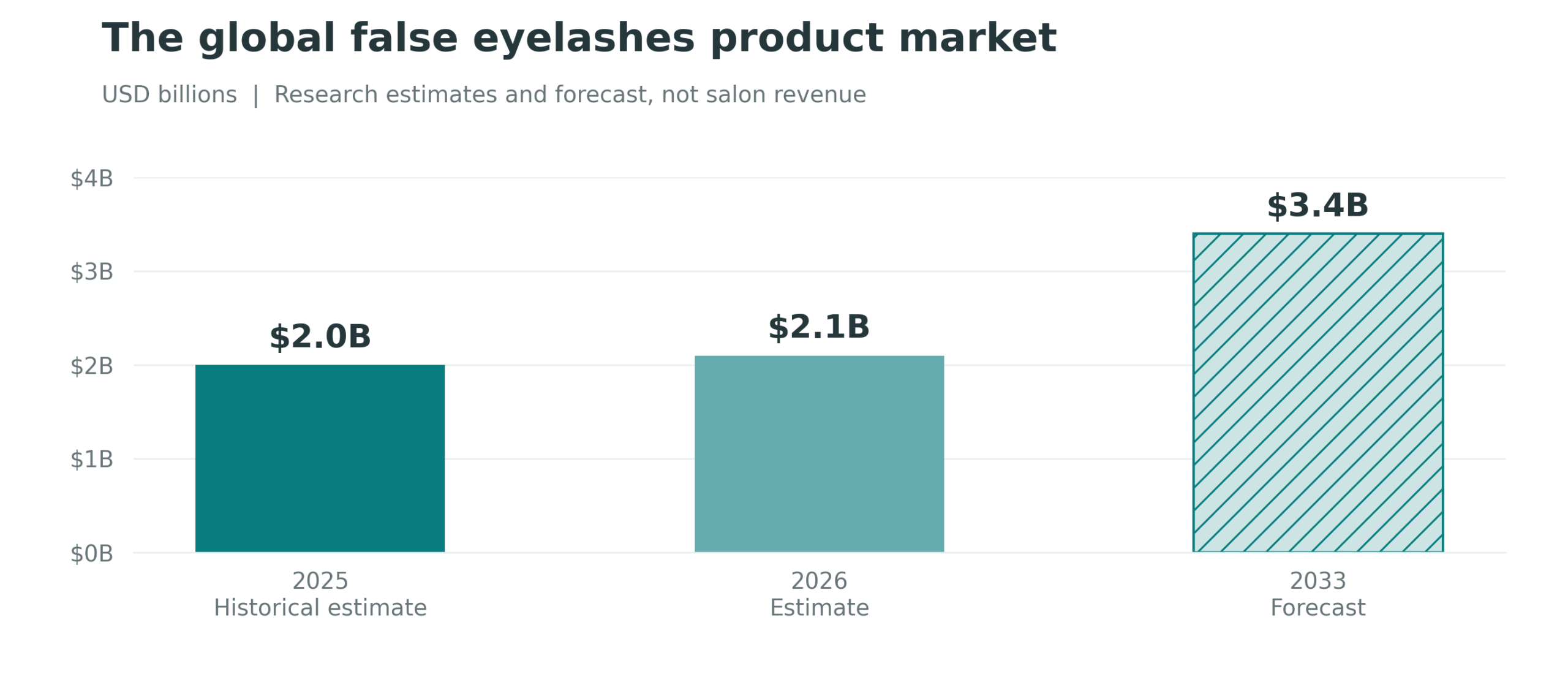
Global false eyelashes products, USD billions: 2025 historical estimate, 2026 estimate, and 2033 forecast. These are rounded research estimates, not salon revenue or a local demand forecast.
Source: Grand View Research, June 2026 market report.
Before deciding how to start a lash business locally, compare ten nearby providers. Record advertised prices, service duration, available appointments, review themes, parking, and booking friction. Availability is a clue, not proof of sales.
Interview prospective clients about inconvenient appointment times, maintenance budgets, and why they switch artists. College districts, commuter suburbs, and bridal markets may support different offers; test rather than assume. ZH Consultancy’s market research services can help structure that investigation when a larger investment warrants it.
Turn interviews into a practical demand test. Ask interested clients to join a launch list for specific appointment windows, then measure how many book when you are authorized to open. Expressions of interest are weaker evidence than completed paid appointments. An eyelash extension business needs enough reachable customers at sustainable prices, not just people who admire the photographs. That distinction matters when deciding how to start a lash business in an already crowded market.
The Real Pros and Cons of Ownership
Repeat appointments can make an eyelash extension business attractive. However, recurring demand is earned through reliable results, comfortable experiences, and clear expectations. It does not arrive automatically with a qualification.
Potential advantage | Practical limitation |
|---|---|
Repeat fills can support predictable bookings | Clients can leave, pause spending, or miss appointments |
One treatment station can support a solo launch | Owner illness or injury can interrupt all service income |
A focused menu simplifies purchasing | Eye-area work creates safety and insurance exposure |
A small premises model can contain overhead | Professional education and compliant space still cost money |
Referrals can lower acquisition costs | Poor experiences can damage local trust quickly |
There is also a physical constraint: detailed work requires sustained concentration and posture. Plan ergonomic equipment and realistic breaks. A business that depends on you working beyond your comfortable capacity has a fragile foundation.
How to Start a Lash Business With a Funded Budget
Estimate lash business startup costs from written local quotes. The three scenarios below are hypothetical U.S. opening cash budgets, prepared in November 2026. They are not supplier quotes, national averages, or ZH Consultancy service prices.
Opening cash category | Approved home | Rented suite | Small storefront |
|---|---|---|---|
Education and specialist training allowance | $2,000 | $4,000 | $6,000 |
Registration, permits, initial insurance | $700 | $1,200 | $2,000 |
Premises deposit and fit-out | $500 | $4,000 | $15,000 |
Bed, lamp, stool, storage | $1,200 | $2,000 | $5,000 |
Opening supplies and hygiene stock | $600 | $1,000 | $2,000 |
Branding, website, printed materials | $800 | $1,500 | $3,000 |
Initial domain, hosting, booking setup | $200 | $300 | $500 |
Launch marketing | $500 | $1,000 | $2,000 |
Operating cash reserve | $2,500 | $5,000 | $10,000 |
Contingency | $1,000 | $2,000 | $4,000 |
Total opening funding | $10,000 | $22,000 | $49,500 |
Required school tuition or construction can exceed these allowances substantially. An already licensed artist may need less education funding; an unlicensed beginner may need much more. Replace those numbers first.
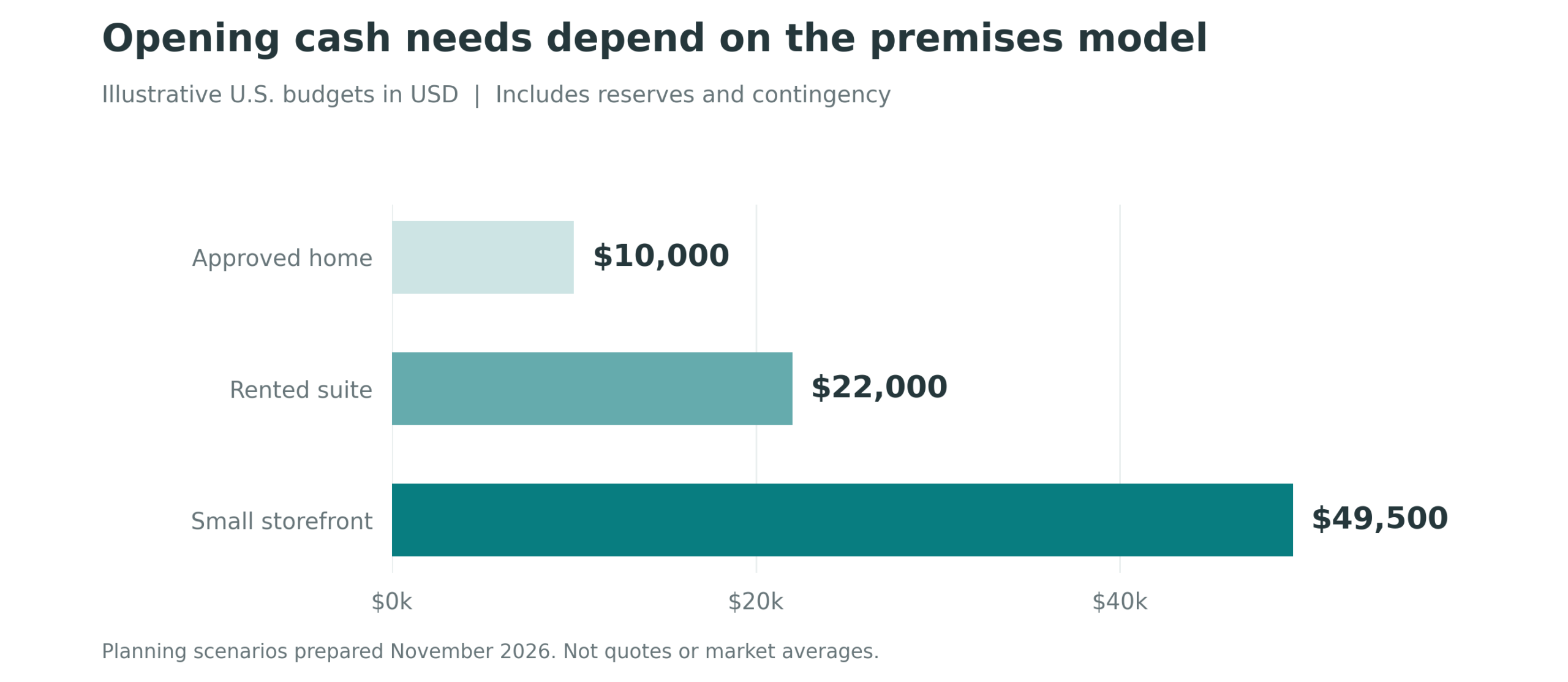
Illustrative U.S. opening cash budgets, USD, November 2026. Includes reserves and contingency; excludes personal living costs. These scenarios are not verified market averages.
Source: ZH Consultancy calculations from the table above. Planning reference: SBA business planning and startup-cost resources.
Separate one-time purchases from recurring rent, software, insurance, stock replacement, utilities, and marketing. Lash business startup costs also include cash consumed before opening: deposits, licensing delays, and practice materials.
Calculate reserve needs from expected monthly cash shortfalls. A $5,000 reserve will not fund three months if the business loses $2,000 monthly. Keep personal living expenses in a separate forecast and include loan payments where relevant.
Build a Lash Business Plan Before Signing a Lease
A useful lash business plan explains how customer demand becomes booked hours and enough cash to operate. Use the SBA planning framework as a starting point, then write for your actual studio.
Define the customer and offer
Your executive summary should identify the founder, service concept, target neighborhood, launch funding, and first-year objective. Specify who you serve and why they would choose you: perhaps reliable evening appointments and understated styling, rather than the lowest price.
Describe competitors honestly. A nearby artist with strong reviews is evidence that customers buy the service, but it also raises the standard you must meet. Explain your service menu, positioning, booking process, supplier arrangements, and staffing responsibilities.
Connect capacity to the numbers
Build monthly projections from appointment counts, service mix, ticket prices, duration, cancellations, and rebooking. Then calculate direct costs, fixed overhead, owner compensation, and break-even volume.
Your lash business plan needs both profit-and-loss and cash-flow forecasts. A deposit received today may relate to work next month; it is not automatically free cash to spend. Equipment purchases and loan principal also affect cash differently from operating profit.
Model a slow launch, expected case, and stronger case. For example, test 30, 50, and 70 monthly appointments instead of assuming every available hour sells immediately. Include what happens if opening is delayed or repeat bookings disappoint.
Write down your personal income requirement as well. If the studio covers its rent but cannot support the owner, you may need a longer part-time transition, lower overhead, or more funding. Identify who handles messages, bookkeeping, purchasing, and complaints. When one person fills every role, those hours still belong in the capacity forecast.
Give the plan decision rules
Set milestones: qualification completed, premises approved, booking tested, first paid clients served, and enough contribution generated to cover overhead. Decide what evidence would justify hiring or moving premises.
For anyone learning how to start a lash business, these rules are more useful than a document full of optimistic adjectives. ZH Consultancy’s business plan writing and financial modeling services can help turn assumptions into a coherent funding case. Review your lash business plan monthly against actual results.
How to Start a Lash Business Legally
A training certificate, a professional license, a business registration, and premises approval serve different purposes. Buying one does not replace the others.
Confirm your state scope of practice
Texas requires applicants using its dedicated Eyelash Extension Specialist pathway to complete 320 hours at a licensed school and pass written and practical examinations. Other qualifying Texas professional licenses can also authorize extensions; verify your own scope.
California’s board bulletin places eyelash application within licensed cosmetology and esthetics practice. California does not offer a standalone extension license. Its official FAQs also explain home establishment requirements.
Ask your state board which credential and approved education apply to your exact menu. A weekend lash extension training certificate alone may not authorize paid services. Check lifts, tinting, and brow treatments separately before adding them.
Register the business and premises
Compare a sole proprietorship with an LLC using the SBA structure guide. An LLC can provide separation in some circumstances, but it does not erase personal responsibility for your own professional conduct.
Confirm state registration, trade-name requirements, local business permits, zoning, establishment licensing, inspections, and lease restrictions. For home work, also check landlord or association rules and whether household access must be separated. Make premises approval a condition of committing money where possible.
Get an EIN when required; the IRS issues it free. Open a separate bank account and arrange bookkeeping. Check state sales-tax treatment of services and retail products, estimated federal taxes, and payroll obligations with an accountant. Hiring also requires proper worker classification and applicable wage and workers’ compensation compliance.
Match insurance and agreements to the work
Request general liability and professional liability quotations that explicitly cover your treatments. Review adhesive reactions, home premises, retail products, employee work, and exclusions. Document cancellation, deposit, refund, consent, and complaint procedures; local legal advice should address enforceability.
For a private-label product line, review FDA cosmetics and MoCRA requirements. Small-business exemptions have exceptions, including certain eye-area products. An eyelash extension business should not assume its treatment license covers manufacturing, importing, labeling, or distributing cosmetics.
Training Equipment and a Reliable Daily Workflow
Choose lash extension training that includes supervised practice, hygiene, consultation, isolation, product handling, safe removal, and responding to problems. Confirm instructor credentials and whether the course satisfies any required state education. A large social following is not a training standard.
After qualification, practice within lawful school or supervised arrangements before promising commercial speed. Keep consented portfolio photographs and record treatment times. Lash extension training should improve repeatable judgment, not just produce a certificate for the wall.
Your station needs a suitable bed, adjustable stool, task lighting, cleanable storage, approved disinfectants, fresh linens or coverings, and appropriate single-use supplies. Buy a focused selection of lash lengths and curls, professional adhesives and removers, tweezers, pads, applicators, and aftercare stock.
Assess suppliers for traceability, ingredient information, safety documentation, expiration dates, consistent batches, and accessible support. Keep a backup source, but evaluate replacements before introducing them into appointments. Follow manufacturer requirements for storage, temperature, humidity, and product use.
FDA eye cosmetic guidance identifies lashes and adhesives as cosmetics and warns about irritation, allergic reactions, and injury. Avoid treating infected or inflamed eye areas. Stop a service if a problem develops and direct medical concerns to a qualified healthcare professional; never promise that a product or patch test eliminates allergy risk.
Build a repeatable appointment sequence:
- Review consultation information, suitability, consent, desired outcome, and pricing.
- Prepare the workspace and follow applicable hygiene and product instructions.
- Record products used, treatment details, client feedback, and any incident.
- Explain aftercare, confirm follow-up arrangements, and reset the station.
Allow time between clients for cleaning and records. Keep personal information access limited, separate photo permission from treatment consent, and back up booking records securely.
Part of learning how to start a lash business is recognizing when an attractive add-on is outside your scope. Ask your board and insurer about proposed services before paying for training. Set aside money for replacing worn tools and maintaining your workspace rather than treating every equipment purchase as a one-time event.
Safe, consistent delivery is central to how to start a lash business that earns recommendations. Have written plans for illness, power failure, product shortages, and urgent cancellations so clients receive clear choices rather than silence.
Pricing Revenue and the Difference Between Sales and Income
An eyelash extension business sells a limited supply of skilled hours. Price the complete appointment, including consultation, cleanup, payment fees, stock, and administrative time.
Define what qualifies as a fill, when extra work becomes a full set, and how removals are charged. Explain these rules before booking. Unclear boundaries turn a modest fill price into an unpaid restoration project.
A worked solo studio example
Assume an experienced owner completes 20 new sets at $150 and 50 fills at $80 per month. New sets take two hours and fills take 75 minutes. These are hypothetical prices and timings, not local market benchmarks.
Assume variable costs average $20 per appointment, including consumables and processing. Fixed monthly overhead is $2,400: rent $1,400; insurance, utilities, and cleaning $300; software and phone $150; marketing $300; and bookkeeping and miscellaneous costs $250.
Monthly calculation | Illustrative amount |
|---|---|
New sets: 20 × $150 | $3,000 |
Fills: 50 × $80 | $4,000 |
Total service revenue | $7,000 |
Variable costs: 70 × $20 | $1,400 |
Contribution before fixed overhead | $5,600 |
Fixed overhead | $2,400 |
Operating surplus before owner pay and tax | $3,200 |
Planning allowance for owner labor | $3,000 |
Residual after owner labor allowance | $200 |
The $3,200 is not passive profit. It compensates the working owner before personal taxes, debt payments, and equipment replacement. The $3,000 labor allowance is a planning measure; its tax treatment depends on the business structure. This simplified model excludes depreciation, financing, retail sales, and tips.
A small change can erase that $200 residual. If average variable cost increases by $3 across 70 appointments, monthly costs rise $210. If one $150 set is canceled without replacement or a retained fee, contribution falls by approximately $130 under the model. Protecting margin requires careful purchasing and attendance management as well as a sensible price list.
Treatment time totals 102.5 hours. Add 17.5 hours for 15-minute changeovers and 20 hours for administration and marketing: 140 working hours monthly. Check your own speed and available hours before adopting the revenue target.
Calculate two break-even points
At this service mix, average revenue is $100 per appointment and contribution is $80. Overhead break-even is $2,400 ÷ $80 = 30 completed appointments. Covering overhead plus a $3,000 owner labor target requires $5,400 ÷ $80 = 67.5, rounded up to 68 appointments.
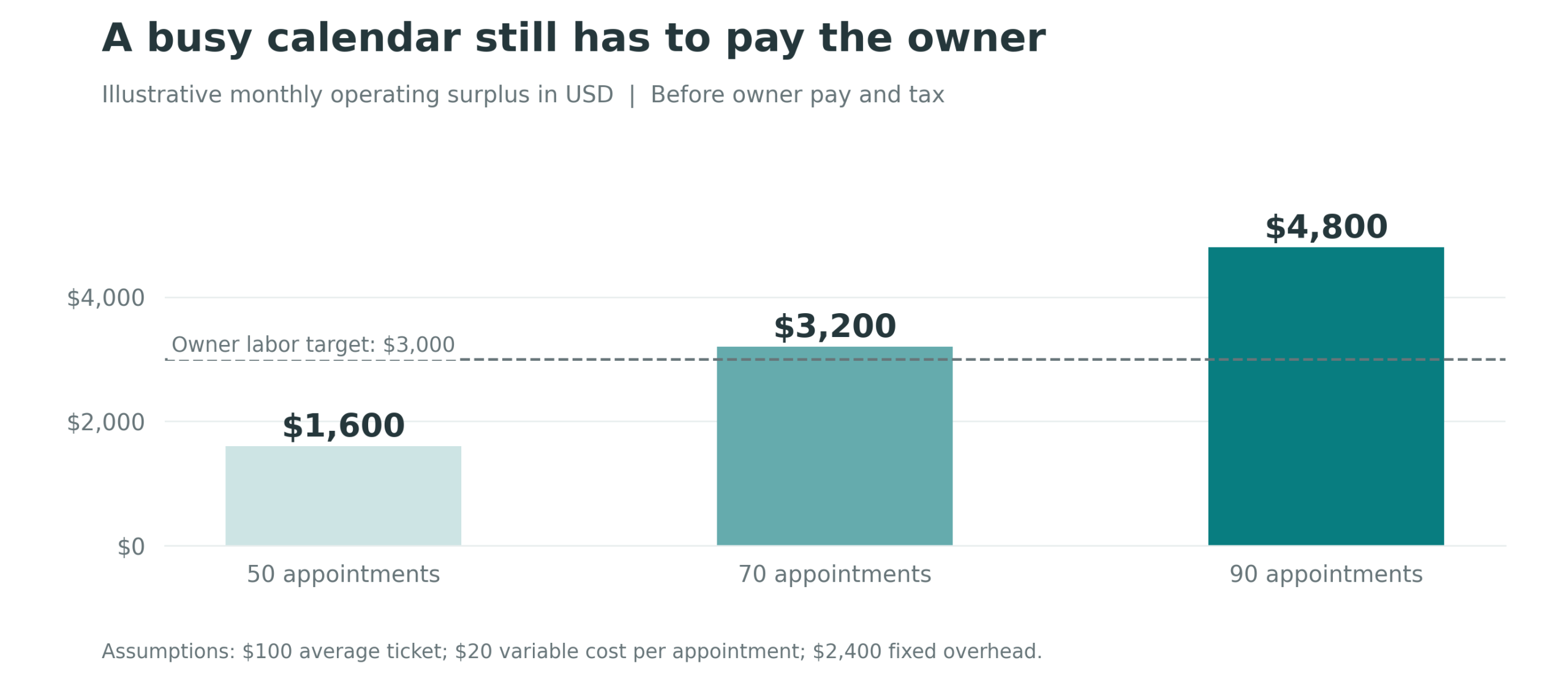
Illustrative monthly operating surplus, USD, at a $100 average ticket, $20 variable cost per appointment, and $2,400 fixed overhead. Service mix is held constant; 90 appointments may strain capacity. The owner labor target is $3,000 monthly.
Source: ZH Consultancy calculations from the worked example above. Method reference: SBA planning and financial projection resources.
This is how to start a lash business with a meaningful income target: work backward from completed appointments, not social media revenue screenshots. Track cash separately and reserve for taxes. Sell aftercare or permitted complementary services only when they improve client outcomes and contribution.
Choose a Name and Build a Recognizable Brand
For founders considering how to start a lash business, branding should communicate a clear promise: who the studio serves, its style, and the experience clients can expect.
Check state business-name availability, trademark conflicts, domains, and relevant social handles before printing anything. A state registration does not settle every trademark question.
Choose a logo that works on a phone screen, a booking confirmation, and a small sign. Legible typography and consistent colors usually help more than elaborate eyelash artwork. ZH Consultancy’s logo design services can support that system without requiring a large launch campaign.
Use the same name, photography style, and contact details across your website, appointment messages, uniforms where appropriate, and business cards. Photograph your real work with permission. Heavy editing may attract clicks while creating expectations your actual service cannot meet.
Prepare Marketing Materials for the Buyers You Want
A solo artist may only need a clear price list, aftercare card, referral card, and digital portfolio. ZH Consultancy’s graphic design services can help keep those materials consistent.
If you approach bridal teams, hotels, or established salons, prepare a concise capability document covering qualifications, service scope, availability, insurance, and booking terms. A larger operator may benefit from company profile design, while a new home studio rarely needs an expensive brochure.
Match each item to a sales conversation. A polished presentation cannot compensate for unclear availability or an unanswered inquiry.
Build a Website That Turns Interest Into Appointments
Someone discovers your portfolio at 10 p.m. They want to know what a set costs, where you work, how long it takes, and whether Saturday is available. If those answers require a message and a next-day reply, you have created another reason to postpone.
A practical answer to how to start a lash business online begins with removing those obstacles. Include service descriptions, visible prices or clearly explained starting prices, fill rules, appointment lengths, genuine reviews, your qualifications, and a prominent booking button.
Add parking and arrival instructions, accessibility information, contact details, cancellation terms, and aftercare guidance. Publish an accurate location or service area without exposing a private address unnecessarily; booking disclosures and platform rules still need to be satisfied.
Choose a suitable platform
Platform | Strong use case | Check before committing |
|---|---|---|
WordPress | Flexible service pages and local SEO | Hosting, security, plugin compatibility, upkeep |
Wix | Owner-managed site with booking tools | Plan limits, payment features, renewal cost |
Squarespace | Visual portfolio with scheduling | Scheduling subscription and payment setup |
Shopify | A product-led lash store | Inventory and shipping needs versus service booking |
Specialist booking software | Appointment operations and reminders | Website limits, fees, exports, customer ownership |
Review official Wix booking features, Squarespace Scheduling, or Square Appointments against your workflow. Test deposits, reminders, cancellation rules, and checkout on a phone before choosing.
Own the domain and understand ongoing costs
Register the domain in your own account with renewal reminders and two-factor authentication. Compare registration and renewal quotes from providers such as Namecheap and Cloudflare Registrar. Check transfer restrictions, extension support, privacy, and support arrangements.
For hosting, compare renewal cost, SSL, backups and restoration, storage, support, and room to grow. Website builders bundle hosting; WordPress usually needs a separate plan. An introductory discount tells you little about the three-year cost.
A local agency may offer in-person coordination, a freelancer may provide direct access, and a remote team may suit a defined scope and written communication. Compare portfolios, testing, ownership, and support rather than geography alone. ZH Consultancy is a Pakistan-based remote option for website development; request a scoped quotation rather than assuming a fixed saving.
Test speed, keyboard access, readable contrast, forms, analytics, and payments. Assign responsibility for updates, backups, and recovery; website maintenance should have a named owner.
Lash Marketing That Produces Booked Clients
Start lash marketing with a clear local offer and a booking page that works. Showing your work to everyone is less useful than reaching nearby people who can attend your available hours.
For how to start a lash business with a small audience, build a limited launch campaign: a defined number of appropriately priced appointments, honest portfolio images, clear experience expectations, and a straightforward booking link. Offer model appointments only within lawful training or licensing arrangements.
Set up an eligible Google Business Profile using Google’s actual-location rules. A virtual mailing address is not a substitute for an operating location. A home studio receiving clients should review the specific requirements rather than assume hiding its address makes it eligible.
ZH Consultancy’s Google Business Profile services can help with accurate setup. Create useful local website content about services, maintenance, and booking questions; avoid dozens of near-identical location pages.
Use Instagram and Facebook to explain results, appointment suitability, and aftercare. Seek relevant partnerships with hair stylists, makeup artists, and bridal professionals. Keep referral offers separate from review requests. Follow FTC review guidance: ask for honest feedback without buying positive sentiment, and respect platform restrictions.
Measure lash marketing by completed first appointments and returning clients. A hypothetical $300 campaign producing six new paying clients has a $50 acquisition cost. If it produces only two, acquisition costs $150 each, which may consume the contribution from an initial set.
Keep the launch test small and pause weak campaigns. ZH Consultancy’s digital marketing services can help coordinate campaigns and measurement where outsourced support fits the budget.
For retention, suggest a suitable maintenance appointment before checkout, send consented reminders, and follow up on concerns. Track inquiries, booking conversion, attendance, acquisition cost, rebooking, and repeat visits. Define retention consistently, such as clients returning within eight weeks, rather than mixing it with same-day rebooking.
Keep lash marketing reports tied to comparable groups. If 12 of 20 first-time clients return within eight weeks, that cohort’s return rate is 60%. Wait until all twenty have had the full opportunity to return before judging it. Separate new clients from repeat appointments so fifty fills do not appear as fifty newly acquired customers. Those distinctions show whether growth comes from attracting people or serving them well enough to return.
Common Operating Problems and Practical Fixes
Empty hours despite plenty of inquiries
Confusing prices or slow replies cause interested people to abandon booking. Review actual inquiry conversations, shorten the booking path, and publish the answers people repeatedly request. Better conversion can improve revenue without increasing advertising spend.
Fills that consume full-set time
Unclear eligibility or inconsistent outcomes create overruns and complaints. Review consultation records, technique, product handling, and aftercare; define fill criteria before checkout. Schedule enough time and charge for the work actually required. Additional lash extension training may be more valuable than another promotion.
Cash pressure after a busy month
Spending deposits or overlooking taxes can leave an apparently successful studio short of money. Reconcile weekly, track future appointment obligations, and forecast the next thirteen weeks of cash. Include revised lash business startup costs if opening expenditure is still continuing.
Growth that damages service quality
Overbooking reduces cleaning time and increases fatigue. Set capacity limits, protect breaks, and build a waitlist. Hire only when the numbers support payroll and quality supervision.
Understanding how to start a lash business includes deciding what to do when demand, timing, and cash do not match your expectations.
Startup Mistakes That Are Expensive to Reverse
Do not sign a long lease before checking licensing, permitted use, fit-out requirements, and realistic demand. Cheap rent can become expensive if the premises cannot be approved.
Avoid buying every lash style, underpricing to fill the calendar, or counting tips as essential revenue. Overbuying ties up cash; excessive discounts attract clients who may leave when prices normalize.
Do not treat lash marketing as permission to publish client photographs without consent. Avoid fake testimonials and claims that results are guaranteed or risk-free.
Finally, keep control of your domain, booking account, customer records, and finances. An attractive brand should not leave you dependent on someone else’s passwords.
Future Trends and Sensible Growth Opportunities
The product-market forecast suggests continued category demand, but an eyelash extension business must still compete with changing styles, DIY alternatives, and discretionary spending pressures. Treat natural styling, premium customization, or retail add-ons as ideas to validate with clients.
Booking automation can reduce reminder and scheduling work. AI can assist with drafts and administrative summaries, but it should not diagnose eye problems, invent reviews, or receive sensitive client information without appropriate controls.
Build further lash extension training into your budget as techniques and products change. Keep quality checks even when tools promise faster work.
Expand through improved retention, useful partnerships, or another artist before assuming a larger storefront is necessary. Memberships require careful pricing, cancellation terms, and enough capacity to honor every included service. Update your lash business plan before adding commitments.
A Practical 90 Day Launch Plan
This is how to start a lash business in a controlled sequence, not a promise that you can qualify in ninety days. Required education, examinations, permits, or construction may take longer. Move paid-service milestones accordingly.
Period | Priority | Evidence to move forward |
|---|---|---|
Days 1–15 | Research clients, competitors, state scope | Clear customer and legal pathway |
Days 16–30 | Write plan, obtain quotes, assess premises | Funded budget and approval checklist |
Days 31–45 | Progress education and operational setup | Competence, supplier checks, lawful space |
Days 46–60 | Build branding, website, booking workflow | Tested mobile booking and policies |
Days 61–75 | Prepare partnerships and launch campaign | Trackable inquiries and available capacity |
Days 76–90 | Open when authorized, review results | Records, feedback, cash and rebooking data |
Recalculate lash business startup costs when quotes change. Keep lash marketing focused on services you are ready and authorized to provide, and review results weekly before committing more cash.
The Takeaway
Knowing how to start a lash business means connecting skilled delivery with a model that pays for your time. Validate local demand, confirm your legal pathway, fund a realistic opening, and make repeat booking easy.
Use your lash business plan to test the uncomfortable questions before they become monthly bills. A smaller, well-run launch can give you better information than an impressive salon financed on optimistic assumptions.
When you need help turning those decisions into a plan, financial forecast, brand, or website, ZH Consultancy can support the work remotely from Pakistan. Build the next step around evidence you can afford to act on.
Faq
Frequently Asked Questions
The illustrative opening budgets here are $10,000 for an approved home setup, $22,000 for a rented suite, and $49,500 for a small storefront. Actual lash business startup costs depend on education, premises, local approvals, and reserves. Obtain quotes before using any scenario as your funding target.
Requirements depend on your state and services. Texas has a dedicated extension-specialist pathway; California requires an appropriate esthetician or cosmetologist license for application. Private lash extension training can develop skills but does not automatically replace state-approved education, examinations, professional licensing, or establishment approval.
Potentially, if professional scope, establishment rules, zoning, property agreements, and insurance permit it. Confirm requirements before modifying a room or accepting clients. Consider household separation, parking, privacy, hygiene facilities, and how the address will be disclosed through bookings and business listings.
It can be, but sales are not take-home pay. In the hypothetical 70-appointment model, $7,000 revenue leaves $3,200 before owner compensation and tax. After a $3,000 owner labor allowance, only $200 remains before other excluded costs. Your prices, speed, overhead, and retention determine the outcome.
Use lawful portfolio appointments, relevant local partnerships, accurate business listings, and a simple booking link. Start with a defined audience and available appointment times. Measure completed appointments and repeat visits rather than followers. Ask actual clients for honest reviews without making rewards conditional on praise.
A studio depends on qualified service hours and local repeat clients. Online retail depends on product sourcing, acquisition costs, shipping, returns, and compliance. Choose the model that fits your capabilities and funding. Adding a private-label product range creates responsibilities beyond reselling an established supplier’s products.
Research, budgeting, branding, and booking setup can progress during a ninety-day planning cycle. Required education, examinations, premises approval, or building work can extend the timeline considerably. Confirm the legal pathway first and avoid promising an opening date before you know which approvals and qualifications remain outstanding.

Zain Hameed
Business strategy specialist helping a global client base of 800+ businesses build credible plans, financial models and investor-ready presentations.
In this article
Book a Free Consultation
Have a business idea, growth challenge or investor deadline? Book a free consultation and get clear next steps from our team.
Call our team
+923104049517
Email us

Business Topics
Business topics
Continue reading
Related insights

How to Start an Electrical Business
Learn how to start an electrical business in the U.S., with

How to Start a Junk Removal Business
Learn how to start a junk removal business with U.S. startup
How to Start a Lash Business and Build a Loyal Client Base
Learn how to start a lash business in the U.S., compare

How to Start a Mobile Drug Testing Business
Learn how to start a mobile drug testing business in the

How to Start a Pest Control Business in the United States
Learn how to start a pest control business in the U.S.

How to Start a Pool Cleaning Business With Costs and a Launch Plan
Learn how to start a pool cleaning business, estimate startup costs,