

In this article
You finish a residential service, collect payment, and head to the next appointment. Then yesterday’s customer calls. The ants are back. Another customer needs a different arrival time, and the inspection you expected to take twenty minutes reveals a much bigger problem.
This is where a pest control company earns its money: through sound diagnosis, realistic promises, and a schedule that can absorb surprises.
If you’re researching how to start a pest control business, begin with the services you’re legally qualified to provide and the customers you can reach efficiently. This U.S. guide connects those decisions to funding, operations, pricing, and customer acquisition. Every budget and earnings example below is illustrative, so you can replace the assumptions with local quotations before investing.
Choose Your Services and Business Model
A pest management company inspects properties, identifies pest activity, recommends prevention, and provides appropriate control and follow-up. Customers pay for expertise, dependable service, and evidence that the problem is being managed.
Residential work might include ants, cockroaches, and rodents. Commercial accounts can involve restaurants, apartment buildings, warehouses, or offices that need scheduled inspections and documented findings. Termite work, structural fumigation, and wildlife services can involve different permissions, equipment, and liability. Treat each as a separate expansion decision.
Revenue can come from initial inspections, individual treatments, recurring service agreements, and separately priced exclusion work. A quarterly agreement should specify the scheduled visits, covered pests, callback terms, and exclusions. Monthly billing does not automatically mean monthly treatment.
Independent ownership gives you control over territory and pricing. A franchise can supply established systems, but evaluate its disclosure document, royalties, territory restrictions, required purchases, and total funding needs. Buying an existing route requires checking customer retention, contract transferability, records, and the seller’s actual service costs.
For someone deciding how to start a pest control business on a manageable scale, a focused residential route can be easier to supervise than several specialties across a wide territory. Confirm that your qualifications support that choice before purchasing pest control equipment.
Understand U.S. Demand and Local Opportunity
The U.S. Census Bureau revenue series published through FRED reports approximately $22.97 billion for U.S. exterminating and pest control services in 2024, compared with $16.83 billion in 2020. These are annual nominal revenues, not inflation-adjusted growth or a forecast for a new company.
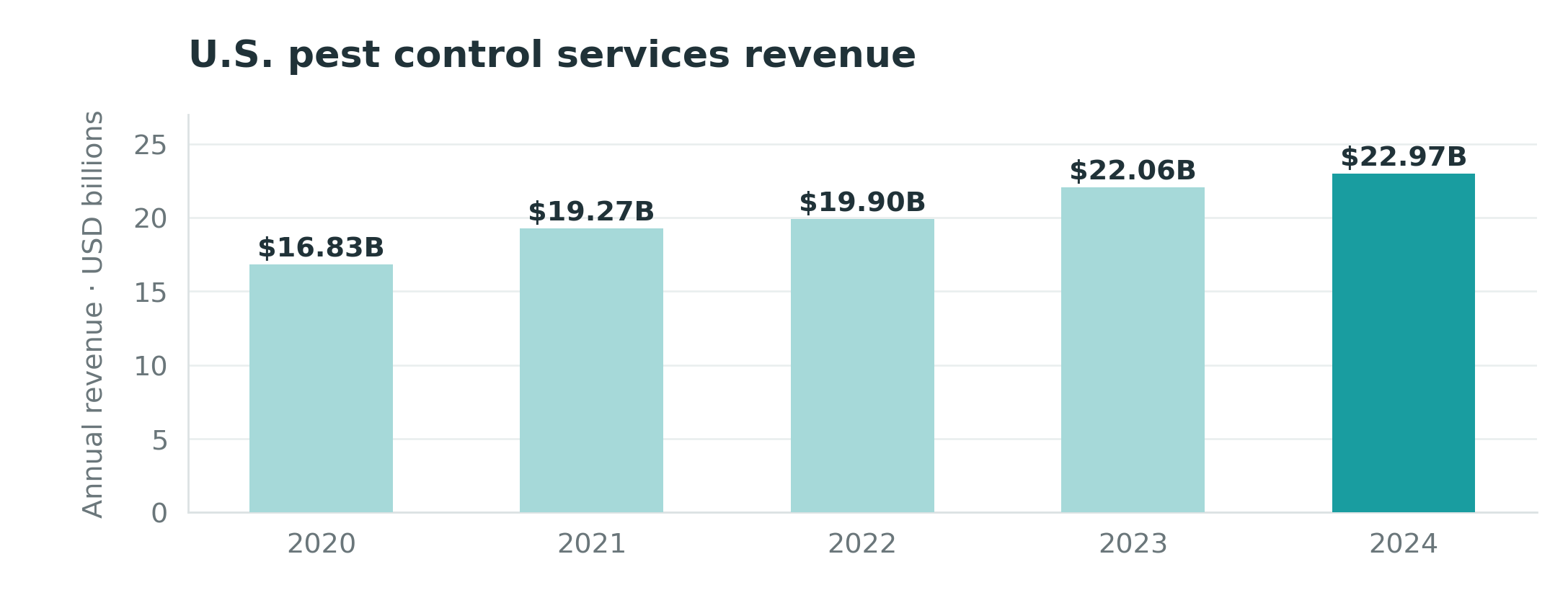
Figure 1. U.S. exterminating and pest control services revenue, 2020–2024, in billions of current U.S. dollars. Rounded labels; historical survey estimates may be revised. This service category is not the global pesticide-products market.
Source: U.S. Census Bureau via FRED, series AIES56171RCT00US. Data checked November 4, 2026.
The Bureau of Labor Statistics projects pest control worker employment to grow 6% from 2025 to 2035. Employment growth indicates demand for labor; it does not predict your sales or profit margin.
Your useful market is much smaller than either statistic. Map a practical service area, then speak with homeowners, property managers, and commercial buyers. Ask what triggers a purchase, how quickly they expect a response, and why they changed providers. Review competitors’ actual service scopes, availability, and recurring complaints.
Warm-weather mosquito demand, winter rodent calls, rental turnover, and commercial inspection schedules can produce different sales patterns. Treat these as local hypotheses to investigate. For help testing a territory, ZH Consultancy’s market research services can connect customer and competitor evidence to a launch decision.
Learning how to start a pest control business includes discovering which nearby customers are underserved at a price that covers reliable service.
Weigh the Advantages and Disadvantages
Recurring agreements can improve scheduling and revenue visibility. Route density can also improve economics: several nearby appointments usually consume less travel time than the same number scattered across a county. Neither advantage appears automatically when you register a company.
Potential advantage | Practical limitation |
|---|---|
Repeat residential and commercial accounts | Retention depends on results, communication, and suitable contract terms |
A focused owner-operated launch | Licensing eligibility and a suitable vehicle may still require substantial investment |
Expansion into valuable specialties | Additional training, authorization, insurance, and supervision may be needed |
Flexible territory development | Seasonal demand, weather, and callbacks can disrupt the calendar |
The work can involve uncomfortable spaces, heat, driving, difficult conversations, and chemical exposure risks. One poorly scoped job can absorb the contribution from several ordinary visits. Decide whether you enjoy the operational work as much as the idea of owning a service business.
How to Start a Pest Control Business With a Funded Budget
Pest control startup costs depend heavily on existing qualifications, transport, service scope, and local insurance. The examples below assume a qualified owner providing limited general pest services, with no employees or fumigation equipment. They exclude the owner’s living expenses and the wages or lost income associated with obtaining lengthy experience requirements.
Initial funding category | Existing vehicle | Used van purchase |
|---|---|---|
Training, licensing, and registration allowances | $1,500 | $2,500 |
Vehicle purchase or compliant setup | $1,500 | $18,000 |
Equipment, PPE, and secure storage | $2,500 | $5,000 |
Initial supplies and monitoring materials | $800 | $1,500 |
Insurance deposits and bond premiums | $1,500 | $2,500 |
Branding, website build, and print materials | $1,200 | $3,000 |
Software, domain, and hosting startup allowance | $450 | $900 |
Launch marketing allowance | $1,500 | $3,000 |
Business working capital reserve | $6,500 | $12,000 |
Total illustrative initial funding | $17,450 | $48,400 |
These are planning assumptions in USD, not supplier quotations or verified industry averages. Software and marketing allowances cover roughly the first three months; domain terms may be annual. Bond premiums are costs, whereas a required bond’s face value is not normally the premium you pay.
Separate one-time purchases from recurring fuel, replenishment, insurance, software, storage, renewals, and marketing. Pest control startup costs also rise when licensing requires additional qualified supervision. Obtain written quotations and prepare a monthly cash forecast before financing purchases.
Keep a personal reserve outside the business budget. A company can appear funded while its owner still needs immediate withdrawals to pay household bills.
Review a rolling thirteen-week cash forecast every Friday. List confirmed receipts, expected collections, supplier bills, insurance payments, and debt service by week. Keep a minimum cash balance and decide in advance which purchases can wait. This makes a slow sales month visible early enough to reduce discretionary spending without compromising scheduled customer work.
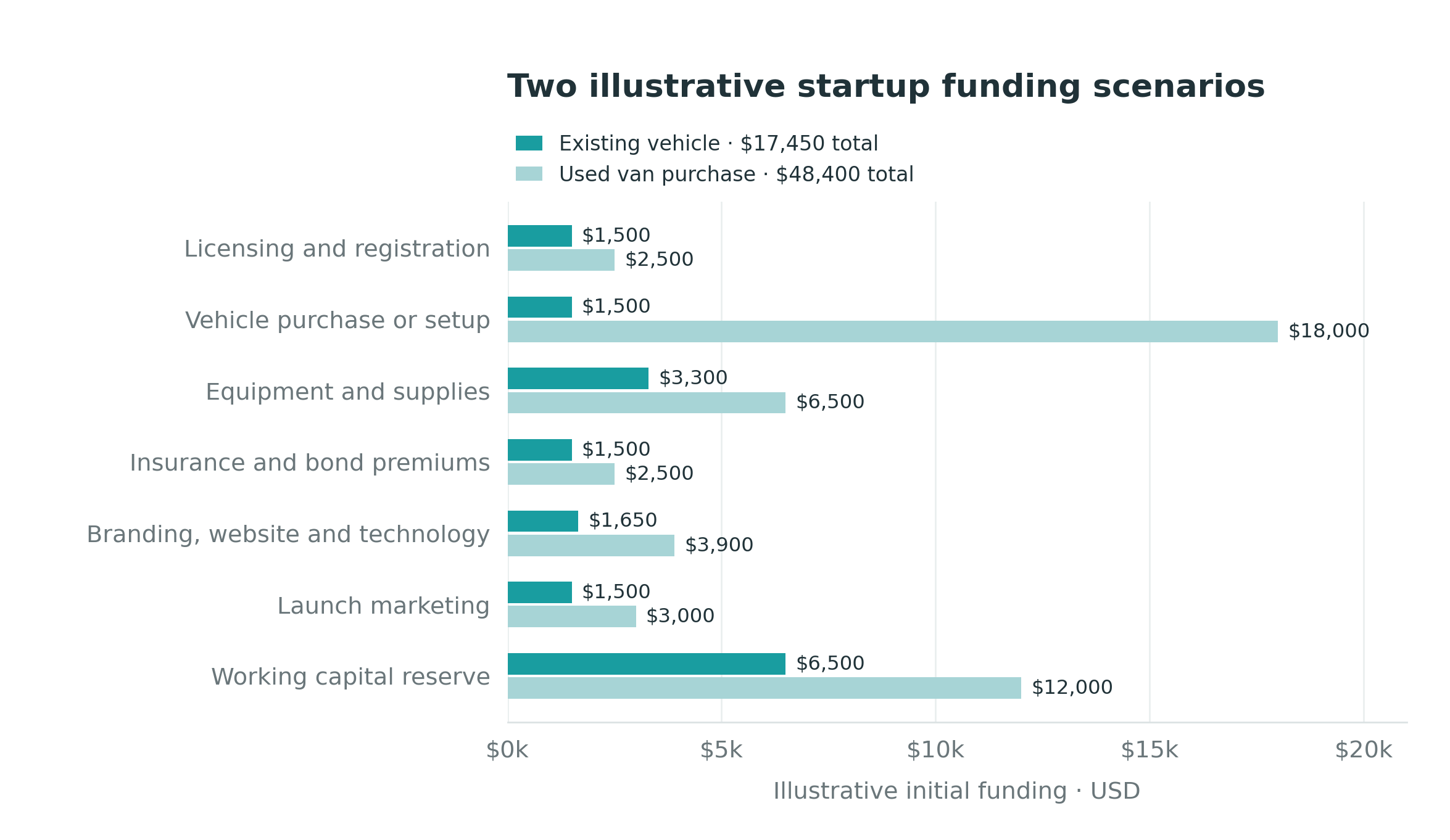
Figure 2. Illustrative initial funding of $17,450 with an existing suitable vehicle and $48,400 with a used van purchase. USD; November 2026 planning examples. No employee payroll, owner living expenses, or specialist treatment systems included.
Source: ZH Consultancy assumptions in the preceding table. SBA business planning guidance explains startup-cost planning; it does not supply these amounts.
Create a Pest Control Business Plan You Can Use
A practical pest control business plan turns your territory, qualifications, and service promise into a set of numbers and responsibilities. Write the executive summary after completing the research so it describes a business you can actually operate.
Start with the target customer and competitors. For example, your initial offer might serve homeowners in two adjacent ZIP codes who want scheduled general pest inspections, clear reports, and straightforward callback terms. Define why they would choose you, what you will sell, and which work you will refer elsewhere.
Your pest control business plan should include pricing, staffing, suppliers, equipment, scheduling, customer communication, and a marketing calendar. Add an itemized startup budget, monthly revenue forecast, profit-and-loss projection, cash flow, break-even calculation, risk register, and measurable milestones.
Build sales from activities rather than optimism. As an illustration, 40 qualified inquiries at a 30% booking rate produce 12 initial bookings. That is a planning assumption to test, not a local conversion benchmark. Then model repeat visits, cancellations, payment timing, and the labor needed to fulfill those bookings.
Test a downside case with fewer bookings, slower commercial payments, and higher callback costs. ZH Consultancy’s business plan writing services can help structure the document, while its financial modeling services can test funding and operating assumptions.
Assign responsibility for answering calls, reviewing technical questions, purchasing supplies, and chasing invoices. An owner working at a customer’s property may miss the next inquiry unless someone handles intake. Before hiring, calculate the full employment cost, including payroll obligations, training, insurance, supervision, and the weeks when the employee is learning rather than operating a full route.
When considering how to start a pest control business, make your first milestone proof that a defined route can work legally and financially. Revisit the pest control business plan monthly as actual inquiry and service data replace estimates.
Meet Licensing and Legal Requirements Before Trading
The first legal question in how to start a pest control business is which authority regulates your exact activities. A general business registration and a pest control license perform different functions. Ask about both company authorization and individual credentials, including the permitted categories and supervision arrangements.
Federal rules and business registration
The EPA’s applicator certification guidance explains that people applying or supervising restricted-use pesticides need certification under applicable requirements. States, territories, and tribes administer certification, and many states require commercial applicator certification beyond restricted-use products. Avoid assuming that a retail product makes professional application unregulated.
Compare a sole proprietorship with an LLC using SBA business-structure guidance. A sole proprietor generally has personal liability for business obligations. An LLC can provide liability separation, but it does not replace insurance or eliminate responsibility for personal misconduct. Discuss entity and tax choices with qualified advisors, register as required, and obtain an EIN directly from the IRS when needed; the IRS does not charge for it.
State examples show why one checklist is insufficient
Jurisdiction | Examples to verify before launch |
|---|---|
Texas | Company licensing for each location, a designated responsible certified applicator, and category-specific credentials |
California | Company registration and a qualifying manager licensed as an operator in the relevant branch |
Florida | Licensed business location, required insurance, and a full-time certified operator in the categories offered |
Check the current requirements with Texas Structural Pest Control Service, California’s Structural Pest Control Board, and Florida FDACS. These examples are not a fifty-state legal checklist. Texas also restricts advertising and solicitation before the required business authorization is issued.
A pest control license may require documented experience, examinations, continuing education, and renewals. Florida’s experience route, for example, ordinarily requires three years of qualifying service experience, including specified Florida experience. A short online course is not a universal substitute. Confirm your pathway before setting a launch date.
Insurance and operating obligations
Ask a specialist broker about pesticide application liability, pollution exclusions, general liability, commercial auto, tools coverage, and workers’ compensation where required. Obtain confirmation that your actual services are covered. Verify zoning, storage, disposal, transport, sales-tax treatment, employment obligations, customer notices, and any wildlife permissions with the relevant authorities.
Use written agreements covering access, scope, preparation, fees, follow-up, cancellations, and warranty limitations. Have local counsel review recurring billing and cancellation terms. Your pest control license and insurance must remain current as your service mix changes.
Buy Equipment and Build a Reliable Service Workflow
Buy pest control equipment for the work you are authorized and trained to perform. A general-service setup might need inspection lights, identification resources, monitoring devices, appropriate applicators, label-specified protective equipment, spill supplies, and secure storage. Purchase from reputable suppliers with reliable labels, safety data sheets, replacement parts, and technical support.
Use EPA integrated pest management principles: identify and monitor the pest, assess whether action is needed, address conditions that support it, and select suitable controls. For a restaurant account, documenting entry points and sanitation issues helps establish what the customer must correct alongside professional work.
The EPA explains that pesticide labeling is legally enforceable. Follow the authorized sites, application directions, precautions, storage, and disposal instructions. This business guide cannot determine treatment products, doses, or protective equipment for a particular job.
Employees need appropriate training and hazard communication. When respirators are required, OSHA’s respiratory protection standard includes program obligations such as medical evaluation and fit testing for tight-fitting respirators. Buying a mask alone does not establish compliance.
Create a repeatable process: inquiry, inspection, identification, written scope, customer preparation, authorized service, documentation, payment, and follow-up. Record the findings and application details required locally, plus customer instructions and the next action. Back up records and control access to customer information.
Schedule maintenance and inspect pest control equipment before use. Keep an emergency contact and spill-response procedure, and arrange qualified backup for vehicle failures or illness. Safe operating capacity matters as much as the sales calendar when planning how to start a pest control business.
Check supplier delivery times and minimum orders before relying on one source. Keep a modest inventory matched to booked work, inspect containers, and monitor expiration and storage conditions where applicable. A large discounted purchase can waste capital if demand changes or the product becomes unsuitable. Establish a backup supplier and a documented process for approved substitutions.
How to Start a Pest Control Business That Covers Its Costs
Prices should reflect the full service obligation. A one-time visit, a recurring residential agreement, and a commercial monitoring contract can have very different labor, reporting, and return-visit needs. Inspect unfamiliar or complex sites before committing to a fixed price.
A worked example of visit economics
Assume an average price of $150 per completed billable visit. This hypothetical example is not a market price recommendation.
Item per completed visit | Illustrative USD |
|---|---|
Revenue | $150 |
Labor allowance, 1.25 hours at $36 | $45 |
Materials and monitoring consumables | $15 |
Variable vehicle and travel costs | $12 |
Payment processing allowance | $5 |
Expected callback cost allowance | $13 |
Total variable cost | $90 |
Contribution toward fixed costs and surplus | $60 |
Assume another $2,500 per month for insurance, storage, software, administration, ongoing marketing, and fixed vehicle ownership costs. Monthly operating surplus in this model equals completed visits multiplied by $60, minus $2,500.
Break-even is $2,500 divided by $60, rounded up to 42 visits. At 90 visits, revenue is $13,500, variable costs are $8,100, and contribution is $5,400. Subtract fixed costs of $2,500 to leave $2,900 before income tax, financing costs, and growth investment.
At 120 visits, the assumed service and travel time alone is 150 hours, before sales and administration. Check real capacity and callback demand before choosing this target. If the owner does fieldwork, the labor allowance values that time; the remaining surplus is not total owner take-home. Your accountant may classify owner compensation differently.
Small errors compound quickly. If average revenue falls from $150 to $140 while variable cost remains $90, contribution falls to $50 and break-even rises to 50 visits. At 90 visits, surplus falls from $2,900 to $2,000. That $10 discount costs $900 monthly in this scenario. Similarly, higher callback costs reduce contribution even when the appointment calendar stays full.
Separate accounting profit from cash movements. Vehicle depreciation can be an expense without an immediate payment, while loan principal consumes cash without being an operating expense. Model debt payments and owner withdrawals separately so a positive operating result does not conceal a funding shortage.
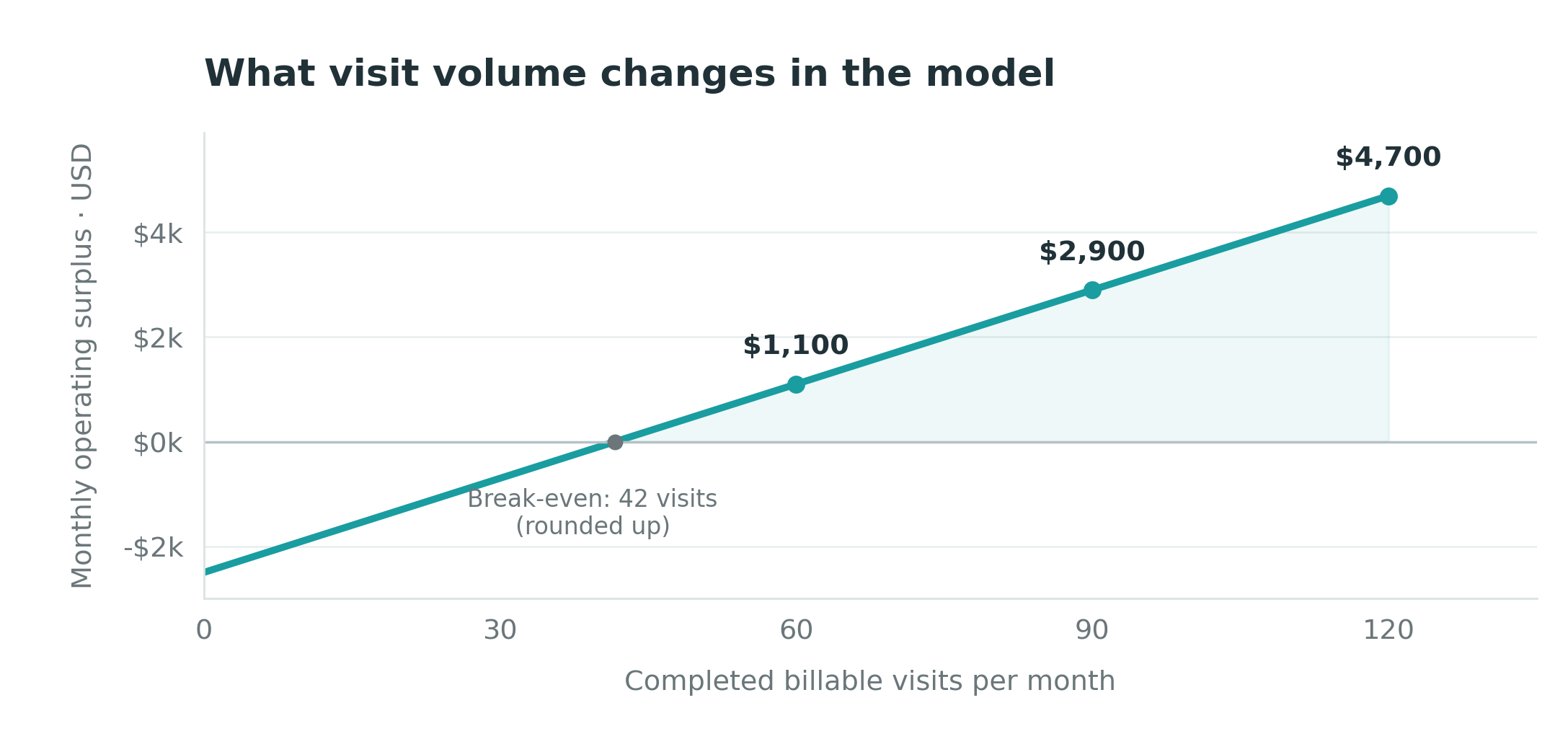
Figure 3. Illustrative monthly operating surplus at 60, 90, and 120 completed visits: $1,100, $2,900, and $4,700. Assumes $150 revenue and $90 variable cost per visit, plus $2,500 monthly fixed costs. Includes a labor allowance; excludes tax and financing.
Source: ZH Consultancy calculations from the assumptions above. SBA business planning guidance provides general cost and break-even planning context, not these earnings figures.
Recurring revenue and cash flow
A hypothetical 150 customers billed $50 monthly generate $7,500 monthly revenue. If each receives four $150-equivalent scheduled visits annually, that averages 50 visits monthly and $500 modeled monthly surplus under the same assumptions. Actual seasonal workload and callbacks will vary.
Track service obligations separately from billing. Advance collections fund future work, and commercial invoices may remain unpaid after labor costs are due. Review pest control startup costs alongside ongoing cash needs so vehicle finance and customer growth do not exhaust the reserve.
Choose a Name and Build Recognizable Branding
Choose a name customers can pronounce, remember, and distinguish from nearby competitors. Check state entity records, relevant trademarks, domain availability, and any regulator’s naming approval rules. Registering a domain does not establish trademark rights.
Learning how to start a pest control business also means deciding what customers should expect from the brand. You might emphasize clear communication, documented prevention, or reliable service windows. Choose a promise you can consistently deliver and avoid unsupported safety guarantees.
A logo must remain readable on a van, work shirt, invoice, and phone screen. Request vector artwork, a simple monochrome version, and a short guide covering colors and typography. ZH Consultancy’s logo design services can help prepare these assets for consistent use.
Carry that identity through uniforms, vehicle graphics, email signatures, business cards, and customer reports. Check which license details local rules require on advertisements and service documents before printing anything in volume.
Prepare Marketing Materials for the Buyers You Want
A residential launch may need little more than a clear service sheet, a professional estimate, business cards, and an explanation of recurring coverage. Commercial buyers may request insurance evidence, qualifications, reporting samples, and a capability statement.
Prepare a concise company profile only when it supports a real sales process. A restaurant manager wants to understand inspection frequency, escalation, reporting, and responsibilities. A glossy brochure without those details gives them little basis for choosing you.
ZH Consultancy’s company profile design services can help organize those materials. Use genuine photographs, verified credentials, and permission-based case studies. Your pest control business plan should identify which materials each customer segment needs before you pay for design and printing.
Build a Website That Helps Customers Book
Someone searching how to start a pest control business often considers the vehicle before the website. Yet an unclear booking page can waste the advertising budget you need to fill that vehicle’s route.
Your homepage should explain the authorized services, real service area, contact options, and what happens after an inquiry. Create useful service pages for problems you actually handle. Explain inspection fees or pricing factors, covered pests, preparation, follow-up, and limitations. Publish genuine reviews and verifiable qualifications.
Make telephone links and inquiry forms easy to use on a phone. Ask for the ZIP code, pest concern, property type, and preferred contact method. Allow inspection requests when a fixed treatment price would be premature. Any online appointment availability should reflect travel time and technician capacity.
Compare platforms against the operating workflow
Platform | Practical fit and tradeoff |
|---|---|
WordPress | Flexible service content and integrations; someone must manage hosting, updates, security, and plugin compatibility |
Wix | Managed website builder with booking tools; check the paid plan, integrations, and payment requirements |
Squarespace | Managed service website with Acuity scheduling; include the required scheduling subscription in the comparison |
Shopify | Consider when product sales are substantial; service booking typically needs an app and does not replace route management |
Specialist field-service software | Useful for recurring schedules, routes, billing, and reports; test website integration and data export before committing |
Review WordPress booking options, Wix Bookings, Squarespace’s scheduling guidance, and Shopify’s service-booking guidance. Tools such as FieldRoutes advertise routing, scheduling, and billing functions; confirm fit through a demonstration using your own workflow.
Own the assets and budget for maintenance
Register the domain in an account your company controls, with secure recovery details and renewal reminders. Cloudflare Registrar is one domain-registration option. Compare registration and renewal costs, transfer terms, support, and management requirements before choosing a provider.
For hosting, compare the total multiyear cost, SSL, backups, restoration support, performance, and upgrade options. Include premium plugins and booking subscriptions. Test keyboard access, form labels, readable contrast, page speed, and payment flows before launch.
A local agency can offer in-person coordination; a freelancer may provide direct specialist access. A remote team can be cost-effective when scope and communication are clear. Compare relevant work, ownership, revision limits, and ongoing support. ZH Consultancy’s website development services provide a Pakistan-based remote option; request a scoped quotation rather than assuming a fixed saving.
Assign updates, backups, security monitoring, and form testing to a named person or website maintenance provider. Include these recurring expenses in pest control startup costs and the operating forecast.
Use secure payment processing rather than collecting card details through an ordinary form. Give staff individual accounts, remove access when people leave, and test a backup restoration. Measure completed inquiries and booking outcomes with privacy-conscious analytics so a working website is judged by actual customer activity.
Make Pest Control Marketing Measurable
Effective pest control marketing connects the right local inquiry to a service you can deliver. Once you are permitted to advertise, set up an eligible Google Business Profile with accurate details. Follow Google’s representation rules: a business traveling to customers should hide its address if it does not serve customers there. Avoid fabricated offices and misleading service locations.
Build useful local service pages, publish original inspection explanations, and request honest reviews without pressuring customers. ZH Consultancy’s Google Business Profile services can support accurate setup and optimization.
For paid search, begin with a narrow territory and services you are qualified to offer. Match the landing page to the inquiry, exclude irrelevant searches, and track answered calls, inspections, paying customers, and retained agreements. Google Ads management support can help structure testing and measurement.
As an illustrative pest control marketing test, spend $600 to generate 30 qualified inquiries. If 12 become paying customers, acquisition cost is $50 per customer. Compare that with contribution after service costs and future obligations, not gross sales. Review results by service and ZIP code before increasing spending.
Referrals from property managers and complementary trades can diversify demand. Use permission-based reminders and seasonal emails for existing customers; share practical prevention advice on social channels. A coordinated digital marketing plan should match the route’s actual capacity.
When deciding how to start a pest control business, choose pest control marketing channels you can measure and afford to test. A modest campaign that produces profitable nearby customers is more useful than broad visibility without bookings.
Solve the Problems That Erode Margins
Callbacks that repeat the original problem
Incomplete diagnosis or uncorrected property conditions can cause repeat visits and disputes. Document findings, explain customer responsibilities, and review unresolved cases with the qualified supervisor. Track callback causes so you can improve inspections and pricing instead of simply squeezing another free visit into Friday.
A busy calendar with too much driving
A large service radius can leave technicians productive on paper but stuck in traffic. Group appointments by area, set clear arrival windows, and price distant work appropriately. Measure travel hours per completed visit. Nearby recurring accounts can improve usable capacity without adding another vehicle.
Commercial customers paying slowly
Payroll and fuel arrive before an overdue invoice clears. Set written payment terms, invoice promptly, monitor receivables, and agree lawful collection procedures. Stress-test a delayed-payment month before accepting a large account. Cash discipline belongs in any plan for how to start a pest control business.
Avoid Expensive Startup Mistakes
The common error in how to start a pest control business is committing money before resolving the conditions that make the model work. Buying specialist systems before validating the territory can tie up cash while qualifications or sales are still missing.
Avoid purchasing every item of pest control equipment offered by a supplier. Maintain a service-specific buying list and expand after demonstrated demand. Recalculate prices when labor, supplies, or travel costs change; yesterday’s profitable quote can become today’s expensive commitment.
Do not depend on a qualifying employee without a continuity plan. Ask the regulator what happens if that person leaves. Document training and succession responsibilities, and keep enough cash to suspend affected work if authorization cannot be maintained.
Finally, put warranty and cancellation terms in writing. A promise of unlimited work at an introductory price can create obligations you never intended to sell.
Plan for Technology and Sustainable Growth
Digital service reports, automated reminders, and route planning can reduce administrative work. Test each tool against an actual bottleneck and confirm that staff can export records if you change systems. Customer information should remain accessible to the business.
AI may help draft routine replies or summarize records, but a qualified person must verify pest identification, legal requirements, and treatment decisions. Avoid promising savings before you have measured errors, time, and support costs in your own operation.
Expansion can mean denser routes, suitable commercial contracts, exclusion services, or an additional authorized specialty. Update your pest control business plan and insurance before introducing new work. Monitor how regulatory changes, weather, wages, and customer budgets affect costs and demand.
Knowing how to start a pest control business gives you a foundation for growth. The decision to hire should depend on retained customers, service quality, and cash available for qualified labor during the ramp-up period.
Put a Practical 90-Day Launch Plan to Work
Use this schedule to organize how to start a pest control business, not to bypass licensing experience or approval periods. If you are not yet eligible, the first 90 days should establish your training pathway and business feasibility rather than promise paid operations.
Period | Main work and evidence of progress |
|---|---|
Days 1–15 | Validate the territory, interview buyers, identify regulators, and confirm your credential pathway |
Days 16–30 | Obtain quotations, complete the financial forecast, choose the entity, and begin eligible applications |
Days 31–45 | Arrange insurance and compliant storage; select suppliers and rehearse recordkeeping workflows |
Days 46–60 | Prepare branding, service agreements, website, and booking systems; review advertising restrictions |
Days 61–75 | After authorization, test customer acquisition and supervised or authorized service delivery |
Days 76–90 | Launch only when approvals are effective; review margins, callbacks, receivables, and retention |
Recheck pest control startup costs before each major commitment. Keep the pest control license verification and insurance dates visible in the launch calendar. A delayed approval should change the operating date and cash forecast immediately.
The Takeaway
Learning how to start a pest control business begins with a narrow service promise you can fulfill safely, legally, and profitably. Verify authorization, validate nearby demand, and budget for the full obligation behind every visit. Then earn repeat business through clear communication and dependable follow-up.
Fund the reserve before expanding the shopping list. A well-used inspection process, realistic pricing, and a practical website can support steady progress while you learn what your local market will actually buy.
Faq
Frequently Asked Questions
The illustrative budgets in this guide are $17,450 using an existing suitable vehicle and $48,400 with a used van purchase. They are not industry averages. Pest control startup costs vary with qualifications, service scope, insurance, location, and the business reserve. Personal living expenses require separate funding.
Begin by checking your state’s eligibility and supervision rules. Gain the required experience and training through a lawful pathway before offering regulated services. Hiring a qualified operator may be an option in some jurisdictions, but that person must meet the actual role requirements and be properly employed or engaged.
Often, yes. A pest control license requirement depends on the jurisdiction, activity, and credential category, and can apply beyond restricted-use pesticides. Confirm company licensing and individual qualifications with the regulator before advertising, inspecting, quoting, or treating properties where those activities are regulated.
Possibly, if zoning, business rules, insurance, vehicle arrangements, and product storage requirements permit it. Check the precise property and product conditions before using a garage or shed. If customers are not served at the address, follow the applicable service-area rules for your Google Business Profile.
Profit depends on prices, service costs, callbacks, route density, overhead, and retention. The worked model produces $2,900 monthly surplus at 90 visits after a labor allowance and fixed costs, before tax and financing. It is a hypothetical calculation, not an earnings promise or a typical owner salary.
Choose pest control equipment after confirming your authorized services, training, and product requirements. Prioritize inspection, monitoring, appropriate protective equipment, secure storage, and reliable documentation. Obtain specialist advice before buying application systems, and avoid purchasing specialist equipment solely because a future service sounds attractive.
Once advertising is permitted, combine an accurate Google Business Profile, useful local service pages, genuine referral relationships, and a small measurable campaign. Pest control marketing should track qualified inquiries, paying customers, acquisition cost, and retention. Start in a compact territory so initial customers can support an efficient route.

Zain Hameed
Business strategy specialist helping a global client base of 800+ businesses build credible plans, financial models and investor-ready presentations.
In this article
Book a Free Consultation
Have a business idea, growth challenge or investor deadline? Book a free consultation and get clear next steps from our team.
Call our team
+923104049517
Email us
info@zhconsultancy.com

Business Topics
Business topics
Continue reading
Related insights

How to Start a Laundromat Business: A Complete U.S. Founder’s Guide
Learn how to start a laundromat business in the USA: market

How to Start a Construction Business in the USA
A homeowner wants to sign a $75,000 remodeling contract on Friday.

How to Start a Plumbing Business in the USA
At 7:15 on Monday morning, a homeowner calls about water coming

How to Start a Car Rental Business in the USA: A Founder’s Practical Guide
A family lands after midnight. They do not care whether your

How to Start a Landscaping Business: Costs, Licenses, Marketing and Profit
Picture two lawns on the same street. One homeowner wants a

How to Start a Cafe Business in the USA: Costs, Licenses, Marketing and Profit
You’re standing inside an empty storefront, and you can already picture