

In this article
Imagine spending six months developing a skincare formula. You refine the ingredients, find a manufacturer, negotiate your first production run, and finally get a sample in your hands. The product is excellent. Then you put it next to ten competing products on a store shelf.
And yours looks like it was designed during a lunch break.
That is an expensive way to learn that people cannot judge the formula through a sealed box. They judge what they can see: the name, the claims, the hierarchy of information, the materials, and whether the whole thing feels trustworthy.
Professional packaging design services help brands solve that problem. Not by sprinkling attractive colors over a carton, but by making a product understandable, recognizable, practical to produce, and appropriate for the place it will be sold.
For US startups and established consumer brands, the challenge is especially interesting. Your packaging may need to work in a thumbnail on Amazon, compete on a crowded retail shelf, survive a shipping journey, and leave room for mandatory label information. A design that succeeds in one setting can fail spectacularly in another.
This guide explains what you are buying, how the process works, what typical US projects can cost, how to compare agencies, what regulatory questions to raise, and where the market may be heading. You will also find real industry data, two practical budget examples, and mistakes worth avoiding before you approve 20,000 printed boxes.
1. What Do Packaging Design Services Actually Include?
A useful distinction: packaging design is not the same as packaging manufacturing. One creates the visual and sometimes structural solution; the other produces physical packaging. Some suppliers do both. Many specialists do not.
Packaging design services can include research, positioning, concept development, graphics, typography, label layout, 3D mockups, artwork adaptation, and print-file preparation. Exactly which tasks are included should be written into the proposal rather than assumed.
Visual design versus structural design
Visual design determines what appears on the package: color, logo treatment, product name, illustrations, information hierarchy, and how variants relate to each other. Structural design determines the physical form: dimensions, folding pattern, closures, inserts, protective features, and how it fits a product.
For example, your new coffee brand may need striking graphics for a pouch that a manufacturer already supplies. That is primarily a visual-design project. A custom folding carton with an unusual opening mechanism may require structural engineering, sampling, and machine compatibility checks as well.
When commissioning custom packaging design, ask whether structural engineering is included or whether the designer will use a supplier-approved template. It is a small question with a potentially large financial consequence.
What should you receive at the end?
A well-scoped product packaging design project may deliver a master layout, approved artwork for each panel, print-ready files, digital mockups, font and asset information as licensed, and guidance for future product variants. Source-file ownership and usage rights should be explicit in the agreement.
You should also know what the provider is not delivering. Printing, shipping, specialized testing, regulatory sign-off, photography, and physical prototypes may be separate services.
At ZH Consultancy’s packaging design services, for example, the published scope focuses on design and artwork using supplier-confirmed specifications; physical printing and manufacturing are separate. That is the kind of scope clarity worth looking for with any provider.
2. Why Packaging Matters Before Anyone Opens the Box
You have probably experienced this without consciously noticing it. Two products sit side by side at a similar price. One tells you exactly what it is, why it is different, and how to use it. The other makes you hunt through tiny text and decorative graphics just to find the flavor.
Which one feels easier to buy?
Good packaging reduces the amount of detective work a shopper has to do. It also reduces uncertainty. That does not guarantee a sale, but it removes avoidable friction from the decision. This is the practical value that good packaging design services should deliver before anyone gets distracted by decorative details.
Three jobs your packaging must perform
First, it must identify the product quickly. Someone scanning a shelf should understand the category, brand, and important differentiator without squinting. Second, it must communicate necessary information accurately. Third, it must work in the real world: on a shelf, inside a shipping carton, against condensation, or in a consumer’s hands.
That third job gets ignored surprisingly often. A beautiful label that wrinkles on a chilled bottle is not a beautiful label for very long. Neither is a premium rigid box that makes shipping costs unmanageable.
Consider both retail and digital presentation
A cereal box may be viewed from several feet away in a grocery store. A supplement jar might first be encountered as a tiny marketplace image. Those situations call for different tests.
For ecommerce, take the main product image and shrink it to thumbnail size. Good product packaging design remains understandable even when the artwork becomes small. Can shoppers still recognize the product type, brand, and variety? For retail, place a printed mockup beside competing packs and look at it from ordinary browsing distance.
A thoughtful packaging design agency should be able to explain how it evaluates both contexts, rather than presenting only dramatic studio mockups under perfect lighting.
There is also a brand-system benefit. If one flavor looks elegant and the next looks like it belongs to another company, every product launch starts from zero. A cohesive system creates recognition without making every package identical.
3. Global Packaging Market Outlook and US Opportunities
Market statistics are useful, but they are easily misused. The global packaging industry includes materials, manufacturing, logistics, and equipment. Its total size is not the same thing as the revenue earned by design studios.
That distinction matters when someone uses a trillion-dollar market figure to imply that every packaging freelancer has a trillion-dollar opportunity. Nice headline. Wrong conclusion.
What Statista's forecast actually tells us
Statista’s global sustainable packaging research reports a 6.6% projected compound annual growth rate for 2026–2035. Its underlying market values require access, so we are not inventing a revenue figure or converting that forecast into a precise sales prediction for design firms.
The signal is still meaningful. Materials choices, environmental claims, and packaging formats are becoming ongoing business decisions rather than occasional design details. For a US consumer brand, that creates a practical need for artwork systems that can adapt as suppliers, materials, and product lines change.
The 2025 Global Packaging Trends report from PMMI examines global developments through 2029, including changing material choices, convenience, pack formats, and regional differences. Its research draws on 2024 baseline data. Those trends inform packaging decisions; they do not prove that any particular redesign will increase sales.
What US recycling figures reveal
In August 2026, the American Forest & Paper Association reported that 61%–65% of paper and 70%–75% of cardboard available for recovery were recycled in the United States in 2025. The ranges are estimates, and they are not a guarantee that a specific package will be recyclable in a customer’s neighborhood.
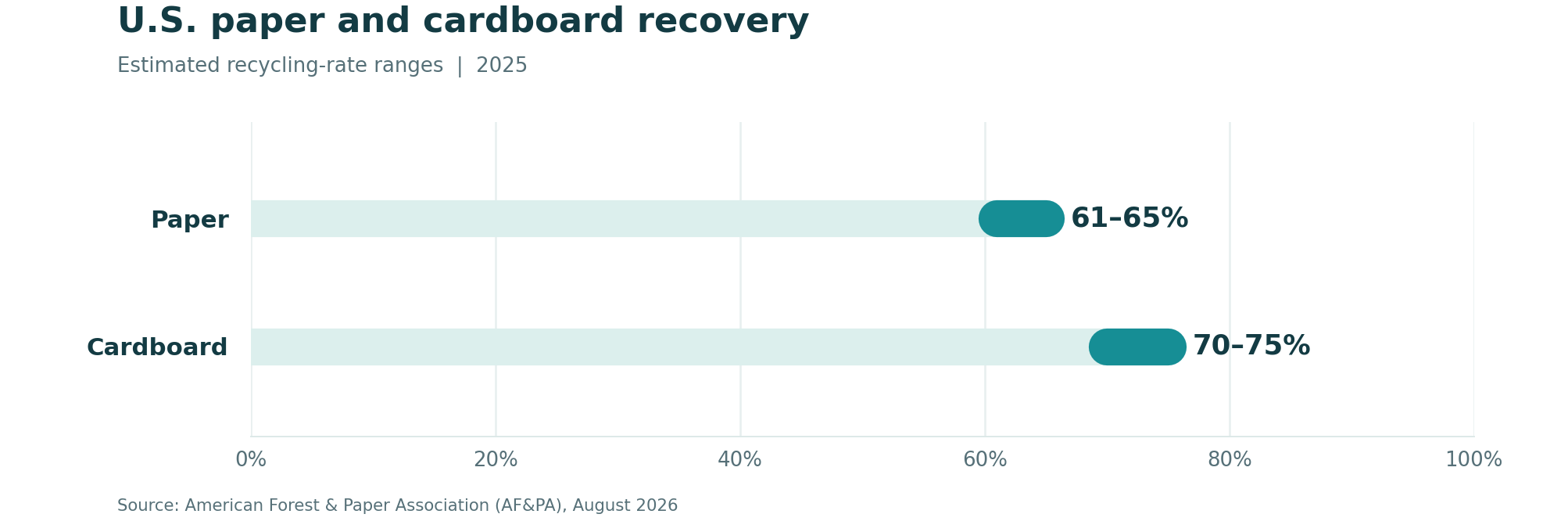
Figure 1. Estimated US recycling rates in 2025. Paper: 61%–65%; cardboard: 70%–75%. These figures reflect material recovery, not the recyclability of a particular finished package.
Source: AF&PA, 2025 US paper and cardboard recycling rates (released August 2026).
The business implication is not “switch everything to cardboard.” It is to evaluate how the full construction—coatings, labels, adhesives, windows, inks, and local collection access—affects your claims and end-of-life options.
For brands planning a launch, packaging design services should connect visual decisions with realistic material choices, rather than treating sustainability as a green icon added at the last minute.
4. Choosing the Right Format, Materials, and Design System
Before anyone chooses a color palette, decide what the package must do. Good packaging design services begin with these operational questions rather than ignoring them.
Will the product leak? Break? Melt? Need a tamper-evident closure? Sit in direct sunlight? Be handled by a child? Ship in freezing temperatures? These questions belong in the brief because they affect the format and available print area.
Common packaging formats and what they solve
Format | Typical products | Design consideration |
|---|---|---|
Folding carton | Cosmetics, supplements, specialty food | Panel hierarchy, folds, shelf-facing side |
Flexible pouch | Snacks, coffee, powders | Seals, gussets, curved viewing area |
Pressure-sensitive label | Bottles, jars, candles | Curvature, condensation, adhesive compatibility |
Rigid box | Gift sets, premium accessories | Cost, inserts, shipping volume |
Mailer or shipping box | Direct-to-consumer orders | Protection, opening experience, shipping dimensions |
Sleeve or belly band | Bundles, soap, gift items | Coverage, movement, exposed product information |
None is automatically superior. A luxury candle may need a protective carton; an everyday refill product may need something lighter. A good product packaging design decision starts with usage conditions and sales channels, not with whatever looked impressive on Pinterest last week.
Build a system for future variants
If you sell three scents now and plan to release twelve, solve that problem before printing the first three. Define what stays fixed—logo, product category, typographic grid—and what changes, such as scent names and colors.
This is where custom packaging design becomes a business asset rather than a one-off illustration. Instead of redesigning every new SKU from scratch, you have consistent rules that make line extensions faster and less error-prone.
Be careful with color alone as a differentiator. Shoppers with color-vision differences, black-and-white marketplace previews, or poor shelf lighting may not reliably distinguish flavors by hue. Names, patterns, and clearly readable variant information provide backup signals.
5. The Packaging Design Process: From Brief to Print-Ready Artwork
A typical project moves through discovery, creative direction, development, artwork production, and approval. The order sounds straightforward. The handoffs are where delays tend to happen.
Stage 1: Discovery and competitor review
Start with the product, audience, price point, channel, and relevant competitors. What must a shopper understand within a few seconds? What does your existing brand already own visually? Which competitor conventions help customers recognize the category—and which are merely clichés?
A credible packaging design company will ask for approved product copy, ingredients or specifications as applicable, target market, SKU list, and supplier details. If the team starts selling color palettes before asking what is inside the package, push for a better discovery conversation.
For unfamiliar categories, outside market research support can help validate assumptions about customers and competing products before creative concepts are finalized.
Stage 2: Concept directions and evaluation
Designers develop directions for visual hierarchy, logo placement, color, typography, and imagery. The best packaging design services show how the ideas answer the agreed commercial brief. Review concepts against the brief, not just personal taste. Ask how each direction works in a small listing image, in a full product range, and on the supplier’s actual dimensions.
Avoid a meeting where five stakeholders vote for their favorite shade of blue and nobody asks whether the net quantity statement fits.
Stage 3: Refine the chosen direction
Once the main system is selected, designers refine panels, variants, illustration details, and information flow. Confirm exactly which revision rounds are included. “Unlimited revisions” often sounds comforting until it turns a four-week schedule into a four-month argument about the word “fresh.”
Stage 4: Build production artwork
Artwork must be adapted to the approved dieline, printer color requirements, bleed, safe areas, finish layers, and output format. This is where packaging design services become more technical than the mockups suggest.
Do not assume that a realistic 3D rendering proves a file is production-ready. Mockups show appearance. Dielines and supplier proofs establish how the art fits the physical package.
Stage 5: Proof, test, and release
Check text against the approved master copy, review every SKU, test barcode readability, inspect color proofs where appropriate, and secure written approval from the responsible brand and production teams. For regulated categories, obtain the necessary legal or specialist review before releasing print files.
Then archive the final approved version. “Final_FINAL_v7_really-final.ai” is not a sustainable document-control system.
6. How Much Does Packaging Design Cost in the United States?
Let’s address the question people eventually ask after admiring the mockups: what will this cost?
The honest answer is that packaging design cost depends heavily on scope. A designer adapting supplied artwork to a label template is doing different work from a team developing brand strategy, structural concepts, and a six-product range.
DesignRush’s US agency overview lists broad indicative ranges of about $500–$2,500 for a single SKU or simpler label, $2,500–$10,000+ for multiple SKUs, and $10,000–$50,000+ for full brand-integrated packaging systems. These are marketplace estimates, not guaranteed quotes and not the pricing of ZH Consultancy.
Example budgets by type of engagement
Project scope | Indicative US budget* | What may change the quote |
|---|---|---|
Single label or straightforward SKU | $500–$2,500 | Source files, illustration, copy, dieline readiness |
Multi-SKU graphic system | $2,500–$10,000+ | Variant count, complexity, number of formats |
Integrated identity and package system | $10,000–$50,000+ | Research, strategy, production coordination |
Ranges summarized from DesignRush; individual firms and project scopes vary. Printing, testing, freight, tooling, and production are often extra.
Why a cheap quote can become expensive
Imagine two proposals. One promises a beautiful box for $600. The other quotes $1,800 and includes the printer’s approved dieline, three product variants, controlled revisions, and production-ready files.
The cheaper quote may be perfect if you already have everything organized. But if it excludes the work you actually need, you could spend more correcting it later.
Compare packaging design cost on total deliverables, not the first number in the email. Scope comparison is one reason packaging design services are easier to evaluate through detailed proposals than through headline package prices.
A sample budget you can adapt
The following is an illustrative planning scenario, not a survey of actual agency fees. Suppose a founder allocates $3,600 to a visual redesign with one master layout and three variants. The allocations could look like this:
Workstream | Example allocation |
|---|---|
Research and brief | $500 |
Creative direction and master design | $1,400 |
Three variant adaptations | $750 |
Mockups and presentation | $350 |
Prepress checks and final exports | $600 |
Total | $3,600 |
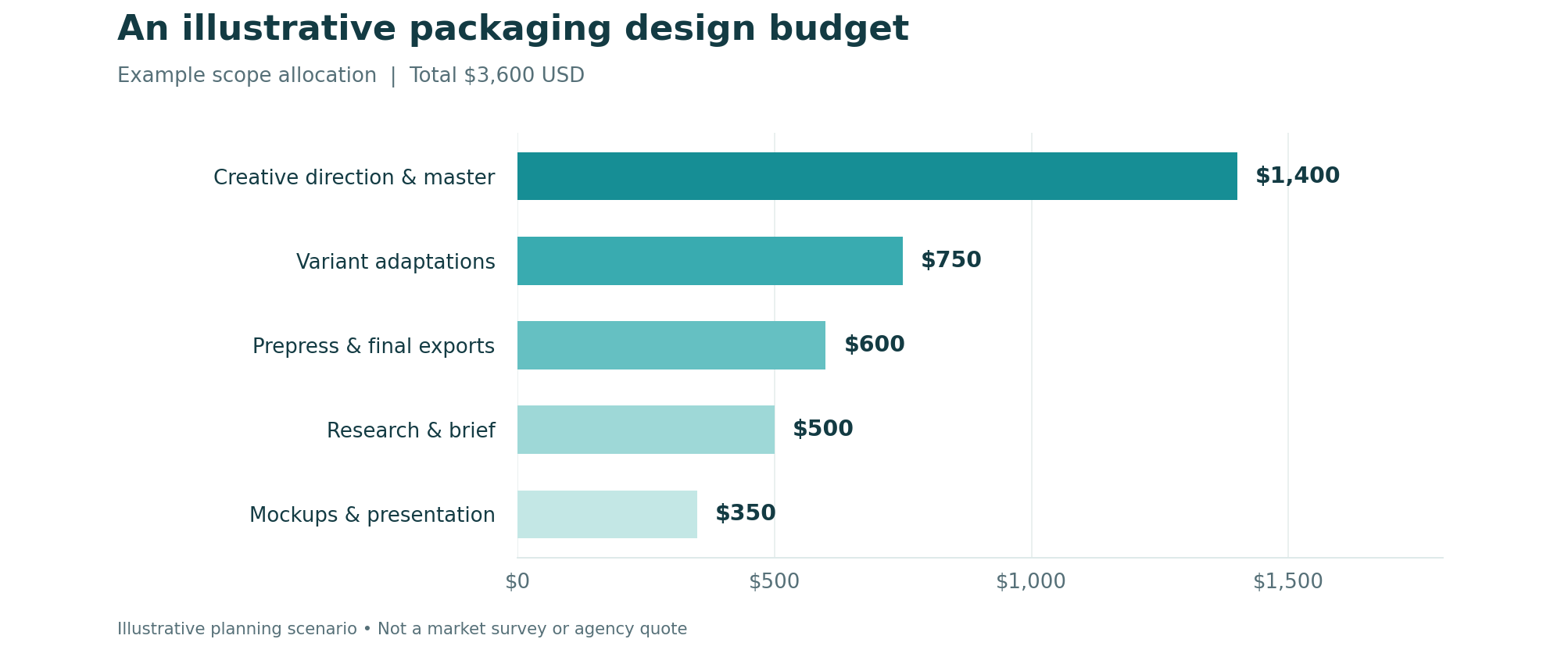
Figure 2. Illustrative US-dollar project budget totaling $3,600. Values are planning assumptions, not a measured industry average or a quote from ZH Consultancy.
Source: Editorial example based on defined workstreams; see DesignRush for published US pricing context.
That example also shows why understanding packaging design cost requires more than asking for a price per box design. You are purchasing thinking, system development, adaptations, and production-ready documentation—not merely a file that looks attractive on screen.
7. US Packaging Rules: Labels, Barcodes, and Environmental Claims
Packaging rules are not decorative suggestions. Some are industry standards; others are legal requirements. They also differ by product category and jurisdiction.
A design team can lay out approved text, but the business placing the product on the market generally needs appropriate legal, regulatory, and supplier review. Don’t confuse “the label fits” with “the label is compliant.”
Food labels need space for mandatory information
For many packaged foods in the US, FDA labeling requirements govern product identity, net quantity, and other disclosures, depending on the product. The FDA’s Food Labeling Guide explains principal display panels and information panels, among other requirements.
For instance, the net quantity statement generally has prescribed placement requirements on the principal display panel. If the front artwork leaves no room for it, the creative concept may need changing—not the regulation.
Cosmetics, dietary supplements, alcoholic drinks, pesticides, and other categories can involve distinct agencies or specialized rules. Confirm which requirements apply before artwork is approved.
Barcodes have technical needs
Retail barcodes are not magic black rectangles that scan regardless of how creatively you decorate them. GS1 US barcode guidance addresses contrast, quiet zones, size, placement, and print quality.
A pretty barcode placed across a fold or over a busy background can become an expensive checkout problem. Ask the printer and retailer to confirm the applicable barcode specifications and verify printed samples when appropriate.
Sustainability claims need evidence
The FTC’s Green Guides summary warns against unqualified recyclable claims when appropriate recycling access is not sufficiently widespread; its guidance uses a 60% access benchmark. That is about access to recycling facilities for the relevant item, not the national paper recovery percentage shown in Figure 1.
A carton containing a plastic window, laminate, or specialized coating might behave differently from an ordinary cardboard box in recycling systems. Blanket labels such as “100% eco-friendly” can create risk if they are not appropriately substantiated.
Professional packaging design services should preserve room for vetted claims and disclosures, while compliance decisions remain with qualified responsible parties.
8. How to Choose a Packaging Design Agency or Company
A portfolio can tell you whether someone has taste. It cannot tell you whether they will organize twenty-seven versions of your ingredient panel without making a mistake.
That is why choosing a packaging design agency involves more than admiring pretty boxes.
Review relevant work, not just glamorous work
Ask for projects close to your category, price level, and intended selling channel. A brilliant perfume box doesn’t automatically demonstrate experience with refrigerated food labels or shipping-sensitive glass products.
Look for systems, not isolated hero shots. Can the designer show a family of SKUs, packaging in real physical conditions, and readable secondary panels?
Ask these seven questions before signing
1. Will you work on supplier-approved dielines, or develop the structure as part of the scope?
2. How many unique SKUs, sizes, and formats are included?
3. What files and editable assets will we receive, and what rights transfer?
4. How many concepts and revision rounds are covered?
5. Who checks copy accuracy, barcode specifications, and regulatory requirements?
6. What happens if the printer requests technical changes after approval?
7. Is the price for design only, or does it include printing and samples?
A reliable packaging design company should answer these in plain language. If the proposal says “full branding experience” but won’t explain file handoff, you have more discovery to do.
Remote collaboration can work well
US businesses do not necessarily need a local studio for every artwork project. Clear briefs, video calls, structured feedback, and supplier-approved files can make remote work practical. What matters is responsibility for the technical handoff and access to decision-makers.
ZH Consultancy serves US clients remotely through its graphic design services, and its packaging page explains that the agreed scope covers artwork rather than manufacturing. If you already have a logo but need matching labels and boxes, that separation can be useful.
When comparing providers, ask for a US-dollar quote that clearly states inclusions and exclusions. A lower price means little if key deliverables sit outside the agreement.
9. Prepare a Brief That Saves Time, Revisions, and Money
A bad packaging brief usually looks like this: “Make it premium, modern, clean, exciting, natural, and different from everyone else. We need it Friday.”
That is not a brief. That’s a collection of adjectives wearing a deadline.
Better briefs turn vague preferences into testable requirements.
What to send your designer
Start with the product dimensions, category, customer profile, price range, selling channel, and brand assets. Add the supplier’s confirmed template, approved label copy, relevant legal guidance from your advisers, SKU list, competitor examples, and a realistic target date.
Explain the commercial problem. Are customers confusing flavors? Is the current package hard to read? Is the product entering a more premium retail channel? A design team cannot solve a problem you haven’t described.
Also share what must not change. Product packaging design should reflect brand equity rather than discard it on a whim. Existing customers may recognize your logo, color, or key product cue. A redesign that discards every familiar element can create unnecessary confusion.
A simple approval system
Nominate one decision-maker who collects comments from internal stakeholders. Put feedback in one place and distinguish required changes from personal preferences. Confirm a master copy deck before final artwork begins.
If your team is commissioning custom packaging design for several variants, use a SKU matrix that lists product names, sizes, approved claims, barcodes, and language versions. It sounds unglamorous because it is. It also prevents expensive misprints.
A clear brief helps a packaging design agency give a more accurate quote and keeps late-stage surprises under control. It also makes packaging design services more accountable: everyone knows which problem the work is meant to solve.
10. Common Packaging Design Mistakes—and How to Avoid Them
Most packaging mistakes are not artistic disasters. They’re ordinary shortcuts that reveal themselves at the worst possible moment: after the print order is paid for.
Mistake 1: Designing before confirming the packaging structure
A team falls in love with a tall, narrow bottle, then discovers the supplier only stocks a wider option. The art must be reworked and the launch gets pushed back. Fix: confirm usable dimensions and a supplier-approved dieline early.
Mistake 2: Treating the back panel as an afterthought
The front looks outstanding. The ingredient list, warnings, and barcode are squeezed into whatever space remains. Fix: allocate required content before polishing the decorative details.
Mistake 3: Approving a mockup instead of production artwork
A 3D preview hides a fold conflict or tiny text. Fix: review flat artwork at actual size and obtain production proofs where needed.
Mistake 4: Changing everything in a redesign
New logo, new colors, new name position, new pack silhouette—everything at once. Loyal buyers may struggle to recognize the product. Fix: identify existing equity worth protecting before the refresh.
Mistake 5: Choosing a provider on price alone
The cheapest proposal excludes additional variants, prepress work, or editable source files. Fix: compare packaging design cost using a deliverables checklist, not a headline rate.
Mistake 6: Making unsupported green claims
A recycling symbol gets added because the carton looks like paper. Fix: review the finished material construction, substantiation, and relevant marketing rules before making environmental claims.
Mistake 7: Skipping physical tests
The label peels in cold storage. The pouch tears at the seal. The box scuffs during fulfillment. Fix: test realistic materials and print proofs with the supplier; graphic approval is not a substitute for functional testing.
Thoughtful product packaging design should account for these failure points as part of a disciplined process. That is much less exciting than choosing a foil finish, but often more valuable.
11. Measuring Whether a Packaging Redesign Worked
A successful redesign is not simply one that receives compliments on Instagram.
You need an answer to a more useful question: did the new package help the business achieve the goal set in the brief?
That goal might be better product recognition, fewer customer questions, improved shelf readability, smoother production, or a more consistent appearance across ten product variants. Measure packaging design services against those defined goals, not compliments alone. Sales can matter too, but many factors influence sales simultaneously.
Decide what to measure before launching
For retail, compare sell-through carefully across similar stores and periods where possible. For ecommerce, assess listing click-through and conversion with suitable controls. For operations, track misprints, production clarification requests, packaging damage, and time required to launch new SKUs.
If you change the design, product price, advertising budget, and retailer distribution at the same time, you cannot credibly credit all the improvement to packaging alone.
A packaging design company that promises a fixed percentage sales lift without understanding your channels and baseline metrics is offering a prediction, not an outcome it can guarantee.
The most useful post-launch review asks what worked, what confused shoppers, and what should change in the next production run.
12. The Future of Packaging Design: What US Brands Should Watch
What will matter between 2027 and 2030? Probably fewer flashy effects than the internet would have you believe—and more disciplined trade-offs.
Material choices and producer responsibility
Packaging laws and extended producer responsibility programs are evolving across US states, while retailers and brand owners continue examining material footprints. The PMMI sustainability research discusses how material performance, equipment compatibility, cost, and regulatory pressure interact.
Instead of promising that every brand must switch to one “winning” material, plan for packaging systems that can accommodate verified supplier changes and revised claims.
Digital discovery will keep influencing hierarchy
Products are increasingly discovered through marketplace listings, short videos, and mobile shopping. That makes clear front-panel information and recognizable imagery especially useful at small sizes. Designers should test actual listing thumbnails, not rely entirely on high-resolution presentation slides.
Automation will accelerate variations—but not responsibility
AI-assisted image development, automated resizing, and packaging artwork workflows may speed up exploration and line extensions. They do not remove the need for human review of claims, licensed assets, color output, regulated copy, or physical production specifications.
The strongest packaging design services will likely combine faster production workflows with careful quality control. Speed is valuable. Speeding up the creation of 15 incorrect labels is not.
More brands will need adaptable systems
As products expand across sizes, scents, subscription packs, and retail partners, consistency becomes harder. Scalable templates, clear variant rules, and disciplined file organization help businesses respond without repeatedly restarting design work.
This is why future-proofing often looks less like a futuristic hologram and more like a well-organized folder of correct files.
13. The Takeaway
A good package has to win more than a beauty contest. It needs to tell the truth about the product, help customers understand the offer, respect the physical format, and survive the journey from artwork to manufacturing.
When choosing packaging design services, start with a clear brief and supplier specifications. Compare proposals by deliverables. Check US-specific labeling questions with qualified advisers. Demand real file handoffs and production checks, not just attractive mockups.
If you want to discuss a new label, a packaging refresh, or a coordinated product range, explore ZH Consultancy’s packaging design work and contact the team with your product details and supplier template. The right first conversation can save a surprising amount of trouble later.
Faq
Frequently Asked Questions
Typical packaging design services can cover research, creative concepts, brand graphics, label layout, mockups, SKU adaptations, and print-file preparation. Scope varies. Ask whether structural engineering, copywriting, regulatory review, printing, and physical samples are included before agreeing to a quote.
A straightforward single-SKU label or package may fall around $500–$2,500 in marketplace estimates, while multi-SKU systems can cost several thousand dollars or more. Your actual packaging design cost depends on creative scope, file requirements, number of variants, and revisions. Production and printing are normally separate unless specifically included.
A simple package using a ready supplier template may take a few weeks; larger systems with research, several variants, structural development, or complex review can take longer. Schedule also depends on how quickly your team supplies approved copy and feedback. Confirm milestones and printer lead times before promising a launch date.
A packaging design agency concentrates on strategy, visual direction, and artwork, while a printer manufactures physical labels or packaging using approved specifications. Some companies offer both. Confirm which party owns structural testing, color proofs, print setup, and final production sign-off.
Yes. Custom packaging design can be tailored for ecommerce, including thumbnail readability, delivery protection, a consistent unboxing experience, and multi-product branding. However, a graphics provider cannot automatically guarantee compliance with marketplace rules, retail requirements, or shipping performance; those should be checked separately.
A packaging design company should provide the specific deliverables in your contract, often including print-ready artwork on the approved dieline, agreed variants, mockups, and organized exports. Request clarity on editable source files, fonts, licenses, color specifications, and whether future alterations are permitted.
No. Sustainability can involve several trade-offs, including material use, transportation, product protection, recycled content, and end-of-life systems. A package’s actual recyclability depends on its complete construction and available collection and processing facilities. Avoid broad claims without evidence and review applicable FTC guidance before printing them.

Zain Hameed
Business strategy specialist helping a global client base of 800+ businesses build credible plans, financial models and investor-ready presentations.
In this article
Book a Free Consultation
Have a business idea, growth challenge or investor deadline? Book a free consultation and get clear next steps from our team.
Call our team
+923104049517
Email us

Business Topics
Business topics
Continue reading
Related insights
How to Start a Photography Business in 2026: From First Client to Profitable Studio
You take a photograph. Someone sees it and says, “You should

How to Start a Dumpster Rental Business: From First Container to Profitable Fleet
Learn how to start a dumpster rental business, estimate startup costs,

How to Start a Bounce House Business: From Weekend Rentals to a Profitable Company
Learn how to start a bounce house business, estimate startup costs,

How to Start an Interior Design Business: From Creative Talent to Profitable Studio
Learn how to start an interior design business, understand qualifications, estimate

How to Start an Electrical Business: From Skilled Electrician to Profitable Contractor
Learn how to start an electrical business, understand licensing, estimate startup

How to Start a Window Cleaning Business: From First Job to Profitable Company
Learn how to start a window cleaning business, estimate startup costs,