

In this article
Imagine this: a procurement manager asks your team to send a company introduction before a meeting. You have an excellent product, a capable team, and several satisfied customers. You also have a PDF last updated four years ago, complete with an old logo, stock photos of handshakes, and a twelve-paragraph mission statement that somehow never explains what you actually do.
You attach it anyway.
Five minutes later, that PDF is representing your business in a room you cannot enter.
This is the uncomfortable truth about company introductions. The document is often read when nobody from your team is there to clarify the confusing parts. A prospect forwards it to colleagues. A partner reviews it between meetings. An investor or procurement officer searches for specific evidence. Your profile either makes those jobs easier, or forces people to do detective work.
That is where company profile design services become useful. The goal is not to fill pages with attractive shapes. It is to turn your actual experience, capabilities, and proof into a convincing document someone can scan, understand, and confidently share.
This guide is written for US startups, consultants, service companies, manufacturers, construction firms, and growing B2B teams. We’ll examine what belongs in a profile, realistic design costs, how a designer works, mistakes that quietly undermine credibility, and how buyer behavior may shape the next few years. You’ll also find a sample content structure, practical budgeting exercises, industry research, and seven questions that come up before businesses hire a designer.
The important distinction is this: your website helps people discover you. A well-built company profile helps them explain why you deserve consideration after they have.
1. What Are Company Profile Design Services, Exactly?
A company profile is a structured introduction to a business. It usually explains what the company does, who it serves, what makes it credible, and how someone can start a conversation. It may be a short PDF, a multi-page document, a presentation-style file, or a print-ready booklet.
Company profile design services combine information architecture and visual communication. Depending on the agreement, the provider might also interview stakeholders, write or edit copy, develop a creative direction, organize case studies, design charts, retouch supplied images, and prepare files for digital or print distribution.
Design and writing are not automatically the same service. Strong business profile design requires deliberate content decisions. Some designers expect finished text and approved images before layout begins. Others offer content development. Clarifying that difference early prevents delays.
A company profile is not a brochure, pitch deck, or capability statement
These formats overlap, but they are not interchangeable. A brochure often promotes a defined offer or campaign. Company brochure design therefore has a narrower objective. A pitch deck is usually built to support a live presentation or a specific funding discussion. A capability statement, frequently used in contracting, can be a concise document focused on qualifications, experience, and supplier identifiers. A company profile introduces the organization more broadly.
For a construction contractor, the corporate introduction might include safety practices, project categories, geographic coverage, qualifications, and selected completed work. For a software consulting firm, the document may focus on services, implementation method, technology partnerships, and client outcomes. The order follows the reader’s questions, not a universal template. This is the real foundation of corporate profile design.
Corporate profile design therefore starts by defining the job the document must perform. A twelve-page profile that opens with company history might be perfectly suitable for one audience and frustratingly irrelevant for another.
What a good project should deliver
Typical deliverables include a page plan, visual concept, revised page layouts, a final screen-friendly PDF, and any agreed print-ready version. Some scopes include editable source files; others provide only final exports. Ask about fonts, photography licensing, charts, revision limits, ownership, and how future updates will work.
If you want a quote or hands-on production rather than this educational guide, explore ZH Consultancy’s company profile design services. That service page covers ZH’s actual approach and project discussion; this article focuses on helping you prepare and evaluate the work.
2. Why a Professional Company Profile Still Matters in 2026
You might wonder whether the company profile has become obsolete. Prospects can search your website, check reviews, browse LinkedIn, and ask AI tools to summarize your business. Why spend money on another document?
Because buying decisions are rarely made from a single screen by a single person. Information moves between channels and people, often in fragments. Well-scoped company profile design services give your team a controlled, portable version of the same business story. It can accompany a proposal, appear in a procurement packet, support a referral, or give a new business partner the necessary context.
Buyers want to research independently, then verify
A May 2026 Gartner survey of 645 B2B buyers reported that 70% preferred a completely digital, self-service buying experience, 67% preferred a sales-rep-free experience, and 45% had used generative AI in a recent purchase. The same research found that 69% preferred to validate AI-generated insights with sales representatives.
Those findings are about broader B2B buying behavior, not an experiment proving that company profiles increase conversion. The implication, however, is practical: buyers want accessible, consistent information they can inspect before a conversation, and they still seek dependable evidence when stakes are high.
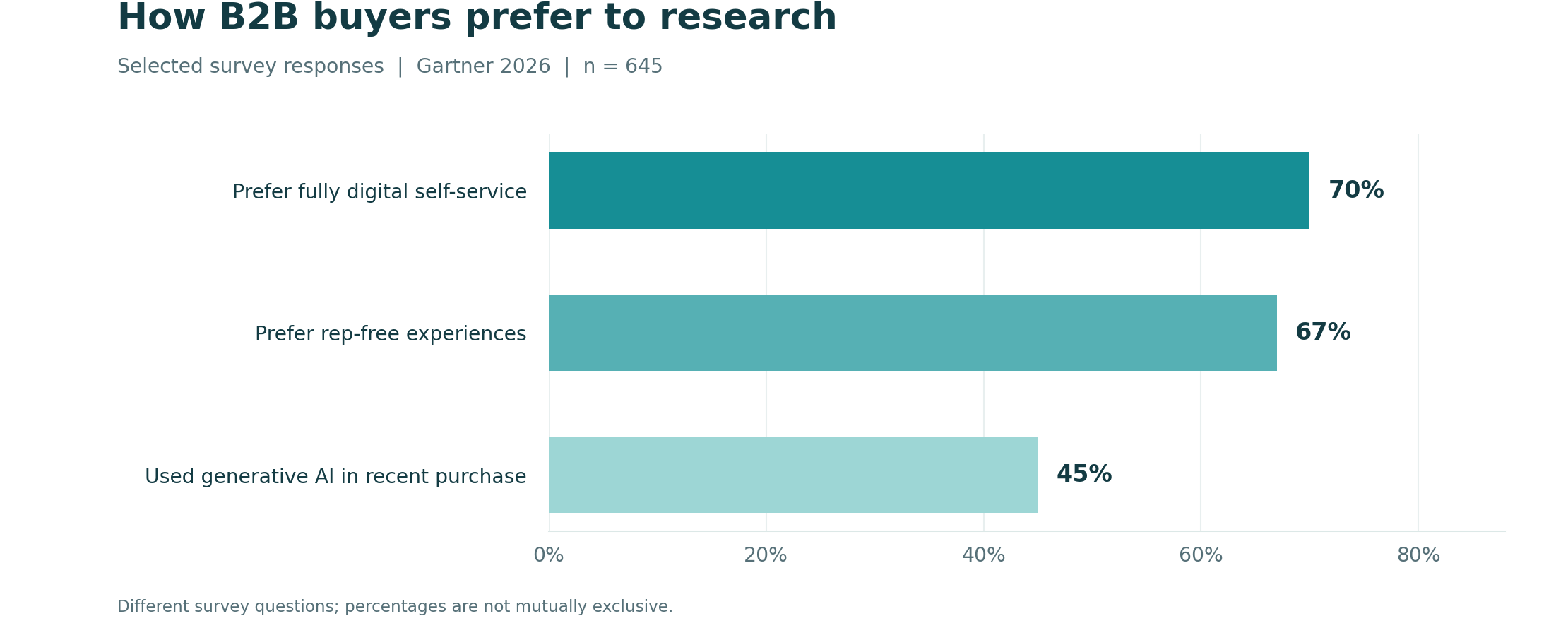
Figure 1. B2B buyer research behaviors, 2026. Percentages refer to different questions in Gartner’s survey of 645 buyers and should not be added together.
Source: Gartner, May 20, 2026.
What does this mean for a company profile? Make information easy to find. State what you do. Explain relevant experience. Support important claims. Remove old, contradictory details. A beautiful PDF that makes customers work harder is still a poor sales tool.
Think about the person forwarding the document
Here’s a useful test. Pretend a prospective client likes your company and must convince a skeptical colleague to include you on a shortlist. They forward your PDF with the note, “This team looks promising.”
Can the colleague quickly find your capabilities, market experience, proof, and contact information? Or do they have to email back with five basic questions?
A professional company profile gives that internal advocate something stronger than enthusiasm. It provides a clear case they can circulate without rewriting the entire introduction themselves.
3. What Should a Company Profile Include? A Reader-First Structure
There is no magic page count or universally correct sequence. Useful business profile design starts with decisions, not decoration. But readers usually arrive with a small group of questions: Who are you? What do you solve? Who trusts you? What have you delivered? Can you handle a project like mine? What happens next?
If your profile answers those questions efficiently, you’ve built a strong foundation. If it doesn’t, no amount of gradient backgrounds will rescue it.
1. Cover and a useful opening promise
Lead with the business name, logo, a relevant visual, and a sentence explaining your value. Avoid turning the cover into an awards ceremony or a philosophical statement about innovation. “Commercial HVAC maintenance across Greater Boston” tells a buyer much more than “Excellence Through Synergy.”
2. Company overview in plain language
Describe what you provide, your primary customers, geographic reach, and business model. Keep the first explanation short enough to repeat in a conversation. Save detailed corporate history for later, if it matters.
3. Services and capabilities
Group offerings around the customer’s problem rather than internal departments. For a manufacturing business, mention production capabilities, relevant materials, quality controls, lead-time considerations, and capacity claims you can substantiate. For a consultancy, explain deliverables and engagement models.
Business profile design works best when each service page is specific rather than an endless sequence of generic adjectives. “We help” is not an outcome. Explain what the customer receives.
4. The people and processes behind the work
Include leadership or team information when it strengthens trust. In some industries, a clear process matters more than a gallery of employee headshots. A simple diagram explaining discovery, delivery, review, and handoff can be more valuable than a full page of motivational quotes.
5. Proof: case studies, credentials, and verified results
This is where a weak profile can become convincing. Describe a relevant challenge, the work performed, and the result. Use numbers when they are accurate, permissioned, and contextualized. A 15% improvement means little unless the reader knows what improved and over which period.
Client logos require permission where appropriate; testimonials should be authentic; awards and certifications should be current. If project details are confidential, explain the industry and type of work without identifying the client or disclosing protected information.
6. Industries, locations, and practical qualifications
A US contractor may need state licensure and insurance details; a technology vendor may be evaluated for security practices; an industrial supplier may need to show specific certifications. Include only what the audience needs and ensure every statement is current. Avoid making vague compliance promises that legal or procurement teams cannot verify.
7. Contact details and next step
Finish with one clear action: request a proposal, arrange an introduction, review a case study, or contact the relevant team. Include accurate website, email, phone, and location information. For a digital profile, links should work. A QR code can help, but it should never be the only contact method.
An example ten-page structure
Pages | Purpose | What the reader should learn |
|---|---|---|
1 | Cover | Who you are and what you do |
2 | Snapshot | Main services, customers, and reach |
3–4 | Capabilities | Specific services and delivery method |
5–6 | Proof | Projects, results, and evidence |
7 | Team or operations | Who delivers and how |
8 | Credentials | Relevant qualifications and standards |
9 | Why work together | Practical strengths and differentiation |
10 | Next step | Contact and clear invitation |
These are illustrative pages, not a rule; company profile design services should fit your actual audience. A two-page overview can outperform a lavish twenty-page booklet if it makes the decision easier. The better question is, “What would this buyer miss if we removed this page?”
4. Company Profile Design Cost in the USA: What Should You Budget?
Let’s talk about the question that often comes up before anyone discusses typography: “How much should this cost?”
The frustrating answer is that two companies asking for a “ten-page company profile” may be buying completely different projects. One has approved copy, licensed images, and an established brand system. The other needs interviews, positioning, writing, charts, photo selection, and a visual identity refresh.
Identical page counts do not mean identical workloads.
Market pricing context without pretend precision
A September 2026 Clutch guide reports that many design agencies on its platform charge $25–$49 per hour and that graphic and print-design projects on the platform often fall below $10,000. These are broad design-industry observations, not a statistically representative price range for US company profiles specifically.
Some published US-oriented rate cards are more specific: Largify Solutions lists a company profile up to ten pages at $399 and a fifteen-to-twenty-page version at $649. At the other end, specialized agencies can charge substantially more for research-led creative work and content production. A simple PDF layout and an executive-ready brand document are different products.
When comparing company profile design services, the safest way to estimate company profile design cost is to define the scope, request comparable proposals, and separate optional work from essentials. Be cautious about any online article claiming that every US profile costs exactly one amount.
Illustrative budget: a 12-page B2B company profile
Consider a fictional US professional-services firm commissioning a refreshed twelve-page document. It already owns its logo and brand guidelines, but needs some copy editing, case-study organization, and final PDF exports.
Workstream | Illustrative allocation |
|---|---|
Discovery, outline, and page plan | $400 |
Copy refinement and proof review | $600 |
Visual direction and master layouts | $1,200 |
Remaining page layouts and graphics | $1,100 |
Revisions, accessibility checks, and exports | $500 |
Total illustrative project | $3,800 |
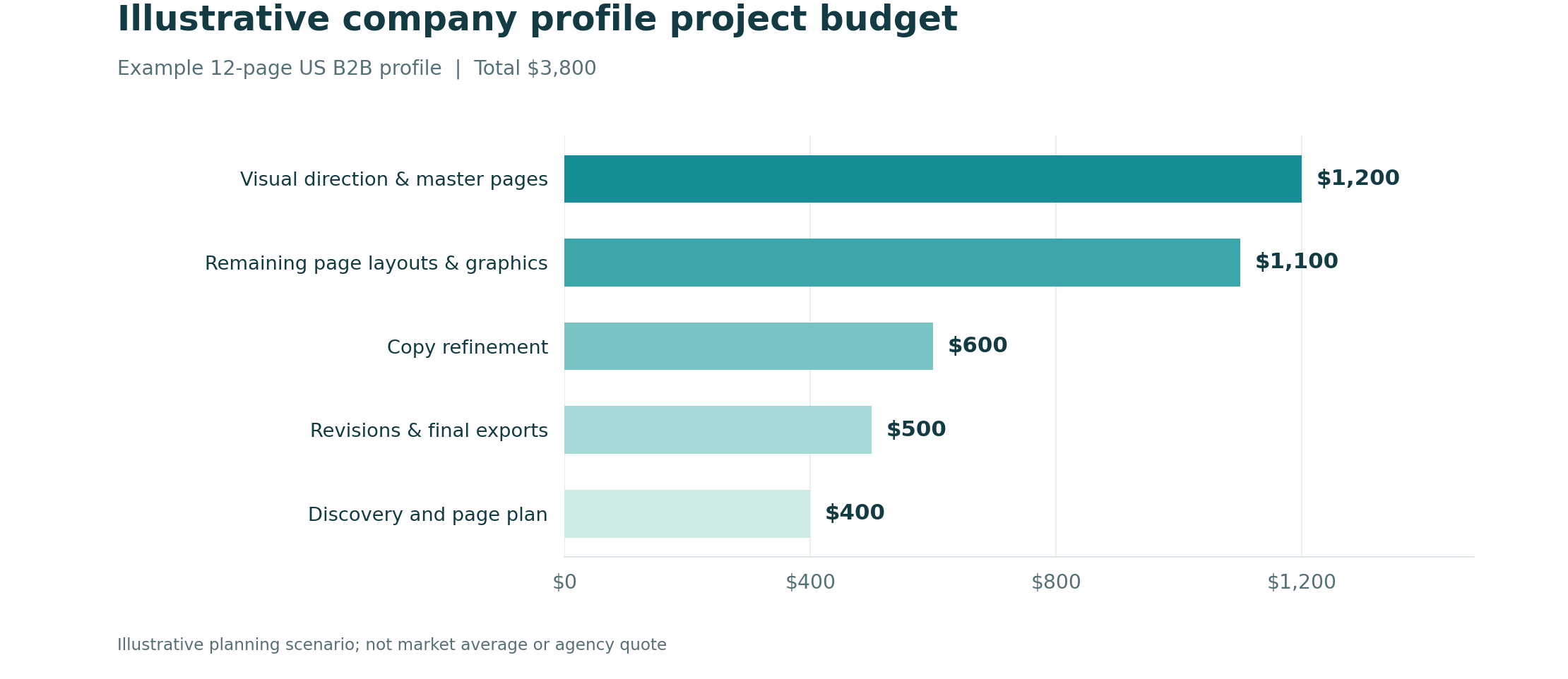
Figure 2. Illustrative 12-page profile budget in USD. Values demonstrate possible scope allocation, not an average quote, survey result, or ZH Consultancy price.
Source: Clutch design pricing context; allocation is an original planning example.
The useful part is not whether your quote matches $3,800. It’s that you can see which tasks drive the total. If you provide approved copy and a reliable brand guide, you may reduce preparation time. If your team wants five departments to approve every page, revisions may take longer and cost more.
What pushes the quote up or down?
Page count matters, but it is rarely the only cost driver. Writing from scratch, executive interviews, custom illustration, infographics, bilingual versions, complex diagrams, photography, print preparation, accessibility remediation, rush delivery, and additional revision rounds all change the workload.
A thoughtful provider should also distinguish design time from printing, licensing, translation, and distribution expenses. Without that separation, you can’t compare proposals fairly.
When evaluating company profile design services, ask for a scope that lists page count, content responsibilities, file formats, stages, number of review rounds, and additional-work rates. That beats choosing the lowest headline price and discovering later that editable files cost extra.
5. How the Company Profile Design Process Should Work
Many disappointing profile projects begin with an instruction that sounds helpful: “Make it modern and professional.”
Modern compared with what? Professional to which audience? What should the reader do afterward?
That brief asks a designer to guess at the most important decisions. Good company profile design services replace guesswork with a sequence of questions and approvals.
Step 1: Define the reader and the use case
Clarify who receives the document and what decision it supports. Is it for an initial customer introduction, a procurement review, distributor onboarding, conference outreach, recruiting, or a partner proposal? Different purposes demand different proof.
For regulated or technical work, identify who verifies claims. Existing business planning or market research materials can provide source content, although they are separate from design services.
Step 2: Audit what already exists
Gather the website, current PDF, sales slides, brand guide, past proposals, approved customer stories, and product or service details. Flag outdated logos, statistics, certifications, and contact information. Company profile examples from your industry can help identify familiar conventions, but do not copy competitors’ narrative or visual identity.
Step 3: Agree on a page map before design
Write one sentence explaining the purpose of every page. Ask whether the reader will know what to look at, which evidence supports the claim, and what question remains unanswered. This is the content strategy behind strong corporate profile design.
Step 4: Approve copy and information hierarchy
Use short paragraphs, meaningful headings, credible claims, and appropriately labeled metrics. Avoid filling every blank space with extra prose. No one has ever complained that a company profile made the most relevant information too easy to find. This is where corporate profile design earns its keep.
Step 5: Design an actual system, not isolated pages
Choose type styles, spacing, colors, grids, photo treatment, table and chart styles, and recurring layouts. Once these foundations are approved, create the full profile. Consistency improves both recognition and maintainability.
Step 6: Run real-world checks
Open the PDF on a phone and a laptop. Read it at ordinary zoom, not only on a 27-inch designer monitor. Check links, image quality, color contrast, file size, page order, and whether charts remain legible. If printing is needed, confirm trim, bleed, and printer requirements.
Step 7: Deliver ownership and update instructions
Know who retains editable files, whether commercial fonts and images are licensed correctly, and how corrections will be handled. An editable document is valuable only if your team also has the required fonts, assets, permissions, and software.
This is why business profile design is not simply picking a template and dropping in the logo. The preparation and quality checks often determine whether the final result remains useful six months later.
6. Company Profile Examples: What Different US Businesses Need
To get the best from company profile design services, stop asking what a beautiful document looks like and start asking what a useful document looks like for your customer.
Example A: Construction and facilities services
Imagine a regional contractor bidding for commercial maintenance work. The customer wants evidence of delivery capability, not a dramatic origin story. The opening pages should state geographic coverage, service categories, relevant project types, safety practices, and verified credentials. Project spreads might show scope, schedule, and the contractor’s role in clear terms.
Useful company profile examples here include selected project summaries and a straightforward capabilities matrix. Avoid using generic construction photos that have nothing to do with actual work unless clearly labeled as illustrative.
Example B: B2B software and technology consulting
A technology buyer needs to understand the company’s service model, typical project stages, relevant technologies, security responsibilities, and credible outcomes. An attractive list of software logos is not proof of certification or partnership. Name relationships only if they are verified.
A short process graphic can make an engagement understandable without cramming in engineering details. The best company profile examples show this discipline. For firms with complex products, professional company profile writing should clarify what is included and what remains the customer’s responsibility.
Example C: Professional services and consulting
A consulting firm’s differentiator often lies in its people, methodology, judgment, and experience. A profile may benefit from leadership credentials, a clear service model, sector focus, and anonymized project outcomes when confidentiality limits disclosure. Compare company profile examples for how each treats confidential work.
If every section says “innovative solutions,” the reader learns nothing. Show a relevant business problem, how the team approached it, and what the customer can reasonably expect during an engagement.
7. The Global B2B Market Outlook: What Research Tells Us
There is no reliable single market-size figure that cleanly represents worldwide spending on company profile documents. Some reports measure graphic design agencies; others include software applications, printing, brochures, corporate communications, or all of the above. Treating those markets as interchangeable would mislead the reader.
Statista’s Graphics & Design worldwide forecast covers consumer design apps and associated app revenues, not corporate profile design fees. It is useful evidence of design-tool activity, but it would be the wrong figure to present as the size of this service market.
Instead, two more relevant global indicators come from recent studies of how businesses evaluate suppliers.
Buyers now move across many channels
In May 2026, McKinsey’s Global B2B Pulse described research among nearly 4,000 decision-makers across 13 countries. Buyers used an average of ten channels across the purchasing journey and expected information to remain consistent as they moved between them.
Company profile design services address just one of those touchpoints. Its job is to reinforce your website, proposal, salesperson, and other materials rather than contradict them.
Trust and verification matter more than polished claims
A 2025 Forrester summary of B2B trust research reported that 82% of B2B buyers trusted coworkers and management as information sources, while 79% trusted vendors with whom they already worked. These are trust ratings from a broader B2B study, not evidence that a PDF alone creates trust.
Still, they point to a useful design choice. A profile should help a champion explain the decision to coworkers, using tangible evidence rather than generic self-praise. The material must also align with what existing customers and your sales team can substantiate.
What might change between 2027 and 2030? Expect more buyers to discover vendors through AI-assisted research, more need for concise and machine-readable factual content, and stronger pressure to keep sales materials synchronized. Those are direction-of-travel judgments based on the research above—not guaranteed forecasts for the price or demand of profile design.
8. How to Choose a Company Profile Design Agency
A common mistake is hiring based on the prettiest mockup in a portfolio. Gorgeous layouts tell you something about visual ability. They tell you less about research, writing, accuracy, and how the provider handles a complicated approval process.
The right company profile design services begin with questions less glamorous than color palettes. Who will read this? What do they already know? What decision is at stake? What evidence can we include? Who owns the final content? What happens if your sales team wants changes six months later?
When comparing company profile design services, review at least one complete multi-page sample, not just a cover. Look for readable body text, consistent grids, relevant visuals, and useful page sequencing.
Seven questions to ask before signing
1. Who writes and fact-checks the text, and when is content considered approved?
2. Can I see a full profile from an industry similar to mine, with confidential details appropriately removed?
3. What is included in the price, and how many revision rounds do we receive?
4. Will you provide screen-optimized and print-ready PDF versions if required?
5. Are editable source files, fonts, stock imagery, and commercial rights included?
6. How will you handle charts, accessibility, and updating pages after launch?
7. What does the schedule depend on, and who must approve each milestone?
The answers make competing proposals easier to evaluate. If one supplier includes writing, a master design system, two review rounds, and editable files while another supplies only a flattened PDF, you aren’t comparing like for like.
What about freelancers versus agencies?
Business profile design can be delivered well by a freelancer or an agency. A freelancer may fit a small profile with approved content and branding. An agency can be useful when copy strategy, design, stakeholder management, and several related deliverables need coordination. Neither option is automatically better.
A company profile design cost comparison should focus on scope and handoff rather than the provider’s label.
Company brochure design may be an adjacent deliverable, but it is not automatically included. For businesses whose profile is part of a wider brand refresh, it may make sense to coordinate with ZH Consultancy’s graphic design services rather than treating the PDF as a completely separate asset.
9. Common Company Profile Mistakes—and How to Fix Them
Some of the most damaging mistakes made during company profile design services are barely noticeable during the review. The colors look good, the cover is impressive, and everyone approves the PDF. Then the document goes into the real world, where a buyer asks a very ordinary question and can’t find the answer.
Mistake 1: Telling your history before explaining your value
A seven-paragraph founder story makes readers wait to learn what your company actually does. Solution: open with your services, audience, and differentiator. Move company history to the section where it supports credibility.
Mistake 2: Treating adjectives as evidence
“World-class,” “industry-leading,” and “customer-centric” may be appealing, but they don’t tell the reader what happened on a real project. Solution: use specific capabilities, relevant credentials, and properly contextualized outcomes.
Mistake 3: Designing every page for print, then emailing it as a PDF
Small type, complicated spreads, giant file sizes, and dead links can turn a handsome document into an irritating screen experience. Solution: test the profile at actual email-and-phone sizes and provide a screen-optimized version. Print can be a separate export.
Mistake 4: Including unapproved client names or misleading metrics
This can create relationship, legal, and reputational problems. Solution: review permissions and claims, label estimates, and remove confidential information. Don’t manufacture case studies to fill a layout.
Mistake 5: Letting five departments rewrite the same page
Too many decision-makers can produce an inconsistent voice and endless revision loops. Solution: appoint one content owner, one final approver, and a defined feedback window. Collect consolidated comments rather than scattered messages.
Mistake 6: Choosing a template before understanding the audience
Company brochure design and profile templates are useful starting points. But when a manufacturer and a software consultancy get the same page structure, at least one is probably making readers work unnecessarily hard. Solution: audit real information needs before choosing layouts.
Mistake 7: Forgetting what happens after delivery
Someone changes the service offering, a leader leaves, or a certification expires. The PDF remains online for two more years. Solution: set an owner and review schedule for factual updates, and request appropriate editable files.
The cure for most mistakes is not more decoration. It’s a stronger brief, better content decisions, and clear ownership.
10. The Future of Company Profiles: AI, Personalization, and Trust
AI will make drafting and visual experimentation faster. That’s useful, but it also makes it easier to create polished documents filled with generic or inaccurate language. The ability to produce a PDF quickly is not the same thing as communicating a trustworthy business case; company profile design services still need factual judgment.
AI-assisted production will need human verification
AI can help brainstorm outlines, simplify technical language, propose page hierarchy, and create preliminary illustrations. A responsible team still verifies every client claim, number, quotation, certification, logo, and photo license before publication. Sensitive information also requires appropriate handling.
A strong professional company profile will likely become more evidence-rich rather than merely more elaborate. The competition isn’t only other designers. It’s the fact that your reader can easily compare your claims with websites, review platforms, procurement records, and other available sources.
Modular profiles will become more useful
Instead of rebuilding the entire PDF for every opportunity, businesses can maintain a verified core document and adapt a few pages for relevant industries, services, or regions. Done well, this creates consistency without sacrificing relevance. Done badly, it produces a confusing collection of outdated versions.
Corporate profile design should therefore consider how page modules, case studies, charts, and credential details will be updated later. This is a practical design requirement, not a futuristic gimmick.
Your profile will need to agree with everything else
The most avoidable problem is inconsistency. Different headcounts, outdated location details, old offerings, and unsupported client numbers create doubt. In an AI-assisted research environment, such contradictions may become even more noticeable.
For that reason, business profile design should increasingly connect with a company’s ongoing content governance. Someone needs to own the truth, not just the layout.
11. The Takeaway: Make Your Company Easier to Understand and Trust
A company profile should do more than look established. It should make it easier for another person to understand your capabilities, verify your claims, and explain why your business belongs on the shortlist.
Start with the reader, not the page count. Identify the purpose, gather strong evidence, choose a sensible structure, and create a visual system that works across screens and print where needed. Review the costs by scope rather than chasing a suspiciously cheap headline number. Above all, treat factual accuracy and maintainability as part of the design.
The strongest company profile design services won’t simply make you look impressive. They’ll help your real strengths become easier to see—and harder to misunderstand.
If your team is ready to turn scattered materials into a focused business introduction, visit ZH Consultancy’s company profile design service page to discuss deliverables and the right format for your audience.
Faq
Frequently Asked Questions
Most projects include content organization, visual design, page layouts, and PDF delivery. Some also cover interviews, copywriting, case-study development, custom charts, image editing, and print preparation. Confirm the exact deliverables, review rounds, editable files, and ownership in the written proposal before work begins.
Company profile design cost varies with pages, writing needs, research, custom visuals, and production formats. Basic layout-only services can be inexpensive, while full research-led corporate documents may cost thousands of dollars. Compare quotes with the same scope and ask whether printing, photos, revisions, and source files are included. Company brochure design may be separately priced.
There is no mandatory length. A concise two-to-four-page overview can work for a simple introduction. An eight-to-twelve-page document can accommodate services, proof, and team information, while complex businesses may need more. Choose the shortest version that addresses the reader’s real questions without omitting important evidence.
Yes, especially when you already have approved copy, clear branding, and a straightforward audience. A template can save time, but it won’t decide which claims matter or which structure best supports a buying decision. Review the finished document for readability, authenticity, and brand consistency, regardless of how it was produced.
A company profile gives a broader introduction to an organization, its capabilities, and its credibility. A brochure often promotes a more specific service, product, or campaign. Company brochure design may share visual techniques with profiles, but the content strategy and expected reader action can differ substantially.
Provide current business details, target audience, services, approved logos and brand guidelines, usable photographs, verified credentials, case studies, and desired file formats. Company profile examples that demonstrate a style you like can help, but explain why you like them instead of asking for a copy. Identify one person to consolidate feedback and verify facts.
Timelines depend on the scope, quality of supplied content, number of stakeholders, and revision rounds. A simple layout using approved material may move relatively quickly. A larger document requiring interviews, writing, imagery, and multiple approvals can take substantially longer. Ask for milestones and a realistic schedule rather than relying on a generic turnaround promise.

Zain Hameed
Business strategy specialist helping a global client base of 800+ businesses build credible plans, financial models and investor-ready presentations.
In this article
Book a Free Consultation
Have a business idea, growth challenge or investor deadline? Book a free consultation and get clear next steps from our team.
Call our team
+923104049517
Email us

Business Topics
Business topics
Continue reading
Related insights
How to Start a Photography Business in 2026: From First Client to Profitable Studio
You take a photograph. Someone sees it and says, “You should

How to Start a Dumpster Rental Business: From First Container to Profitable Fleet
Learn how to start a dumpster rental business, estimate startup costs,

How to Start a Bounce House Business: From Weekend Rentals to a Profitable Company
Learn how to start a bounce house business, estimate startup costs,

How to Start an Interior Design Business: From Creative Talent to Profitable Studio
Learn how to start an interior design business, understand qualifications, estimate

How to Start an Electrical Business: From Skilled Electrician to Profitable Contractor
Learn how to start an electrical business, understand licensing, estimate startup

How to Start a Window Cleaning Business: From First Job to Profitable Company
Learn how to start a window cleaning business, estimate startup costs,