

In this article
Imagine walking into a bank with an excellent idea, loyal customers, and a business that’s finally gaining momentum. You explain why $120,000 could fund equipment and new contracts.
Then comes the question that changes the conversation: “How will you pay us back?”
You might say, “We’ll sell more.” Unfortunately, that is not a repayment strategy.
How to write a business plan for a loan is really a question about evidence. Can you show where sales will come from, when cash will arrive, what the money will pay for, what could go wrong, and why the business can still meet its obligations? A lender needs that story told clearly, with numbers that agree with one another.
This lender-oriented guide covers the essential sections, financial forecasts, funding requests, and avoidable mistakes. We use a fictional U.S. company to show the process. A compelling plan does not guarantee approval.
1. What Makes a Business Plan Different When You're Asking for a Loan?
When you learn how to write a business plan for a loan, begin with the reader. A plan for potential shareholders tries to explain growth and returns. A plan for internal management keeps people aligned. A lender, however, has a more immediate concern: whether borrowed money can be repaid on time without putting the business in danger.
That means a business plan for a bank loan should answer five practical questions: How much money is needed? What exactly will it buy? Is there genuine customer demand? What cash will repay the loan? And what happens if the optimistic forecast doesn’t materialize?
The U.S. Small Business Administration’s business-plan guidance notes that lenders commonly request detailed traditional plans, not just one-page lean summaries. But requirements vary by lender. Check its requirements before relying on a loan business plan template.
Do banks always require a written business plan?
Not always. An established borrower may be assessed primarily through tax returns, financial statements, bank records, credit information, and other requested materials. Startup or complex expansion financing may require more detailed explanation. Ask the lender before drafting a long document.
For SBA-backed financing, the SBA generally guarantees loans made by participating lenders; it does not simply read a document and hand you a loan.
2. Start With the Loan, Not the Introduction
The practical starting point for how to write a business plan for a loan is the request itself. Before typing your first paragraph, figure out the proposed loan. Our fictional example is Harborline Commercial Cleaning, an established service company that wants to add three larger corporate accounts. It needs equipment and working capital to serve those contracts before customers start paying regularly.
Here’s its illustrative request—not a quotation or a recommendation from a lender.
Planned use of funds | Amount |
|---|---|
Cleaning equipment and vehicles | $60,000 |
Initial payroll and training | $25,000 |
Supplies and inventory | $15,000 |
Software and customer onboarding | $8,000 |
Working-capital reserve | $12,000 |
Total requested financing | $120,000 |
Notice what this table does. It turns “we need money to grow” into five identifiable uses. Each amount can be supported by vendor quotations, staffing estimates, contracts, or purchasing schedules.
Match the funding amount to real costs
Asking for an arbitrary extra $50,000 “just in case” makes a loan harder to defend. Explain every use, including a clearly reasoned reserve. If you’re contributing owner funds, show that contribution separately instead of blending it into the borrowing request.
A good loan repayment plan begins here: debt must be tied to an investment, and that investment must lead to an understandable stream of cash.
Match the proposed loan product to its purpose
Equipment financing, term loans, lines of credit, and real estate financing solve different problems. A short-term inventory gap may not justify the same structure as a long-lived machinery purchase. An expansion requiring renovations and hiring needs a timing schedule, not merely a number.
The SBA’s 7(a) program can support eligible uses including working capital, equipment, refinancing, and certain real-estate expenses, subject to current program rules and lender review. Its maximum loan amount is listed as $5 million, but that is a program ceiling—not the amount a particular borrower should seek or qualify for. Check current terms before building repayment assumptions around a product.
3. What U.S. Small-Business Lending Data Say in 2026
Market data matters when learning how to write a business plan for a loan, provided we don’t read more into the numbers than they actually say.
According to the Federal Reserve Banks’ 2026 Report on Employer Firms, based on responses to the 2025 Small Business Credit Survey, 60% of surveyed employer firms applied for some form of financing during the preceding 12 months. Among financing applicants, 42% received the full amount sought, 36% received some or most, and 22% received none.
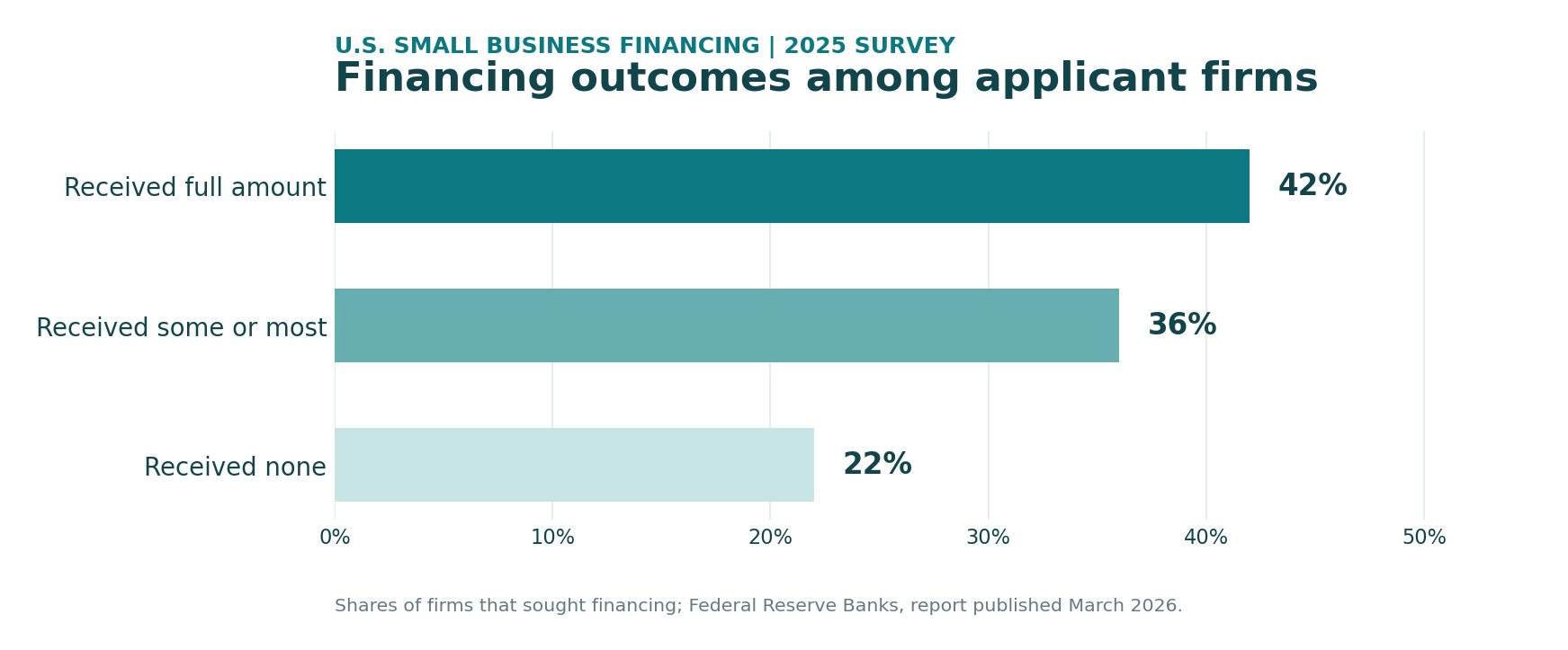
Chart: Financing outcomes among applicants in the Federal Reserve Banks’ 2025 Small Business Credit Survey, reported in March 2026. Percentage shares are rounded and refer to survey respondents seeking financing; they are not predicted approval probabilities for an individual loan.
Source: Federal Reserve Banks — 2026 Report on Employer Firms.
The same report identifies increased costs of goods, services, and wages as a financial challenge for 73% of firms, paying operating expenses for 54%, and uneven cash flow for 50%. These are overlapping survey responses, not pieces of one total.
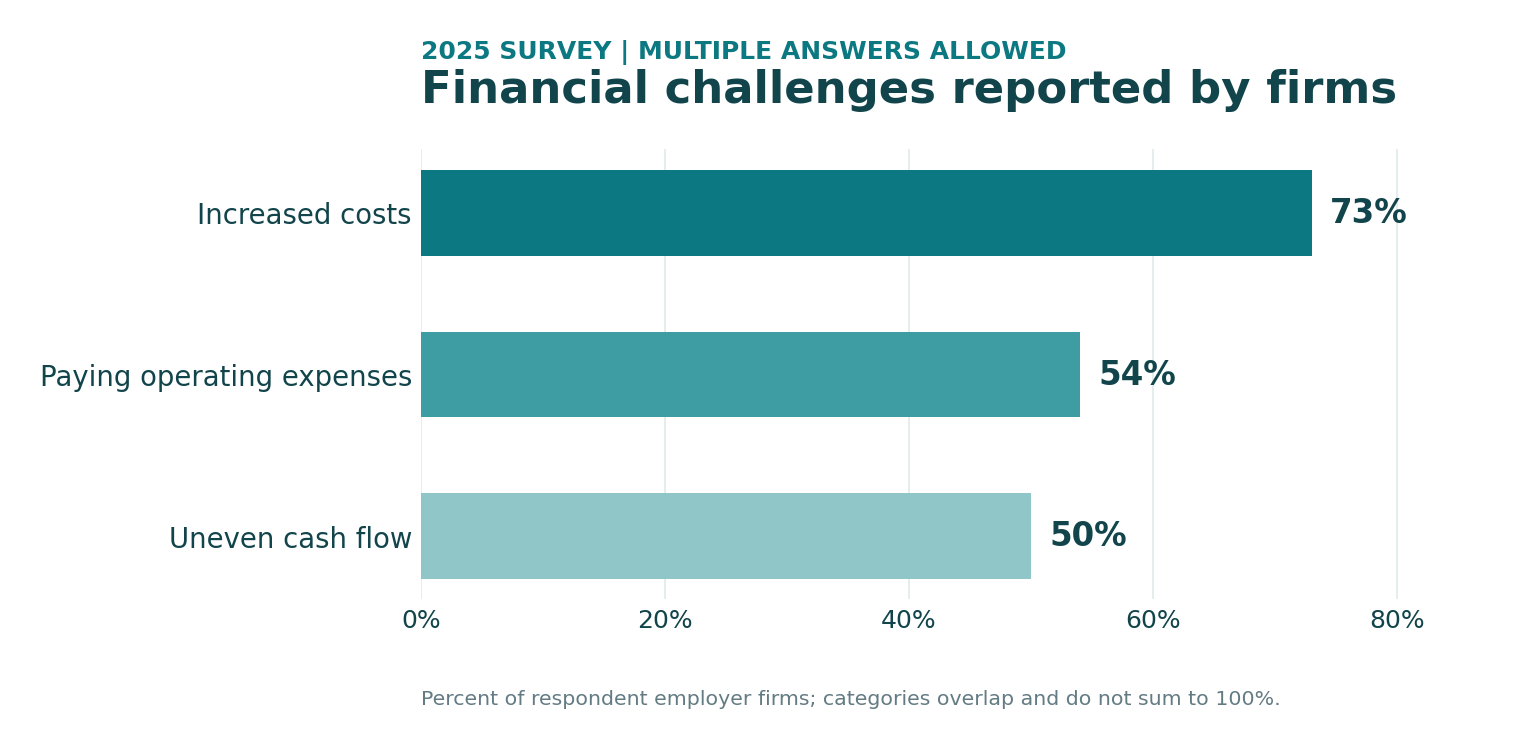
Chart: Selected financial challenges faced by U.S. small employer firms in the prior 12 months, 2025 survey (reported March 2026). Respondents could choose multiple challenges; percentages do not total 100%.
Source: Federal Reserve Banks — 2026 Report on Employer Firms.
Those percentages reveal why a lender wants more than a rosy profit forecast. Businesses face cost inflation, late-paying customers, and debt service at the same time. A sensible plan connects those pressures to a cash forecast and explains what management will do if they worsen.
A note on global research: Statista publishes international banking and small-business finance data, but applying an unrelated global borrowing figure to a U.S. loan application would be misleading. This guide instead uses official U.S. financing data that directly match the reader’s decision. The Federal Reserve survey is a weighted nonrandom sample; its findings are informative about respondents, not a guarantee of outcomes for every U.S. firm.
4. Gather Your Evidence Before You Draft
One rule of how to write a business plan for a loan is easy to overlook: the best-looking plan cannot repair contradictory paperwork. Start with an evidence folder and a list of missing documents. For existing businesses, that normally means historical profit-and-loss statements, balance sheets, cash-flow statements, recent tax returns, debt schedules, bank statements, and current accounts receivable and payable records, as requested by the lender.
For startups, there may be no historical sales to demonstrate. You’ll need a more explicit assumptions trail: owner experience, supplier quotations, market evidence, signed customer commitments when available, startup budgets, licensing status, and enough cash reserves to handle slower-than-expected revenue.
Also prepare ownership information, management resumes, lease terms, important contracts, insurance evidence, and any documents the lender specifically requests. The SBA’s Lender Match preparation guidance highlights the amount and use of funds, credit history, and business plan among the items borrowers should prepare to discuss.
Separate facts, assumptions, and hopes
An SBA loan business plan can use a template for organization, but the evidence still needs verification. Use labels such as “contracted revenue,” “pipeline opportunity,” and “management assumption.” Provide sources and dates for market statistics; explain how competitor pricing was observed; and never present an imagined customer order as confirmed revenue.
5. Write an Executive Summary a Loan Officer Can Understand
Once the evidence is clear, the next step in how to write a business plan for a loan is the executive summary. Keep it direct. A lender reading your summary should understand the company, the proposed request, how funds will be used, and the expected repayment source without searching through thirty pages.
For Harborline Commercial Cleaning, a useful opening might read:
“Harborline is a commercial cleaning company serving recurring office and light-industrial contracts in a defined metro area. The business seeks $120,000 to purchase equipment, recruit and train staff, and finance initial operating costs associated with three planned larger accounts. Management expects debt repayment to be funded by cash generated from existing and new customer contracts, subject to the revenue, collections, and expense assumptions detailed in the attached forecast.”
Notice that the example does not treat prospective accounts as guaranteed revenue.
Include the essentials, not the entire plan
A strong summary usually gives a brief description of the company, customer, track record, funding amount, intended uses, management capability, and the projected source of repayment. For an existing business, summarize historical financial performance with dates. For a startup, be explicit that the financial figures are projections.
Write the summary last, even though it appears first. Once the underlying model is complete, summarizing it accurately becomes much easier.
6. Explain the Business and Its Competitive Advantage
A company description matters in how to write a business plan for a loan because it answers deceptively basic questions: What do you sell? Who buys it? Where and how do you deliver? Why should customers choose you instead of an established competitor?
Avoid statements such as “We offer exceptional quality and excellent service.” Everyone says that. Instead, describe something measurable. Harborline might specialize in after-hours cleaning for offices that need documented site checklists, secure access procedures, and a consistent two-person crew.
Explain the legal structure, ownership, location, operating history, facilities, workforce, supplier dependencies, and licenses or permits relevant to the business. Distinguish what exists today from what the loan would enable. If a second location hasn’t been leased, don’t write about it as though the doors are already open.
Show who will run the plan after the loan arrives
An experienced owner may be reassuring, but titles alone are not evidence. Describe the management team’s relevant operating experience and responsibilities. Who handles sales? Who manages compliance and quality? Who controls purchasing and cash? If the founder is also the only person able to perform a critical task, explain how the company will cope with absence or growth.
7. Prove Customer Demand With Market Research
A critical trap in how to write a business plan for a loan is this wonderfully common piece of fiction: “Our target market is worth $20 billion. If we capture just 1%, we’ll become huge.”
Nice arithmetic. Weak evidence.
A business plan for a bank loan needs a serviceable market, not just an impressive national figure. If you’re opening a neighborhood café, the U.S. restaurant industry total doesn’t tell you how many people will buy breakfast from your particular corner.
Specialist market research services can help substantiate local demand. Identify the people or businesses most likely to purchase, their location, buying patterns, budget, and alternatives. Research direct competitors, realistic market share, price ranges, switching costs, and sales channels. The most useful research often combines public data with customer interviews, observed prices, signed intent, or previous sales records.
For Harborline, the market analysis might include the number of suitable commercial buildings in its service radius, typical contract sizes, staffing requirements, nearby cleaning competitors, and evidence that prospective clients are soliciting bids. Three signed letters of intent may be more informative than a giant market-size estimate, although neither automatically guarantees future sales.
Build a sales forecast from actual drivers
Start from units of activity instead of announcing a revenue number. For a contract service business, the formula could be active customers × average monthly revenue per customer. For a retailer, it might be transactions × average sale, adjusted for seasonality, returns, and collection timing.
Suppose Harborline has 20 active customers paying an average of $1,500 per month. That’s $30,000 monthly revenue before considering churn, price changes, and billing schedules. New contracts should be added only in the months they’re realistically expected to start. This is where business loan financial projections become more credible: each line has a driver you can inspect.
8. Lay Out Marketing, Sales, and Operations in Plain English
When considering how to write a business plan for a loan, remember that a forecast does not acquire customers by itself. If the plan says monthly revenue will grow from $30,000 to $50,000, explain who will make that happen and what it will cost.
Describe the steps from lead to invoice: prospecting, site visits, quotations, closing, onboarding, service delivery, billing, and collections. Include the likely time between the first sales conversation and the first payment. For a contractor or B2B service business, 30- or 60-day customer payment terms can create a significant cash gap even when the work is profitable on paper.
Then connect the sales plan to operating capacity. Can existing teams deliver the forecast volume? Will equipment arrive before new work begins? Are permits, inspections, staff training, or subcontractors needed? A beautiful financial forecast becomes unreliable if the plan assumes capacity you don’t yet have.
Use milestones lenders can evaluate
9. Prepare Financial Statements and Cash-Flow Forecasts
Financial modeling is the part of how to write a business plan for a loan where many guides get vague. They tell you to “include financial projections” and quietly move on.
But the spreadsheet is often where the lender discovers whether the written narrative makes sense.
Specialist financial modeling services can help validate debt schedules and downside cases. A proper set of business loan financial projections typically includes a projected income statement, balance sheet, and cash-flow statement, backed by clear assumptions. For an established company, link the forecast to actual historical results. If the forecasts show a huge improvement in margins, be able to explain why.
The SBA’s traditional business-plan outline recommends three to five years of outlook, with more detailed monthly or quarterly figures for the first year. That is useful general guidance, not an assertion that every lender demands identical periods.
Income statement: does the business earn a profit?
List revenue, direct costs, operating expenses, interest, taxes, and resulting net income. The model should reflect your operational plan. If you hire three people in month two, wages shouldn’t mysteriously appear in month eight.
Profit matters, but profit is not cash. A customer may owe you money for work you’ve completed. Inventory may be purchased before sales. Loan principal payments reduce cash but don’t appear as an ordinary operating expense on the income statement.
Cash-flow statement: can the business pay when bills are due?
This is the beating heart of a loan repayment plan. Show when customers pay, when suppliers are paid, how payroll and taxes flow, when the loan is funded, and when principal and interest leave the account.
Balance sheet: what does the business own and owe?
The balance sheet shows assets, liabilities, and equity at a point in time. If loan proceeds buy equipment, the model should reflect the borrowing and the acquired assets. Debt balances should decline as principal is paid. Any owner contribution should appear consistently in both the balance sheet and cash-flow assumptions.
10. Show the Math Behind Loan Repayment
The repayment calculation is where how to write a business plan for a loan turns into hard numbers. Suppose the fictional company is evaluating a $120,000 loan at a hypothetical 10% annual interest rate, amortized over 60 months, with payments monthly. This is a teaching example, not a current lender quote, and fees or other financing terms could change the economics.
Using a standard amortization calculation, the estimated monthly payment is $2,549.65, or about $30,596 over 12 months. Total payments over five years would be approximately $152,979, of which roughly $32,979 is interest under these assumptions.
Illustrative loan input | Value |
|---|---|
Principal | $120,000 |
Annual interest rate | 10.0% (hypothetical) |
Amortization period | 60 months |
Estimated monthly principal + interest | $2,549.65 |
Estimated annual debt service | $30,596 |
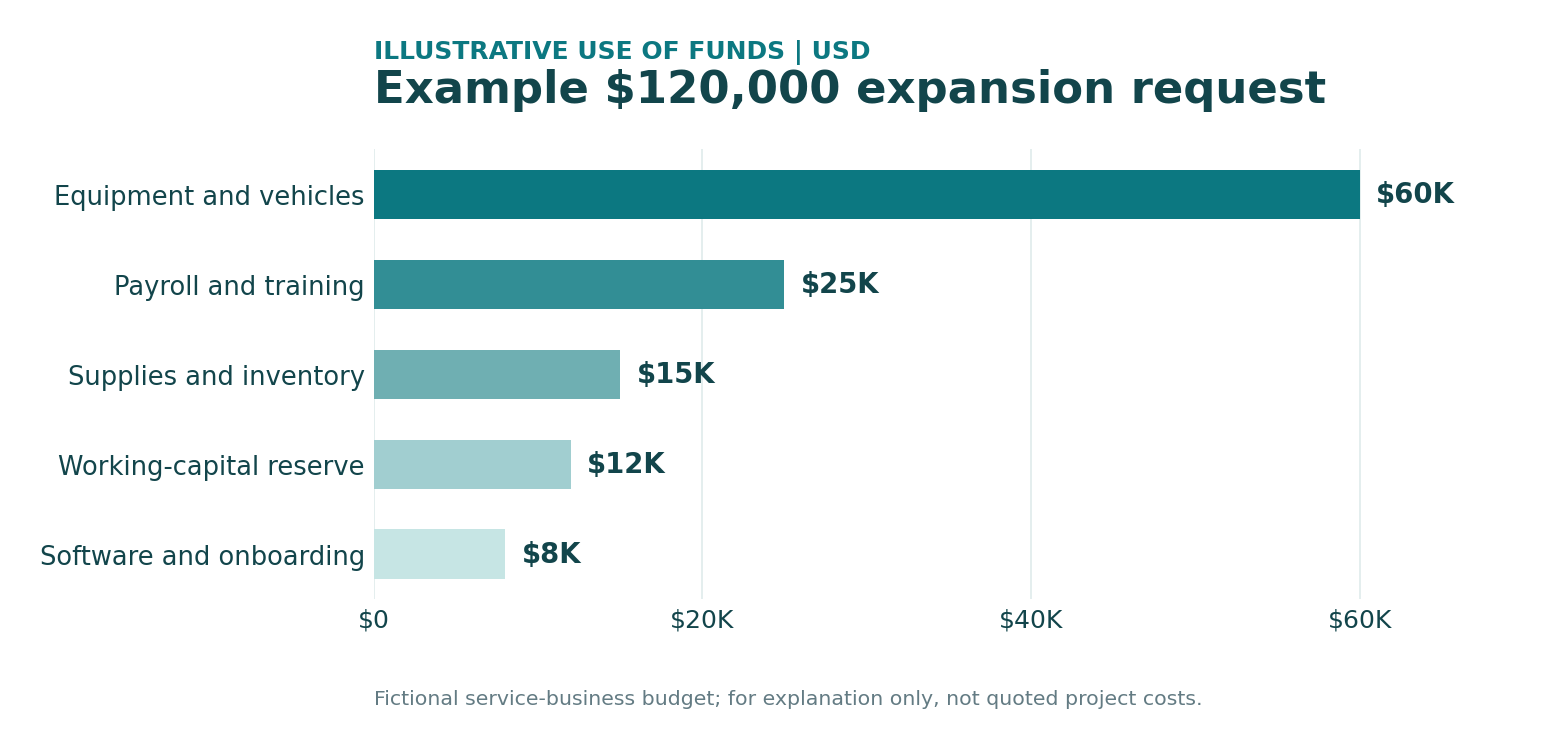
Chart: Illustrative allocation of a fictional $120,000 commercial-cleaning expansion loan, USD. These are planning assumptions for the example, not market prices or lender-approved expenses.
Source: Author’s illustrative loan budget and calculation; not an external market dataset.
What debt-service coverage ratio tells you
Some lenders assess a debt-service coverage ratio (DSCR), broadly comparing cash available for debt service with required debt payments. Definitions vary by lender and transaction; don’t assume a universal ratio or automatically apply an arbitrary cutoff.
For a simplified illustration, suppose the company expects $42,000 in annual cash available for debt service after appropriate operating expenses and before the modeled annual loan payments. Divide $42,000 by $30,596, and the example produces a ratio of roughly 1.37. If available cash falls to $28,000, the ratio drops to about 0.92—meaning the forecast no longer covers the modeled debt payments.
That’s far more informative than saying “we expect strong profits.” It tells you how much room there is for disappointment. Ask the lender which cash-flow definition, obligations, owner compensation adjustments, and minimum coverage expectations it uses.
Stress-test the numbers before the lender does
Run a base case, a lower-sales case, and a delayed-collections case. Try revenue 15% below plan; increase wages by 8%; delay a major customer payment by 30 days. What happens to cash balances and debt payments? If the business cannot withstand a modest setback, adjust the funding structure, timing, costs, or expansion plan before submitting.
Good business loan financial projections are honest about uncertainty. They aren’t an exercise in making every scenario look wonderful.
11. Explain Risks, Collateral, and Your Backup Plan
Another essential part of how to write a business plan for a loan is admitting that every business has risks. Pretending otherwise is not confidence; it’s a sign that management hasn’t thought carefully enough.
A credible plan identifies the risks that matter most to your particular business. A restaurant might face food and labor cost volatility. A construction contractor may struggle with project timing and collections. A software company could depend heavily on one customer or platform.
For each, explain the trigger, likely financial effect, and response. A credible loan repayment plan considers: if sales fall short, which spending can be postponed? If a supplier fails, is there an alternative? If a key customer leaves, how concentrated is revenue?
Discuss security, guarantees, and collateral only as they apply to the proposed lending product. Do not promise that a specific asset satisfies the lender’s requirements without checking its rules and valuation. Owners should understand that personal guarantees and collateral can put personal or business assets at risk.
A strong loan repayment plan should include reasonable safeguards—not invented promises to liquidate assets at unrealistic prices.
12. Put the Loan-Ready Document Together in the Right Order
The organization of the document matters, too. Once you understand how to write a business plan for a loan, assemble the research and model in a lender-friendly order. The precise structure can vary, but this sequence is easy for a lender to follow and aligns broadly with the SBA’s traditional-plan approach.
Section | What it must establish |
|---|---|
Executive summary | Business, request, repayment source |
Company overview | Ownership, operations, track record |
Products and customers | How the business earns revenue |
Market and competition | Evidence behind customer demand |
Management and operations | Ability to deliver the forecast |
Marketing and sales | Where growth will come from |
Funding request | Amount, timing, and use of proceeds |
Historical financials | Verifiable past performance, if any |
Forecasts and repayment | Cash-flow capacity and assumptions |
Risk analysis | Downside cases and safeguards |
Appendix | Quotes, resumes, contracts, licenses, other requested evidence |
A loan business plan template is fine as a framework if it helps you avoid missing a section. But resist filling its blank boxes with generic sentences. Lenders don’t need 25 pages of adjectives. They need documents they can reconcile to a lending decision.
What goes into the appendix?
Include only supporting documents relevant to the request: financial statements, supplier quotes, equipment proposals, lease commitments, credentials, tax and formation documents, customer agreements where appropriate, and lender-required forms. Organize and label them so a reviewer can find evidence quickly.
13. SBA Loan Business Plans: What Changes and What Doesn't
People researching how to write a business plan for a loan sometimes expect a special SBA format. There isn’t a magic paragraph that turns an ordinary proposal into an approved SBA loan.
For U.S. SBA-backed 7(a) lending, the applicant generally works through a participating lender. Program eligibility, creditworthiness, use of funds, and reasonable ability to repay all matter. Application paperwork varies with the loan amount, lender process, and borrower circumstances. Check the latest SBA 7(a) requirements and the lender’s own documentation list rather than relying on an old sample from the internet.
An SBA loan business plan should therefore make the same essential repayment case, but it should also address any program-specific information and attachments the lender requests. Existing-debt details, ownership information, and eligibility questions may matter even when they don’t fit naturally into your business narrative.
14. Mistakes That Weaken a Loan Business Plan—and How to Fix Them
Mistake 1: Asking for a round number with no supporting calculation. “We need $200,000” is not a funding schedule. Fix it with vendor quotes, project timing, a working-capital calculation, and a reconciled sources-and-uses table.
Mistake 2: Copying an industry statistic into the sales forecast. A large national market doesn’t prove your own customer pipeline. Fix it with local demand research, actual leads, conversion assumptions, and operating capacity.
Mistake 3: Treating earnings as available cash. Accounts receivable, inventory purchases, taxes, and principal repayments change the picture. Fix it with monthly cash-flow modeling and a separate debt schedule.
Mistake 4: Making every month better than the one before. Seasonality, project delays, churn, and collections aren’t personal insults; they’re business realities. Fix the model by including their timing and testing slower growth.
Mistake 5: Conflicting numbers across sections. If the summary says $120,000 but the funding table says $130,000, confidence disappears. Reconcile the summary, use-of-funds table, forecasts, and supporting paperwork before submission.
Mistake 6: Ignoring prior debt and owner compensation. The company must cover existing obligations, not just the new payment. Include current debt, owner draws or salaries as applicable, and realistic operating costs.
Mistake 7: Assuming a great-looking document guarantees approval. Eligibility, risk, pricing, collateral, and lender policies exist independently of the writing. Use the plan to present evidence, not to disguise weak credit or cash flow.
Mistake 8: Using AI-generated claims without verification. Drafting tools can make a paragraph sound authoritative while inventing sources or mixing dates. Verify every market statistic, calculation, citation, and legal claim before using it in an application.
A business plan for a bank loan is most convincing when it invites scrutiny and survives it.
15. How to Improve the Plan Before You Apply
The final stage of how to write a business plan for a loan is quality control. A review can catch problems that an enthusiastic founder no longer sees. Start by reading only the summary, funding request, and cash-flow forecast. Do they tell the same story? Then read from the perspective of a skeptical lender who has never met you.
Check the requested amount against supporting quotes. Confirm revenue assumptions against actual orders or a clearly described sales pipeline. Reconcile beginning cash and debt balances. Make sure the first loan payment occurs in the correct month. Verify that the owner can afford any required contribution and that important licenses or approvals are accurately described.
Ask someone familiar with finance to challenge the downside case. If numbers need specialist support, a business-plan writing and consulting service can help organize the evidence, identify missing assumptions, and prepare a coherent lender-facing narrative. An independent accountant or qualified finance professional can also review projections. None can responsibly guarantee the bank’s decision.
Use an SBA loan business plan checklist when applying for that program, but don’t substitute it for the actual lender’s instructions. And if you are working from a loan business plan template, strip out any example numbers or generic statements that don’t describe your company.
A realistic 14-day writing schedule
Days 1–2: confirm the lender’s requested format and gather historical records. Days 3–4: document the funding amount and uses. Days 5–6: research customers and competitors. Days 7–9: build and reconcile financial statements, repayment schedules, and scenarios. Days 10–11: write operations, marketing, management, and risks. Day 12: draft the summary. Days 13–14: verify calculations, source links, documents, and consistency.
16. Future Lending Trends That Will Matter to Borrowers
Understanding how to write a business plan for a loan also means watching the lending environment. The direction of U.S. small-business credit will influence what borrowers need to explain in 2027 and beyond, but nobody can responsibly promise the next interest-rate path or an easy-approval market.
Recent evidence points to practical priorities. The Federal Reserve Banks’ 2026 survey reported that applicants at online fintech lenders had risen from 17% in the 2020 survey to 29% in the 2025 survey, while many online-lender borrowers reported higher-than-expected costs. That makes total borrowing cost and term comparison especially important.
Borrowers should expect increased attention to cash resilience when costs, tariffs, or customer payments remain unpredictable. Digital application systems may streamline document collection, but they do not eliminate the need for accurate underlying records. AI can help draft summaries or identify arithmetic inconsistencies; it cannot replace verified books, current lender criteria, or honest management assumptions.
The durable lesson is simple: lenders need a clear financial story regardless of how the application is submitted.
17. The Takeaway: Show How the Money Comes Back
If you remember one thing about how to write a business plan for a loan, make it this: the plan isn’t a sales brochure for your idea. It’s a disciplined explanation of how borrowed money moves through the business and returns to the lender.
Start with a defensible funding request. Explain what the money pays for. Prove the customer demand with relevant evidence. Link the operating plan to sales assumptions. Build financial statements that agree with one another. Show the monthly cash required for the proposed repayment, and be clear about risks that could change the result.
A well-prepared business plan for a bank loan review makes the lender’s questions easier to answer. A transparent loan repayment plan makes the owner’s decisions better too. For a stronger business plan for a bank loan, always reconcile the written claims to the numbers. Whether you create it yourself or seek help, the strongest plan is the one you can defend without asking anyone to take the spreadsheet on faith.
Faq
Frequently Asked Questions
Focus on your relevant experience, startup costs, customer evidence, operational readiness, owner investment, and clearly labeled forecasts. Startups cannot provide years of business financial statements, so the assumptions behind revenue and cash flow need to be especially transparent. Before preparing loan documents, confirm with the prospective lender whether that product fits your company’s stage and which documents it requires.
There is no universal page requirement. A straightforward existing-business request may need a concise narrative plus detailed statements, while a startup, acquisition, or complex expansion may need a longer plan. Follow the lender’s checklist and prioritize completeness over length. An adaptable loan business plan template is useful, but a polished 40-page document is not automatically stronger than a clear 15-page one.
Lenders may request forecast income statements, balance sheets, cash-flow statements, capital expenditure plans, and a debt repayment schedule. The SBA suggests a multi-year outlook with monthly or quarterly detail in year one for traditional plans. Build business loan financial projections from realistic sales, staffing, cost, and collection assumptions, then reconcile them to historical results when available.
Yes. A loan business plan template can give you a sensible outline and prevent important omissions. But replace every generic claim with your actual company information, verified customer research, and financial numbers. Use a verified loan business plan template structure, but remove assumed margins, unsupported market sizes, or a prewritten management biography.
For a typical 7(a) loan, you apply through an SBA participating lender, which evaluates the application under applicable rules; the SBA provides a loan guarantee rather than simply approving a business-plan document. An SBA loan business plan can support your case but does not override eligibility or repayment requirements. Confirm current processes with the lender and SBA.
The funding request and repayment evidence are central: how much money you need, what it will finance, and whether business cash flow can cover debt payments. A lender also considers credit, operating history, management, collateral or guarantees where applicable, and overall risk. Your loan repayment plan should agree with the cash-flow forecast and debt schedule.
Consider professional help if you lack time, your financial model is complicated, or the lender asks for a detailed document you cannot prepare reliably. Look for someone who asks tough questions, verifies sources, and explains assumptions. They should support business loan financial projections, not merely rewrite your company description. ZH Consultancy offers business-plan preparation services, but no professional can promise approval or favorable loan terms.

Zain Hameed
Business strategy specialist helping a global client base of 800+ businesses build credible plans, financial models and investor-ready presentations.
In this article
Book a Free Consultation
Have a business idea, growth challenge or investor deadline? Book a free consultation and get clear next steps from our team.
Call our team
+923104049517
Email us

Business Topics
Business topics
Continue reading
Related insights

How to Start a Photography Business in 2026: From First Client to Profitable Studio
You take a photograph. Someone sees it and says, “You should

How to Start a Dumpster Rental Business: From First Container to Profitable Fleet
Learn how to start a dumpster rental business, estimate startup costs,

How to Start a Bounce House Business: From Weekend Rentals to a Profitable Company
Learn how to start a bounce house business, estimate startup costs,

How to Start an Interior Design Business: From Creative Talent to Profitable Studio
Learn how to start an interior design business, understand qualifications, estimate

How to Start an Electrical Business: From Skilled Electrician to Profitable Contractor
Learn how to start an electrical business, understand licensing, estimate startup

How to Start a Window Cleaning Business: From First Job to Profitable Company
Learn how to start a window cleaning business, estimate startup costs,