

In this article
You take a photograph. Someone sees it and says, “You should charge for this.”
A few compliments later, you’re pricing cameras, imagining a beautiful studio, and wondering whether your weekend hobby could become your actual income. It’s an exciting thought. It’s also where an astonishing number of new photographers start spending money before they’ve worked out who is going to pay them.
Because here’s the part nobody puts in the camera advertisement: beautiful photographs do not automatically create a business. Customers, repeatable delivery, and enough money left after expenses do.
If you’re researching how to start a photography business, you’ve probably got a dozen questions circling your head. What should you shoot? How much equipment is enough? Do you need a license? What if nobody books? And how do you charge a fair price without scaring away your first customer?
We’ll answer those questions in the order they matter. Not with a fantasy about instant six-figure success, but with a workable route from testing demand to booking clients and building something worth growing. All financial examples use US dollars for consistency; actual prices, permits, and taxes depend on your location.
Pick a Photography Niche That Has Paying Customers
One of the fastest ways to confuse a potential customer is to introduce yourself as the photographer who does everything. Weddings? Absolutely. Restaurant menus? Sure. Luxury apartments? Why not. Portraits of an extremely energetic golden retriever? Bring him over.
Versatility is a useful skill. It is not necessarily a useful marketing message. If you are working out how to start a photography business, being specific gives people a reason to remember you.
Someone planning a wedding wants evidence that you can handle an unrepeatable day. An online store owner wants consistent product photographs and predictable turnaround times. They are buying different outcomes, even if you use the same camera for both.
Start with the job the customer needs done
Choose two or three possible niches, then evaluate each against four tests: demand, access, delivery, and economics. Demand means people are already paying for that service. Access means you can realistically reach them. Delivery means your skills and photography equipment can produce the expected result. Economics means fees can cover the time and expense involved.
Wedding photography can generate substantial project fees, but it carries long hours, weekend commitments, high expectations, and a serious need for backups. Corporate headshots may offer shorter sessions and repeat teams. Real estate photography often rewards dependable scheduling and fast delivery; product photography can reward a controlled studio workflow and recurring brand relationships.
The best niche isn’t necessarily the one with the biggest headline price. It’s the one you can serve reliably, sell consistently, and still enjoy doing on your twentieth assignment.
Run a small demand test before choosing
Search for your potential service plus your city. Review the first ten credible local competitors. Note their specialties, sample images, starting prices where published, delivery promises, and recent customer reviews. Then interview five prospective buyers or people who recently hired a photographer.
Ask what they needed, why they chose their provider, what worried them, and what made the process difficult. Avoid asking whether they’d buy your hypothetical service; people are wonderfully generous with hypothetical money. Ask about actual past behavior instead.
You might discover that your area has plenty of portrait photographers but few who offer easy weekday workplace headshot sessions. That’s a stronger opportunity than simply declaring yourself “affordable and professional.” For a more formal assessment of local demand and competitors, our market research service explains the kind of evidence worth examining before investing.
Decision rule: pick one primary niche for your homepage and core portfolio. You can accept adjacent work without advertising yourself as everybody’s photographer.
Understand the Global Market Without Mistaking a Forecast for Your Income
Is professional photography a dying business because everybody owns a smartphone? Or is it booming because businesses need an endless stream of visual content?
Both arguments contain part of the truth. Neither tells you whether ten customers in your city will hire you next month. That is the difference between reading about an industry and understanding how to start a photography business inside it.
What current global statistics actually show
Grand View Research estimates that the global photography services market was worth US$43.3 billion in 2025, rising to an estimated US$45.4 billion in 2026, with a forecast of US$69.2 billion by 2035. Its projected compound annual growth rate for 2026–2035 is 4.8%. The report identifies wedding photography as the largest service-type segment in 2025 and Asia Pacific as the fastest-growing region over its forecast period. These are research estimates and projections, not guaranteed outcomes. Source: Grand View Research.
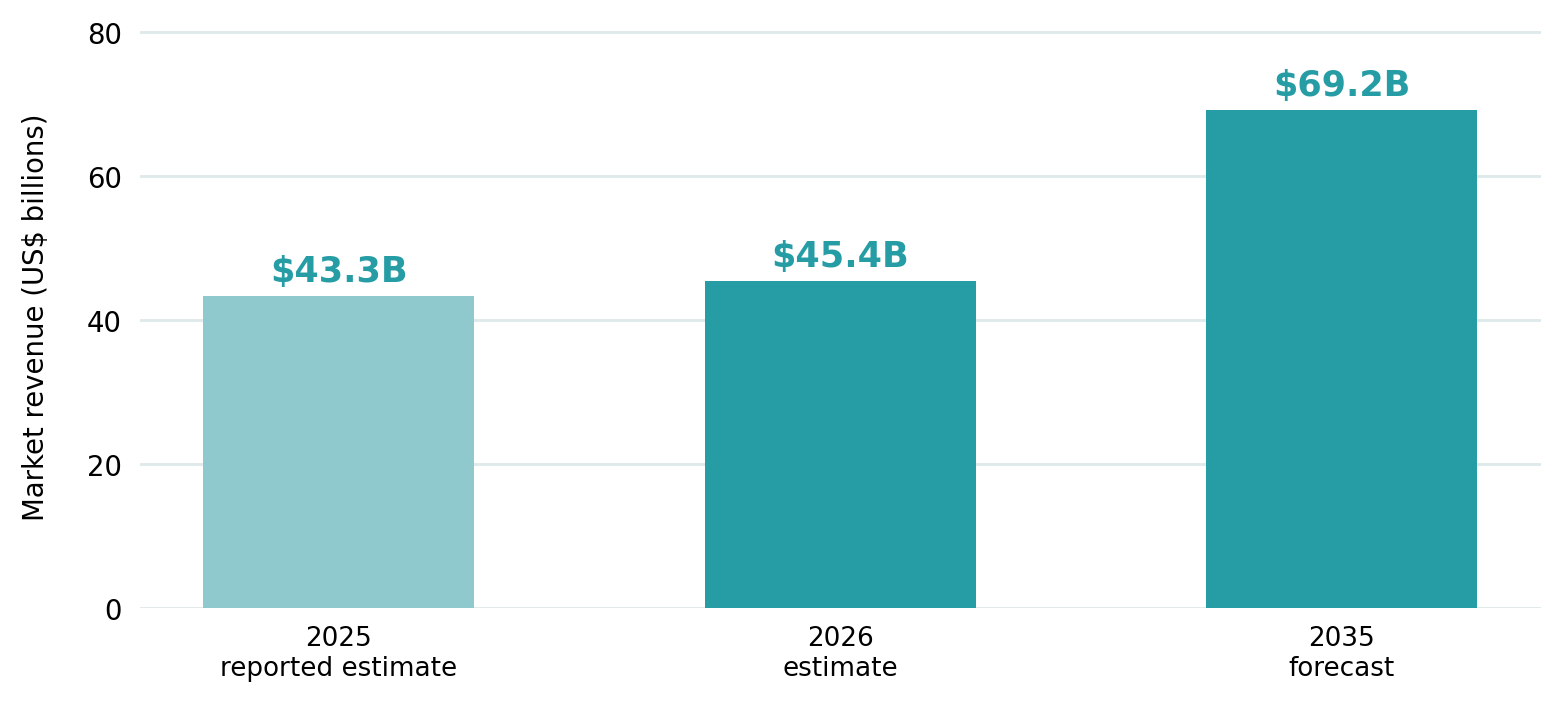
Global photography services market: US$ billions. 2025 and 2026 are research estimates; 2035 is a forecast, not an actual result. Forecasts may change.
Source: Grand View Research — Photography Services Market, 2026–2035
Statista tracks the worldwide digital cameras market, including revenue, volume, average prices, and brand share. That’s useful context for technology and equipment purchases, but crucially camera sales are not photography-service revenue. The detailed Statista revenue figures on its global digital cameras forecast are access-restricted, so there is no defensible public number to copy into this guide.
For an independently verifiable equipment indicator, industry association CIPA recorded 9,438,876 digital camera shipments worldwide in 2025, 11.2% above 2024. Of those, 7,001,965 were interchangeable-lens cameras. Source: CIPA, February 2026. This is evidence of ongoing camera-equipment demand, not proof that photography businesses are booking more clients.
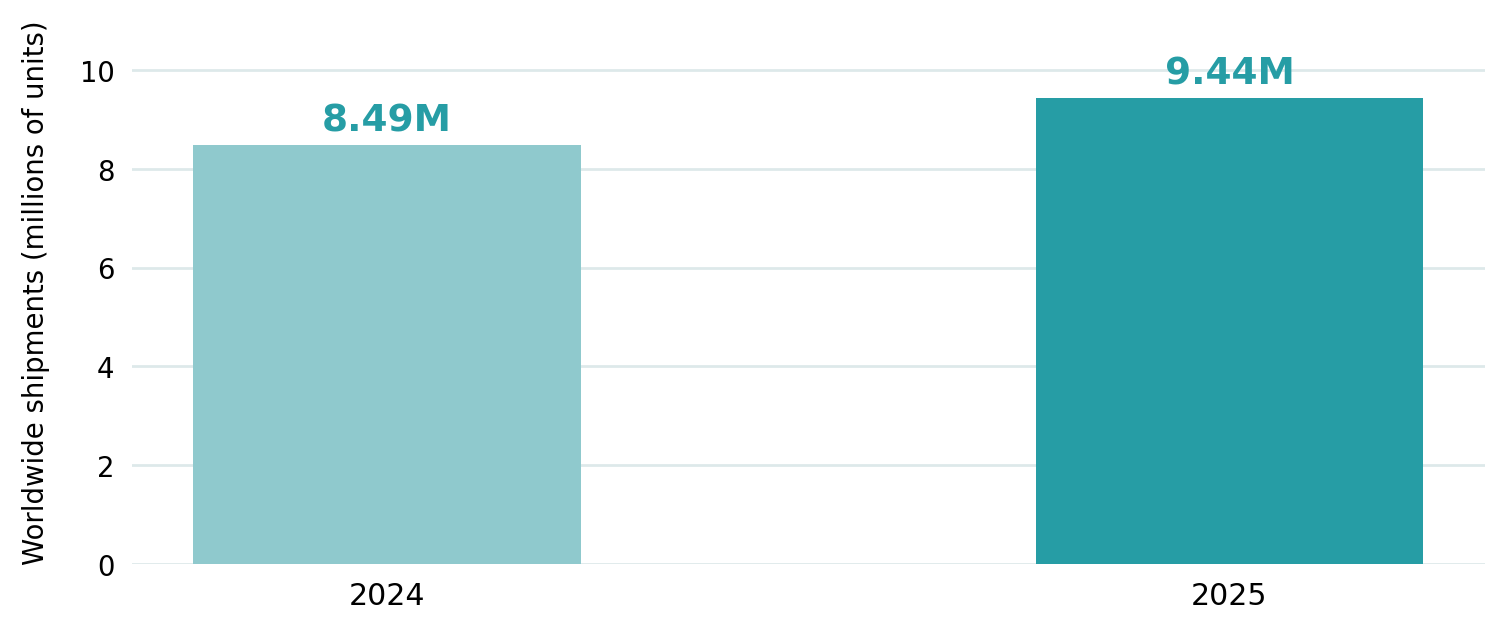
Worldwide digital-camera shipments, 2024–2025, in millions of units. These are camera sales shipments, not professional photography-service revenue.
Source: CIPA — 2026 Outlook on Camera Shipments (published February 26, 2026)
There is a tougher reality check, too. The U.S. Bureau of Labor Statistics reports that 67% of U.S. photographers were self-employed in 2025 and projects photographer employment to decline 1% between 2025 and 2035. Yet it still expects about 10,700 job openings annually, mainly replacing people leaving the occupation. Its median hourly employee wage in May 2025 was $21.47; that is not a freelancer’s average billable rate or net profit. Source: BLS.
What those numbers mean for a beginner
Here’s the useful interpretation: opportunities exist, competition is real, and demand is uneven. A generic stock-photo seller faces different pressures from a photographer who documents real weddings or creates accurate catalog images for local retailers.
The global figures help you understand the landscape. Your actual photography business plan needs local evidence: how many prospective customers you can reach, what they pay, how frequently they buy, and why they’d choose you.
Future demand will also be influenced by ecommerce growth, consumer spending, AI-assisted editing, smartphone quality, short-form video, and how convincingly businesses can demonstrate authenticity. More on those changes later.
Calculate Photography Business Startup Costs Before Shopping
A new business can fail with a brilliant camera and an empty bank account. It can also begin with modest gear, a disciplined budget, and its first three paid bookings. That is why any serious guide to how to start a photography business must begin with money, not shopping.
That’s why photography business startup costs should be calculated from the work you intend to deliver, not from a stranger’s favorite equipment list.
A realistic beginner budget
The ranges below are planning examples in USD, not retailer quotes or universal requirements. They assume a solo, largely location-based operation without studio rent.
Cost category | Lean launch (USD) | Higher-spec launch (USD) |
|---|---|---|
Camera and suitable lens | $650–$1,400 | $1,800–$3,500 |
Lighting, cards, batteries, bag | $150–$350 | $400–$900 |
Computer, editing and storage allocation | $150–$500 | $500–$1,200 |
Website, domain and gallery tools | $80–$250 | $250–$600 |
Registration, contracts and insurance provision | $200–$650 | $400–$1,200 |
Portfolio work and initial marketing | $120–$450 | $350–$900 |
Illustrative total | $1,350–$3,600 | $3,700–$8,300 |
To make the budget easier to visualize, here is one example allocation. It is a hypothetical $2,250 launch budget, not a quoted market average.
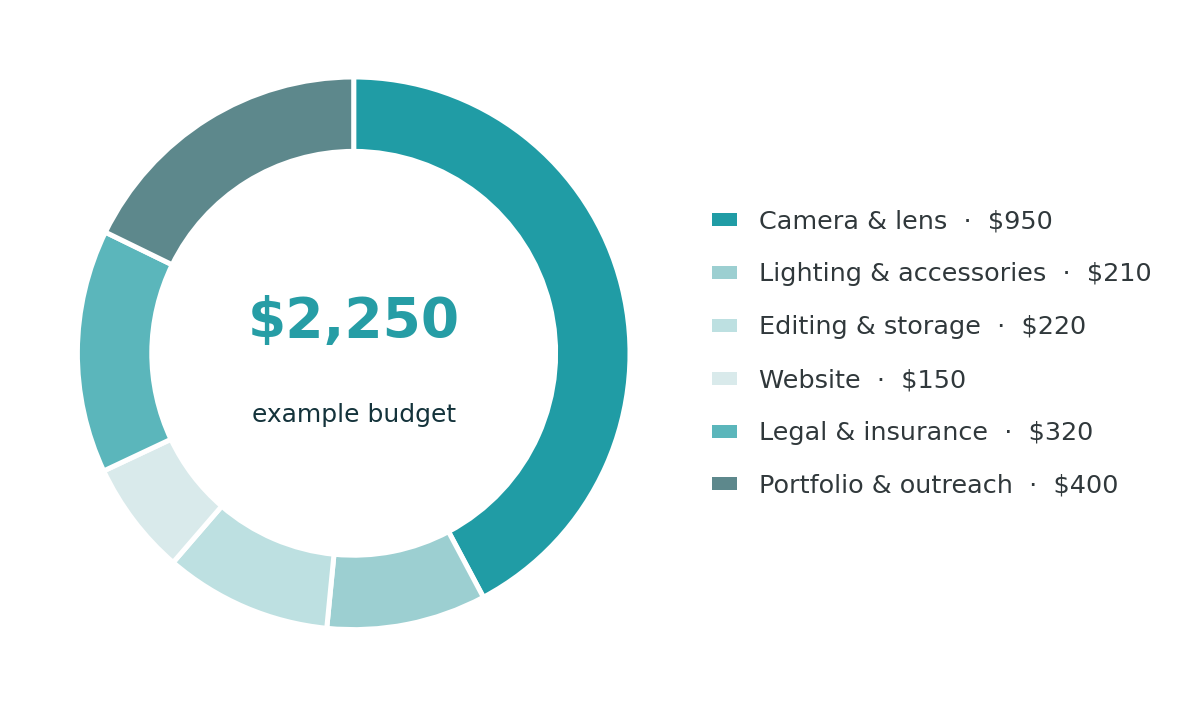
Illustrative photography startup budget: US$2,250, allocated by expense category. Example only; actual costs depend on location, existing gear and chosen niche.
Source: ZH Consultancy illustrative calculation based on the planning ranges in this article; not an external market survey.
If you already own suitable gear, you can spend less. If you need a studio, two professional camera bodies, specialist lenses, assistants, or significant travel, you can spend much more. The right total depends on your niche and market.
Separate the money into three buckets
Startup purchases are one-off costs such as a camera or initial website. Operating costs recur whether you book clients or not: insurance, software, subscriptions, storage, marketing, and accounting. Assignment costs happen because a particular job exists: travel, an assistant, rented lighting, props, prints, or location fees.
Now add a fourth bucket beginners forget: cash reserve. A slow month or damaged lens shouldn’t immediately force you into debt. Decide how much operating cash you need and build toward it rather than pretending your entire bank balance is available for new lenses.
Don't buy everything on day one
Divide your shopping list into “required to deliver,” “required once bookings grow,” and “nice to own.” For an outdoor portrait photographer, a reliable camera, suitable lens, batteries, cards, and backups matter immediately. A rented lighting kit may cover occasional indoor jobs. A permanent studio probably belongs in a later category.
Choosing photography equipment based on actual jobs also tells you what to rent. If a product customer wants a highly specialized macro lens for one campaign, renting it and including the cost in the quote may make more sense than buying it.
Photography business startup costs become manageable when purchases follow demand. It’s a lot harder when demand is expected to follow purchases.
Build a Reliable Equipment and Delivery Setup
The “best camera” debate has a remarkable ability to consume entire weekends. Yet people learning how to start a photography business usually need a reliable setup more than an award-winning specification sheet. But the best camera for your business is the one that consistently meets client requirements, works with your lenses, and has a backup plan.
Start with one dependable body, a lens suited to your niche, spare batteries, quality memory cards, a basic lighting solution, editing software, and secure storage. Your photography equipment should solve delivery problems before it solves aesthetic preferences. Portrait photographers may prioritize flattering focal lengths and comfortable direction of subjects; product photographers may need controlled light and a consistent background; events may demand strong low-light performance and redundancy.
Before buying used photography equipment, inspect the body, sensor, autofocus, card slots, battery behavior, and lens condition. Prefer a reputable seller with a clear return policy.
The gear you can't afford to ignore
Backups are unglamorous until they save a wedding. Build a repeatable process for copying cards, keeping separate copies, checking file integrity, and delivering galleries securely. Consider a 3-2-1 approach: three copies, two storage types, and one off-site copy. For irreplaceable events, a second camera and dual-card recording may be essential safeguards.
Write a simple checklist before every session: batteries charged, cards formatted only after verified backup, date/time synchronized, lenses cleaned, shot list understood, permissions confirmed, route checked, and weather alternative ready.
That checklist is far more valuable than an expensive accessory you haven’t learned to use.
Write a Photography Business Plan and Set Profitable Prices
Here’s a tiny experiment. Ask three photographers what they charge for a portrait session. Then ask what they actually keep after expenses and time. Those answers can be wildly different.
This is why a photography business plan needs numbers, not motivational slogans. Knowing how to start a photography business without understanding its economics is a short-lived advantage. It doesn’t have to be 40 pages. It does have to explain how money comes in, what goes out, and who is responsible for getting the next booking.
A one-page plan you can use immediately
Write down your target customer, signature service, unique advantage, price and inclusions, monthly fixed costs, cost per job, average job hours, customer acquisition channels, and 90-day booking goal. Review it monthly. A beautiful document that never changes is less useful than a scrappy worksheet you actually follow.
For instance, a fictional photographer could aim for eight family sessions a month, deliver 20 edited images per session, and differentiate through easy booking and a clear seven-day gallery deadline. Whether this works depends on pricing, demand, capacity, and costs. If you need a more structured plan for a larger investment or studio, our business plan support explains what a credible planning process should examine.
Why photography pricing must include the invisible hours
Imagine charging $300 for a one-hour portrait shoot. After a 30-minute consultation, an hour of preparation and travel, the session, three hours of selecting and editing, and 30 minutes for delivery and administration, you’ve worked six hours. Your effective gross revenue is $50 per working hour, before any expense or tax.
If travel and direct job costs are $45 and allocated overhead is $35, the job leaves $220 before personal taxes and owner compensation accounting. That’s the figure to compare with your time investment—not the glamorous $300 headline.
Use this practical photography pricing formula:
Minimum sustainable quote = direct job costs + allocated overhead + pay for all working hours + target profit allowance.
For commercial jobs, also consider image licensing, usage scope, exclusivity, additional editing, and rush delivery. Portrait packages may be easier for consumers to compare; commercial retainers may suit businesses needing images every month.
Calculate the booking target before you quit your job
Suppose you want $4,000 each month in owner compensation, have $800 in fixed business expenses, and expect $50 of job-specific costs per booking. At an average $600 booking fee, each job contributes $550 before fixed costs and owner compensation. You need nine bookings to cover $4,800 ($4,800 ÷ $550 = 8.73, rounded up), before income tax and other unmodeled costs.
Nine bookings may be manageable—or impossible—depending on seasonality, editing hours, location, and how many leads you can generate. That’s exactly why you calculate it.
Don’t decide photography pricing by copying a competitor’s menu. Their rent, experience, speed, and financial goals aren’t yours. Use competitor prices as market context, not as your accountant.
Register, Insure, and Protect Your Photography Business
This section will never win an award for glamour. But any complete answer to how to start a photography business must cover the less exciting legal basics. It might, however, save your business from an avoidable disaster.
Business registration, permits, tax obligations, and legal structures vary by country and often by city. You may operate as a sole proprietor, partnership, company, or another permitted entity depending on local law. Check official guidance for your location before accepting paid work; do not assume a US rule applies everywhere.
Insurance may include equipment cover, general liability, professional liability, vehicle coverage, or other protection appropriate to your assignments. Studio leases, venues, and commercial clients may require specific policies. Discuss the real risks with a licensed professional.
Put important promises in writing
Your agreement should specify the date, location, scope, price, payment schedule, cancellation and rescheduling rules, expected number or type of images, editing limits, delivery date, and what happens if equipment fails or the venue changes access. Also address copyright, image licensing, privacy, and whether you can use client photographs in your portfolio.
Do not assume that paying for a photograph automatically transfers all copyright to the client. Rights depend on applicable law, employment status, and contracts. The U.S. Copyright Office’s photographer guidance offers one jurisdiction-specific explanation of ownership and work-for-hire rules; check the law that governs your own contracts.
Keep a separate business account where practical, issue invoices, record receipts, and set aside money for taxes. Protect identifiable client images, particularly children and sensitive commercial projects. A professional business is built on trust before it is built on referrals.
Create a Portfolio and Website That Win Enquiries
A portfolio isn’t a trophy cabinet. It’s a sales conversation that happens while you’re not in the room. You cannot explain how to start a photography business without explaining how a stranger decides to trust your work.
Imagine a restaurant owner arrives on your website looking for menu photography. They see an impressive sunset, three street portraits, a wedding dance floor, and a close-up of your cat. All lovely. None answers their question: “Can this person make my dishes look appealing and consistent?”
Show the work you want customers to buy. For a new niche, arrange carefully planned practice shoots, collaborate with local businesses where appropriate, and label self-initiated work honestly. Aim for a focused selection of excellent, relevant images rather than 120 unrelated favorites.
Build for decisions, not applause
Your website should answer five questions within a minute: what do you photograph, where do you work, what does the experience look like, how does pricing or quoting work, and how can someone contact you? Give each main service a dedicated page with a portfolio sample, clear deliverables, common questions, and a prominent enquiry action.
A gallery can impress somebody and still lose the booking if the contact button is buried. Test your entire mobile journey yourself, from arriving on a service page to sending the form. Good custom website development should make that path obvious, fast, and usable on a phone.
Make photographs discoverable through local SEO
Use descriptive page titles such as “Corporate Headshot Photographer in [City]” when that accurately describes your service. Write natural descriptions of each service, use compressed images and meaningful alt text, include genuine reviews, and keep contact information consistent.
If you qualify for one, a Google Business Profile can help customers discover a local photography service. Google allows eligible service-area businesses that travel to customers, but requires real-world business information and generally prohibits fake or virtual offices. See Google’s eligibility guidelines. ZH Consultancy also has Google Business Profile guidance for businesses looking to improve accurate local visibility.
This is where photography marketing becomes less mysterious: your website makes a promise, your portfolio proves it, and the booking process makes it easy to act.
Find Your First Clients Without Becoming a Full-Time Influencer
Let’s say your website is live, your portfolio looks sharp, and your pricing makes sense. Now what?
Waiting for the algorithm to discover your genius is not a strategy. Search for how to start a photography business and you will find endless gear recommendations; far fewer explain how to get a real person to book.
Good photography marketing starts by matching how a particular customer actually finds suppliers. Families may ask friends and search locally. Real estate agents may value referrals and rapid service. Brands may respond to a strong, relevant portfolio and a thoughtful introduction.
Try a focused first-30-leads campaign
Build a list of 30 realistic prospects or referral partners—not random strangers. For a product photographer, this could be ten small ecommerce brands with inconsistent images, ten agencies or designers, and ten business owners you already know. Research each before reaching out.
Your message should be useful, not desperate. For example: “I noticed your new collection has great products but inconsistent lighting across the catalog. I specialize in creating consistent product photographs and can share two examples of a similar style if helpful.” Only make this observation when it is accurate.
Don’t send 30 generic sales pitches and call it a marketing strategy. Offer a clear next step, respect local marketing and privacy laws, follow up sparingly, and keep a record of replies.
Use channels that fit the purchase
A wedding photographer can build relationships with planners and venues. A headshot specialist can speak with HR teams and coworking spaces. A real estate specialist can offer a trial workflow to an agent with consistent listings. Social media helps showcase work; local search captures people already seeking a provider. Referrals help with trust.
The job of photography marketing is to create qualified conversations, not a pile of likes. Track enquiries, sources, quotes issued, bookings, average booking value, and repeat clients. If one channel brings 500 likes and no bookings while another brings three clients, the smaller channel may be doing the better job.
Turn enquiries into bookings
Reply promptly. Ask about the date, location, intended use, deliverables, budget range, and deadline. Explain the process in plain English, then send a concise proposal with scope and payment terms. For larger commercial work, distinguish the shoot fee from licensing and revisions.
Customers are buying more than photographs. They’re buying confidence that someone will show up, understand the assignment, and finish it without chaos.
Deliver Smoothly, Earn Reviews, and Build Repeat Work
A remarkable first session is wonderful. A repeatable customer experience is better for business. Learning how to start a photography business gets you to the first invoice; systems help you earn the next one.
Create a simple workflow: enquiry → consultation → quote → agreement and deposit → shot plan → session → secure backup → editing → quality check → gallery delivery → follow-up. Assign a deadline to every step. Use templates for routine messages, but personalize the parts that matter to the client.
After delivering, ask one specific question: “Did you receive everything you expected?” Fix legitimate problems promptly. When the customer is satisfied, request an honest review and permission to share suitable images. Never publish private client work without the necessary rights or consent.
Repeat customers beat endless prospecting
A restaurant might need a new menu every season. A company may hire for new-starter headshots each quarter. Families may return annually. Look for a genuine next need, not a contrived upsell.
This is where your photography business plan becomes a living document. Record which services create repeat work, how much editing they require, and what customers actually value. Over time, use those findings to refine your packages and photography pricing.
Prepare for the Forces Shaping Photography in 2027 and Beyond
AI is changing some photography tasks. So are smartphones, cheaper editing tools, video-first advertising, and customers’ expectations about speed. Pretending none of that matters is risky. Declaring photography finished is just as lazy. Anyone asking how to start a photography business now should build room for changing tools and customer expectations.
Stock-style images and generic visual assets face more substitution from AI-generated work. Documenting an actual wedding, showing a real property’s condition, or accurately presenting a product creates a different kind of value: the images have to correspond to reality.
AI-assisted selection, masking, and retouching may improve production speed, but examine licensing, privacy, authenticity, and the risk of altering a client’s product or event beyond what was agreed. Adding short-form video may open opportunities in commercial work, but only if you can produce it well and price the extra labor.
Customer demand can also change with economic conditions. When household budgets tighten, optional portrait purchases may be delayed. Some commercial clients may reduce campaigns while others invest more in product listings and brand imagery. Build a reserve and avoid depending on one client or one seasonal service.
The strongest long-term investment may be surprisingly old-fashioned: understanding buyers, delivering dependable work, communicating clearly, and adapting your services as needs change. New technology can support those skills. It can’t replace the need for them.
Common Photography Business Mistakes—and How to Fix Them
Mistake 1: Buying gear before finding demand.
People exploring how to start a photography business often treat purchases as proof of progress. A $3,000 lens feels productive because it arrives in a box. Market validation is less glamorous, but much more useful. Fix it by testing services with existing or rented gear first.
Mistake 2: Charging only for shutter time.
The one-hour session can take six hours to deliver. Fix it by tracking preparation, travel, editing, admin, and direct costs on every assignment. Review photography pricing against your actual effective earnings.
Mistake 3: Copying another photographer’s entire brand.
What works for a destination wedding specialist may be wrong for local corporate portraits. Fix it by identifying your own buyers’ problems and building a clear, differentiated promise.
Mistake 4: Mistaking followers for a sales pipeline.
A large audience may not contain local buyers. Fix it by measuring leads, bookings, revenue, referrals, and the channels that generate them. Put photography marketing time into what produces qualified enquiries.
Mistake 5: Weak contracts and vague delivery terms.
“I’ll send the photos soon” is an invitation to disappointment. Fix it with written scope, dates, usage rights, revision limits, and a realistic gallery deadline.
Mistake 6: Ignoring backup and privacy risks.
One lost card can damage your reputation overnight. Fix it with redundant copies, secure galleries, and a tested recovery process. Don’t post identifiable client images simply because they’re beautiful.
Mistake 7: Expanding before proving profit.
A studio lease can make a side business look established while quietly emptying its bank account. Fix it by expanding when repeatable revenue and cash reserves justify additional fixed costs.
Your First 90 Days: A Launch Plan You Can Actually Follow
Knowing how to start a photography business is useful. Knowing what to do on Monday morning is better.
Days 1–15: Find the customer. Choose two niches, interview potential buyers, review ten competitors per niche, and select one initial offer. Write down the actual problem your photography solves.
Days 16–30: Prove you can deliver. Plan two or three targeted shoots, assemble a focused portfolio, inspect your equipment, and establish safe file backups. Work out photography business startup costs and a reserve target.
Days 31–45: Set up the business. Confirm local registration and insurance needs, prepare an agreement, create payment and invoicing processes, and finish your first photography business plan. Make sure you can explain every service in one paragraph.
Days 46–60: Open for enquiries. Launch a simple website with a niche-specific service page, portfolio, pricing guidance or quote process, and contact form. Check the mobile experience from first click to confirmation.
Days 61–75: Generate conversations. Contact 30 carefully chosen prospects or referral partners, ask for introductions where appropriate, and document every response. Test two photography marketing channels rather than attempting ten at once.
Days 76–90: Improve the economics. Complete booked assignments, collect feedback and genuine reviews, record the full time spent, and update your photography pricing. Ask which customers could reasonably return and how to serve them again.
A 90-day plan isn’t a guarantee of bookings. It’s a way to replace hopeful guessing with observable progress. And it’s a much better answer to how to start a photography business than simply ordering another lens.
The Takeaway: The Business Is Bigger Than the Camera
If you’ve been wondering how to start a photography business, the answer is less complicated—and more demanding—than most equipment advertisements suggest.
Pick a clear customer. Prove there’s demand. Buy only what you need to deliver reliable work. Know your numbers. Protect both your clients and your files. Build a portfolio that answers the buyer’s question, then make it easy to enquire, book, and come back.
Your photographs may be what first catch someone’s eye. Your pricing, reliability, and customer experience are what give the business a chance to last.
You don’t have to build the perfect studio this month. Find one real customer who needs a real outcome, serve them exceptionally well, and learn from the numbers. That’s a far better starting point than another shopping cart full of lenses.
Faq
Frequently Asked Questions
For a solo, location-based setup, an illustrative starting budget could run from roughly $1,350 to $3,600 if you need essential gear and basic operating systems. Existing equipment can reduce that; studio rent, specialized lenses, travel, and backup bodies can raise it substantially. Estimate photography business startup costs for your exact niche, include recurring expenses and an emergency reserve, and avoid treating example budgets as fixed market prices.
You can begin learning and building a portfolio without prior paid work, but don’t accept assignments you cannot reliably deliver. Practice on carefully planned sessions, assist established photographers, learn lighting and editing, and get honest feedback. Start with lower-risk projects that match your capabilities. Professional results and clear expectations matter more than announcing yourself as a professional.
Neither is universally required. Customers usually care about the outcome, and the necessary photography equipment depends on the assignment. A capable camera and lens can be enough to start certain portrait or product services. Formal study can help, but practical ability, a relevant portfolio, reliable delivery, and business skills are essential regardless of qualifications.
Rules vary by location. You may need to register your activity, obtain permits, handle taxes, and comply with local rules for studios, public locations, or drones. Appropriate liability and equipment insurance can protect against important risks. Check official local guidance and speak with a qualified adviser rather than relying on a generic international checklist.
Choose a narrowly defined service, build examples that prove you can deliver it, and approach buyers or referral partners who actually need that service. Combine focused outreach, relevant local search pages, genuine reviews, and a straightforward enquiry process. Effective photography marketing is about conversations with likely customers, not simply maximizing followers.
Start with the entire job: preparation, shoot time, travel, editing, delivery, direct costs, fixed overhead, and the profit you need. Compare the resulting quote with local offers and the value delivered. Photography pricing may use session packages, project fees, hourly rates, retainers, or separate commercial licensing. Revisit your figures after several completed projects to see what work truly earns.
Yes, many photographers handle editing, enquiries, and administration from home while shooting at clients’ locations. That can keep fixed costs low, but profit still depends on demand, sustainable fees, and efficient delivery. Check home-business rules and whether customers may visit your premises. Running from home doesn’t remove the need for contracts, secure backups, bookkeeping, and a credible photography business plan.

Zain Hameed
Business strategy specialist helping a global client base of 800+ businesses build credible plans, financial models and investor-ready presentations.
In this article
Book a Free Consultation
Have a business idea, growth challenge or investor deadline? Book a free consultation and get clear next steps from our team.
Call our team
+923104049517
Email us
info@zhconsultancy.com

Business Topics
Business topics
Continue reading
Related insights

How to Start a Laundromat Business: A Complete U.S. Founder’s Guide
Learn how to start a laundromat business in the USA: market

How to Start a Construction Business in the USA
A homeowner wants to sign a $75,000 remodeling contract on Friday.

How to Start a Plumbing Business in the USA
At 7:15 on Monday morning, a homeowner calls about water coming

How to Start a Car Rental Business in the USA: A Founder’s Practical Guide
A family lands after midnight. They do not care whether your

How to Start a Landscaping Business: Costs, Licenses, Marketing and Profit
Picture two lawns on the same street. One homeowner wants a

How to Start a Cafe Business in the USA: Costs, Licenses, Marketing and Profit
You’re standing inside an empty storefront, and you can already picture