

In this article
A Digbeth gallery plans to release a digital edition alongside an exhibition. The artist has approved the images. The gallery has promised buyers a place at a workshop. Then someone asks what happens when a visitor buys the edition on a phone and arrives with an email receipt but no idea how to open a wallet.
That question belongs in the brief. The gallery needs an exhibition site, a clear purchase journey and a way for staff to recognise a valid claim. Each part has a different owner. A developer can build a good page and still leave the team with a difficult evening at the door.
If you searched for “local NFT website developers Birmingham”, start by deciding what the project must deliver. This guide explains the choices in practical terms, from a public catalogue to a minting site or marketplace. It also covers GBP budgets, UK buyer information and the evidence to request before hiring.
Start with the Experience You Want to Sell
Write down what the buyer receives
An NFT is a distinct token recorded on a blockchain. A website can show the associated artwork, help a buyer create or acquire a token, or verify a token to offer a benefit. For example, the gallery might let a holder reserve a workshop place. The reservation still needs a process that staff can run.
Describe the offer in plain English before choosing technology. What does the buyer get immediately? Which benefits need to be claimed later? How long do they last? If a token changes hands, decide how the project will handle unused benefits and claims already made.
Ask local NFT website developers Birmingham venues can interview to map one journey from arrival to fulfilment. Include a customer who has never used a wallet. The route should explain the artwork, the cost, the steps and the support contact before the customer needs to make a decision.
Test the concept with the intended audience
Show a few potential buyers a simple preview. Ask them to explain what they think the purchase includes and how they would claim it. If several people expect a physical print, change the description before building checkout. A defined audience study can also inform the brief through ZH Consultancy’s market research services.
Put Birmingham’s Market in Context
Separate the city from the wider region
The mid-2025 estimate for Birmingham local authority was 1,176,960 residents. About 65.5% were aged 16 to 64. The 2021 Census put the city at about 1,144,900 people and recorded 6.7% growth from 2011. Use the census comparison for that historical growth rate and the later estimate for current planning. See Nomis Birmingham population data and the ONS Birmingham census profile.
The West Midlands Combined Authority brings together Birmingham and six other constituent councils. A Birmingham venue can draw visitors from that wider area. Therefore, map the actual location of an event, its arrival instructions and the places a physical benefit can be redeemed. See the Combined Authority’s description of its area.
Use business and pay data for practical decisions
Birmingham had 38,605 registered enterprises and 45,590 local units in the March 2026 business counts. An enterprise represents a business operation with some autonomy. A local unit represents an individual site, such as a shop or workshop. The counts draw on VAT and PAYE records. Micro enterprises make up 89.0% of the registered enterprises. See Nomis UK Business Counts for Birmingham.
Median gross weekly pay among full-time employees living in Birmingham was £707.90 in the 2025 survey. Use the area benchmark for context and test price expectations with your own audience. For example, put the digital edition and any optional event charge in separate, clearly described lines before people decide what to buy.
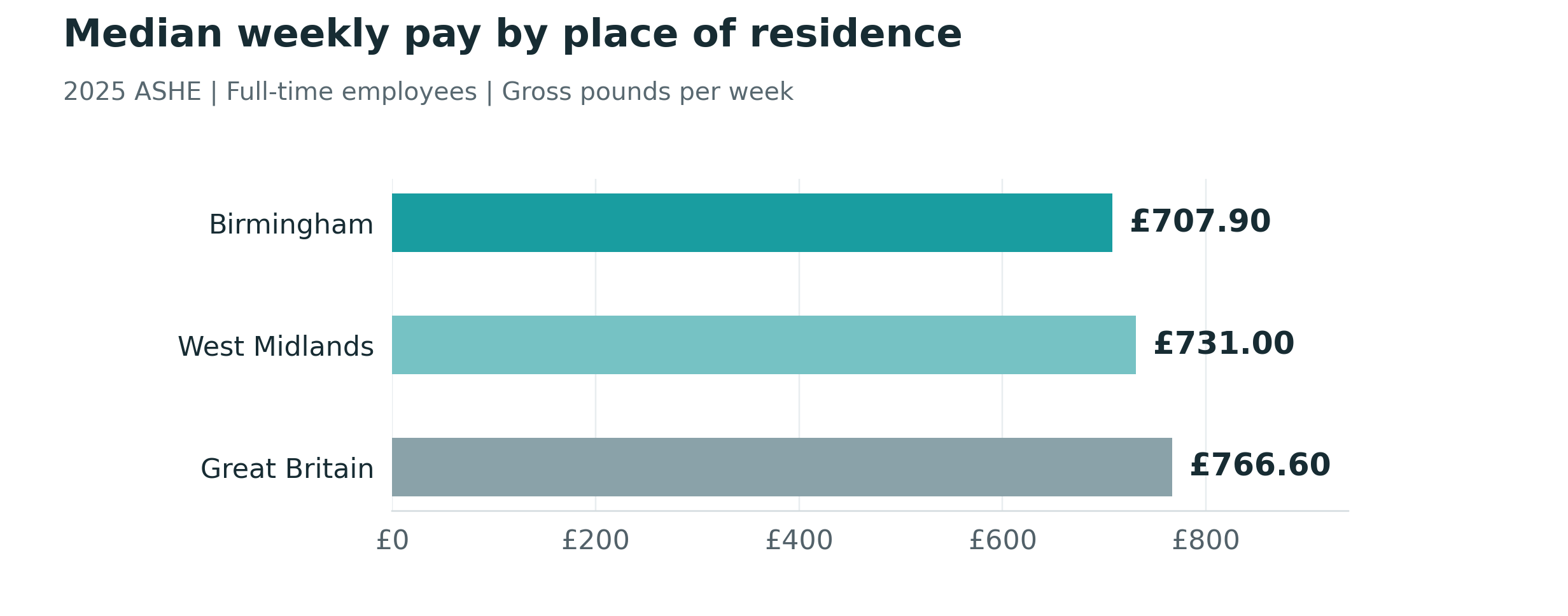
Figure 1. Median gross weekly pay in pounds for full-time employees by place of residence, 2025. The figures describe employee earnings before deductions. Individual buyers may have different incomes and spending priorities.
Source: Nomis Birmingham profile, ONS Annual Survey of Hours and Earnings, accessed 6 November 2026.
Translate local settings into requirements
The city’s plans give buyers useful starting points. Digbeth’s creative activity and the Jewellery Quarter’s maker heritage support different website briefs. The examples below are hypothetical projects. See Birmingham’s Digbeth prospectus and the Jewellery Quarter Neighbourhood Plan.
Birmingham setting | Buyer’s practical question | Website requirement |
|---|---|---|
Digbeth exhibition | What does the edition include after the show closes? | Public catalogue, artwork licence and benefit dates |
Jewellery Quarter maker | How do I link the physical piece to its digital record? | Clear item reference, issuer details and a transfer process |
City centre event venue | Will my purchase get me through the door? | Claim confirmation, staff checks and a way to handle an unavailable wallet |
Regional creative studio | Who can use the artwork after a token changes hands? | Licence terms and a clear handover rule |
For local NFT website developers Birmingham makers may engage, these examples give a concrete test. Show what staff see when a buyer arrives with the wrong reference. Then ask how the project will record a correction without exposing another customer’s details.
Start with the audience’s reason to visit
Birmingham Open Media’s portfolio includes Brum SoundTracks, an interactive project that uses augmented reality and app development. It gives a local example of how a digital experience can be tied to a place. For a gallery brief, start with the part of the work people can understand and explore before a purchase. See Birmingham Open Media’s portfolio.
For example, a visitor might find a Digbeth exhibition through an event listing and read about the artist while travelling. Show the work, venue and date in plain text. Then explain how to return later for a purchase or claim. Test those pages with actual visitors and ask which terms need a simpler explanation.
Choose the Smallest Scope That Meets the Brief
Scope | What the site does | Main work to quote |
|---|---|---|
Public gallery and collection links | Shows the work and sends buyers to an identified external purchase page | Editing, artwork rights, accessibility and verified links |
Branded mint page | Presents the collection and initiates minting on a defined contract | Wallet flow, network checks, fees, status and support |
Marketplace interface | Displays listings and supports purchases or resales | Listing data, fees, transaction roles and operational support |
Private holder area | Checks eligibility for a specific benefit | Wallet sign-in, access rules, claims and a staff workflow |
Begin with a public page if it meets the goal
NFT website development can start with a public catalogue and a clear link to an existing collection. That lets people explore the work on a phone before deciding whether to buy. In the FCA’s 2025 online survey, 8% of people reported being cryptoasset users. The survey provides UK context and may overestimate the share because it omits people who are digitally excluded. See the FCA consumer research note.
An NFT minting website makes sense when the project needs more control of the primary release. The site can explain the edition, guide the buyer through the transaction and display its outcome. First, agree which contract controls the edition and which team owns support after the release.
Give secondary sales a separate brief
NFT marketplace development adds questions about listings, seller permissions, price changes and transaction failures. For example, a listing can become stale if an item moves to another wallet. Set out how the site will detect that change and what the buyer should see. Ask who will investigate disputes about a listing.
Local NFT website developers Birmingham organisations shortlist should explain where they would reuse existing services. A website that reads listings from another platform has different responsibilities from a project that operates its own trading system. Name the platform, contract, data feed and support owner in the quote.
Shortlist Developers Using Evidence You Can Check
Verify the team and the meeting location
Ask which legal entity will sign the contract, who will build the website and who will write or review the smart contract. A local workshop can help you work through a gallery’s visitor journey. Separate that benefit from the need for a specialist who has deployed comparable blockchain code.
Check addresses on the provider’s own contact page. For example, NEXA markets Web3 services to Birmingham and lists its UK contact in Manchester. Ask where the team can meet and who would attend. See NEXA’s Birmingham service page and UK contact page.
Local NFT website developers Birmingham buyers interview can include a web studio working with a named blockchain partner. Ask each person to describe their responsibility in one sentence. Then confirm who covers the handover if the specialist leaves. This is useful even when both suppliers work under one contract.
Ask for one comparable project and a demo
For a previous NFT website development project, request a public page or a demo you can use with test data. Ask which parts the supplier delivered. For example, a design portfolio can show page quality, while a contract address and release record help you check the blockchain work.
Ask Web3 developers to demonstrate a failed transaction as well as a successful one. Watch what appears when a buyer declines a request, changes network or closes the wallet. Then ask how the support team can identify the transaction without collecting credentials.
For NFT marketplace development, include a specific case in the demo. Ask what a buyer sees when a listing changes price just before confirmation. Have the supplier explain which system checks the latest state and how the interface recovers. That makes proposals easier to compare than a list of feature names.
Compare Published Prices and Build a GBP Budget
Read the scope behind a starting price
The following prices were checked on 6 November 2026. The first two offers cover general websites. The latter two describe specialist NFT work advertised by a UK provider. Confirm current scope, VAT and recurring charges with the supplier before treating any price as a quote.
Published offer | Advertised GBP price | Scope to confirm |
|---|---|---|
Sparkbyte brochure site | From £799 | Up to six pages. Useful context for a public information site |
Swick Labs AI Business Website | £2,950 | General business site from a studio that describes itself as Birmingham based and works remotely |
Black Candy NFT launch site | From £6,500 | Wallet connection and minting. Ask about contract work and independent review |
Black Candy marketplace | From £19,995 | Advertises OpenSea integration. Confirm the service and support boundaries |
Published prices from Sparkbyte, Swick Labs and Black Candy NFT.
When comparing local NFT website developers Birmingham clients can meet, give them the same scope. Count the pages, languages, wallet types and supported networks. Ask for separate allowances for legal review, security review and live support. A quote for a marketplace interface may assume that another service already handles listings.
Budget the work around the contract
Suppose a gallery commissions an NFT minting website for an existing contract that has already been reviewed. The illustrative build budget below is £7,200 before VAT. It covers the website and integration. Add a separate allowance for any new contract, additional specialist review, artwork production or legal work your project requires.
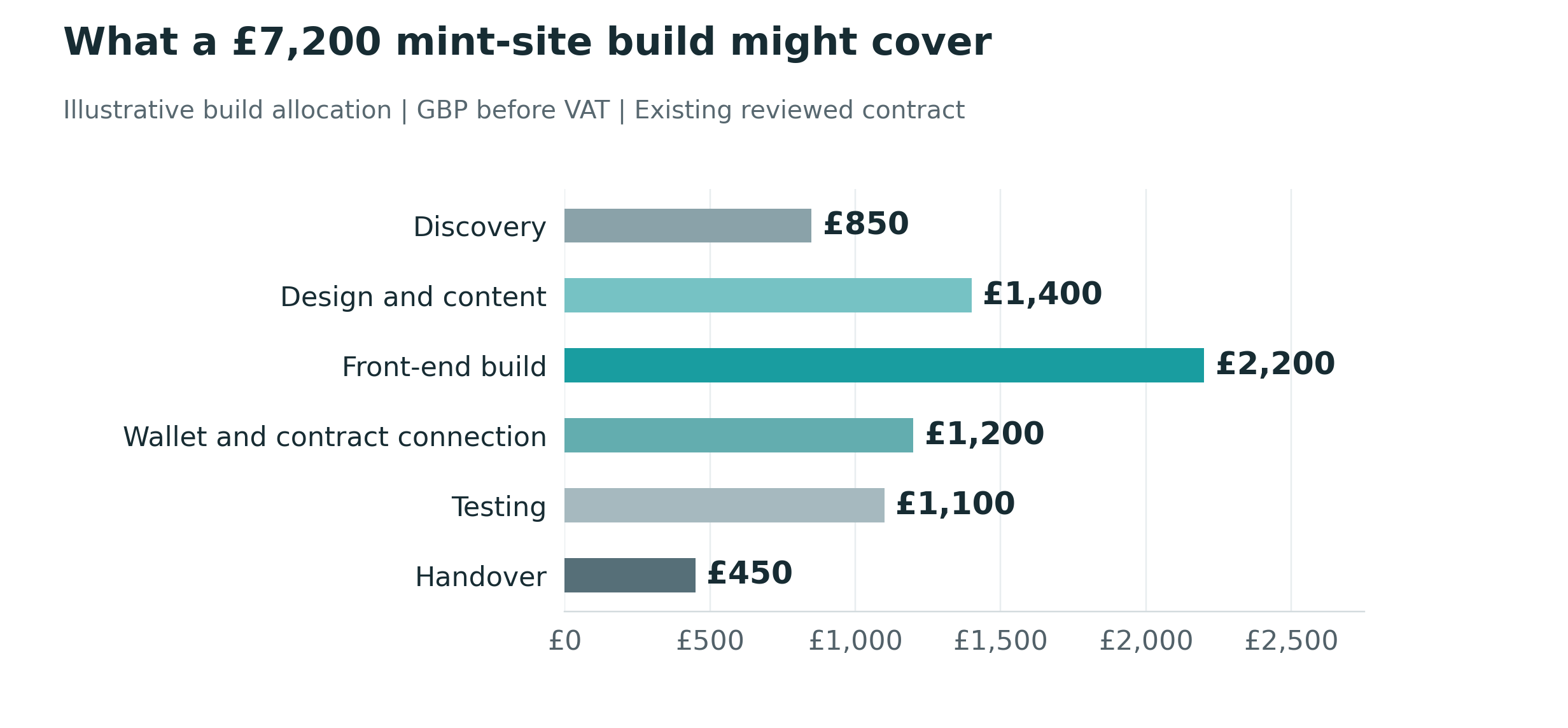
Figure 2. Illustrative build allocation in GBP, prepared in November 2026. It assumes an existing reviewed contract. The £7,200 total covers the site scope shown, before VAT and any separately commissioned work.
Source: ZH Consultancy, original planning example prepared 6 November 2026.
Next, list hosting, monitoring, storage, indexing and any service subscriptions. Check which costs depend on transactions or traffic. For wallet integration, agree who pays network fees and how support explains an estimate. Ethereum transaction fees depend on gas used and the price of gas. See the Ethereum gas documentation.
Set the Contract, Network and Content Boundaries
Match the token standard to the edition
On Ethereum-compatible projects, ERC-721 provides distinct token IDs within a contract. ERC-1155 can represent multiple token types and balances within one contract. For example, an edition with several copies of the same design may use ERC-1155. Ask Web3 developers to explain how the standard meets the actual edition and transfer rules. See the ERC-721 specification and ERC-1155 overview.
Before commissioning NFT website development, agree which network the audience can use and which wallets the project will test. Keep the first release manageable. A second network can introduce separate contracts, data and support questions. Ask how staff will distinguish the official collection when a buyer finds a similar-looking one.
Plan how artwork and metadata stay available
Metadata describes the token and can point to the associated media. Agree where those files live and who can change them. If you choose IPFS, put persistence in the operations brief. Pinning keeps selected content available on a node or service. Also keep an export and a recovery plan. See IPFS guidance on persistence.
Ask local NFT website developers Birmingham creators rely on to show the final file location and what happens if a provider account ends. Decide who holds copies of the media and what changes the collection allows. This is especially useful when an artwork needs a correction after launch.
Decide who runs the services behind the page
List the systems that read transaction data and serve artwork. Ask Web3 developers which ones the business will pay for and who gets an alert when one fails. If a service cannot confirm availability, decide whether to pause purchases and keep the public catalogue open. Write that behaviour into the acceptance tests.
For NFT marketplace development, request a diagram of the parties involved in a sale. Identify who holds any funds or assets and who controls the contract. Also establish what happens if a data feed or listing service ends. If the site relies on a third party, confirm what information you can export and what a migration would require.
Make Wallet Steps Understandable on a Phone
Separate connection from approval
Wallet integration should let people browse the offer before they connect. Explain why you need a wallet at each step. A connection can show an address. A later signature or transaction can authorise a specific action. Use the site and wallet prompts to make that action clear.
For an NFT minting website, show the network, collection, item quantity and cost before requesting approval. Then display whether the request is pending, confirmed or failed. A buyer who closes the browser should have a way to find the result using the transaction reference.
Test the screens with a keyboard, enlarged text and a phone. For example, a wallet modal should keep its controls accessible and tell a visitor how to return to the offer. Add a clear status message when an action fails. Use WCAG 2.2 to set accessibility checks.
Show customers how to get help
Local NFT website developers Birmingham galleries work with should provide a support path that a first-time buyer can use. Ask for a public contact page and a way to report a stuck transaction. Train staff to ask for a public transaction reference and to keep recovery phrases and private keys out of support exchanges. See Ethereum’s wallet security guidance.
For wallet integration, define the supported device and browser combinations before testing. Include people who start on a desktop and open their wallet on a phone. Then check whether they return to the same order and can see the result. That handoff deserves a place in the acceptance brief.
Design the receipt and the later claim together
An NFT minting website should distinguish the result of a purchase from the status of an event reservation. A gallery can show a confirmed transaction and still need to allocate a workshop place. Decide when a buyer receives the reservation confirmation and what information staff will see at the door.
For example, make a simple rehearsal with two buyers and one remaining space. Have both try to claim it. Check how the team explains the outcome and where it records the final allocation. Then test what happens when the confirmed buyer loses access to their wallet. Give staff an agreed process to follow under the project’s terms.
Set Rights, Buyer Terms and Data Handling Early
Explain the artwork licence and benefits
Write out the rights included with the token. A buyer may receive permission to display a digital work while the creator retains copyright. If an agreement assigns copyright, UK law generally requires a signed written assignment. Set out what happens when the token transfers and check the underlying rights to images, music and brand assets. See Copyright, Designs and Patents Act section 90.
For NFT marketplace development, model initial proceeds separately from any resale royalty. The ERC-2981 interface can communicate royalty information. Marketplaces and transaction workflows determine whether it is paid. Use written terms and an operating assumption you can support. See the ERC-2981 royalty specification.
Review the offer before you market it
Have a UK adviser review the actual token and promotion. The FCA’s financial promotion guidance concerns qualifying cryptoassets. Ask how the rules apply if the proposal involves fractional interests, pooled returns or secondary trading. Approve the commercial claims and buyer information alongside the technical scope. See the FCA’s financial promotions guidance.
For an NFT minting website, make the total and mandatory charges clear before the order. If a charge varies, explain how the buyer will see it and when it is set. Review delivery, benefit claims and cancellation terms for the specific offer. See the CMA’s price transparency guidance and GOV.UK online selling guidance.
Keep customer information manageable
Keep email, support and event records in systems where your team can manage access and retention. Check how a wallet address links to those records. Also review privacy notices and any overseas access needed for support. If the arrangement involves a restricted transfer, assess the relevant safeguards before sharing personal data. See the ICO’s international transfer guidance.
Test What Happens When the Release Goes Wrong
Agree who can make sensitive changes
Ask Web3 developers to list the accounts that can change price, update metadata, pause minting or withdraw proceeds. Match those permissions to named roles. For example, two authorised people can be required to approve a sensitive change if the chosen controls support it. Review the proposed design using OpenZeppelin’s access control documentation.
Ask local NFT website developers Birmingham organisations hire to identify the exact contract version used in testing. Arrange an independent review appropriate to its risk. Then record the deployed contract address, the review scope and the controls that remain available to the operator. Review the website separately for compromised scripts, incorrect links and exposed credentials.
Run a release rehearsal with staff
Acceptance case | Expected outcome |
|---|---|
Buyer has no wallet | The offer stays visible and the page explains the next step |
Buyer connects on the wrong network | The site identifies the expected network before approval |
Buyer cancels or the request fails | The site explains the state and allows safe recovery |
Edition sells out during checkout | The site shows the latest availability and gives a clear response |
Transaction completes while the tab is closed | The buyer can recover the outcome using a transaction reference |
Buyer claims an event benefit twice | Staff see the earlier claim and know how to resolve the enquiry |
Run these tests against a preview with test transactions. Include an interrupted wallet connection and a failed claim lookup. For wallet integration, distinguish an issue on the site from a rejected or pending action in the wallet. Then agree who responds during the first release window.
For NFT marketplace development, test permissions and failure states for both buyers and sellers. For instance, confirm who can remove a listing and what happens if a seller transfers the item. Record the results next to the expected behaviour before accepting the build.
Agree a Release Plan and a Handover
Set stages around decisions
Start with discovery, then prototype the purchase and claim flow. Once the team agrees the content and rights, test the integration on a preview. Set the release date after the contract review and acceptance checks are scheduled. The timeline depends on the number of suppliers and the readiness of the artwork.
For local NFT website developers Birmingham teams can work with in person, use workshops for decisions that need several roles together. Bring the artist, event manager and support lead to one rehearsal. Record who will publish the official link and who can suspend the site’s buying interface during an incident.
Keep control of accounts and access
At handover, receive the source code or agreed access, setup instructions and the list of third-party services. Keep domain and hosting ownership with the business. Also record how new staff will access the project and how an outgoing supplier’s permissions will be removed.
Ask Web3 developers to document any ongoing contract administration. Then agree which ordinary site updates your team can make. Use a support schedule for backups, monitoring and releases. For the web infrastructure side, review ZH Consultancy’s website maintenance services.
Work Out Whether the Launch Can Pay for Itself
Calculate contribution before assuming demand
Use the illustrative £7,200 build and add £140 per month for six months of hosting and support. That puts the modelled six-month fixed cost at £8,040. Suppose a sale brings in £55 before VAT and £15 goes to direct payment, fulfilment and support costs. Each completed sale then contributes £40.
At that contribution, the project needs 201 completed sales to cover the modelled fixed cost. If the edition has 180 available units, selling every unit produces £7,200 of contribution. That leaves an £840 gap. Use the calculation to decide whether to narrow the first release or fund it partly from a separate event budget.
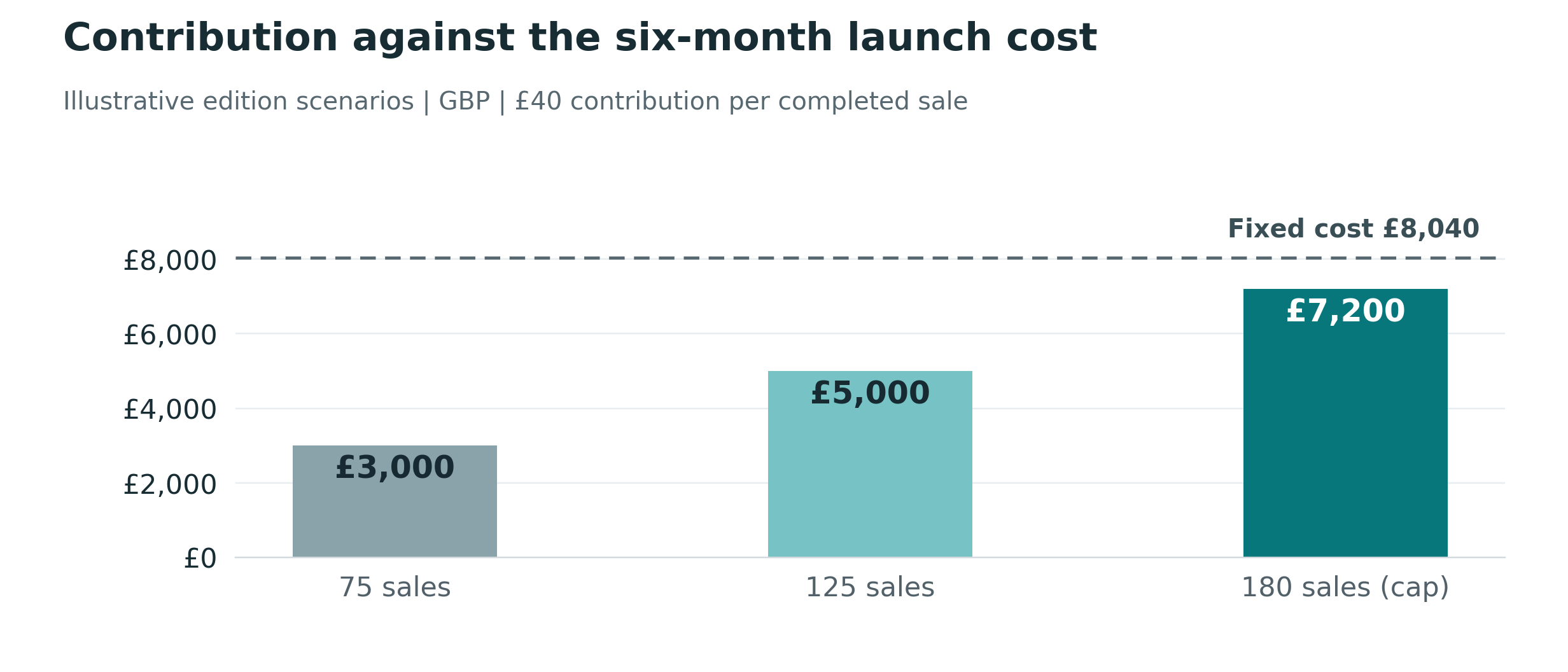
Figure 3. Six-month cost recovery for an illustrative edition in GBP. Contribution uses £40 per completed sale, with £8,040 in fixed costs. The three quantities are scenarios. The edition cap is 180 units, and the model excludes taxes and any resale receipts.
Source: ZH Consultancy, original calculation prepared 6 November 2026.
Give each benefit its own measure
Track completed sales, claims fulfilled and staff time spent on support. For example, a gallery may decide the project deserves funding because it supports an exhibition programme. Put that purpose in the budget and agree how you will measure it. For a project with several funding sources, consider ZH Consultancy’s business consultancy services.
Ask local NFT website developers Birmingham teams select to show what each extra feature changes in the budget. A second wallet option may improve access for part of the audience. A secondary market adds ongoing work. Estimate both the operating cost and the result you would measure before deciding.
Keep the Collection Useful After Launch
Review links and artwork availability after the release. For example, visitors may follow an old social post long after a sale ends. Give them a useful collection page with current status, the official address and the route for claims. Keep the contact details current when a team changes.
For NFT website development, plan for updates to browsers, wallet connectors and hosted services. Store a list of dependencies and their owners. Then repeat a small set of purchase and claim tests before an important update. This helps you catch changes that affect the audience.
If a retailer also sells physical work, separate that buying journey in the brief. A standard store may handle delivery, stock and returns while the collection page explains the token. For the physical catalogue and checkout, see ZH Consultancy’s ecommerce website development services.
Publish a collection page you can keep current
For NFT website development, keep a public page for each release with readable artwork descriptions, creator information and a clear status. When the sale closes, update the page with the next action a visitor can take. For example, point an existing holder to the claim instructions or show the archive to someone who only wants to see the work.
Ask local NFT website developers Birmingham teams shortlist to put the official collection information on a domain your business controls. Decide which page partners should link to in exhibition listings and emails. If a service provider changes, update that page first. Then check that older links still lead buyers to accurate information.
For a project that expects future releases, schedule a review after the first month. Measure how many people found the collection and how many completed the intended action. If staff spent most of their time explaining one step, improve the instructions before funding another feature.
Scope the Website Work with ZH Consultancy
ZH Consultancy provides website design and development remotely from Pakistan. A Birmingham team can send a brief for the public collection site, content pages or an integration it needs to assess. Include the audience, the supported network, the purchase steps and the roles already assigned to technical specialists. Start with ZH Consultancy’s web development services.
If a project needs custom workflow work, agree the division between front-end design, integration and independent smart contract review. For wallet integration, ask for a test plan and named support owner before accepting the scope. Discuss specific features through custom website development services.
Give the project one clear identity and one official site address. Prepare artwork assets and agree how the team will use them across the public pages and event material. If the identity needs development, see ZH Consultancy’s logo and brand design services. Send the agreed brief through the contact page.
The Takeaway
Choose local NFT website developers Birmingham buyers can evaluate through a working demo. Start with what the customer receives and how your team will deliver it. Then compare prices for the same website, contract and support responsibilities.
Before launch, complete the purchase and claim on a phone using a test account. Review the result with the person who will answer customer questions. Use those tests and the cost model to decide how much of the project belongs in the first release.
Faq
Frequently Asked Questions
The quote depends on whether you need a gallery, a branded mint page or trading features. Ask local NFT website developers Birmingham businesses shortlist to quote the same scope. Separate design, wallet work, contract review, legal work and ongoing support. The published examples above give starting points for that conversation.
A public catalogue and a verified link to an existing collection can suit an exhibition that needs a clear way to show the work. Build a branded mint flow when the team needs control of purchase steps, price presentation and support. First, check what your audience can complete on a phone.
Use the team that can demonstrate the work your project needs. A local studio can help with workshops and content. A specialist may handle contract and wallet work remotely. Ask each person to define their role and make one lead responsible for the complete journey and handover.
A marketplace needs rules for listings, seller access, fees and changes in ownership. Ask who operates each part and who supports the buyer if a transaction fails. Also decide how to handle disputes and reviews. That work belongs in a separate scope with its own acceptance tests.
Yes. You can publish the catalogue, licence information, dates and support pages for anyone to read. Use wallet integration when the site needs to verify ownership or request a defined action. Explain that step in plain language and test how it works on the devices your audience uses.
Ask the developer to show where the media and metadata are stored. Then confirm who pays for the service, keeps a copy and can recover it. If the team uses IPFS, check the pinning arrangements. Include those responsibilities in the handover and in the cost of running the site.
ZH Consultancy can discuss the website and integration scope from Pakistan. Share the page list, the proposed purchase journey and the teams already responsible for the contract, legal review and security. Ask for a GBP quote that identifies deliverables, dependencies, access arrangements and post-launch support.

Zain Hameed
Business strategy specialist helping a global client base of 800+ businesses build credible plans, financial models and investor-ready presentations.
In this article
Book a Free Consultation
Have a business idea, growth challenge or investor deadline? Book a free consultation and get clear next steps from our team.
Call our team
+923104049517
Email us

Business Topics
Business topics
Continue reading
Related insights

How to Start a Side Business in the UAE While Working Full-Time
Learn how to start a side business in the UAE. Compare

How to Start an Electrical Business
Learn how to start an electrical business in the U.S., with

How to Start a Junk Removal Business
Learn how to start a junk removal business with U.S. startup

How to Start a Lash Business and Build a Loyal Client Base
Learn how to start a lash business in the U.S., compare

How to Start a Mobile Drug Testing Business
Learn how to start a mobile drug testing business in the

How to Start a Pest Control Business in the United States
Learn how to start a pest control business in the U.S.