

In this article
The sales team at a Birmingham components supplier gets an email at 4.47 pm. A buyer wants a price for 400 units, but the website form has dropped the part number and won’t accept a drawing. The salesperson asks for both. By the time the buyer replies, someone else has already sent a quote.
Picture the supplier asking three firms to rebuild its site. One offers a polished catalogue. Another proposes a customer portal. A third wants to fix the enquiry journey and connect it to the sales team’s inbox. All three call their proposal a website redesign. Each solves a different problem.
A search for web development companies in UK directories can put all three on the same page. To tell the proposals apart, describe the buyer’s next step and the work your staff must do once it happens. For the supplier, that means a buyer can find the correct part, attach a drawing from a phone and get confirmation that the request reached the right person.
Use that level of detail whether you need a site for a clinic, a trade supplier or an online shop. It gives you something concrete to price, test and measure. It also makes it easier to decide which work belongs in the first release.
What web development companies in UK markets build
A designer plans how pages look and how people move through them. A developer makes the forms, checkout, integrations and editing tools work. A web development agency may cover both, plus content, testing and project management. Ask who owns each job in your proposal. A quote for six pages tells you little about whether someone will configure a booking system or import 600 existing products.
The website development services you need depend on where the work breaks down. A business with reliable enquiries and an outdated layout may be able to rebuild just its busiest page templates. A retailer with a recurring stock discrepancy may need integration work even if the storefront looks fine. Look at recent abandoned forms, customer support messages and sales calls before asking anyone to recommend a platform.
What the customer needs | What to put in the brief | What to see in a demo |
|---|---|---|
Verify the firm and make contact | Clear service pages, trust signals and an editable contact page | Staff can change hours and contact details without developer access |
Book a service or request a quote | Service areas, availability, form routing and confirmation | A test enquiry reaches the right inbox and its status is visible |
Buy and receive an item | Catalogue, stock, payment, delivery rules and returns | A real test basket shows the correct delivery charge before payment |
Sign in and place repeat orders | Account roles, negotiated prices, order history and integrations | Two test accounts see their own prices and order records |
Some web development companies in UK listings specialise in one of these jobs. That can be an advantage. A WordPress development agency might be a strong fit for a firm with dozens of service pages and several editors. A team that does ecommerce website development should be able to talk through partial refunds, overselling and what happens when a courier integration stops responding. Approval roles or a connection to a legacy system are good reasons to explore custom website development services.
If the first version needs three core services and a dependable form, put the portal in a later phase. This gives you a chance to see which questions customers ask and which tasks staff actually repeat. You can use that evidence to decide whether a portal will save work or create another account customers have to remember.
What geography changes for a UK website
The UK had an estimated 69.5 million residents at mid-2025, up 0.3% over the year, according to the Office for National Statistics population estimates. At the start of 2026, the Department for Business and Trade estimated 5.6 million private-sector businesses. About 74% employed nobody other than the owners. London and South East England accounted for 33.5% of the national business total. The estimates cover registered and unregistered businesses and attribute them to their head office locations.
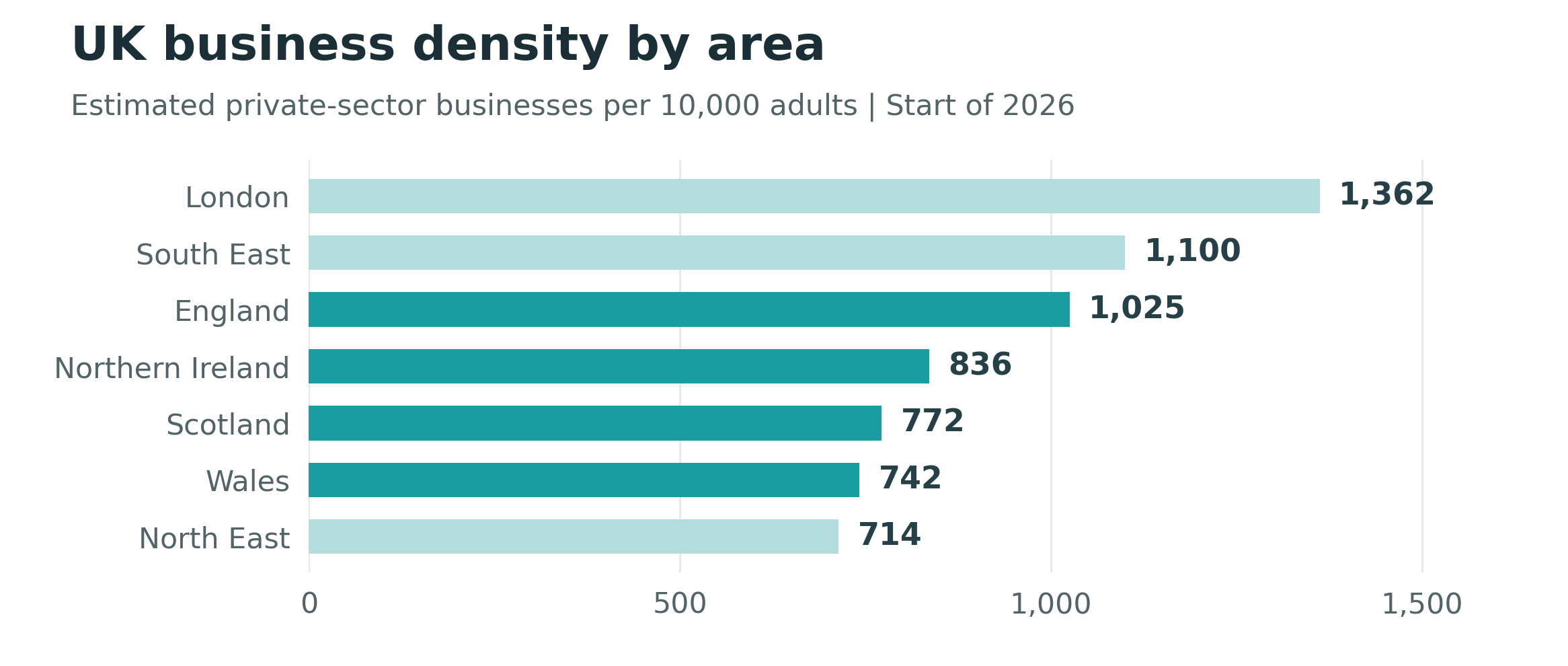
Figure 1. Estimated private-sector businesses per 10,000 adults at the start of 2026. London, the South East and the North East are English regions included in England. Counts use head office locations.
Source data from the Department for Business and Trade’s 2026 business population estimates.
If you’re comparing web development companies in UK cities, judge how their work fits your actual customers. A London accountancy firm selling to employers may want sector pages that explain who handles payroll and what information a buyer needs to switch. A West Midlands manufacturer with sales across England may get more value from searchable specification sheets and a way to enquire about discontinued parts. Both sell to businesses. The right prototype for each would look quite different.
When local differences belong in the brief
In Wales, language can affect how you commission and maintain the site. At the 2021 Census, 64.4% of residents aged three and over in Gwynedd reported being able to speak Welsh, compared with 12.2% in Cardiff. For a Gwynedd business serving Welsh-speaking customers, ask who will translate and keep both versions current. Include translated booking confirmations and a language switch that takes customers to the equivalent page. Decide based on your audience, using the ONS data for Gwynedd and Cardiff.
A tour operator selling departures across Scotland might show the meeting point, departure time and cancellation terms early. Test the booking on a slow mobile connection and send meeting details in a confirmation customers can retrieve later. For a merchant selling from Great Britain into Northern Ireland, price a Belfast test order and verify fulfilment with the carrier. Build delivery zones from actual service rules and consult the government guidance on GB–Northern Ireland parcels.
The buyer’s device matters alongside their postcode. Smartphones accounted for 77% of online time among UK adults who used the internet in May 2025, according to the Ipsos measurements reported by Ofcom’s Online Nation research. That covers time across measured services and devices. Use your own analytics and sales records to understand how visitors use your site. A buyer might discover a supplier on a phone and return from a work computer to upload a specification.
Ofcom estimated that full fibre was available to 82% of UK homes in January 2026. Availability describes where a service could be bought. Test checkout and enquiries on a slower connection even if most visitors have access to fast broadband at home. Ask the provider to demonstrate what users see if a payment takes a few extra seconds or an upload fails. See Ofcom’s spring 2026 broadband update.
Where online retail figures help
In Great Britain, internet sales represented 27.4% of retail sales value in 2025, up 8.2 percentage points from 2019. The share peaked at 30.7% in 2021 within the period shown. In September 2026, it was 28.8% on the seasonally adjusted monthly measure. Those figures put the channel in context. Use your own margins, stock and fulfilment capacity to decide how much to invest in ecommerce website development. The recent monthly figure is from the ONS September 2026 retail sales bulletin.
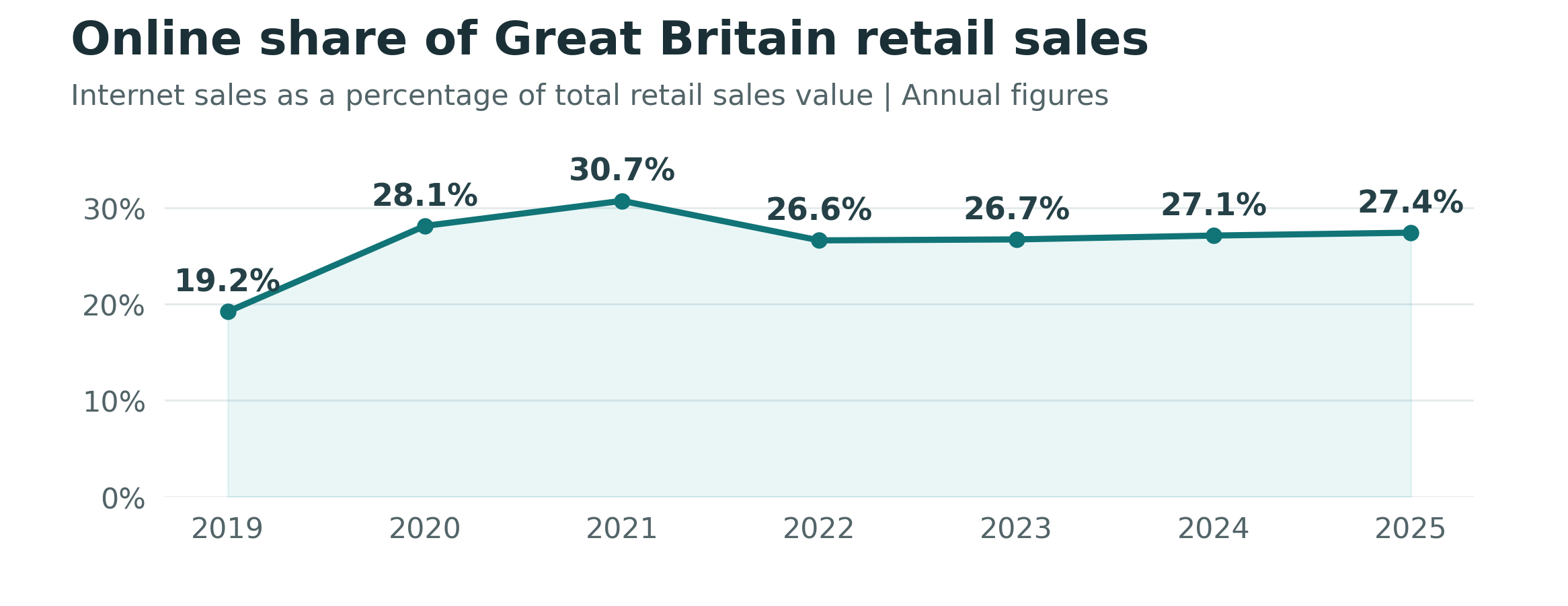
Figure 2. Online share of total retail sales value in Great Britain, annual percentages from 2019 to 2025. The series covers Great Britain and excludes Northern Ireland.
Source data from the Office for National Statistics Retail Sales Index, series J4MC.
How to shortlist web development companies in UK directories
Start with work you can use. Ask each firm for two live sites that resemble your project and an explanation of its role. Open the site on your phone. Try searching for a product or completing a form up to the last step. During the call, ask the supplier to show how a member of staff would edit the same journey.
A solo freelancer can suit a focused website with a single decision maker. You usually talk directly to the person doing the build. Ask who covers leave and what another developer would need to take over. A local web development agency may be better placed to run workshops or coordinate a move involving several departments. Check whether the team at the pitch will do the work and which parts are subcontracted.
A remote team may be able to offer a lower-cost quote for comparable website development services. Get the schedule and support commitments in writing. ZH Consultancy is based in Pakistan and provides web development remotely. If you’re comparing its website development services with those of a UK team, give both the same brief and ask who will handle UK-hours demos, feedback and urgent issues.
When you find web development companies in UK business directories, filter by platform and project scope, then read the project descriptions and review dates. For a firm trading through a UK limited company, match the company number and legal name in the proposal to the Companies House register. Ask which entity invoices and signs the contract, particularly when the brand name is shared by several businesses. For examples of how suppliers describe their work, browse Clutch’s UK web developer directory.
Choose a platform your staff can run
Ask web development companies in UK markets to demonstrate an ordinary Tuesday on their proposed platform. Can a staff member update a service price, correct a delivery estimate or remove a sold-out product without a developer? Try the task on a staff account. A fast demo on an administrator’s account can hide the permissions and workarounds your team will live with.
Platform | Good fit | What to price separately |
|---|---|---|
WordPress | Content-led service sites with multiple editors | Hosting, plugin licences, updates and editor training |
WooCommerce | Stores needing flexible commerce within WordPress | Payment and shipping extensions, hosting and order testing |
Shopify | Merchants that want managed hosting and standard checkout | Subscription, apps, payment charges and theme changes |
Hosted site builder | Small, straightforward sites with limited integrations | Paid features, renewal terms and content export |
Custom build | Portals with unusual permissions or business rules | Integration work, hosting, tests and long-term engineering |
A WordPress development agency should be able to explain what a plugin does, why it is needed and who renews it. Ask which content uses reusable templates and what happens to those pages if you change the theme or page builder. With WooCommerce, confirm backups cover both the website files and the database. A product spreadsheet alone cannot restore orders, customer accounts and store settings. See WooCommerce’s backup documentation.
Shopify can simplify infrastructure while still leaving commercial decisions about apps, payment fees, product feeds and returns. When checked in November 2026, the UK Basic plan displayed £19 per month with yearly billing or £25 with monthly billing. Treat the subscription as one line in the website development cost. Ask your provider to itemise apps, billing intervals and any setup work around delivery, payments and taxes. Compare the official Shopify UK plans and the scope of Shopify development services.
For ecommerce website development involving trade accounts, make the hardest rules part of the demonstration. Can customers with approved accounts see their own price lists? Can one account have several buyers with different permissions? Who handles a stock update that arrives after a customer submits an order? If a simpler platform meets those rules with a well-supported extension, ask for its renewal and update costs before choosing bespoke code.
Own the accounts that keep the site online
Put the domain in your organisation’s name and use a business-controlled email address for recovery. Give the provider delegated access where available. Record who controls the domain, DNS, hosting, code repository, analytics and payment accounts. During a hosting move, export the DNS records and make sure email records survive the switch. For UK domains, check what you can manage through Nominet’s domain account service.
Compare hosting offers at renewal and ask for the backup retention period, SSL renewal process and a staging environment. If your website development services include managed hosting, ask how you can export the database and files. A backup is useful when someone can restore it. Have the provider restore a copy to staging before you sign off.
What UK website development costs in practice
The first price you see can be a sensible starting point for the scope it covers. It is easy to misread when you compare a five-page starter site with a migration that includes copywriting, redirects, an inventory feed and staff training. Here are published GBP examples from three providers, checked in November 2026.
Provider and offer | Published price | Scope to check |
|---|---|---|
Web Cardiff WordPress build | £800 | Confirm page count, copy, hosting and VAT treatment |
Elite Digital Starter Website | £1,500 | Up to five pages. Check content, renewals and VAT |
NRCM Digital custom business site | From £3,500 + VAT | Confirm migration, design revisions and handover |
NRCM Digital ecommerce project | From £7,500 + VAT | Price the integrations, catalogue import and shipping rules |
These figures describe advertised offers, and the providers can revise them. A site for an existing business can cost more than a starter package if it needs legacy URLs mapped, product data cleaned or a third-party system tested. Ask web development companies in UK directories to split the website development cost into discovery, design, build, content, migration, testing and ongoing support. Get an explicit invoice total in GBP and check VAT. The UK standard VAT rate is 20% where it applies. Confirm how each supplier’s quote is treated using HMRC’s VAT rates guidance.
Separate the number of templates from the number of pages. A chain with 20 branches may need one well-designed location template and 20 sets of opening hours, photographs and booking links. If the quote covers the template and five populated pages, price who will enter and check the remaining 15. Apply the same test to products with sizes or colours. The time needed to clean the data and verify stock and prices can be more significant than the number of templates.
Compare the first two years
Suppose you have two quotes for the same deliverables and comparable support. Quote A is £6,400 to build and £195 a month to run. Quote B is £8,300 to build and £95 a month to run. At 12 months, A costs £8,740 and B costs £9,440. At 24 months, A comes to £11,080 and B to £10,580. The totals meet at 19 months because B’s £1,900 higher build price is offset by £100 a month in running costs.
This example assumes constant fees, equal scope and no VAT, financing or additional work. Ask for a two-year cost schedule and what happens when introductory rates end. If a provider bundles hosting and maintenance, get its response hours, update policy and exclusions in writing. If leaving means paying a migration fee or rebuilding a proprietary template, include that cost in your decision.
Write a brief that gets comparable proposals
Give web development companies in UK business networks the same brief as the candidates you find through directories. Set out your customer groups, the actions you want them to take, the systems your staff use, the URLs that matter and the people who will approve the work. Include a sample enquiry, order or product record with personal details removed.
If you are buying website development services because you need more enquiries, describe which enquiries make money. A trade supplier might require a buyer’s organisation, delivery postcode, part number and minimum quantity. A clinic might need service type and preferred contact time, with sensitive details collected later through an appropriate channel. If you are still unsure who buys or why they hesitate, set aside time for interviews or customer and market research.
Ask the web development agency to identify the riskiest assumption in the brief. Perhaps the scheduling system has a limited API, or the original site contains more pages than anyone expected. A short paid discovery phase can be worthwhile when the unknown could change the website development cost. Agree what you will receive, such as an integration test, a list of pages to move and an estimate with clear boundaries. Ask whether you can use those outputs with another supplier.
Score the evidence in each proposal
Give each row zero for missing evidence, one for a plausible written answer and two for something you can verify. Set any essentials before scoring. A supplier that fails your required delivery or data-handling test needs to resolve it before you award the work.
What to judge | Evidence worth asking for |
|---|---|
Relevant work | Two live projects with a similar customer task and a clear account of the supplier’s role |
Ability to edit | A demonstration of your staff adding a service, product or page on staging |
Testing | A test plan that covers mistakes and failures as well as successful transactions |
Ownership and support | Written account access, licence terms, named support contact and export procedure |
Two proposals from web development companies in UK directories can look similar until each team attempts the same task. For ecommerce website development, use a real basket with a delivery restriction, a discount and a partial refund. For a WordPress development agency, ask a non-technical colleague to create a service page from a template and fix a broken link on staging. Compare how many steps each approach takes and who needs access.
Tie payment milestones to outcomes you can review. That might mean agreeing the content structure, accepting the booking journey on staging and receiving the account handover. Put the number of revision rounds and the rate for agreed changes in the contract. Clarify which work you own or can continue to use, including source files, custom code, photography and licences for fonts or extensions. A provider can transfer the finished build while certain third-party components keep their own licence terms.
Make launch a series of checks you can repeat
Protect the pages that already bring business
Before the rebuild, export your top landing pages and enquiries, then find the URLs people link to and the pages that earn search traffic. Keep useful URLs where possible. If they change, map each old page to its closest replacement and test permanent redirects. This lets a buyer’s saved link reach the right document or product after launch. Read Google’s site move guidance.
Look at how web development companies in UK redesign case studies handled old links, then price that work in your own project. Verify that the new site can be indexed once it is ready, that important pages point search engines to the intended canonical URLs and that sitemaps contain live pages. Test a sample of redirects, forms and payment confirmations again after DNS changes. For a business serving customers at real locations or across a defined service area, also check the opening hours, booking URLs and contact details in its Google Business Profile.
For a store that keeps selling during migration, agree which system will be the source of truth during the switch. Decide when to take the last copy of stock and orders and who reconciles new purchases that come in after that copy. Set a rollback decision time and name the person who can call it. Reverting a storefront can be quick. Recovering orders and customer records created while it was live takes a separate plan.
Test with a keyboard, a phone and a slow connection
Walk the main customer task using a keyboard and try it with a screen reader. Check visible focus, readable contrast, labels that remain clear when fields are filled, and errors that tell the customer how to recover. Use the mobile menu, increase text size and try a failed payment or invalid postcode. Ask the web development agency to log the faults, the person fixing them and the result of each retest.
For UK public-sector websites within scope, the government guidance generally calls for WCAG 2.2 AA and an accessibility statement. Service providers have reasonable adjustment duties under applicable equality law, with separate legislation in Northern Ireland. Confirm the obligations for your organisation and include an accessibility test in your acceptance criteria. Start with GOV.UK’s accessibility guidance.
Use a short list of performance targets for key templates. Google’s good thresholds for Core Web Vitals are Largest Contentful Paint at 2.5 seconds or less, Interaction to Next Paint at 200 milliseconds or less and Cumulative Layout Shift at 0.1 or less, measured at the 75th percentile of page loads. Staging tests help catch problems early. Field data after launch can show how real visitors experience the site on mobile and desktop. See Google’s Web Vitals documentation.
Decide how customer data will be handled
Have the provider list what forms, chat, analytics and checkout collect, where that information goes and who can access it. When a supplier processes personal data for you, the UK GDPR requires a controller–processor contract. Check subprocessors and whether overseas access or hosting creates a restricted transfer. Ask your data protection lead or adviser to confirm any safeguards before granting access to real customer data. The ICO explains processor contracts and international transfers.
Ask each supplier to demonstrate which tracking tools run when a visitor declines consent or changes their preferences. Set up consent for tools that require it. The ICO’s current PECR guidance also describes a limited exception for statistical purposes, subject to conditions including clear information and a simple, free way to object. Classify the actual use of each tool, including analytics and advertising, with reference to the ICO’s storage and access technologies guidance.
For consumer sales, show delivery costs and cancellation information where customers can find them before ordering. Have staff run a cancelled order and a return on staging. It is easier to adjust a confirmation email before launch than to explain hundreds of unclear emails after it. Agree which tasks fall within your ecommerce website development scope and check GOV.UK’s online selling guidance.
Measure whether the new site earns its keep
A rise in form submissions can be misleading if they come from outside your service area. Track qualified enquiries, sales accepted by your team and the contribution from won orders. A lead qualifies when it meets criteria you can document in your customer relationship management system, such as location, minimum order or work type. When you compare proposals from web development companies in UK listings, ask how you can reconcile website events with accepted leads. Include the cost of connecting or maintaining those reports in the website development cost.
Suppose a supplier receives 1,200 relevant visits a month and 1.5% generate a qualified enquiry. That produces 18 enquiries. If one in three becomes a sale, the supplier wins six orders. At a 2% enquiry rate, with traffic and the sales close rate unchanged, it receives 24 enquiries and wins eight orders. At £400 of contribution per won order after variable costs, the two extra orders add £800 a month.
Take off £125 in extra monthly running costs and the difference is £675. On an illustrative build cost of £6,750, simple payback is ten months once the improvement is sustained. At a 1.75% enquiry rate, the same maths gives 21 enquiries, seven won orders and £275 in net monthly improvement. Payback moves to about 25 months. These scenarios hold traffic, costs and sales conversion steady and exclude taxes and financing. In practice, the timing of invoices and order fulfilment can affect cash flow.
Record a baseline before the launch and review the first month for broken journeys or missing tracking. Compare outcomes over a suitable sales cycle and account for changes in traffic mix, seasonality and ad spend. If a campaign brings a surge of traffic, track that audience separately. Build reporting into the handover so your staff or digital marketing team can see where interest becomes revenue.
Agree who looks after the site after launch
The first support question worth asking is who answers when something goes wrong. In a store, a broken payment button may need attention that day. On a brochure site, a request to update team photos can wait. A web development agency should distinguish outages and defects from planned improvements, and state when it will respond and how work is charged.
Ask a WordPress development agency where updates are tested, how often backups run, and who can restore the site if a plugin causes a conflict. For ecommerce website development, include the work that sits outside the theme, such as checkout tests after app changes and product-feed monitoring. Support contracts from web development companies in UK tenders can use different definitions of urgent. Ask who would investigate a missing order and when they would involve the payment provider. Request these details in the website maintenance scope.
Over the next few years, expect more suppliers to pitch AI features for content, support and search. Ask what each feature replaces in your team’s workload. A retailer might test an assistant that answers delivery questions from its approved policy, with a route to a human for exceptions. Count wrong answers and escalations alongside the time saved. For discovery in Google’s AI search features, Google’s guidance emphasises useful, accessible content and standard search fundamentals. Review its guidance on generative AI features in Search.
Set a review date after your staff have used the site for a few weeks. Bring three real customer questions, an export of errors and a list of changes staff struggled to make. That gives you a grounded backlog for the second release. If the highest priority is still a simpler booking form, fix it before paying for another integration.
The Takeaway
When you compare web development companies in UK markets, start with a customer task and a problem your staff can recognise. Ask each firm to show the task working, itemise two years of costs and explain what your team will control after handover. A short, specific brief makes it easier to choose the right team and easier to hold it to the result.
If you are weighing a local quote against remote website development services, share the same brief with both. ZH Consultancy can review your scope and explain how its Pakistan-based team would deliver it remotely. Discuss your project with ZH Consultancy.
Faq
Frequently Asked Questions
Published prices reviewed for this guide include an £800 WordPress offer and a custom business site starting at £3,500 plus VAT. The final website development cost depends on what is included. Ask for separate totals for the build, migration, platform and support so you can compare the same scope.
A small site with approved copy can be planned in weeks. A redesign with hundreds of URLs or a store tied to stock and fulfilment needs more time for migration and testing. Ask for a dated plan that includes time for your feedback, content approvals, staging tests and staff training.
Filter by the customer task you need solved, platform experience and the size of project the firm handles. Select two or three suppliers with relevant work you can inspect. Give them the same brief, ask for a live demonstration and compare the costs of running the site after launch.
A local web development agency can be convenient for workshops and a shared working day. A remote team can be a fit when it offers dependable UK-hours overlap, documented decisions and clear support terms. Compare the proposed people and process, and establish how the provider will handle access to customer data.
A WordPress development agency can help if editorial workflows, service pages or a flexible WooCommerce store are central. Shopify may suit a merchant that prefers managed hosting and a standard checkout. Ask for a demonstration of your hardest requirement on each proposed platform, then compare the fees and ongoing work.
Look for a provider that inventories current URLs, keeps important pages where possible and tests redirects before launch. Agree who monitors indexing, errors and leads afterwards. Search visibility can fluctuate during a migration, so review business outcomes alongside rankings and make a plan to resolve issues quickly.
Use business-controlled accounts for your domain and critical services. Agree in writing which code, designs and content will be transferred, and which third-party components are licensed. Ask for a working backup, a list of renewals and a handover a new developer could follow.

Zain Hameed
Business strategy specialist helping a global client base of 800+ businesses build credible plans, financial models and investor-ready presentations.
In this article
Book a Free Consultation
Have a business idea, growth challenge or investor deadline? Book a free consultation and get clear next steps from our team.
Call our team
+923104049517
Email us

Business Topics
Business topics
Continue reading
Related insights

How to Start a Side Business in the UAE While Working Full-Time
Learn how to start a side business in the UAE. Compare

How to Start an Electrical Business
Learn how to start an electrical business in the U.S., with

How to Start a Junk Removal Business
Learn how to start a junk removal business with U.S. startup

How to Start a Lash Business and Build a Loyal Client Base
Learn how to start a lash business in the U.S., compare

How to Start a Mobile Drug Testing Business
Learn how to start a mobile drug testing business in the

How to Start a Pest Control Business in the United States
Learn how to start a pest control business in the U.S.