

In this article
A customer is on the Green Line, looking for a last-minute dinner near Copley Square. She finds a restaurant with lovely photos, taps “Menu,” and gets a PDF that is impossible to read on her phone. The reservation button disappears behind a sticky banner. Two stops later, she books somewhere else.
Across town, a Dorchester contractor has the opposite problem. His website loads quickly and lists every service he offers. But it says nothing about permit-related work, the neighborhoods his crew serves, or what happens after someone requests an estimate. Visitors leave without knowing whether they should call. In the Seaport, a software company faces another version of the same problem: plenty of polished design and almost no explanation of who its product is for.
The missing ingredient in boston web design isn’t prettier graphics. It’s an understanding of the customer and the market. Boston web design should respond to the way residents, workers, students, patients, and visitors actually buy in this city. For website design in boston, this matters: the city isn’t one uniform audience, and a website that works for a Newbury Street retailer can be wildly wrong for an East Boston family service or a Longwood healthcare provider.
This guide puts Boston’s population, business counts, household spending, device access, consumer patterns, neighborhood economies, and real website problems at the center. Then it shows how to turn those facts into a practical website plan—one that generates clearer enquiries, easier bookings, and business outcomes you can measure. It is written for owners and marketing teams, not just designers talking to other designers.
1. Boston Web Design by the Numbers: Know the City Market
Start with the numbers, but don’t stop there. A census table won’t write your homepage for a website design boston project. It will, however, stop you from making questionable assumptions about who your potential customers are.
A serious boston web design brief begins with the U.S. Census Bureau’s Boston city profile estimates 672,973 residents as of July 1, 2025. It reports a $97,344 median household income, a 16.6% poverty rate, and a $61,698 per-capita income from the 2020–2024 reporting period. The median and per-capita figures measure different things; neither is the amount an average Boston shopper has available for discretionary purchases.
Boston population, ages, and household characteristics
Boston city measure | Latest cited figure | What a business should consider |
|---|---|---|
Estimated population | 672,973 (July 2025) | A dense local market, but not the whole Greater Boston customer base |
Under age 18 | 15.1% | Family products, parent-facing information, child-friendly appointment logistics |
Age 65 and older | 13.0% | Larger text, readable forms, accessible navigation, telephone alternatives |
Female residents | 52.0% | A demographic description, not a reason for stereotyped design |
Foreign-born residents | 27.8% | Test whether clear language or translation would reduce real customer barriers |
Other language spoken at home, age 5+ | 35.6% | Consider audience-specific multilingual information where justified |
Bachelor's degree or higher, age 25+ | 54.9% | Technical audiences still need clarity; don't mistake education for patience |
Median household income | $97,344 (2020–2024) | Segment offers by budget and needs rather than assuming equal spending power |
Residents in poverty | 16.6% | Transparent prices, eligibility information, and mobile-light experiences may matter |
Race and ethnicity also matter when understanding community needs, though no business should assume an individual’s preferences based on demographic identity. Census QuickFacts reports about 44.1% non-Hispanic White, 20.5% Black alone, 10.4% Asian alone, and 19.3% Hispanic or Latino. Race and Hispanic-origin categories can overlap; do not sum these percentages. Source: U.S. Census QuickFacts.
Here’s the practical point. A dentist serving working families in East Boston may need concise appointment preparation information, insurance explanations, and language support. A boutique selling premium homeware in Back Bay may emphasize product photography and fulfillment policies. Neither needs a website built around a citywide “average customer” who doesn’t really exist.
How many businesses are competing in Boston?
A particularly useful source is the City of Boston’s 2024 Small Business Strategy report. Based on 2022 data, it estimates about 58,000 small-business entities across the city. Of those, approximately 18,000 are operating small-business establishments, the subset generally accessible to the public through physical or virtual storefronts. Those establishments account for approximately $28 billion in revenue and 127,000 jobs.
The 58,000 and 18,000 figures are not competing estimates: the smaller group sits inside the larger one. They are also not a count of websites, nor a 2026 census of newly opened companies. Calling all 58,000 businesses “shops” would seriously distort the market.
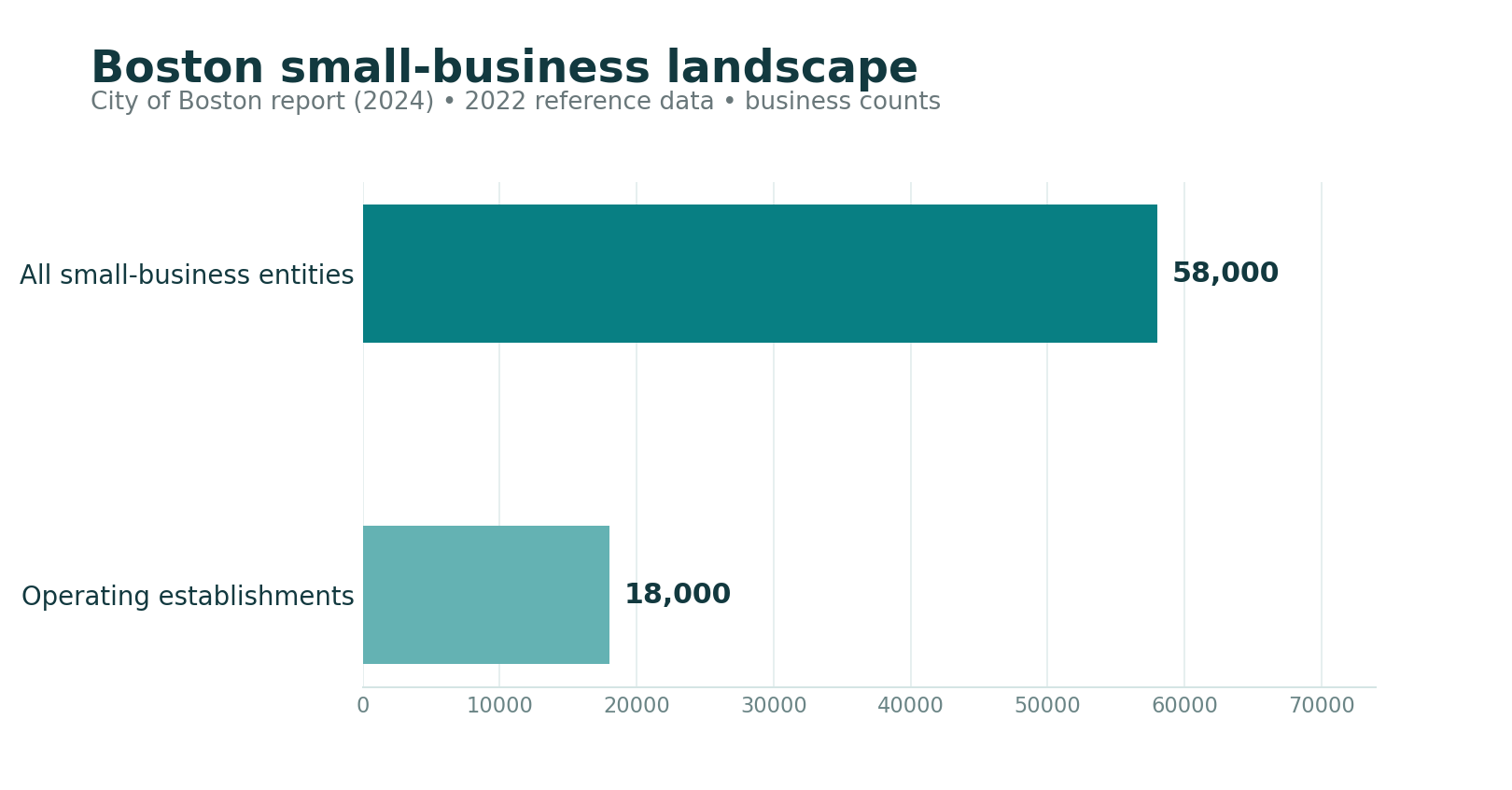
Chart: Boston small-business entities (~58,000) and operating establishments (~18,000) from the City of Boston 2024 report using 2022 data. Establishments are a subset of all entities; values should not be added.
Source: City of Boston, 2024 Small Business Strategy
In that same report, consumer-facing categories—including retail, restaurants and bars, healthcare, arts and entertainment, and local services—make up 55% of small-business establishments; professional services account for 21%. This is why boston website design cannot be a one-template product. A neighborhood barber needs fast appointment booking. A professional-services firm needs persuasive proof of expertise. A retailer needs inventory clarity, pickup or delivery options, and returns information.
The city’s business map is uneven too. Downtown, Dorchester, and Back Bay together contain roughly 40% of small businesses in the strategy report. Roslindale has a high micro-business share—46% of its small-business establishments. The local opportunity therefore changes not only by industry but also by business size and neighborhood. Source: City of Boston Small Business Strategy.
2. Boston Spending Power: What Customers Can Afford and What They Choose
Boston looks affluent when you read its headline income figures. That is not the same thing as every household having spare money to spend. The city’s median income, housing costs, income distribution, and its large student and visitor populations make simplistic luxury-market assumptions especially risky.
The Bureau of Labor Statistics consumer expenditure report, published January 6, 2026, found that households across the Boston-Cambridge-Newton metropolitan area spent an average of $105,320 annually in 2023–2024. That compares with a $77,907 U.S. average. The BLS figure is a metropolitan household spending average, not Boston city’s median income or a measure of online shopping.
For boston ma website design planning, consider household budgets. Metro households spent an average of $37,409 on housing, $14,525 on transportation, and $13,515 on food. Food away from home accounted for $5,522 of that food spending. Housing alone took 35.5% of the budget, compared with 33.2% nationally. A big household budget does not guarantee a big discretionary budget after rent, mortgages, and essentials.
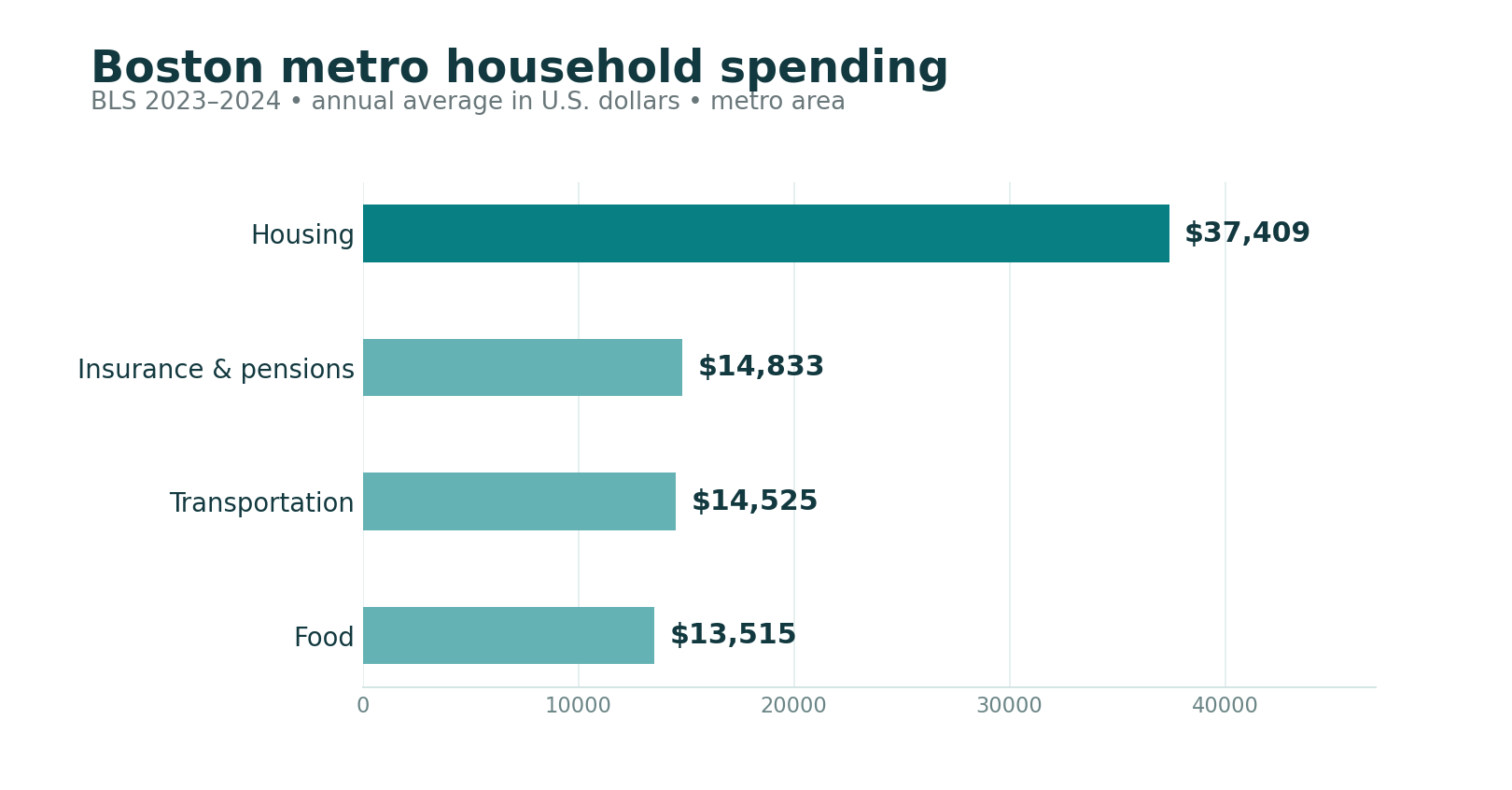
Chart: Selected annual household expenditure categories, Boston-Cambridge-Newton metropolitan area, 2023–2024 average in USD. Not Boston city spending or online sales.
Source: Bureau of Labor Statistics, consumer expenditures report January 2026
For website design in boston, those numbers point toward a practical priority: make value easier to judge. Boston website design should not mistake high regional spending for unlimited customer budgets. If your customers are comparing a $180 service against a $300 service, explain what they receive, how long it takes, and what happens if they need a change. A costly-looking website with no pricing context can quietly repel price-conscious customers, including households that earn well but have substantial housing expenses.
Three different Boston buying situations
The everyday neighborhood purchase: A resident searches for a repair, salon, cafe, childcare service, or clinic. They want to know if you’re close, available, trustworthy, and within budget. Show opening hours, service-area detail, fees where feasible, transport information, and the quickest next action.
The planned professional purchase: A Back Bay employer considers accounting, legal support, consulting, or a B2B vendor. It may involve multiple decision-makers. The website should clarify qualifications, scope, process, case evidence, and what an introductory meeting delivers. The need is less “Buy now” and more “Can we trust this organization?”
The visitor purchase: A traveler searches from a hotel or while walking. Meet Boston’s 2025 visitor metrics report 38.7 million domestic visitors and $14.08 billion in domestic visitor spending for the destination tracked by Meet Boston. These are tourism-market metrics, not sales attributable to Boston city websites. Still, they help explain why concise mobile navigation, same-day availability, walking directions, and straightforward booking are commercially relevant.
A good boston web designer answering website design boston enquiries turns those three journeys into different page layouts, rather than giving everyone the same full-screen video and a generic “Contact Us” button.
3. Boston Web Design on Mobile and Desktop: What the Data Proves
Be wary of anyone claiming that “83% of Bostonians browse on mobile” without a source. There is no single public statistic that reliably describes the device split for every Boston business. A law firm’s referral traffic may lean desktop; a restaurant’s street-level discovery may lean mobile. Your own analytics are the correct source for *your website’s* device mix.
For web design boston ma and boston ma website design briefs, what we can verify is how Boston households connect. Census QuickFacts reports that 95.6% had a computer and 92.0% had a broadband subscription in its 2020–2024 estimates. The City of Boston’s June 2025 Digital Equity Plan estimates that 21,504 households, about 8.7%, relied solely on cellular internet service at home. Some of those households may use a phone as a hotspot for other devices; mobile-only home service does not prove every visit occurs on a smartphone.
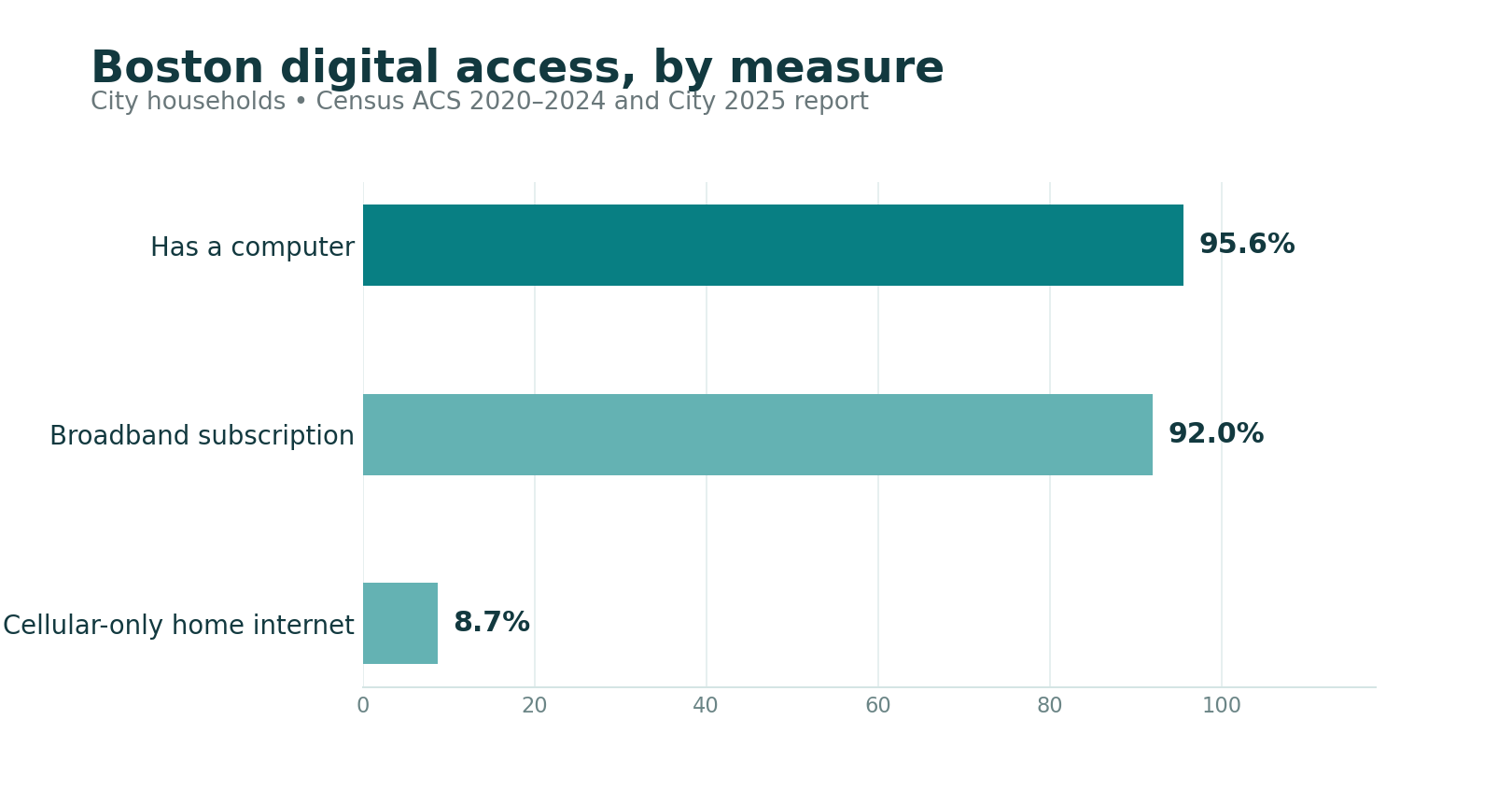
Chart: Boston households: 95.6% have a computer and 92% a broadband subscription (Census 2020–2024); 8.7% rely on cellular-only home internet (Boston Digital Equity Plan 2025, derived from ACS). The measures overlap and are not traffic-device shares.
Source: U.S. Census Bureau QuickFacts and City of Boston, June 2025 Digital Equity Plan
This matters for web design boston ma and boston web development projects because many businesses design on a large office monitor, then treat the phone layout as a smaller version of the same page. That is backwards for a visitor trying to book a table from the T, compare a local quote on a break, or find a clinic without convenient fixed broadband.
What to test on an actual phone when considering boston web page design
Try completing the main task on a moderately priced phone with a slow connection. Can you read the price without pinching? Does the primary button remain visible? Does the menu open with a thumb? Can someone copy an address or start a call? Is the contact form short enough to finish while standing outside? Does a page depend on a giant file that takes seconds to load?
On desktop, confirm that commercial buyers can review case studies and office staff can download required materials. Make critical tasks work on both devices.
A reasonable baseline for boston web page design includes responsive layouts, compressed images, properly labeled forms, keyboard accessibility, and no essential information hidden inside hover effects. Then use Google Analytics or another privacy-appropriate analytics solution to learn your actual mobile/desktop conversion rates. Do not assume city demographics can substitute for that measurement.
4. Seven Boston Web Design Problems That Cost Local Customers
“Our site looks outdated” may be true, but it rarely captures the business problem. Diagnose these seven failures first.
Problem 1: Customers cannot tell whether you serve their neighborhood
Picture a heating contractor based in Dorchester. The site says “Serving Boston” but doesn’t explain service boundaries, emergency availability, parking or access constraints, or whether customers in Hyde Park and Mattapan can book. People wonder if they’re outside the coverage area and abandon the inquiry.
The fix: Publish accurate service coverage. Add individual location pages only for distinctive services or logistics; never invent offices.
Measure: Qualified calls or forms by service area, not raw page views.
Problem 2: The website hides crucial price or booking details
A North End restaurant hides its menu in an unreadable PDF; a wellness provider won’t disclose appointment length. Visitors leave.
The fix: Provide mobile-readable information, what is included, starting prices where practical, and clear next steps. For bespoke quotes, explain what drives the price.
Measure: Booking starts, completed bookings, and questions repeatedly asked by phone.
Problem 3: The site looks credible but never proves its claims
“Innovative solutions” tells a buyer almost nothing about comparable experience.
The fix: Show approved projects, qualifications, named specialists, and evidence-backed results. Never invent case studies.
Measure: Quality of inbound enquiries and enquiry-to-meeting conversion.
Problem 4: Mobile forms break at the worst possible moment
A parent booking a clinic from an MBTA bus shouldn’t fight a tiny date picker or lose form data. Healthcare marketing forms should avoid unnecessary medical details.
The fix: Short forms, readable labels, useful error messages, straightforward appointment routes, privacy-safe data collection, and a telephone fallback where appropriate.
Measure: Form starts versus successful submissions, segmented by device.
Problem 5: Your site attracts visitors but does not match their intent
An East Boston emergency-repair search lands on a generic homepage; a venue search shows no capacity information. The pages miss the visitor’s question.
The fix: Build specific service pages around actual customer tasks. Explain who the service is for, what the process looks like, what area is covered, and what to do next. For boston web development projects, functionality should follow those pages rather than dictate their content.
Measure: Organic landing-page leads and searches that generate those leads.
Problem 6: The business cannot update the site when Boston changes
Hours, menus, and event information change, but edits take weeks and pages go stale.
The fix: Give trained staff an editable system, review responsibilities, and a reliable update workflow.
Measure: Time from approved change to publication and number of incorrect live listings.
Problem 7: Nobody knows whether the website increases business
“Traffic went up” is not a business result by itself. A site can generate thousands of curious visitors and zero worthwhile enquiries.
The fix: Define actions that have economic value—bookings, qualified calls, quote requests, purchases, or scheduled consultations. Connect those events to a clean reporting dashboard and compare performance before and after changes.
Measure: Qualified leads, conversion rate, booked value, revenue or contribution margin where measurable.
The job of boston web design is to remove these obstacles; website design in boston should start there. If an agency cannot explain which obstacle its redesign will solve, you may be shopping for decoration rather than growth.
5. How Better Boston Web Design Can Increase Revenue
It is tempting to promise that a redesign will “double sales.” Nobody responsible should make that promise without knowing your traffic, enquiry quality, capacity, prices, and conversion process. A better way to evaluate website design boston and boston website design investment is to model what happens when friction is removed.
Suppose a Boston home-services business receives 1,000 relevant monthly website visits. At a 2% enquiry conversion rate, that produces 20 enquiries. If clearer service pages, faster mobile loading, and a simpler quote form raise the conversion rate to 3.5%, the same traffic produces 35 enquiries—15 additional enquiries.
If 20% of those extra enquiries turn into customers, that is three additional jobs. At an illustrative $450 contribution margin per job, the incremental monthly contribution would be $1,350. This is an illustrative calculation, not a forecast. Real results may differ.
Example monthly performance | Before improvements | After improvements |
|---|---|---|
Relevant website visits | 1,000 | 1,000 |
Enquiry conversion rate | 2.0% | 3.5% |
Enquiries | 20 | 35 |
Enquiry-to-customer close rate | 20% | 20% |
Customers from those enquiries | 4 | 7 |
Contribution margin at $450/job | $1,800 | $3,150 |
Choose measures by business: restaurant reservations, privacy-safe appointment requests, qualified B2B meetings, or completed ecommerce sales.
When evaluating boston website design, ask a provider to identify the conversion event, establish the baseline, set up measurement, and explain what can realistically improve. A design agency should be able to describe a mechanism for growth, not merely promise “better engagement.”
6. What Boston Neighborhoods Tell Us About Website Priorities
A neighborhood name is not an SEO ornament. It changes the audience, the travel patterns, the competitive set, and often the commercial task. City data shows business concentrations in Downtown, Dorchester, and Back Bay and many micro-businesses in Roslindale and Jamaica Plain. That describes business mix, not every resident’s behavior.
Downtown, Financial District, and Back Bay: Trust before the first meeting
A professional-services firm may earn its business after referrals, research, and internal review. Its website often acts as a credibility check. Can a prospect find the right expert? Does the firm explain relevant experience? Can the team schedule a consultation without a long email chain?
For these organizations, boston web design should emphasize specialist service pages, staff credentials, substantive examples, accessibility, and a concise contact path. For boston web page design, make that evidence easy to find before asking for an enquiry.
South Boston Waterfront and Seaport: Sell complexity without hiding it
Many Seaport businesses operate in technology, enterprise, hospitality, or professional services. A technical product site should explain its offer at two levels: a plain-English overview for decision-makers and detailed documentation or use cases for evaluators. The hotel or restaurant next door, meanwhile, may need immediate event enquiries and mobile booking.
A B2B platform may need “Security” and “Request Demo”; a restaurant may need “Menus” and “Reserve.” Strategy decides the navigation.
Longwood, Mission Hill, and Fenway: Accuracy, accessibility, and reassurance
Healthcare and university-adjacent organizations may serve patients, families, students, researchers, and staff. They need precise service information, consistent accessibility, clear transit or parking instructions, and disciplined handling of sensitive information. Do not treat a normal website enquiry form as a secure patient portal without appropriate safeguards.
When commissioning website design in boston or boston ma website design, these organizations should ask who approves content, who owns accessibility testing, and whether the site can be updated promptly when services or schedules change.
North End, Chinatown, and downtown visitor corridors: Decisions made while moving
A visitor may be choosing a restaurant or activity in real time. They need readable menus, language clarity where appropriate, availability, walking directions, and information about whether reservations are necessary. Do not make a tourist download a huge brochure just to find the next available table.
Meet Boston’s visitor statistics give market context; actual seasonal booking patterns should come from your business.
Dorchester, Roxbury, Mattapan, East Boston, and Roslindale: Earn practical trust
Neighborhood businesses may rely on repeat purchases, referrals, language accessibility, and clear evidence that a service is local and dependable. Show actual service boundaries, genuine customer feedback, and directions. For a repair service, explain how appointments work and whether there is an estimate fee. For childcare or family services, show eligibility and scheduling information without forcing people to call for every basic detail.
Use actual customer enquiries to identify language needs. Translate priority pages accurately rather than publishing unmanaged machine-translated copies.
Allston, Brighton, and Jamaica Plain: Make changing demand easy to handle
Student cycles and renter turnover can shape demand. A moving service needs booking and price clarity; a shop needs inventory and pickup updates. Both need timely edits.
A credible boston website design proposal should validate local use cases. For an example of service scope, review ZH Consultancy’s web development approach. “We will optimize for every Boston neighborhood” is not a strategy unless the provider can say what will actually differ.
7. Local Search: Where Boston Customers Find and Compare Businesses
The phrases people use are not always neatly aligned with municipal boundaries. A resident in Brookline may search for a Boston specialist, while someone in East Boston may care whether a provider can cross the harbor promptly. Boston, Cambridge, Somerville, Brookline, and Quincy are separate municipalities; don’t label them all Boston neighborhoods.
What different Boston website searches actually mean
People don’t use one tidy phrase. The exact query is a clue about their decision stage—not an instruction to create eight duplicate landing pages.
Search phrase | Likely reader need |
|---|---|
web design boston ma | Compare local providers and geographic coverage |
website design boston | Evaluate layouts, services, and past projects |
website design in boston | Assess location relevance and local business knowledge |
boston web page design | Improve individual pages and customer journeys |
boston website design | Find a complete business website solution |
boston web development | Understand technical builds and integrations |
boston web designer | Evaluate the people and skills behind the work |
boston ma website design | Compare Boston-area offers and costs |
These searches overlap. One excellent buyer’s guide and substantial service pages are better than multiple thin pages aimed at minor wording variations.
Make pages useful beyond a city keyword
A dental practice’s pages should answer appointment, insurance, location, and treatment questions. A contractor’s pages should explain services, scheduling, examples of work, and genuine coverage. An event venue’s site needs capacity, accessibility information, booking rules, and date availability.
This matters for boston web page design and website design boston because search visibility is valuable only when the landing page helps the person who arrives. Twenty thin location pages with identical text will do less for customers than a few substantial pages with accurate, distinctive information.
A Google Business Profile may be appropriate for eligible companies, but businesses should follow Google’s business representation guidelines and avoid fake addresses, virtual-office claims, and invented reviews. Website design should support legitimate location signals, not fabricate them.
Track actual local leads, not just keyword positions
Track enquiries, successful jobs, and lead quality by landing page and genuine service area, not just positions in search results.
If you are commissioning boston web development or web design boston ma, insist on a measurement plan: who configures analytics, who owns the account, which events are tracked, and how privacy is handled. A provider can deliver an impressive site and still leave the owner unable to answer the simplest question: “Did it bring us more business?”
8. What Should a Boston Website Project Cost?
A low quote is only a bargain when the site works. For a Boston company that needs clear service pages, mobile booking, and dependable support, a lean, well-scoped remote build may be better value than paying for a large local-agency process it does not need.
The current Clutch directory for Boston web design companies shows listed agency project minimums ranging from about $5,000 to $25,000+ among prominent providers, with many displayed hourly rates around $100–$149. These are directory listings and provider-posted minimums, not a representative price survey of all Boston projects. Actual quotes depend on scope.
Website situation | Common scope questions | Cost drivers |
|---|---|---|
Neighborhood service site | Services, location, phone, enquiry forms, staff editing | Content, design, photography, booking integration |
Restaurant or retail site | Menus, inventory, reservation, pickup, payments | Ecommerce tools, accessibility, ongoing updates |
Professional-services site | Sector pages, biographies, case studies, lead capture | Copywriting, approval rounds, CRM integration |
Healthcare or education site | Complex content, accessible navigation, sensitive workflows | Compliance review, security, integrations, testing |
B2B product platform | Documentation, demos, multilingual or technical content | Research, custom development, user roles, analytics |
A more affordable remote option for Boston businesses
ZH Consultancy operates remotely from Pakistan. That can make a carefully scoped Boston business website more affordable than some local-agency projects. Compare actual deliverables: mobile usability, accurate local pages, working enquiry or checkout flows, account ownership, and ongoing support.
Affordable project planning examples (USD; illustrative, not published ZH Consultancy prices):
Illustrative project scope | Budget planning range | Typical included work |
|---|---|---|
Focused landing page | $400–$900 | One conversion-focused page, mobile testing, and contact action |
Lean service-business website | $900–$2,200 | Approximately 5–8 core pages with simple enquiry flow |
Service website with booking or richer content | $1,800–$3,500 | Booking integration, more content, and additional quality checks |
Small ecommerce build | $2,500–$4,500 | Catalog, payments and checkout tests |
These are example budgets for comparing tightly defined scopes—not guaranteed offers, a Boston market survey, or a public ZH rate card. Final costs may change with copywriting, multilingual pages, integrations, revisions, hosting, accessibility work, or maintenance. Request an itemized quote and confirm milestones, revisions, and support before paying.
Ask agencies to itemize discovery, content, design, development, testing, analytics, hosting, and maintenance, including future change fees.
A sensible boston ma website design and boston web development budget includes ongoing work. For stores, review ZH Consultancy’s ecommerce development services. Someone must maintain software, renew domains, monitor forms, back up data, update content, and resolve errors. Neglecting those tasks can undermine the value of the initial build.
9. How to Choose a Boston Web Designer Without Buying a Sales Pitch
Look beyond portfolio screenshots. Ask these questions.
Ask for a diagnosis. Does the team review traffic, booking failures, customer objections, and whether a smaller improvement could work?
Ask about Boston knowledge. Can it distinguish actual neighborhoods from nearby municipalities and explain how it validates local assumptions?
Ask about measurement. Which calls, bookings, or purchases count as success? Who configures and reviews tracking?
Ask about ownership. Confirm access to domain, hosting, CMS, analytics, and assets after the contract ends.
Ask about support. Clarify updates, emergency response, backups, security, and training separately from the initial build.
Choosing a boston web designer for boston web page design isn’t about finding someone who can place the city’s skyline on a homepage. It’s about finding a partner who can turn local customer needs into reliable digital experiences.
10. A Boston-Specific 90-Day Website Improvement Plan
Days 1–15: Review search landings, calls, bookings, customer objections, and device reports. Set a baseline.
Days 16–30: Fix inaccurate hours, broken buttons, slow pages, mobile forms, and unclear coverage.
Days 31–60: Add real project proof, meaningful neighborhood information, and better service pages. Translate priority content if research supports it.
Days 61–90: Compare qualified enquiries and bookings against baseline; inspect mobile abandonment and iterate.
This approach to boston web design and boston website design is less theatrical than launching a flashy new homepage, but it gives a business owner something more useful: evidence about what works.
11. Mistakes Boston Businesses Should Stop Making
Treating the whole city as one audience. The needs of a Fenway visitor, East Boston resident, and Seaport procurement manager are not identical. Research the actual customers and buying journey instead of stuffing neighborhood names into the same paragraph.
Mistaking spending power for a luxury-only market. Boston metro expenditures are high, but housing costs are substantial and household means mask wide differences. Be transparent about price and value where possible.
Treating citywide device statistics as your device conversion report. Census computer ownership and mobile-only access are valuable context. Only your own analytics can tell you which devices produce business enquiries.
Adding unnecessary features before fixing the basics. Smooth mobile forms, reliable booking, useful content, and speed usually deserve investigation before video backgrounds, complex animations, or custom interactive effects.
Promising a guaranteed ranking or sales increase. No agency can reliably guarantee Google placement or a revenue multiple. Demand a transparent process, realistic testing plan, and reporting you can inspect.
Using AI-generated local content without checking it. Invented offices, inaccurate transit guidance, fake case studies, and fabricated neighborhood reviews are trust problems. All local content should be fact-checked and maintained.
Ignoring what happens after launch. The best launch checklist is worth little if booking links break and nobody notices for weeks. Put ownership, testing, maintenance, and conversion reporting in writing.
12. What Will Change in Boston's Digital Market After 2026?
The next phase of boston web design will likely emphasize successful tasks, credibility, accessibility, and security over visual novelty.
AI may simplify page production but cannot replace verified local evidence, trustworthy service information, and functioning customer journeys.
Healthcare needs careful content governance; hospitality needs booking accuracy; neighborhood shops need manageable, current information.
None of this is a guaranteed forecast of spending on website services. It’s a useful way to decide what capabilities will remain important even as platforms change.
13. The Takeaway
Good boston web design is not just an online brochure. For a Boston business, it may be the difference between a visitor booking the table, a resident making the appointment, a family finding the right service, or a procurement team deciding to start a conversation.
Boston has roughly 673,000 city residents, a diverse population, thousands of operating small businesses, meaningful digital-access gaps, and a metropolitan consumer market with high but uneven household spending. Those facts should lead to better questions—not demographic stereotypes or keyword-stuffed landing pages.
Before paying for boston web design or website design boston, identify the exact customer journey you want to improve. Find where people struggle, make critical information easier to reach, clarify the next action, and measure whether enquiries and bookings change. If you need a partner, see ZH Consultancy’s custom website development services and request a scope based on real Boston customer journeys.
Faq
Frequently Asked Questions
Prices vary by project. Some Boston-area agencies list minimum projects of $5,000–$25,000+, but those listings are not citywide averages. For planning purposes, lean remote projects may be scoped at substantially lower budgets, such as $900–$2,200 for a straightforward small-business site. That is an illustrative scenario, not a ZH Consultancy quote. Compare accessibility, mobile performance, content, integrations, ownership, and maintenance before deciding.
The U.S. Census Bureau estimated 672,973 residents in Boston city in July 2025. A 2024 City of Boston report, using 2022 data, estimated 58,000 small-business entities, including approximately 18,000 operating small-business establishments. The categories are not interchangeable, and Greater Boston is larger than Boston city. Always label the geography and source year when using these numbers.
A search for web design boston ma will not reveal a universal mobile-versus-desktop split for local businesses. The Census Bureau estimates that 95.6% of city households have a computer, while Boston’s 2025 Digital Equity Plan estimates roughly 21,504 households use only cellular home internet. Those measures don’t reveal actual website sessions. Examine your own analytics and test essential tasks on both devices.
The Bureau of Labor Statistics reports average annual household expenditures of $105,320 in the Boston-Cambridge-Newton metro area for 2023–2024. Housing accounted for $37,409, transportation $14,525, and food $13,515. These are regional household averages—not personal disposable income or online retail spending. Businesses should research their own customers’ budgets and buying triggers before choosing a pricing or website strategy.
For website design in boston, focus on neighborhoods you genuinely serve and can describe accurately. Downtown and Back Bay may call for different service evidence from Dorchester, East Boston, Roslindale, or Longwood. Prioritize substantial service pages, verified locations, real examples, and meaningful logistical detail instead of dozens of almost identical keyword pages.
Start with the task that generates revenue: booking, purchasing, scheduling, calling, or requesting a quote. Remove friction by improving mobile forms, load times, pricing clarity, service-area information, and proof of expertise. Measure completed actions and lead quality before and after. A higher conversion rate can improve results with the same traffic, but no specific revenue outcome is guaranteed.
Either can work. A Boston-based agency may make in-person collaboration easier, while a Pakistan-based remote team such as ZH Consultancy may offer a more affordable, defined-scope option. Evaluate relevant experience, Boston-specific customer research, communication hours, test results, ownership of accounts, handover, and ongoing support. Never treat a low quote as proof of quality, and never assume a remote provider has a physical Boston office.

Zain Hameed
Business strategy specialist helping a global client base of 800+ businesses build credible plans, financial models and investor-ready presentations.
In this article
Book a Free Consultation
Have a business idea, growth challenge or investor deadline? Book a free consultation and get clear next steps from our team.
Call our team
+923104049517
Email us

Business Topics
Business topics
Continue reading
Related insights

Website Development Company in Dubai: Costs, Hosting, Local Buyers and the Right Team for 2026
A potential customer in Business Bay is looking for an accountant.

Boston Web Design: What Local Businesses Need to Win More Customers in 2026
A customer is on the Green Line, looking for a last-minute

How to Start a Photography Business in 2026: From First Client to Profitable Studio
You take a photograph. Someone sees it and says, “You should

How to Start a Dumpster Rental Business: From First Container to Profitable Fleet
Learn how to start a dumpster rental business, estimate startup costs,

How to Start a Bounce House Business: From Weekend Rentals to a Profitable Company
Learn how to start a bounce house business, estimate startup costs,

How to Start an Interior Design Business: From Creative Talent to Profitable Studio
Learn how to start an interior design business, understand qualifications, estimate