

In this article
Imagine collecting rent on 25 homes you don’t own. The numbers look attractive: steady monthly fees, long-term clients, and no down payment on the buildings themselves.
Then Tuesday happens.
A resident’s ceiling is leaking. A second tenant disputes a late fee. One owner wants to approve every repair while another expects you to handle everything. Your maintenance contractor isn’t answering. And somebody has deposited a security payment into the wrong account.
That is the part missing from many cheerful guides about how to start a property management business. The work is not passive income. It is a service operation built around other people’s homes, money, time, and legal obligations.
The good news is that a carefully run firm can be valuable to both landlords and tenants. The trick is to build it backward from the problems owners will pay you to solve, rather than forward from how many doors you hope to manage.
We will use the Keys-to-Cash-Flow Framework—positioning, compliance, unit economics, and operations—to connect current market research with startup decisions, pricing, client acquisition, and a 90-day plan.
Decide Which Owners and Properties You Can Serve Well
Before answering how to start a property management business, decide what kind of owner would have a reason to trust you and how that owner measures success.
The first decision in how to start a property management business isn’t a logo or company name. It’s deciding whose phone calls you are prepared to answer.
A suburban investor with two single-family rentals may want tenant placement, quarterly inspections, and someone to call when the water heater fails. A condominium association may want board reports, reserves oversight, and vendor contracts. A commercial owner may expect lease administration, operating-expense reconciliation, and coordination with specialist trades.
These are different businesses wearing similar names. Treating them as interchangeable is one of the fastest ways to promise more than you can deliver.
Start with one property type, one geography and one owner problem
For a first-time founder, a focused niche can make both service delivery and marketing easier. Residential long-term rentals are often easier to describe and standardize than a mixture of apartment buildings, vacation rentals, and commercial sites. That doesn’t make residential work easy; it makes the workflow more predictable.
Create a simple target-customer statement: “We manage long-term rentals for independent owners with two to 20 doors within a 25-minute service area, with clear monthly statements and reliable maintenance follow-up.” Distance matters. Ten units in one well-maintained building may be simpler than ten scattered houses across an entire county. Before accepting a property, estimate travel time, age of building systems, maintenance history, vacancy exposure, and owner expectations.
Ask owners what already irritates them
Owners rarely wake up thinking, “I’d like to purchase property management services today.” They have a problem: a vacancy is taking too long to fill, tenant messages interrupt their job, repairs arrive as surprises, or their financial statements are confusing.
Speak with at least ten landlords or investor contacts before designing packages. Ask what they handle themselves, what they dislike, what they currently pay for help, and what would make them change providers. ### Choose a service scope before you quote a percentage
Make a clear distinction between leasing-only work and ongoing management. Leasing might include marketing, showing appointments, applications, lease paperwork, and move-in coordination. Ongoing service can include rent tracking, communications, repair coordination, inspections, renewals, and reporting.
Understand Market Demand Without Confusing Market Size With Your Opportunity
Good research on how to start a property management business distinguishes a national rental population from the small group of landlords you can serve profitably.
According to The Business Research Company’s September 2026 global property management service report, the measured market was $16.79 billion in 2025, with an $18.14 billion estimate for 2026 and a $23.69 billion forecast for 2030. The publisher projects approximately 6.9% compound annual growth from 2026 through 2030. These are figures under that firm’s service-market definition; other research providers use broader classifications and report very different totals.
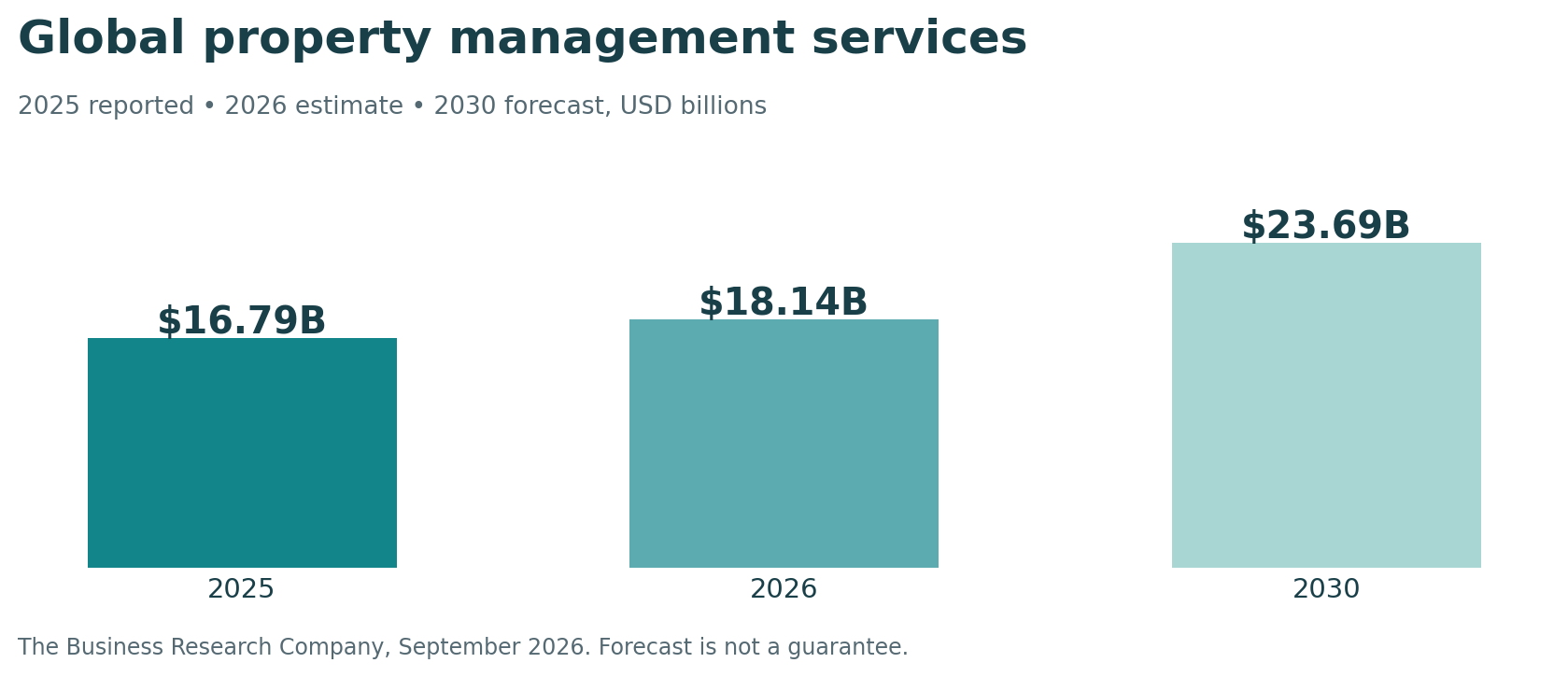
Global property management service market under The Business Research Company’s definition: $16.79 billion in 2025 (reported baseline), $18.14 billion in 2026 (estimate) and $23.69 billion in 2030 (forecast). USD billions; projections are not guaranteed.
Source: The Business Research Company, Property Management Service Market Report, September 2026.
This is useful context for the future of property management services, not a prediction of what an individual startup will earn. Demand depends on the rental housing stock, investor ownership patterns, local regulations, and how many competing managers already serve a market.
The U.S. rental base is large, but it is not automatically available to you
The U.S. Census Bureau’s fourth-quarter 2025 Housing Vacancy Survey estimated 45.867 million renter-occupied housing units, about 30.8% of all housing units. Those units are homes—not signed management contracts. Many are managed by property owners, employees of large firms, housing organizations, or on-site teams.
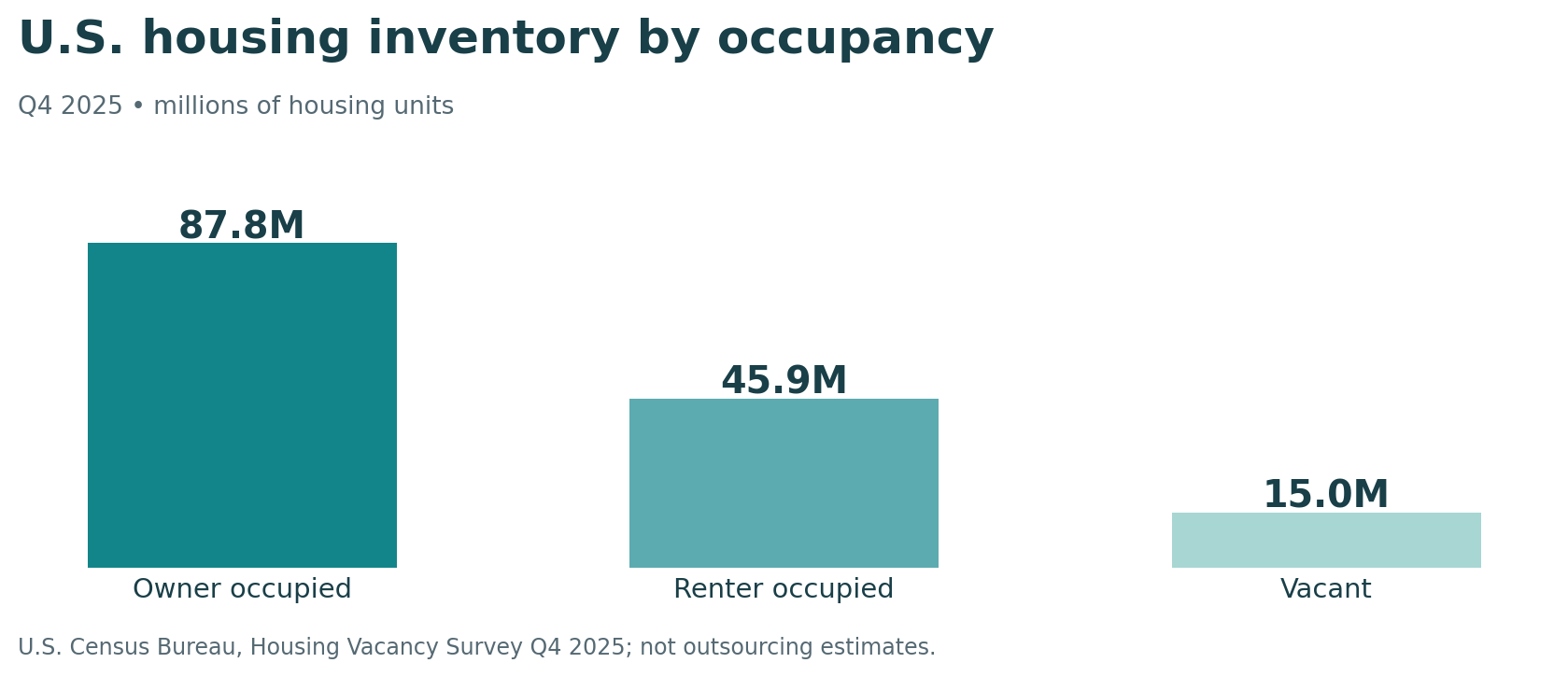
U.S. renter-occupied housing units: approximately 45.87 million in Q4 2025. The Census Bureau notes reduced Q4 survey collection. The figure measures occupied units, not outsourced management contracts or available customers.
Source: U.S. Census Bureau, Housing Vacancy Survey, Q4 2025.
The Bureau of Labor Statistics reports about 460,400 jobs in property, real estate, and community association management in 2025, projects 4% employment growth from 2025 to 2035, and estimates 36,900 annual job openings on average. This is occupational employment evidence, not a count of property management companies.
The BLS also reports a $69,990 median annual wage in May 2025. That is employee pay, not a founder’s business profit, so it should never be used as a promise about owner earnings.
Turn national data into a local demand test
When researching how to start a property management business, build a small market map for your actual service area. Use local assessor data where available, rental listings, apartment inventories, investor groups, public ownership records where permitted, and competitor service pages to answer questions such as:
- What share of local housing appears to be rental housing?
- Are there small investors with dispersed single-family properties or larger operators with on-site teams?
- How many managers advertise in your neighborhoods, and how clearly do they explain their fees?
- Which owners are dissatisfied with communication, maintenance, leasing speed, or reporting?
- Can you reach properties quickly enough to service them profitably?
For a structured analysis, ZH Consultancy’s market research service can help founders compare customer segments, local competitors, and pricing opportunities before committing to an operating model.
Check Licensing, Fair Housing, Trust Accounts and Insurance First
The legal side of how to start a property management business is where attractive plans can quickly become expensive mistakes.
Here is an uncomfortable but essential point: you can form an LLC, build a website, and buy software without necessarily being authorized to manage rentals for other owners.
Rules vary materially by U.S. state, by the services offered, and sometimes by municipal law. Leasing property or collecting rent on behalf of someone else may be regulated real estate activity. A few activities or ownership structures may qualify for exemptions, but an exemption must be verified rather than guessed.
Determine what license is required for your actual services
Before offering property management services, contact the state real estate commission or licensing authority. Describe precisely whether you will advertise vacancies, show units, negotiate leases, collect rents, hold deposits, or arrange maintenance. Ask whether a broker’s license, supervised salesperson status, company registration, or other approval is required.
Some founders already work as licensed real estate professionals; others need a licensed broker or a different business arrangement. Do not assume that a registration website’s approval creates professional authorization.
Also consider local rental registration, landlord-tenant notices, habitability standards, security-deposit restrictions, short-term rental rules, and insurance requirements. These are highly location-specific. This guide is business planning information, not legal advice.
Separate operating money from client money
An owner may authorize you to collect $2,100 in rent. Only the agreed management fee belongs to your company. The balance may belong to the owner, while security deposits may be subject to separate statutory handling requirements.
Where applicable, use the legally required trust or escrow arrangement, clear transaction ledgers, reconciliation procedures, dual approvals for sensitive transfers, and documented controls around disbursements. Ask a qualified local attorney and accountant to design the process around your jurisdiction’s rules.
Commingling funds is not an administrative shortcut. It can create serious client harm and legal exposure.
Understand screening and fair-housing duties
Screening residents is another area where a generic checklist is inadequate. The Federal Trade Commission’s landlord guidance explains that tenant screening reports can be consumer reports under the Fair Credit Reporting Act. If such a report contributes to an unfavorable rental decision, certain adverse-action notices may be required. The FTC also discusses permissible purposes, applicant data, and secure disposal.
Fair-housing obligations apply to advertising, screening, interactions with applicants, accommodation requests, and many other housing activities. Use lawful, consistently applied criteria; get jurisdiction-specific advice before implementing policies that could create discriminatory outcomes.
Train anyone who speaks to applicants. A compliance manual does little good if a temporary leasing assistant improvises rules on the telephone.
Arrange insurance around the risk you actually carry
Discuss general liability, professional errors and omissions, cyber liability, workers’ compensation where required, and any additional coverage appropriate to your properties and contracts. Check whether hired vendors must carry their own insurance and whether your agreement defines responsibility for contractor selection and repair decisions.
Calculate Property Management Startup Costs Without an Equipment Shopping Spree
Another essential part of how to start a property management business is understanding which costs happen before your first management fee arrives.
A home-based property management company can avoid office rent, but licensing, insurance, bookkeeping and a cash reserve remain essential.
The answer on property management startup costs depends on licensing, location, staffing and service scope. Someone who already holds the required license and has an existing computer may launch far more cheaply than a founder who must complete education, hire a broker, or establish a staffed office.
An illustrative $6,500 lean-launch budget for property management startup costs
Expense category | Illustrative USD |
|---|---|
Registration, permits and licensing provision | $700 |
Insurance provision | $800 |
Legal documents and accounting setup | $1,000 |
Software, equipment and secure storage | $600 |
Website, local presence and launch outreach | $900 |
Working-capital reserve | $2,500 |
Illustrative total | $6,500 |
These are illustrative figures, not vendor quotes or a national average. Licensing, employees, office space and slower collections may increase the budget substantially.
Consider property management startup costs in three buckets: upfront setup, recurring overhead, and cash tied to timing. A website may be paid for once, while insurance and software renew. A management fee may be earned monthly but arrive after you have paid for customer acquisition and support.
Choose software by workflow, not feature count
A practical property management software shortlist should cover owner and resident records, rent ledgers, bank reconciliation, maintenance tickets, secure communication, document storage, reporting, and permissions. Ask vendors whether their product supports the trust-account and deposit-handling rules relevant to your operation.
Run a trial with five fictional properties. Create a maintenance ticket, record a rent payment, apply an authorized fee, generate an owner statement, and export data. If the trial cannot support those ordinary tasks without a maze of workarounds, a lengthy feature list will not rescue it.
Property management software should reduce duplicate entry and missed tasks. It should not make legal decisions for you. Keep control of your data, records, account access, backups, and vendor exit process.
Don't forget the working-capital gap
Suppose you win four owner contracts in the first month. Excellent—but when do you collect your first fee? If fees are earned only once rent is collected, a vacancy can delay cash coming into your company.
Model six months of expenses before making commitments. Include insurance premiums, phone and software subscriptions, transport, marketing, legal consultation, bookkeeping, and a realistic allowance for the founder’s own time. Compare a slow-launch case with your target case.
A property management company without enough cash reserve may be forced to accept unsuitable properties simply to meet its next bill.
Write a Business Plan Based on Doors, Workload and Collections
The numbers make how to start a property management business easier to evaluate because they separate a busy operation from a financially sound one.
Before you build a property management business plan, answer three simple questions: Who will pay you? What exactly will you do? And how many clients can you serve profitably without letting service quality collapse?
This is a good point to use professional business plan writing support if the funding request, staffing model, or revenue assumptions need independent scrutiny. The aim is not a decorative PDF. It is a plan you can adjust after actual clients arrive.
Build the financial model from one door upward
Consider a fictional portfolio with average rent of $1,600 per occupied unit, a 95% cash-collection assumption on scheduled rent, and a management fee of 8% of rent actually collected. Each unit then generates about $121.60 in average monthly management fees before other revenue and expenses.
Managed units | Gross rent scheduled/month | Rent collected at 95% | Management fees at 8% |
|---|---|---|---|
25 | $40,000 | $38,000 | $3,040 |
40 | $64,000 | $60,800 | $4,864 |
70 | $112,000 | $106,400 | $8,512 |
This is an illustration, not a market fee benchmark or promise. It assumes all units are in service, equal rent, and the stated collection rate. Vacancies, discounts, fee definitions, and local practices can change the result materially.
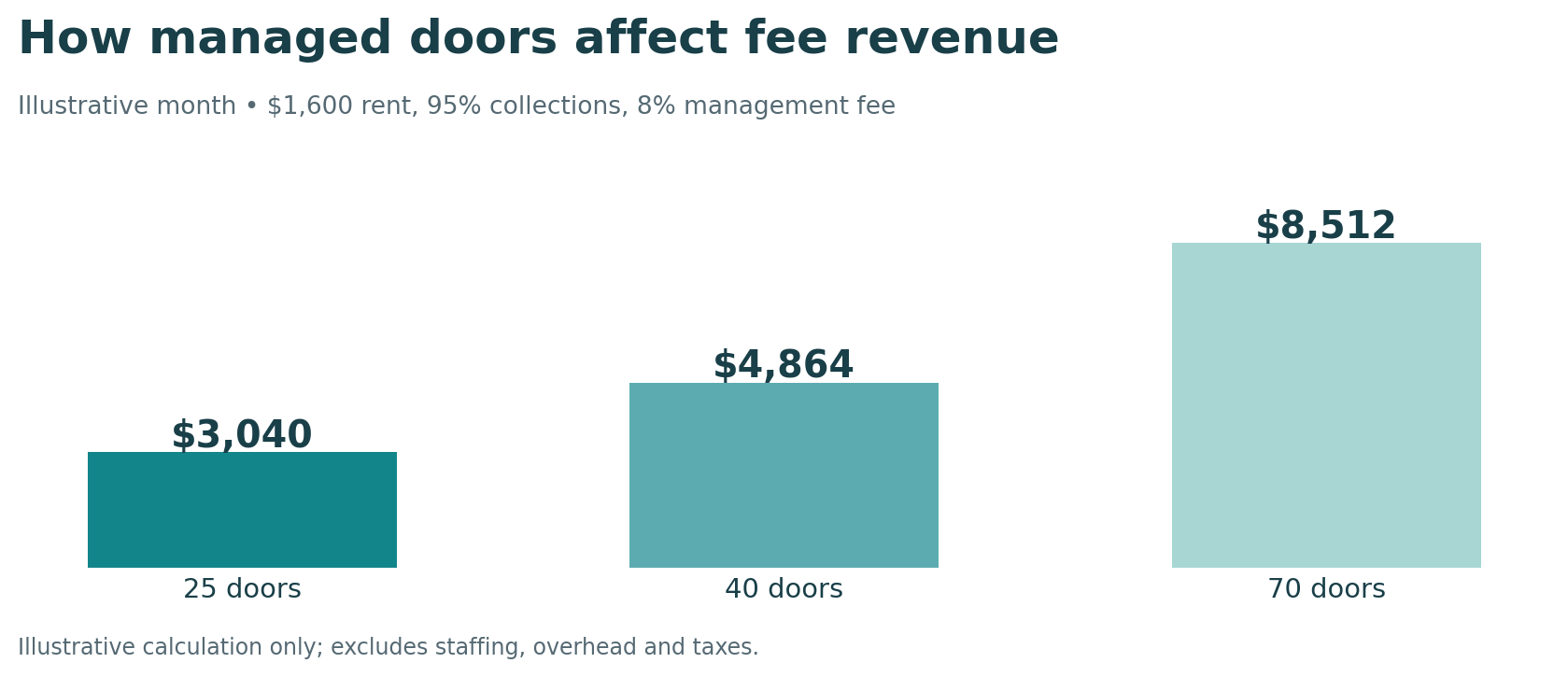
Illustrative monthly management-fee revenue by portfolio size at $1,600 rent, 95% collection and an 8% fee on collections. USD; excludes leasing fees, repairs, owner distributions, overhead and tax.
Source: Illustrative calculation prepared for this guide; assumptions are shown in the table above.
Now consider the misleading headline: “My 40 properties bring in $60,800 a month.” No. That is rent collected for owners. Under these assumptions, management fee revenue would be $4,864 before expenses. The difference is the entire business model.
Calculate break-even instead of chasing an impressive door count
Suppose monthly operating overhead is $2,700 and the founder wants $3,300 per month before personal taxes. Combined, the operation needs $6,000 in monthly contribution before it meets that target.
At $121.60 in management revenue per door, a simplistic calculation suggests roughly 50 doors. But that estimate ignores per-unit variable costs, unpaid owner time, and any additional service fees. A more realistic model adds the marginal cost of each new property, expected turnover, collections, staffing triggers, and a contingency.
For an editable forecast with different collection rates and staffing scenarios, ZH Consultancy’s financial modeling service is relevant to the cash-flow stage of planning.
Test pessimistic scenarios before you celebrate the optimistic one
What happens if you sign only 12 doors instead of 30? What if two major owners terminate contracts during the same quarter? What if your vendor network becomes overloaded in peak season? A credible property management business plan should reflect those possibilities.
Set Property Management Fees So Both Sides Know What They Are Buying
A careful approach to how to start a property management business treats pricing as a service promise, not merely a percentage on a website.
Cheap pricing sounds like an easy competitive advantage. But a low percentage becomes expensive if you must perform emergency coordination, routine inspections, leasing, and detailed reporting for nothing extra.
Common property management fees may include an ongoing charge based on rent collected, a flat fee per unit, an agreed leasing charge, or separate charges for specialized tasks. Some sources discussing U.S. residential agreements describe monthly charges in the broad 8%–12% range, but pricing differs by geography, property type, and service package. Treat any range as context, not a quote for your market.
Write the entire fee schedule before quoting the headline rate
Consider two providers. Manager A charges 7% but adds several owner-paid transaction fees. Manager B charges 9% with more services included. Which is cheaper? You cannot know without running a full-year example at realistic turnover and maintenance levels.
A management agreement should describe fee triggers, leasing services, tenant placement, renewal work, maintenance coordination, additional inspections, cancellation terms, owner reporting, and the handling of vacancies and nonpayment.
Avoid vague terms such as “additional fees may apply.” These are exactly the sentences that turn a routine owner statement into a frustrated phone call.
Put authority and communication terms in writing
Who can authorize a $350 repair? What happens if an emergency requires work before the owner answers? How quickly will you acknowledge a tenant issue? Who chooses the vendor? When must money be remitted to the owner?
Document the answers. Some decisions are set by applicable law rather than agreement. A contract cannot waive statutory tenant rights or override trust-account obligations.
A reputable property management company wins owner trust by showing what will happen on an ordinary Wednesday, not just by promising to be available during a crisis.
Build Repeatable Operations Before the Portfolio Becomes Busy
The operational answer to how to start a property management business is surprisingly unglamorous: consistent records, assigned responsibilities and predictable communication.
Once you have clients, the company becomes an operations business. Your calendar fills with recurring rent cycles, move-ins, inspections, renewals, repair approvals, invoices, and financial reconciliation.
If you’re still discovering how to start a property management business, build those processes with your first three properties rather than waiting until the fiftieth.
The owner onboarding sequence
Start with a signed, legally reviewed management agreement. Record property ownership, existing leases, deposit balances, access instructions, warranties, emergency contacts, contractor history, outstanding repairs, and insurance information.
Conduct an initial property condition review within the legally permitted scope. Capture photographs with appropriate permissions, separate urgent safety concerns from optional improvements, and agree on a repair authorization threshold.
Leasing, screening and move-in controls
Create a leasing workflow with standardized listings, legally appropriate advertising, appointment scheduling, consistent applicant criteria, document collection, and recorded decisions. Never assume your property management software automatically complies with fair-housing and consumer-reporting rules.
On move-in, confirm lease documents, inventory or condition records, payment instructions, utility responsibilities, and how residents request maintenance. A good first week makes later disputes less likely.
Maintenance response: define categories and escalation
Not every repair deserves the same response. Classify requests by safety impact, property damage risk, habitability concerns, and urgency. Document when residents should contact emergency services, when the manager contacts a vendor, and how the owner is informed.
Build a vendor network with relevant licensing, insurance, service coverage, and reference checks. Avoid promising response times your vendor arrangements cannot deliver. Measure the delay between request, acknowledgment, work authorization, completion, and invoice review.
Owner reporting that answers questions without another phone call
Give owners understandable monthly statements: beginning cash, rent received, arrears, agreed fees, approved expenses, reserve balances, and transfers. Include commentary on vacancies, repairs, upcoming renewals, and known risks.
Find Your First Property Owners Without Wasting Your Marketing Budget
For anyone researching how to start a property management business, customer acquisition should begin with relationships and a narrow service promise, not expensive mass advertising.
Marketing a property management business is a little different from promoting a café. You’re trying to win a recurring relationship with an owner who is handing over access, money flows, and responsibility for a valuable asset.
Start where that trust already exists: investor meetups, agents, mortgage brokers, accountants, contractors, and property owners who have experienced the headache of self-management. Be transparent about referral arrangements and any restrictions applicable to licensed activity.
Make your website answer the questions owners actually ask
Your website should feature a service-area map, a clear management-versus-leasing explanation, appropriate proof of experience, a simple inquiry form, and genuinely helpful owner education. ZH Consultancy’s web development services can help businesses structure that kind of practical customer journey; the site should not imply you serve locations where you do not operate.
Include an honest explanation of your maintenance process. “We respond quickly” sounds nice; “Urgent issues reach the duty contact and each request receives a tracked update” tells owners what to expect.
Local search, referrals and direct outreach
Where eligible, use an accurate Google Business Profile and maintain consistent business details. Local visibility can support discovery, but do not create fake office locations. A business serving properties across several towns should explain the actual coverage area.
You can also publish useful articles for landlords, compare how different lease terms affect management workload, or explain the documents needed to transfer a property from one provider to another. Those topics attract a more qualified audience than generic real-estate news.
For support with local visibility, Google Business Profile optimization is a relevant service; the profile should reflect genuine eligibility and real operating details.
Follow the numbers that matter
Track qualified owner enquiries, consultations, proposals, signed doors, acquisition cost, average fee per door, owner churn, and maintenance satisfaction. An advertising campaign that produces 50 enquiries but no appropriately located owners isn’t a success.
Know When to Hire, Automate and Expand
Long-term success after learning how to start a property management business depends on knowing when the next property creates more strain than profit.
A founder can answer every phone call at five doors. At 50, that same habit may become a bottleneck. Before expanding, record how many work hours each property category uses and which duties require licensed supervision or specialized expertise.
Establish practical capacity triggers
Instead of saying “one manager can handle 100 units,” look at your actual activity data. How many tenant messages arrive per week? What percentage of units turn over annually? How many maintenance incidents are open at once? How far apart are the properties? What share of the owner’s requests is exceptional?
When recurring work begins to delay promised responses, it’s time to redesign the workflow or add capacity. An assistant may handle scheduling or records; a qualified leasing professional may handle regulated tasks subject to state law. Neither should receive unrestricted access to sensitive funds or personal information without appropriate controls.
Technology and AI will change the work, but won't erase accountability
The coming years will probably bring more automated reminders, maintenance triage, document extraction, and reporting. Better tools may reduce routine administration. At the same time, owners will likely expect faster updates and clearer audit trails.
Treat these as operating trends, not a guarantee that future property management fees will rise. Automating a reminder is useful; letting an unreviewed model make tenant eligibility decisions is a different matter entirely.
Common Mistakes That Make New Management Firms Unprofitable
Mistakes in how to start a property management business usually come from skipping a legal, financial or service-delivery assumption that felt unimportant at first.
Mistake 1: Starting before checking licensing.
Filing an LLC is not the same as authorization to negotiate leases or collect rent for owners.
Fix: confirm the exact activities you can legally perform and document the answer before advertising services.
Mistake 2: Counting rent as business revenue.
Your ledger might show $80,000 collected this month while the company’s earned fees are only a fraction of that amount.
Fix: separate owner money, earned fees, and expenses in every dashboard.
Mistake 3: Using a single price for every property.
One well-run duplex and one neglected duplex may require entirely different amounts of work.
Fix: review property condition, distance, turnover and required services before quoting.
Mistake 4: Underestimating property management startup costs.
A small budget may exclude licensing, insurance, professional advice, marketing, and months with slow collections.
Fix: maintain a reserve and test a low-revenue scenario.
Mistake 5: Treating property management software as the operation itself.
A notification does not repair a broken heater.
Fix: assign named owners for workflows and measure whether the underlying issue was resolved.
Mistake 6: Weak tenant screening and inconsistent decisions.
Poorly documented criteria can create confusion and potential legal exposure.
Fix: use lawfully designed procedures, protect personal data and understand FCRA and fair-housing requirements.
Mistake 7: Promising round-the-clock service without coverage.
An owner’s trust disappears when the emergency number goes unanswered.
Fix: establish an escalation rota and service agreement with dependable vendors before making the promise.
Mistake 8: Growing doors faster than reporting capacity.
Clients may overlook a slow first month; they won’t indefinitely overlook unclear statements.
Fix: standardize reconciliation and owner communication before signing more properties.
Your First 90 Days: A Launch Sequence That Doesn't Skip the Hard Parts
Days 1–15 — validate. Select a niche and radius; interview owners and compare competing offers. Confirm regulated activities with the relevant licensing authority.
Days 16–30 — establish controls. Register appropriately, arrange insurance, obtain advice on client money and screening, and draft an honest property management business plan.
Days 31–45 — rehearse. Test accounting, property management software, owner statements, maintenance escalation and tenant communications using fictional properties.
Days 46–60 — build lead channels. Publish a clear website, identify investor and agent relationships, and explain fees, coverage and process.
Days 61–75 — onboard carefully. Document ownership, existing tenancies, deposits, property condition and authority limits. Reject work you cannot reliably serve.
Days 76–90 — improve. Review signed doors, collections, service delays and owner feedback. Recheck property management fees and forecasts before expanding.
If you’re wondering how to start a property management business in the most practical order, that is it: validate, authorize, control the money, test delivery, then acquire clients at a pace you can sustain.
The Takeaway
Learning how to start a property management business means building a company that owners trust to protect property, handle sensitive money, and keep residents informed. It isn’t a shortcut to passive income, and the largest portfolio isn’t automatically the healthiest business.
The Keys-to-Cash-Flow Framework still holds: positioning tells you whom you serve; compliance and trust make the service credible; unit economics make it sustainable; operations and growth determine whether you can deliver repeatedly.
Start with a narrow niche, understand your legal responsibilities, keep owner funds distinct, model fees rather than total rent, and turn every recurring task into a documented process. Then pursue the next owner contract.
If you need help evaluating your market, writing a business plan, or stress-testing the numbers before launch, ZH Consultancy offers research, business planning, and financial modeling support through the linked services above. Those services can support your planning, but they do not replace a qualified local lawyer, broker, or accountant.
Faq
Frequently Asked Questions
There is no single national cost. Your location, licensing status, insurance, staffing and software requirements determine the investment. The $6,500 budget in this article is an illustrative home-based scenario, not a market average. Prepare a separate working-capital reserve for months with limited fee revenue, and obtain actual local quotes before setting a funding target.
In many states, collecting rent, negotiating leases or advertising rentals on behalf of owners may require a real estate license or broker supervision, but requirements and exemptions vary. Contact the relevant state real estate regulator and describe the exact services you intend to provide. Forming a company alone does not establish permission to perform regulated activities.
Yes. A property management company typically earns contractual fees for managing real estate owned by other people or organizations. You still need the appropriate authorization and systems for handling leasing, maintenance, owner reporting, tenant data and client money. Owning properties is not required to offer services where you are legally permitted to operate.
Agreements may charge a percentage of rent actually collected, a fixed monthly amount, leasing fees or other agreed charges. A recent fee guide discusses 8%–12% as broad U.S. residential context, but location, property type, included work and contract terms matter more than the headline figure. Compare the total annual cost of property management fees and make every fee trigger explicit in writing.
A property management business plan should identify the service area, target property types, ideal owners, licensing obligations, service scope, pricing, customer-acquisition channels, operating workflows, staffing capacity and cash-flow forecast. Include a slow-growth scenario and show the difference between owner rent collections and the company’s earned fee revenue. Editable assumptions make the plan useful after launch.
The best property management software is the one that fits your compliant workflow at a sustainable cost. Evaluate rent ledgers, owner statements, maintenance tickets, permissions, record exports, security, and any trust-account functions you require. Trial ordinary tasks before signing a long contract. No software can substitute for responsible screening, financial controls or emergency response.
There is no fixed timetable. Existing investor relationships may produce early enquiries, while a new entrant without local contacts can need months to establish trust and a credible portfolio. Focus on qualified owners in a manageable service radius, a clear service promise and transparent agreements. Measure signed doors, cost of acquisition and owner retention rather than treating website traffic as proof of success.

Zain Hameed
Business strategy specialist helping a global client base of 800+ businesses build credible plans, financial models and investor-ready presentations.
In this article
Book a Free Consultation
Have a business idea, growth challenge or investor deadline? Book a free consultation and get clear next steps from our team.
Call our team
+923104049517
Email us

Business Topics
Business topics
Continue reading
Related insights

Website Development Cost UK (2026): Pricing Guide 2027
Compare UK website build prices in pounds and plan a 2027

UK Web Development Agency vs Remote Agency: Costs, Quality and Support
Choosing a UK web development agency vs remote agency? Compare first-year

How to Choose a Website Development Agency in Sussex
Three quotes land in your inbox for a new website for

How to Start a Laundromat Business: A Complete U.S. Founder’s Guide
Learn how to start a laundromat business in the USA: market

How to Start a Construction Business in the USA
A homeowner wants to sign a $75,000 remodeling contract on Friday.

How to Start a Plumbing Business in the USA
At 7:15 on Monday morning, a homeowner calls about water coming