

Getting paid to remove unwanted furniture, appliances and household clutter sounds straightforward.
You arrive with a truck, load what the customer no longer wants, take it away and collect payment.
But what happens when the disposal fee is twice what you expected? How do you price a third-floor apartment cleanout? Which items can you legally transport? And how many jobs do you need before the truck starts paying for itself?
These are the questions that separate someone doing occasional hauling work from someone building a junk removal company.
Starting a junk removal business involves more than a vehicle and a willingness to lift heavy things. You need a service customers will pay for, a safe and legal way to handle what you collect, pricing that protects your margins and a reliable source of bookings.
Think of this as the Load-to-Profit Framework:
Positioning: Who needs your service, and what will you remove?
Compliance and disposal: Can you collect, transport and dispose of those items legally and safely?
Job economics: Will each booking cover labour, transport, disposal, overhead and profit?
Customer acquisition: How will people find you when they need a collection?
Here is how to make those four parts work together.
1. Choose Your Junk Removal Business Model
Before buying a truck or paying for advertising, decide what kind of work you want to take on.
Removing one sofa from a home is very different from clearing an office or collecting renovation debris. The equipment, crew size, loading time, disposal requirements and customer expectations can all change.
Choose a focused service offering
Possible services include residential furniture and appliance removal, garage and attic cleanouts, estate clearances, rental-property turnovers, office cleanouts, garden waste and certain construction debris.
You do not need to offer every service on day one. Start with jobs you can complete safely, dispose of legally and price with confidence. Restricted or hazardous materials may require specialized operators.
Decide who you want to serve
A homeowner clearing a garage might hire you once. A property manager responsible for multiple units could need recurring cleanouts.
Ask which customers are most common in your service area, whether they prioritize speed or price, and whether they can send repeat jobs.
Then study local competitors. What do they promise? How quickly do they respond? Do reviews mention unclear quotes, missed appointments or difficult booking processes?
Your opportunity may come from being easier to contact, clearer about pricing or better at handling a specific type of collection—not simply being cheaper.
If you need to test the viability of the service area before investing, business consultancy support can help assess demand, competitors and business economics.
2. Global Waste Market Outlook and Opportunities
More waste is being generated worldwide. That creates pressure on collection and disposal systems, but it does not mean every new junk removal company will automatically find customers.
According to the World Bank’s What a Waste 3.0, global municipal solid waste generation reached 2.56 billion tonnes in 2022. Under a business-as-usual scenario, it could reach 3.86 billion tonnes by 2050—an increase of around 50%.
Global municipal waste generation: 2022–2050
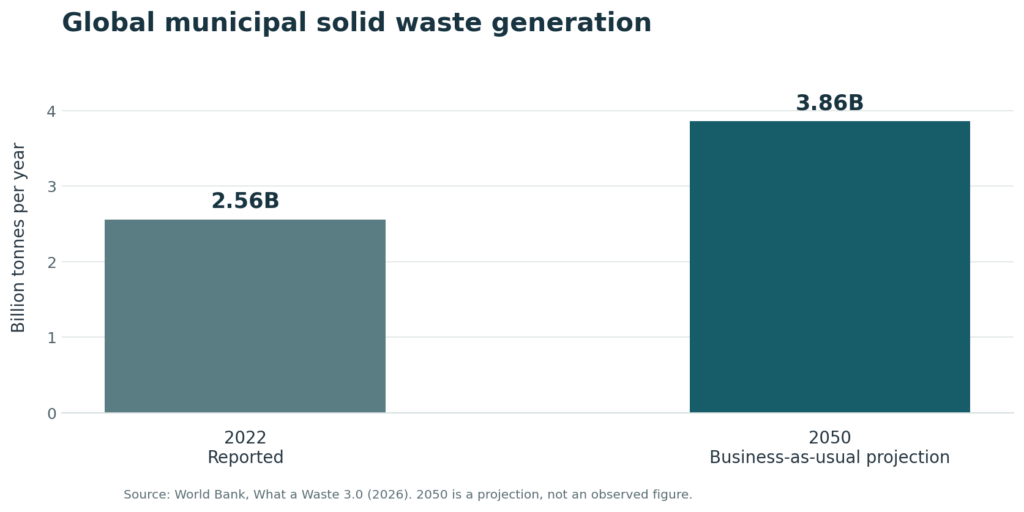
Source: World Bank, What a Waste 3.0. Figures are global municipal waste volumes, not junk removal industry revenue. The 2050 figure is a projection under a business-as-usual scenario.
What does this mean for a junk removal business?
Urban growth, changing consumption patterns, property renovations and the replacement of bulky items can create demand for collection services. Rental turnovers, office moves and estate clearances may provide particularly useful customer segments.
At the same time, recycling expectations and waste-handling regulations can affect where you take different items and how much disposal costs.
The real opportunity is not the size of global waste generation. It is finding enough local customers willing to pay for a reliable service at a price that leaves a profit.
3. Understand Licensing, Equipment and Startup Costs
A junk removal business can be relatively lean if you already own a suitable vehicle. But a truck is only one part of your startup budget.
Check collection and disposal rules
Requirements vary by country, region and waste type. You may need business registration, commercial vehicle permissions, waste carrier registration, liability insurance and employee coverage.
For example, businesses transporting waste in England generally need to register as waste carriers. Other countries and regions have different systems.
Do not agree to collect paints, chemicals, asbestos, batteries or unfamiliar hazardous materials without checking the applicable rules and whether an approved specialist should handle them. Confirm that disposal sites will accept what you carry.
Build your startup budget
Your costs might include:
- Truck, van or trailer and vehicle insurance
- Loading equipment, gloves and other protective gear
- Fuel, maintenance and initial disposal fees
- Business registration, permits and liability coverage
- Website, phone, software and marketing
- Working capital for slow weeks and unexpected repairs
Divide purchases into essential now, needed as bookings grow and nice to have.
A larger truck can carry more waste, but it can also cost more to finance, fuel and maintain. Start with realistic demand rather than the biggest vehicle you can afford.
4. Create a Business Plan and Set Profitable Prices
A truck can be busy all week and still fail to make money. That happens when quotes cover the obvious costs but ignore everything else required to operate.
Build a practical junk removal business plan
Your plan should answer who you serve, what you collect, how many jobs you can complete, what each job costs and how you intend to find customers.
It should also estimate vehicle expenses, disposal fees, seasonal changes, marketing costs and your break-even point. A practical business plan ties those assumptions together before you commit to major purchases.
Calculate the true cost of a job
Suppose you quote $350 for a furniture collection. Here is a simplified example in USD:
| Item | Amount |
|---|---|
| Customer payment | $350 |
| Disposal fees | −$80 |
| Fuel and transport | −$35 |
| Hired labour | −$85 |
| Remaining before overhead | $150 |
That $150 is not necessarily net profit. It must still support vehicle maintenance, insurance, admin, advertising, taxes and your own labour if you haven’t included it.
Choose a pricing approach
You might charge by load volume, provide fixed quotes, set minimum collection fees or add charges for difficult access and heavy materials.
Before quoting, consider volume, weight, loading time, travel distance, disposal restrictions and crew requirements.
A small collection far away can be less profitable than a larger nearby job.
Rather than asking only, “What will customers pay?”, also ask, “What will remain after completing the job properly?”
5. Build an Efficient and Responsible Removal Operation
Good operations protect your margins as much as good pricing does.
Use a simple process:
Enquiry → Estimate → Booking → Collection → Sorting and disposal → Payment → Follow-up
Ask customers for photographs when possible. Confirm the type and approximate quantity of items, stairs or access restrictions, parking, and anything that may need special handling before committing to a final price.
Plan routes and disposal destinations
Group nearby jobs when you can. Long journeys between small collections can quietly consume the profit you expected to earn.
Develop working relationships with authorized disposal facilities, recycling centres, donation organizations and specialist handlers. Verify what each facility accepts and keep transfer records where required.
Responsible disposal is not just a marketing claim. It protects your customers, reputation and business from preventable problems.
Expand only when demand justifies it
Track the time spent on each job, disposal costs, fuel, customer complaints and profit per booking.
If work repeatedly exceeds your capacity and the jobs are profitable, additional crew members or vehicles may make sense. Expanding simply because your calendar looks full can increase costs faster than income.
6. Find and Retain Junk Removal Customers
Most people look for junk removal when they have a specific problem: a move, a renovation, an overflowing garage or a property that needs clearing quickly.
Make it easy to find and book your service at that moment.
Create a website that converts enquiries
A professional business website should show what you remove, where you operate, how quotes work and how customers can contact you. Add genuine reviews and photographs of completed work, with permission.
If visitors cannot tell whether you cover their neighborhood or handle their type of job, many will leave.
Use local search and referrals
An accurate Google Business Profile, where available and eligible, can help local customers find your service. Maintain your contact details, service areas and opening hours, and invite genuine customer reviews.
Build relationships with property managers, estate agents, moving businesses and renovation contractors. These partners may generate more repeat work than one-off residential bookings.
A focused digital marketing strategy can combine local SEO, useful service pages and carefully measured paid campaigns.
Track enquiries, booking conversion, average job value and customer acquisition cost—not just website traffic.
7. Common Junk Removal Startup Mistakes
Underestimating disposal fees
A heavy or restricted load can cost far more to process than expected. Check material types and destination fees before confirming a quote.
Buying too much equipment too early
An expensive vehicle adds financial pressure before a reliable booking pipeline exists. Match equipment to actual demand.
Winning work by always being cheapest
Discounting every job can leave too little money for labour, fuel, repairs and overhead. Compete on reliability and clarity, not price alone.
Accepting waste, you cannot handle legally
Some materials need special permits or approved disposal partners. Know your limits and refer work when necessary.
Ignoring repeat customers
Property managers, contractors and commercial clients can provide recurring jobs. Maintain relationships instead of treating each booking as a one-time transaction.
The Takeaway: Your Truck Is Not the Business
Starting a junk removal business requires more than a vehicle and hard work.
You need a clear customer, a lawful disposal process, profitable job pricing and a repeatable way to win bookings.
That brings us back to the Load-to-Profit Framework:
Positioning → Compliance and Disposal → Job Economics → Customer Acquisition
When those pieces work together, you are no longer simply hauling unwanted items. You are building a business that can support dependable income and, when the numbers justify it, growth.
If you’re launching or expanding a junk removal company, ZH Consultancy can help you assess the opportunity, prepare a business plan and develop realistic financial projections.
Faq
Frequently Asked Questions About Starting a Junk Removal Business
It depends on your location, vehicle, insurance, permits, equipment and marketing. Using a vehicle you already own may reduce initial costs, but you still need enough working capital for fuel, disposal fees and unexpected repairs.
It can be, provided prices cover labour, transportation, disposal, overhead and customer acquisition. Profit depends on the service mix, local demand and how efficiently jobs are completed.
Rules vary by location and materials handled. You may need business registration, waste carrier permissions, commercial vehicle documentation or special approvals for certain waste. Check with local regulators before operating.
Yes. A single vehicle can be enough to begin, provided it is suitable for the jobs you accept. Expand when profitable demand consistently exceeds capacity.
Local SEO, Google Business Profile, referrals, partnerships with property managers and renovation contractors, and targeted advertising can all help. Focus first on the channels used by customers in your service area.
It may not be legally required, but a plan helps you budget for equipment, estimate disposal costs, set prices, forecast cash flow and determine how many jobs you need to break even.

Zain Hameed
Business strategy specialist helping a global client base of 800+ businesses build credible plans, financial models and investor-ready presentations.
In this article
1. Choose Your Junk Removal Business Model
2. Global Waste Market Outlook and Opportunities
3. Licensing, Equipment and Startup Costs
4. Create a Business Plan and Set Prices
5. Build an Efficient Removal Operation
6. Find and Retain Junk Removal Customers
7. Common Junk Removal Startup Mistakes
8. Common Photography Business Mistakes
Frequently Asked Questions
Book a Free Consultation
Have a business idea, growth challenge or investor deadline? Book a free consultation and get clear next steps from our team.
Call our team
+923104049517
Email us
info@zhconsultancy.com